
NEWS
VideoRay’s Wraith Puts Navy Thrust in a 220-Pound ROV
AeroVironment’s VideoRay launched the 220-pound Wraith ROV with 10 thrusters, taking Navy Mission Specialist design into compact subsea work.

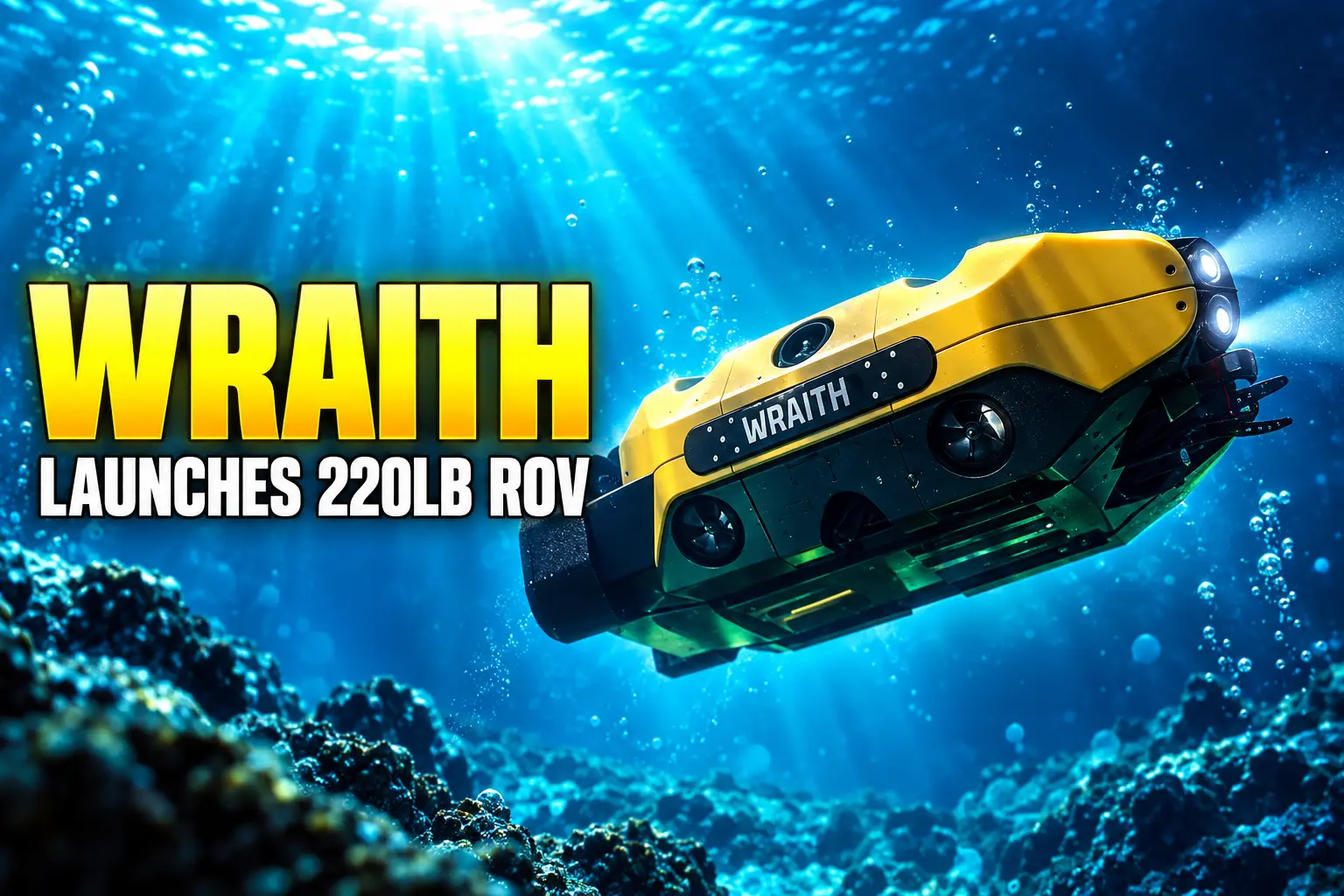
AeroVironment’s VideoRay unit launched the Mission Specialist Wraith on January 13, 2026, a 220-pound ROV with 10 thrusters and 80+ pounds of forward thrust. The first kit is the Expeditionary setup, built to fly from small boats and austere decks instead of a dedicated ROV ship.
The brochure lists offshore energy inspection, infrastructure checks, wreck work, and defense. The quieter shift is who owns the factory. VideoRay is now a wholly owned AeroVironment subsidiary, and the same compact hull is being sold as a way to work under the water without putting a crew on the target.
Wraith Depth Rating, Speed, and Payload Bay
The Wraith Expeditionary configuration datasheet puts dry weight at 99.8 kg (220 lb) and the hull at 131.2 x 77.6 x 34.3 cm (51.7 x 30.6 x 13.5 in). Standard depth is 1,000 meters. Forward speed is 4.2 knots, with 0.9 knots lateral and 1.5 m/s vertical. VideoRay’s published transit figure is about 12 minutes per kilometer.
The payload bay measures 67.3 x 33 x 33 cm (26.5 x 13 x 13 in). Lift is 36.3 kg (80 lb), which is the number Chris Gibson, VideoRay’s chief executive, uses when he stacks Wraith against the Mission Specialist Defender. The Defender lifts about 9.5 kg. Gibson also said Wraith’s bay sits in the vehicle architecture rather than hanging under it, so sensors and tools can be built around the job instead of around a skid.
WRAITH VERSUS THE DEFENDER
| Item | Wraith Expeditionary | Mission Specialist Defender |
|---|---|---|
| Thrusters | 10 (4 horizontal, 6 vertical/lateral) | 7 |
| Forward thrust | 36.3+ kg (80+ lb) | Not stated on the Wraith sheet |
| Lift | 36.3 kg (80 lb) | About 9.5 kg |
| Forward speed | 4.2 knots | Not used here |
| Standard depth | 1,000 m | Deeper kits added later (see below) |
| Dry weight | 99.8 kg (220 lb) | Man-portable class |
Reverse thrust is 18 kg (39.6 lb). The four horizontal and six vertical/lateral units are oil-filled brushless motors with quick-change propellers. Gibson said Dive Mode can drop the vehicle up to three times faster than drop-weight dives, and Surface Mode can climb up to ten times faster than a straight thrust-up. Those multipliers are his figures, not a third-party sea trial.
VideoRay’s launch film walks the hull, the battery bay, and the open payload space.
Ten Thrusters Hold Any Attitude
The selling point is not a single extra motor. It is native six-degree-of-freedom control, so the pilot can hold inverted, vertical, fully rolled, or anything in between while still pushing toward a target. AeroVironment’s sheet calls that “direct-to-target transit” and says the same thrust setup removes drop weights and long dive or surface waits in deep water.
WHAT THE 6-DOF LAYOUT IS FOR
- Inverted hold: The vehicle can sit upside down on a hull, a ceiling, or a jacket member without fighting the frame.
- Vertical flight: Straight up or down is a controlled attitude, not a clumsy climb on vertical thrusters alone.
- Rolled inspection: Full roll lets a camera or sonar stare at a weld or a mine-like object while the body stays parked.
- Current work: Forward thrust of 80+ lb is the figure VideoRay uses for station-keeping when water is moving.
The first release still uses a streamlined payload, with imaging, navigation, and the tools expeditionary crews already carry. Later spirals are supposed to add volume, tooling, endurance, deeper ratings, and fly-out hosts that can send a smaller sentinel vehicle. A VideoRay product film already shows the hull as a host for that smaller system when the job needs it.
The Navy Already Bought the Architecture
Wraith is a new hull. The design language is not new. VideoRay has built Mission Specialist vehicles in Pottstown, Pennsylvania, since the line began, and the Defender is the vehicle the U.S. Navy already bought in volume.
On May 14, 2024, VideoRay announced a $92.6 million MESR production contract for the MK20 Defender, based on the Mission Specialist Defender, for the Navy’s Maritime Expeditionary Standoff Response program. The five-year IDIQ, run through Naval Information Warfare Command, Pacific, covers production, sustainment, and development for expeditionary mine countermeasure work. The kit on that contract includes Greensea IQ control software, BluePrint Subsea sonar and USBL, a Nortek Doppler Velocity Log, and an Eddyfi two-function manipulator, all inside a man-portable SWAP budget.
Gibson said at the time that Navy feedback was feeding the next expeditionary EOD and MCM systems for defense and commercial buyers. Wraith is that next hull in public. It is larger, it lifts more, and it is the vehicle VideoRay now calls the flagship of the series.
FROM DEFENDER CONTRACTS TO THE WRAITH HULL
- 1999: VideoRay is founded in Pottstown, Pennsylvania, around small inspection ROVs.
- May 14, 2024: VideoRay wins the $92.6 million MESR IDIQ for the MK20 Defender.
- 2024: VideoRay delivers its first 1,000-meter Defender, and BlueHalo buys the company.
- May 1, 2025: AeroVironment closes the BlueHalo deal; VideoRay becomes an AV company.
- January 13, 2026: AV and VideoRay launch the Mission Specialist Wraith Expeditionary kit.
- 2026: VideoRay delivers its first 4,000-meter Defender, a deeper sibling, not the Wraith rating.
- 2027: Gibson says VideoRay plans a 6,000-meter Wraith configuration.
The Navy money was for Defender. The open modules, field-swappable payloads, and expeditionary packing are the same family Wraith inherits, which is why a commercial inspection buyer and an EOD unit can share spares.
AeroVironment Needed a Way Into the Water
BlueHalo bought VideoRay in 2024. AeroVironment completed its purchase of BlueHalo on May 1, 2025, and folded maritime robots into an Autonomous Systems group that already sold air and ground vehicles. VideoRay’s January 13 launch announcement is written as AeroVironment’s next step in compact unmanned underwater systems, not as a standalone Pottstown product drop.
Modern operations increasingly depend on access, awareness, and freedom of maneuver below the surface. Wraith gives forces a compact, rapidly deployable system that delivers the precision and control once reserved for much larger vehicles, helping operators extend reach, reduce risk to personnel, and respond faster in complex maritime environments. It expands what compact UUVs can achieve while improving overall mission efficiency.
Chris Gibson, Chief Executive Officer, VideoRay, January 13, 2026
That language is about forces, reach, and risk to people, not about a wind-farm survey day rate. In May 2026, AeroVironment’s own account put Gibson and Eric Wirstrom, from the VideoRay team, on mine countermeasures and over-the-horizon work, using the Strait of Hormuz as the example and saying 20 percent of the world’s oil moves there. The company line was that presence does not have to mean putting crews on the front line.
Presence no longer has to mean putting crews on the front line.
Chris Gibson and Eric Wirstrom from our VideoRay team outline how platforms like the Mission Specialist Wraith enable autonomous, over-the-horizon MCM—clearing threats without delay, and without being there at all.… pic.twitter.com/9FjqO5cm3G
— AV (@aerovironment) May 11, 2026
The public chatter around the launch followed that defense pitch and the ticker, not a fight over cable-inspection tactics. If you only read the sponsored spec sheet, Wraith looks like a faster survey tool. If you read AV, it looks like a way to clear a chokepoint without a dive team on top of the threat.
Gibson later told an industry interview that VideoRay and AeroVironment share the same tight envelopes, weight limits, and hard environments, so motors, cameras, power, and batteries can move across air and water. He also pointed at AV’s unmanned ground vehicles, which already serve many of the same EOD customers VideoRay serves under the water.
A Ship Still Carries True Work-Class Gear
Launch copy talks about work-class performance without a work-class footprint. The honest comparison is narrower. Heavy work-class vehicles still weigh several tons, ride a tether management system, and need a launch and recovery spread on a ship. Wraith ships in hard-sided watertight cases and uses a splashproof controller. That is a different job, even when the job is inspection.
Eighty pounds of lift will carry a manipulator, a sonar, or a battery pack. It will not do the hot-stab, heavy-tool work that keeps a hydraulic work-class crew on charter. The operators who gain are small-boat inspection teams, public-safety units, and expeditionary MCM crews who already live with Defender-class kits and want more thrust and a bigger bay without adding a vessel spread.
The operators who do not gain are construction and intervention contractors whose tools start at hundreds of kilograms. For them Wraith is a scout or a light intervention cousin, not a swap for the vehicle in the hangar. VideoRay is not hiding that. The first Wraith is the Expeditionary kit, with a planned path to more payload, not a claim that the hangar is empty.
Two Kilowatt-Hours Set the Dive Clock
Power is the other half of the portable pitch. Six Mission Specialist subsea batteries ride on the vehicle. Instantaneous output is 6 kW. Total energy on the sheet is 2 kWh. Topside input is a universal 85-264 VAC, 47-440 Hz, 500 W feed into a 400 VDC power module. Accessory rails are 12 VDC at 120 W, 24 VDC at 200 W, and 48 VDC at 6 kW.
At a 6 kW peak draw, 2 kWh is about 20 minutes. That is arithmetic on the published pack, not a VideoRay runtime claim, and cruise plus hotel load will last longer. It still means the clock starts when the vehicle leaves the deck. A copper work-class umbilical can push power for hours. Wraith’s fiber tether is for control and video; the energy is in the hull.
THE ENERGY TRADE ON THE EXPEDITIONARY KIT
- No drop weights: VideoRay says the thruster layout replaces extra ballast for fast dives and climbs.
- Smaller topside: Batteries cut the generator and high-voltage deck plant a work-class spread hauls.
- Depth limit on the pack: The first Wraith is rated to 1,000 m, and the batteries are a Mission Specialist accessory with matching depth kits.
- Endurance is on the roadmap: Larger-capacity power is listed as a future spiral, which is an admission that 2 kWh is the opening tank.
Gibson has said customers want portable vehicles to go deeper. The 1,000-meter Defender arrived in 2024. The 4,000-meter Defender arrived in 2026. Wraith’s current sheet stays at 1,000 m even while the press kit mentions later depth growth. Speed and attitude are what this hull is buying first. Hours in the water are the next fight.
Gibson Is Planning a 6,000-Meter Wraith
In a 2026 interview, Gibson said VideoRay plans to deliver a 6,000-meter Mission Specialist Wraith configuration in 2027. That is a plan, not a rating on the vehicle you can order from the January 13 sheet. The same talk sketched software VideoRay now wants in-house: a common cockpit across the family, multi-camera views, predictive maintenance, semi-autonomous assists, and later SLAM, over-the-horizon control, multi-vehicle control, and tetherless runs.
Those items matter because the hardware already shares modules. A Defender shop can take a Wraith without a new spare-parts religion. The bet AeroVironment is making is that the Navy-shaped Mission Specialist line, scaled with AV’s factories and batteries, can cover inspection and MCM from the same crate. The 220-pound Wraith is the first hull in that bet that looks like a flagship instead of a micro-ROV.
Whether a 2 kWh, 1,000-meter Expeditionary kit actually pulls work off ships will show up in orders, not in thrust curves. The 6,000-meter version, if it arrives in 2027 with a larger pack, is the test of whether this stays a fast portable or becomes the compact UUV Gibson described when he said it brings Defender to the next level.
Frequently Asked Questions
What Camera and Computer Sit on the Wraith?
The Expeditionary kit uses an Ultra 4K smart camera with a 12.3 MP 1/2.3-inch sensor, 180-degree vertical and 150-degree horizontal field of view, and digital pan, tilt, and zoom. The onboard processor is an NVIDIA Jetson Orin NX with a 1 TB SSD, which is the computer doing local vision work, not the topside tablet.
How Long Is the Wraith Fiber Tether?
The standard reel is 1,500 meters of fiber-optic tether on a manual reel with a removable handle, packed in a hard-sided watertight case with removable wheels. Connections on the vehicle include a Type ST fiber port, a 5-pin 48 VDC thruster and LED bus with RS-485, and a 9-pin accessory port with 12/24 VDC, 100 Mbps Ethernet, and RS-485.
What Controller Do Pilots Use With Wraith?
The listed topside is a Dell Latitude 7230 Rugged Extreme tablet, with a 12th Gen Intel Core i5-1240U vPro, 16 GB memory, a 500 GB SSD, and a 12-inch outdoor-viewable FHD touchscreen. The controller and console are IP65-rated and travel in a hard-sided watertight rolling case, which is the Workhorse Splashproof Controller on the sheet.
How Bright Are the Wraith Lights?
Two LED arrays sit on the vehicle, each mixing spot and flood, each drawing up to 38 W, at 3,000 K and 80 CRI. Each module is listed at 7,600 lumens, and the arrays are individually controlled, so a pilot can run one side, both, or a flood-only mix without swapping hardware on the dive.

Saquon Barkley’s Hamstring Leaves the Eagles Thin in London

The Online US Passport Still Needs a Witnessed Oath

Ken Urker Died on His Birthday With No Cause Named

FOX Ices Portnoy After Ohio State’s Access Fight

Micron’s Record Memory Profits Lock RAM Tight Through 2028

Musk’s $914 Billion Lead Is a Public SpaceX Bet

Microsoft’s 96% Cyber Score Sits at 86.3% on the Board

Free Live Sports Streaming in 2026: What to Watch Without Cable

Endgame Encore’s $86 Million Trial for Infinity Vision

The Odyssey’s IMAX Film Run Hit a 41-Theater Limit
-
 BUSINESS4 months ago
Musk’s $914 Billion Lead Is a Public SpaceX Bet
-
 NEWS2 months ago
Microsoft’s 96% Cyber Score Sits at 86.3% on the Board
-
 SPORTS3 months ago
Free Live Sports Streaming in 2026: What to Watch Without Cable
-

 ENTERTAINMENT4 weeks ago
Sterling Point Holds No. 2 on Prime Video After 32 Days
-
 ENTERTAINMENT3 months ago
The Odyssey’s IMAX Film Run Hit a 41-Theater Limit
-
 ENTERTAINMENT3 months ago
Endgame Encore’s $86 Million Trial for Infinity Vision
-

 ENTERTAINMENT2 years ago
Andrew Garfield’s Spider-Man Films Are No Longer Free
-

 NEWS4 weeks ago
G20 Cheers AI Investment After Bailey’s Frontier Cyber Warning