
BUSINESS
Musk’s $914 Billion Lead Is a Public SpaceX Bet
The Bloomberg Billionaires Index is now a US stock tape: Musk at $914 billion, Dell up $113 billion, Ellison down $60 billion, and every name in the top 10 American.

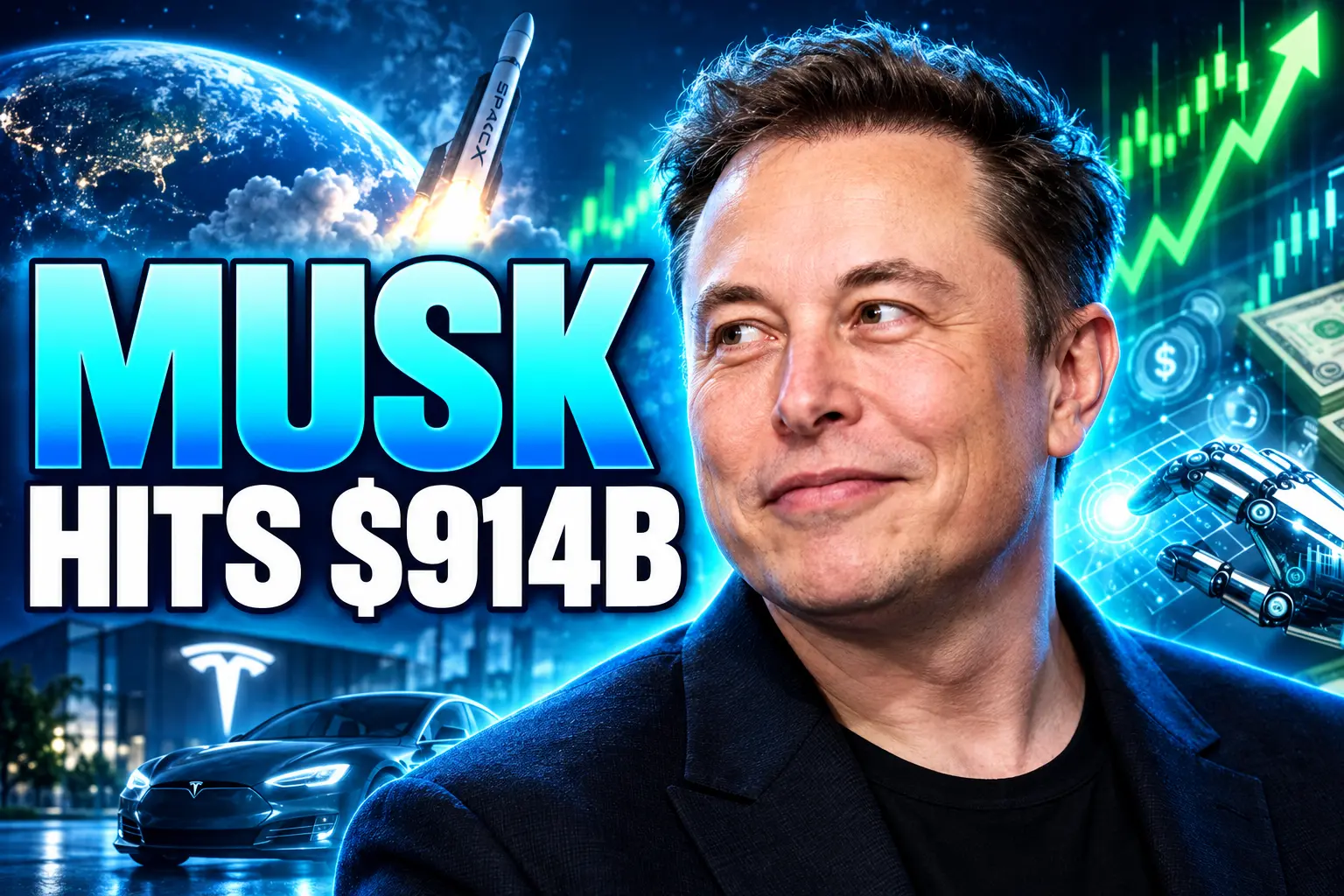
Elon Musk stood at $914 billion on the Bloomberg Billionaires Index after the October 2 close, up $295 billion in 2026. That single-year gain is larger than Warren Buffett’s entire fortune, and it leaves Musk $624 billion ahead of Larry Page in second place.
The list still looks like a celebrity scoreboard. It behaves like a stock screen. Nine of the ten richest people on earth are US technology names whose wealth is marked to New York prices each session, and the tenth is Buffett.
The World’s 10 Richest Are Now a US Equity Tape
The daily ranking of the world’s richest reprints after the New York close. On October 2 it was an American sheet from first place to tenth, with no luxury heir, no retailer, and no operator based outside the United States in the top 10.
At the first close of 2026 the same index still had a French seat. Bernard Arnault of LVMH sat seventh at $208 billion. Michael Dell sat outside the ten. Larry Ellison sat fifth at $247 billion, still riding Oracle’s cloud-and-AI rerating from 2025. The ten names together were worth $2.55 trillion.
Nine months later the ten are worth $2.957 trillion, and Musk alone is 30.9% of that pile. Page, Jeff Bezos and Sergey Brin together come to $834 billion, which means Musk’s fortune is $80 billion larger than those three combined. That is the shape the 2026 tape actually printed, and it is a harsher split than how AI split the January ranking.
OCTOBER 2 VERSUS THE START OF 2026
| October 2 rank | Name | Net worth | 2026 change | January rank |
|---|---|---|---|---|
| 1 | Elon Musk | $914B | +$295B | 1 |
| 2 | Larry Page | $290B | +$20.9B | 2 |
| 3 | Jeff Bezos | $274B | +$20.5B | 3 |
| 4 | Sergey Brin | $270B | +$19.5B | 4 |
| 5 | Mark Zuckerberg | $257B | +$23.4B | 6 |
| 6 | Michael Dell | $252B | +$113B | Outside top 10 |
| 7 | Jensen Huang | $191B | +$36.7B | 9 |
| 8 | Larry Ellison | $187B | -$60.0B | 5 |
| 9 | Steve Ballmer | $179B | +$10.3B | 8 |
| 10 | Warren Buffett | $143B | -$8.87B | 10 |
Dell’s $113 billion rise is the second-largest 2026 gain on the list, trailing only Musk. Ellison’s $60 billion decline is the largest loss among people who are still in the ten. The ranking is no longer sorting industrialists against investors against luxury families. It is sorting a handful of US shareholdings against each other.
SpaceX’s Listing Turned Musk Into a Public Quote
Musk’s fortune is mainly a SpaceX stake and Tesla holding, and both now trade in public view. SpaceX, already merged with xAI at a $1.25 trillion valuation, went public in June 2026 at $1.8 trillion and raised $86 billion, the largest initial offering the index records. The listing is what pushed Musk through $1 trillion on paper and made SPCX his biggest asset.
The index is stricter than a headline. It counts about 11% of Tesla from a June 2026 filing and leaves out 424 million restricted shares from his 2025 chief-executive award. Unvested shares from the 2018 award were pulled as well, a $111 billion haircut, because Tesla still requires him to stay in eligible service through January 2028. On SpaceX it counts 4.76 billion shares and 352.5 million options from the June S-1 and excludes another 1.3 billion unvested shares plus 237,530 shares pledged against debt.
That is why $914 billion is not a round number from a magazine cover. It is a daily close with the unvested paper stripped out, and it can gap by $14.7 billion in a single session, as it did on October 2. The same listing that minted the first trillionaire also turned the top of the rich list into a quote that anyone with a brokerage app can watch.
HOW 2026 REPRICED THE TOP OF THE LIST
- January 2, 2026: Musk leads at $619 billion, with Page at $269 billion and Dell still outside the top 10.
- 2026: xAI and SpaceX merge at a $1.25 trillion valuation, folding the AI shop into the rocket company before the listing.
- June 2026: SpaceX lists at $1.8 trillion, raises $86 billion, and Musk is recorded as the world’s first trillionaire.
- October 2, 2026: Musk is back at $914 billion, up $295 billion on the year and $624 billion clear of second place.
The giveback from the trillion-dollar print is the point of the listing, not a footnote. Once the rocket company was public, the richest person on the index became a leveraged holder of two tickers, and a down day in those names now moves global rank the way a private round never could.
Dell’s $95 Billion Backlog Bought Sixth Place
Dell began 2026 outside the ten and closed October 2 at $252 billion, good for sixth place, after a $113 billion year-to-date jump. The money did not come from a social network or a search engine. It came from the servers that sit under other people’s models.
Dell Technologies reported fiscal 2027 second-quarter results on September 1 for the period ended July 31. Revenue was $47.0 billion, up 58% from a year earlier. Infrastructure Solutions Group, the server and storage arm, did $31.8 billion, up 89%. AI-optimized servers alone did $16.4 billion, double the year before, and the company booked $60.9 billion of AI orders in the quarter. It left the period with a record $95 billion AI backlog and raised full-year revenue guidance by $25 billion, to $192.0 billion, up 69%. The AI-server outlook for the year is now $74.0 billion, up 200%.
THE QUARTER THAT MOVED DELL’S RANK
- Company revenue: $47.0 billion, up 58% year over year, with non-GAAP diluted earnings of $7.04 a share, up 203%.
- AI-optimized servers: $16.4 billion of revenue, up 100%, against $60.9 billion of orders booked in the quarter.
- Unfilled work: a $95 billion AI backlog on exit, with traditional servers and networking at $10.5 billion, up 122%.
- Year guide: $192.0 billion of revenue, raised $25 billion, and $74.0 billion of AI-server sales, up 200% year over year.
Jeff Clarke, Dell’s vice chairman and chief operating officer, put the backlog in the same breath as the rest of the catalog, because the AI box is now large enough to pull networking and storage with it.
That’s clearest in our AI server business where we booked a record $60.9 billion in orders, recognized a record $16.4 billion in revenue and exited the quarter with a record $95 billion backlog.
Jeff Clarke, vice chairman and chief operating officer, Dell Technologies fiscal 2027 second-quarter results
Dell holds about 40% of the company that carries his name and a large Broadcom position left from the VMware sale, so a server cycle and a chip-cycle both hit the same household balance sheet. Jensen Huang’s Nvidia fortune, at $191 billion and up $36.7 billion this year, is the other side of that order book. The people selling the racks and the people selling the chips both climbed. The people selling unfinished cloud promises did not.
Larry Ellison Lost $60 Billion on the Same Bet
Ellison started 2026 fifth at $247 billion. He finished October 2 eighth at $187 billion, a $60 billion hole. Oracle had been the 2025 version of the AI-infrastructure trade: a software house that told investors it could rent the same data-center capacity Dell was shipping as hardware. The 2026 tape marked that story down.
The index does not need a new biography to explain the drop. Ellison’s wealth is still Oracle, and Oracle spent the summer defending a capital plan that ballooned as customers asked for more compute than the firm could turn into billed revenue on the old schedule. A fortune that can lose $60 billion without the holder selling a control stake is a fortune that lives in the last sale on the exchange.
Steve Ballmer, whose Microsoft holding is an early-employee position rather than a founder block, added $10.3 billion and slipped from eighth to ninth at $179 billion. Mark Zuckerberg added $23.4 billion and moved up a seat to fifth at $257 billion. Page and Brin each added about $20 billion and did not change place. Those are large numbers that barely move rank, because Musk’s $295 billion and Dell’s $113 billion reset the scale of what counts as a climb.
Paper wealth this concentrated also feels a bond market. When the 10-year yield above 5 percent starts to tax long-duration AI trades, the same names that dominate the billionaire list are the ones that sit in the most rate-sensitive part of the equity market. Ellison’s year is what that looks like when the multiple comes in.
Buffett Is the Only Non-Tech Name Left
Arnault’s 2026 is the cleanest picture of what the list no longer is. He entered the year seventh at $208 billion and sat 13th on October 2 at $131 billion, down $76.9 billion, tied in dollars with Rob Walton and a step behind Jim Walton’s $134 billion. LVMH is still a global luxury house. It is no longer a hedge against an American technology tape.
Buffett remains tenth at $143 billion, down $8.87 billion on the year, the last diversified book in the ten. Berkshire Hathaway is a stack of operating companies, cash, and publicly traded stakes, which is why it can lose less than Oracle in a year when AI multiple compression hits software and still fail to keep pace with a server cycle. The Waltons, Amancio Ortega at $125 billion, and Carlos Slim at $116 billion now live in the teens, which used to be where technology names sat when the top of the list still had room for retail and telecom.
Zhang Yiming, the ByteDance founder, is the first Chinese name on the October 2 sheet, 18th at $105 billion and up $40.3 billion this year. Gautam Adani is 19th at $103 billion. Mukesh Ambani is 25th at $76.6 billion, down $31.1 billion. The rest of the world is still producing large fortunes. It is not producing them fast enough to crack an American top 10 that is now a closed circuit of listed technology equity plus Buffett.
The Top 0.1% Now Holds 15% of US Wealth
A January compilation of the index put listed billionaire wealth at $9.8 trillion, with the United States at $5.08 trillion, or 51.8% of the pile. That was already a country concentration. The October 2 top 10 makes it a ticker concentration: every name is American, nine of the ten are coded technology, and Musk’s $914 billion is itself a two-stock position.
The Federal Reserve’s Distributional Financial Accounts, carried on the St. Louis Fed’s FRED service, put the thinnest slice of US households in the same neighborhood. The top 0.1% held 15.0% of US household wealth in the second quarter of 2026, up from 14.1% in the second quarter of 2025. That series is not the billionaire list. It is the household sector, and it is why a SpaceX close or a Dell backlog now shows up in national wealth shares rather than only in a magazine ranking.
WHERE THE CONCENTRATION SITS
- The top 10: all United States as of October 2, nine of them technology, Buffett the only diversified book.
- January country split: US listed-billionaire wealth $5.08 trillion, 51.8% of a $9.8 trillion compilation.
- Household tip: the top 0.1% of US households held 15.0% of net worth in Q2 2026, versus 14.1% a year earlier.
- Musk’s mechanics: about 11% of Tesla in the index, 4.76 billion SpaceX shares, unvested awards left out.
Most of these fortunes are not pools of cash and operating companies in several countries. They are founder and early-holder blocks in a few US issuers, which is why Dell can climb $113 billion on a backlog and Ellison can fall $60 billion on the same AI-capex cycle without either man running a new business. The index is doing what it has always done, repricing public stakes after the New York close. In 2026 that close is the whole story, because there is almost no one left in the top 10 whose wealth lives anywhere else.
Musk is still $624 billion ahead of Page, Dell still has $95 billion of AI servers to ship, and Ellison is still eighth on a $187 billion Oracle mark. The next reprint is due after Monday’s close in New York.

The Court Revisits the Climate Nuisance Door It Left Open

ChatGPT Now Compiles Live Interfaces With GPT-6

A Tanker Attack Moves the War Into Qatar’s Waters

Personio Buys Circula to Own the DATEV Channel

Bluesky Files for .bsky and Enters the Registry Queue

Musk’s $914 Billion Lead Is a Public SpaceX Bet

Microsoft’s 96% Cyber Score Sits at 86.3% on the Board

Free Live Sports Streaming in 2026: What to Watch Without Cable

Andrew Garfield’s Spider-Man Films Are No Longer Free

Endgame Encore’s $86 Million Trial for Infinity Vision
-
 NEWS2 months ago
Microsoft’s 96% Cyber Score Sits at 86.3% on the Board
-
 SPORTS3 months ago
Free Live Sports Streaming in 2026: What to Watch Without Cable
-
 ENTERTAINMENT2 years ago
Andrew Garfield’s Spider-Man Films Are No Longer Free
-
 ENTERTAINMENT3 months ago
Endgame Encore’s $86 Million Trial for Infinity Vision
-

 NEWS4 months ago
Singapore’s 3×3 and Surfing Debuts Miss the Medal Stand
-

 ENTERTAINMENT1 month ago
Sterling Point Holds No. 2 on Prime Video After 32 Days
-

 NEWS6 months ago
White Sands Footprints Put People in Ice Age New Mexico
-

 NEWS1 month ago
G20 Cheers AI Investment After Bailey’s Frontier Cyber Warning