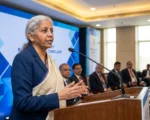
ESSEC Business School dean Vincenzo Vinzi says geopolitics must move from the margins of business education to its center. A 2025 survey of French executives found 97% of their companies already hit by geopolitical shocks, while the school’s own Institute and new Global Foresight Council aim to train leaders who treat political power as a core force rather than an external risk.
The old assumption that markets would grow ever more open and efficient no longer matches the operating environment graduates will enter.
ESSEC Builds Structures Around the New Reality
ESSEC created the ESSEC Institute for Geopolitics and Business in 2024. It operates from campuses in France, Morocco and Singapore and draws on four internal centers covering negotiation, defense and leadership, European law and economics, and business in Africa.
In June 2026 the school added the Global Foresight Council. Vinzi chairs it. Academic co-directors Aurélien Colson and Cédomir Nestorovic serve as vice-chairs, with Thomas Friang as secretary-general. The body gathers ambassadors, a Nobel Peace Prize laureate, senior executives and policymakers.
- Ambassador Dr. Assia Bensalah Alaoui (Morocco)
- Oleksandra Matviichuk, 2022 Nobel Peace Prize laureate (Ukraine)
- Ziad Haider, McKinsey global director of geopolitics (Singapore)
- Yann Le Pallec, president of S&P Global Ratings
- Former UNCTAD secretary-general Isabelle Durant
- Former MEDEF president Geoffroy Roux de Bézieux
The Council’s first plenary in Paris on 10 July 2026 examined the “passport of the firm,” Europe’s future-proofing and the weaponization of capital. Its stated jobs are strategic foresight, thought leadership, network building and outreach. Full Global Foresight Council launch details list the complete membership and three opening themes.
Vinzi wrote that schools once prepared students for expanding, efficient, interconnected markets in which borders mattered less. That frame has broken. Trade disputes, regional conflicts, technology rivalries and shifting alliances now shape business models directly.
The Numbers That Make the Old Curriculum Obsolete
The Institute’s first 2025 Geopolitics and Business Barometer, run with L’Express and OpinionWay, surveyed 100 French executive-committee and board members from firms with more than 250 employees.
| Impact reported | Share of executives |
|---|---|
| Company already affected by geopolitical shocks | 97% |
| Rising raw-material costs | 81% |
| Rising energy costs | 80% |
| Supply-chain disruptions | 46% |
| Cyberattacks | 40% |
| Workforce demobilization | 20% |
Despite that exposure, only a minority of firms had built geopolitics into strategy in a structured way. Most stayed in a wait-and-see posture, waiting for external directives rather than redesigning internal processes.
The Institute flagged three under-estimated geo-economic risks: economic predation and trade pressure from Washington that exploits Europe’s new dependence on U.S. LNG; persistent hybrid and economic fallout from Russia’s war on Ukraine; and deep Chinese penetration of European economies combined with potential force against Taiwan.
Stats snapshot
- 97% of surveyed French executives report prior geopolitical shocks to their firms
- Nearly 70% of central banks in a 2026 Reuters survey of managers of more than $9.5 trillion in reserves ranked geopolitics their top risk, up from 35% in 2024
- 300+ ESSEC MIM students already in tracks heavy on negotiation, defense, European affairs and China’s political economy
That same pressure shows up among central banks ranking geopolitics top risk in successive surveys. Boards and treasuries already price the disruption. Curricula that treat it as an elective leave graduates unprepared for the conversations they will join on day one.
European Schools Move First on the Same Shift
ESSEC is not alone. Other European and Canadian schools have expanded offerings in response to student demand and employer reality.
IMD in Switzerland runs dedicated IMD geopolitics executive programs, including Geopolitics for Boards, and has delivered multiple customized programs for senior teams. Faculty such as Simon Evenett (geopolitics and strategy) and Richard Baldwin (international economics) sit inside core teaching. Research cited by the school found 75% of 2023 U.S. SEC filings already named geopolitical risk as a decision factor.
HEC Paris maintains a Center for Geopolitics, a core Executive MBA course on the business environment, and a long-running summer school on geopolitics, globalization and strategy. IE Business School reports strong demand for dual degrees pairing the BBA with international relations or political science and treats strategic foresight as a core pillar in executive programs. IESE offers a popular Strategy & Geopolitics elective. Rotman in Toronto embeds live trade-mission work for Canadian companies.
Student interest is measurable. At ESSEC more than 300 Master in Management students sit in geopolitics-linked tracks. IE’s dual-degree numbers and IMD’s custom-program volume tell the same story: the market for this training already exists.
How Business Education Absorbed Earlier Shocks
Business schools have rewritten their cores before. When capital markets grew more complex, finance moved from niche to required. Sustainability and ESG followed the same path once investor and regulator pressure made them material. Artificial intelligence is completing the jump from specialist topic to everyday tool in strategy, operations and marketing courses.
- 2024, ESSEC founds the Institute for Geopolitics & Business across three continents.
- Summer 2025, First Barometer fielded with L’Express and OpinionWay.
- September 2025, Barometer results released; 97% exposure figure public.
- Mid-May 2026, First session of the executive certificate “Geopolitics & Business: Risks, Strategy & Leadership.”
- 22 June 2026, Global Foresight Council announced.
- 10 July 2026, Inaugural Council plenary in Paris.
Geopolitics is now on the same trajectory. Schools that keep it optional train leaders for a world that no longer exists. The parallel is not rhetorical; the institutional response (dedicated institute, external high-level council, barometer, executive certificate, degree-program integration) mirrors the earlier build-outs for finance, sustainability and AI.
What Changes for Graduates and Employers
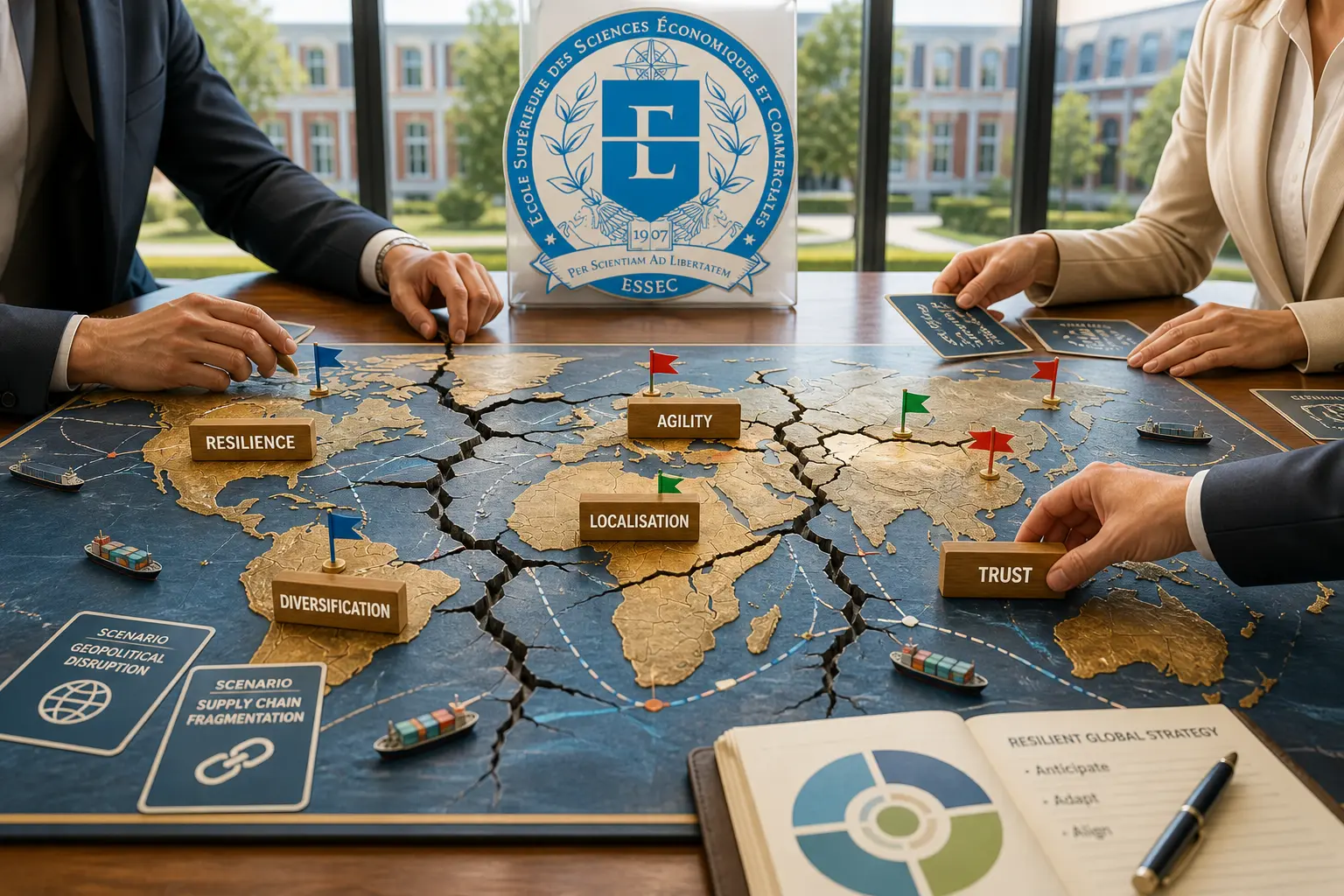
Supply chains once optimized only for cost. The new question is resilience under political disruption. Talent flows now collide with immigration rules, demographic shifts and great-power competition for skilled workers. These pressures hit finance, manufacturing, healthcare and hospitality, not just multinationals or governments.
Vinzi’s list of required abilities is concrete: evaluate scenarios, adapt under incomplete information, connect political, economic, technological and social variables, and stay comfortable with ambiguity rather than hunting false certainty. That skill set sits alongside classic finance and strategy, not beneath them.
Companies that still treat geopolitics as a compliance or risk-management silo will keep losing ground to competitors who bake it into strategy and capital allocation. The Barometer’s wait-and-see majority is the vulnerable group. Schools that produce graduates already fluent in the language of polycrisis give those firms an immediate hiring edge and give their own alumni a clearer path to influence.
The same forces appear in how technology itself becomes a geopolitical instrument. Analysis of tech-driven geopolitics and business risk shows export controls, data localization and standards battles rewriting market access. Graduates who can read both the technical and the political layers will hold an advantage that pure functional training cannot match.
Leaders Must Get Comfortable With Ambiguity
The Council’s purpose is not prediction. It is reflection on megatrends that accelerate, amplify and complicate the uncertainty CEOs already face. Decisions on one continent ripple into operations on another. Sustainability goals and technological revolutions intersect with political shocks; treating any of them in isolation produces brittle strategies.
Bringing together minds of this calibre, diplomats, business leaders, Nobel laureates, scholars, in the service of ESSEC’s mission is a historic step. The Global Foresight Council will become a compass for our Institute for Geopolitics & Business, and thus for companies navigating an era of radical uncertainty.
Vincenzo Vinzi said that at the Council’s launch. The practical translation is scenario work, rapid adaptation and decisions made with incomplete data. That mindset replaces the older search for stable rules of the game.
Not every MBA student must become an international-relations specialist. Every graduate does need to see how political choices move markets and how global events create both risk and opportunity. Schools that leave that literacy optional are failing the organizations their alumni will lead.
Frequently Asked Questions
What is the ESSEC Global Foresight Council?
It is a high-level advisory body launched in June 2026 and affiliated with the ESSEC Institute for Geopolitics & Business. Chaired by dean Vincenzo Vinzi, it brings together ambassadors, a Nobel laureate, executives and academics for strategic foresight, thought leadership, network building and international outreach; its first plenary examined corporate nationality, Europe’s future and the weaponization of capital.
What did the 2025 ESSEC Geopolitics and Business Barometer find?
Among 100 French senior executives, 97% said their companies had already felt geopolitical shocks, mainly through higher raw-material and energy costs, supply disruptions and cyberattacks, yet only a minority had integrated those risks into strategy in a structured way; most remained reactive.
How does ESSEC embed geopolitics beyond the Institute?
The Institute feeds degree programs, executive education and research; more than 300 MIM students already follow tracks with heavy geopolitical content, and the school offers an executive certificate “Geopolitics & Business: Risks, Strategy & Leadership” whose first session ran in mid-May 2026.
Which earlier subjects followed the same path into the core curriculum?
Finance became central as markets grew sophisticated; sustainability and ESG moved from specialist electives to required material under investor and regulatory pressure; artificial intelligence is completing the same shift from niche topic to everyday tool across strategy and operations courses.
What practical recommendations does the Institute give companies?
Develop internal expertise and a culture of vigilance, resilience and independence; create an executive-level function dedicated to anticipating and managing geopolitical risk that links signals across all corporate functions; and adopt prospective methods such as scenario analysis and strategic intelligence.
Business schools that treat geopolitics as foundational will send out the graduates boardrooms already need. The rest will keep producing leaders for a smoother world that has already disappeared.