On a humid afternoon in summer 2025, Microsoft staff waited for about 200 teachers to fill a Manhattan conference hall. The topic was AI chatbots. Instructors walked the room through Copilot for parent emails and lesson plans, then played a Minecraft Education video with a cheerful narrator and a cute duck. Natasha Singer of The New York Times sat in the audience.
Singer has covered school technology for more than a decade. The scene forms the opening of an adapted excerpt from her book Coding Kids on Big Tech, published Sunday. After more than 100 interviews and hundreds of documents, she concludes a handful of giants now shape nearly every step of the American education supply chain.
The Workshop That Echoed Pharma Seminars
The session reminded Singer of drug-company trainings she once covered for doctors. “Industry funds what helps industry,” Adriane Fugh-Berman, a Georgetown pharmacology professor who studies pharmaceutical influence, told her.
Many parents would reject Exxon writing climate lessons or Purdue Pharma training biology teachers. Schools have welcomed technology firms in comparable ways with few questions asked. Apple supplies a free Advanced Placement computer science course built around Swift, its iPhone language. Microsoft counters with AP Computer Science Principles through Minecraft Education. No Raytheon physics course or Pfizer biology course exists.
Brad Smith, Microsoft’s vice chair and president, said the pattern started because public schools seemed unprepared for modern subjects. “Philanthropy in the private sector is doing this work because the public sector has failed to do what it’s supposed to do,” he said. He added it is not ideal: “It’s not the way we should want public education to work.” Maggie Johnson of Google’s giving arm made similar points about free coding materials reaching underserved students.
A $23 Million Seat at the Table
The day after the workshop, the American Federation of Teachers announced a national AI training program. Microsoft, OpenAI and Anthropic supplied $23 million. Microsoft put up $12.5 million, OpenAI $10 million and Anthropic $500,000. The hub, called the National Academy for AI Instruction, aims to reach 400,000 educators by 2030 through workshops and courses, starting in New York.
The union represents 1.8 million members. President Randi Weingarten said the deal would help teachers use chatbots “safely, wisely and ethically” and give educators a seat as products are built. Singer raised the fox-and-henhouse problem. Weingarten acknowledged the tension. “Some of the companies that we’re engaged with are in it for profit,” she said. “Those are two fundamentally different goals.”
Lois Weiner, an education professor emerita at New Jersey City University and a retiree UFT member, saw it differently. “This isn’t an alliance,” she told Singer. “We aren’t sitting at the table. We’re the meal.”
This isn’t an alliance. We aren’t sitting at the table. We’re the meal.
Lois Weiner, education professor emerita, New Jersey City University
A few teachers and professors had already warned that chatbots could automate core work such as marking papers. Weingarten later partly reversed course, calling for elementary schools to hold off on AI with students and floating a tech tax to cover disruption costs.
- Microsoft: $12.5 million, largest share
- OpenAI: $10 million in funding and resources
- Anthropic: $500,000 for the first year
- Target: 400,000 educators trained by 2030
Just 18 percent of US public K-12 teachers reported formal administrator guidance on AI tools, according to Gallup figures. The union deal fills a vacuum the companies helped create.
How Chromebooks Took 59 Percent of School Devices
Chromebooks accounted for 59 percent of mobile devices shipped to US schools last year, per Futuresource Consulting figures cited by Singer. An early “Gone Google” campaign helped. Schools in nine states later published near-identical handbook language about Chromebooks empowering students to reach their potential.
Education still accounts for most Chromebook sales globally, around 60 percent in recent tallies, with 93 percent of US districts planning more purchases. Google paid $170 million in 2019 over complaints that YouTube had illegally harvested children’s data. Millions of schoolchildren have since taken the company’s Be Internet Awesome privacy lessons.
| Metric | Figure | Source context |
|---|---|---|
| US school mobile devices, Chromebooks | 59% | Futuresource, last year |
| US districts planning Chromebook buys | 93% | Recent planning surveys |
| Global education share of Chromebook sales | ~60% | Market trackers 2025-26 |
| Active K-12 Chromebooks worldwide | Over 38 million | Industry estimates |
Similar patterns appear elsewhere. Tech professionals teaching computing in Scottish schools show industry stepping into classrooms when public systems lag. A parallel push for full internet coverage in Philippine schools underscores how infrastructure gaps invite private solutions.
The Coding Crusade That Outran the Jobs
In 2011 Eric Schmidt, then Google’s executive chairman, told a Scottish audience that British schools failed at computer science. Microsoft issued a similar warning to the United States a year later, citing an engineer shortage. The message accelerated in 2013 when Code.org released a video starring Bill Gates and Mark Zuckerberg. There were not enough trained people, Zuckerberg said.
Funded by Microsoft and Google, Code.org helped push dozens of states to pass laws expanding computer science. Software engineers now generate large amounts of code with AI. The same companies are steering schools toward the new tools. This year Code.org renamed itself CodeAI.
Bryan Twarek, a vice president at the Computer Science Teachers Association, which represents nearly 10,000 teachers and counts Amazon, Google and Microsoft among its biggest donors, voiced unease. “In other disciplines, we don’t have industry driving K-12 curricular or policy decisions,” he said. “And we probably shouldn’t.”
- 2011: Eric Schmidt criticizes British computer science teaching
- 2012: Microsoft warns of US engineer shortage
- 2013: Code.org video with Gates and Zuckerberg goes viral
- 2010s: Dozens of states pass CS expansion laws
- 2026: Code.org rebrands as CodeAI amid chatbot push
The reckoning is visible in the job market itself. Young people who followed the coding advice often found big tech hiring pipelines far narrower than the rhetoric.
Device Remorse Spreads From Kansas to Los Angeles
Schools spent tens of billions on classroom technology over the past decade. Laptops and learning apps have generally not improved educational outcomes, Singer writes. Studies, including earlier OECD work, have long associated heavy device use with flat or lower results in many systems.
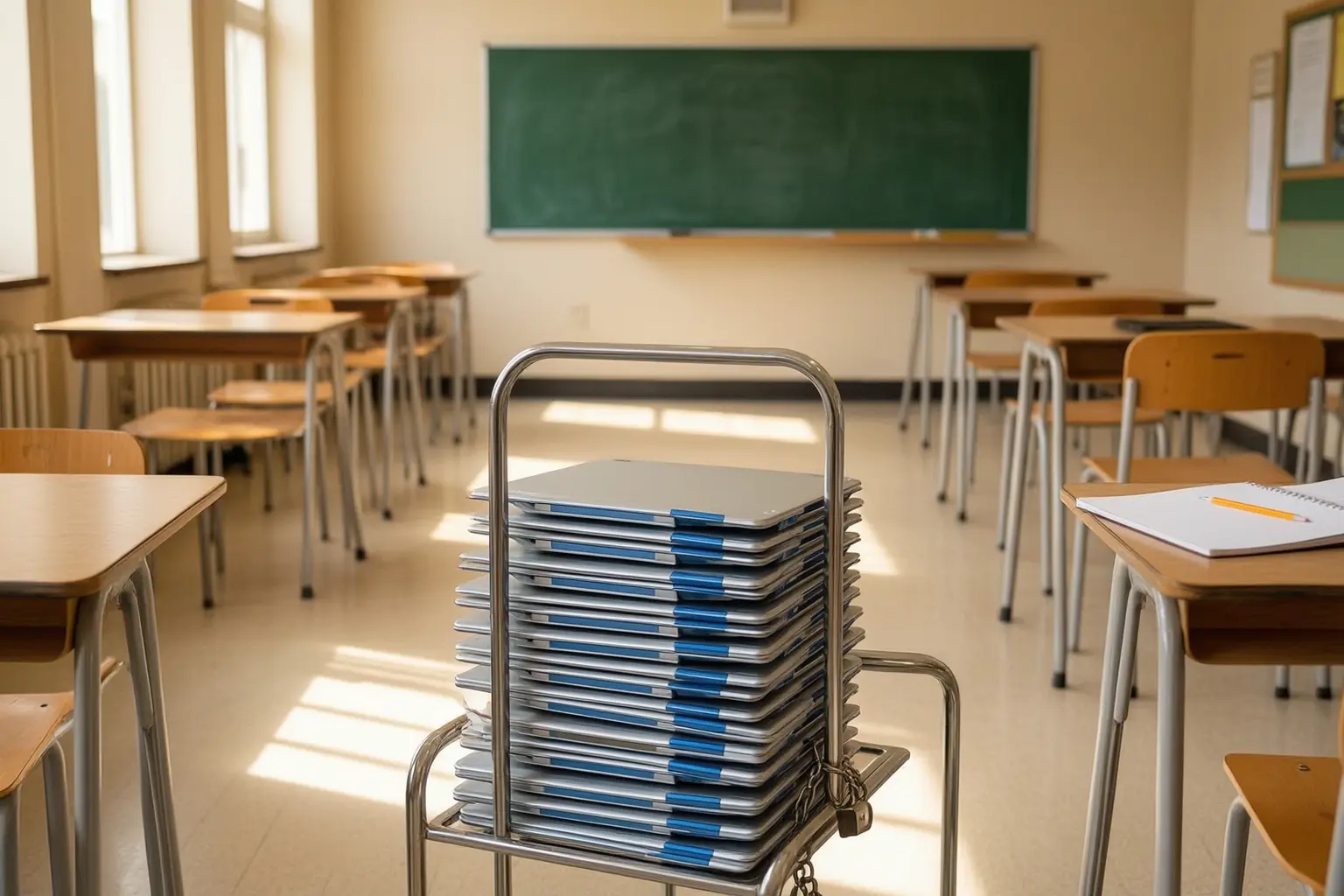
In McPherson, Kansas, middle-school principal Inge Esping collected 480 student Chromebooks. The machines now stay in classroom carts for assigned tasks only. Students take notes mostly by hand. “This technology can be a tool. It is not the answer to education,” she said. Some seventh graders say they prefer learning offline.
Los Angeles Unified agreed this year to stop issuing iPads and Chromebooks from prekindergarten through first grade. “Ten years ago, we bought the narrative from the tech companies,” Lila Byock of the parent group Schools Beyond Screens told an LA school board meeting. “Now we know better.”
- McPherson Middle School returned student take-home Chromebooks to carts
- LAUSD ends devices for pre-K through first grade
- Districts in North Carolina, Virginia, Maryland and Michigan re-evaluate one-to-one programs
- Iowa caps digital instruction for K-5 at 60 minutes a day
- Victoria, Australia ends primary bring-your-own-device schemes from January
- Madrid cuts technology time in primary schools
Australia’s education minister Jason Clare has argued children need a digital detox. The backlash extends beyond phones to the very laptops sold as equalizers.
Classroom Experiments Fill the Guidance Vacuum
Most teachers still operate without clear rules. Alicia Streight teaches maths at Edna Brewer Middle School in Oakland. Her weekly class has students examine innovations from TikTok to ChatGPT: who built this, who profits, and how it will affect them in ten years. Educators call the approach technology civics.
Cheshire Academy in Connecticut labels assignments green, yellow or red. Green allows full AI use, red bans it, yellow permits limited tools such as spell-check. The traffic-light labeling system for AI grew from work by French teacher Miriam Przybyla-Baum, who does not use AI herself. Students let a model edit homework then judge which changes kept their voice; they anonymously grade peers’ AI-assisted work and mark machine-written sections.
Fei-Fei Li has argued the real classroom risk is not cheating but students who stop wanting to learn. Building tools that truly work in schools has proved harder than building a general chatbot. No published evidence yet shows that traffic lights or screen-time caps raise results. Schools are trying them anyway.
The Money Keeps Flowing Into the Same Pipeline
Google is offering students a free year of AI Pro. OpenAI launched ChatGPT for Teens. Investors put $8 million into an AI tutor for UK exam students this month. The companies that once sold coding as the path to high-paying jobs now sell the systems that automate much of that work, while still controlling the devices and platforms most classrooms run on.
Singer’s decade of reporting shows the playbook is durable. Free materials, teacher workshops, branded AP courses and philanthropic framing open the door. Once inside, the firms shape what counts as modern skills. The first wave produced Chromebook remorse and flat test scores. The second wave arrives with fresh funding and the same structural tension Weingarten named: profit goals and public education goals remain fundamentally different.
Districts are writing their own limits while the next generation of training centers opens. The reckoning is incomplete. The infrastructure, the curricula and the training budgets still point toward Silicon Valley.