Savana has no AI running in production. After nearly 18 months of research the digital banking fintech is still whiteboarding operational tools that execute bank policies instead of spitting out recommendations.
President and COO Emily Steele told FinAI News the pause targets a deeper failure: bankers acting as the manual glue between disconnected systems. Advisory AI that only generates insights, she argues, just adds one more screen to the pile.
Eighteen Months Without a Single Production Model
Steele is blunt about the current wave of tools. “That R&D phase has been focused on what’s really going to make a difference in the industry, to give financial institutions a lift, and we don’t believe it’s the hype that’s out there right now,” she said.
The company draws a hard line between advisory AI (insights, recommendations, chat summaries) and operational AI that actually performs steps inside mapped workflows. Without the second, the first becomes another silo.
If we think of all the systems that have been acquired over the years inside of an FI, those stacks of technologies aren’t talking to one another and a banker has become the integration layer at a financial institution.
Emily Steele, president and COO of Savana, made the point in the FinAI News interview published August 7, 2026. Fix the integration first, she said, or customer experience and real transformation stay out of reach.
That framing explains the length of the pause. Eighteen months of whiteboarding is long by startup standards, yet it matches the problem Steele describes. Integration debt accumulated over years of acquisitions does not yield to a single model release.
Steele joined Savana as president and COO in 2022 after serving as president of Temenos North America. She started decades earlier at Sanchez Computer Associates on the Profile core and later ran North America for Temenos. Founder Michael Sanchez moved to executive chairman; Mike Wolfel became CEO while keeping the CTO role.
Her path through core platforms and regional leadership gives the caution weight. She has watched institutions buy successive layers of technology and still leave bankers reconciling screens by hand. The R&D choice follows from that history rather than from reluctance to ship.
What Operational AI Executes
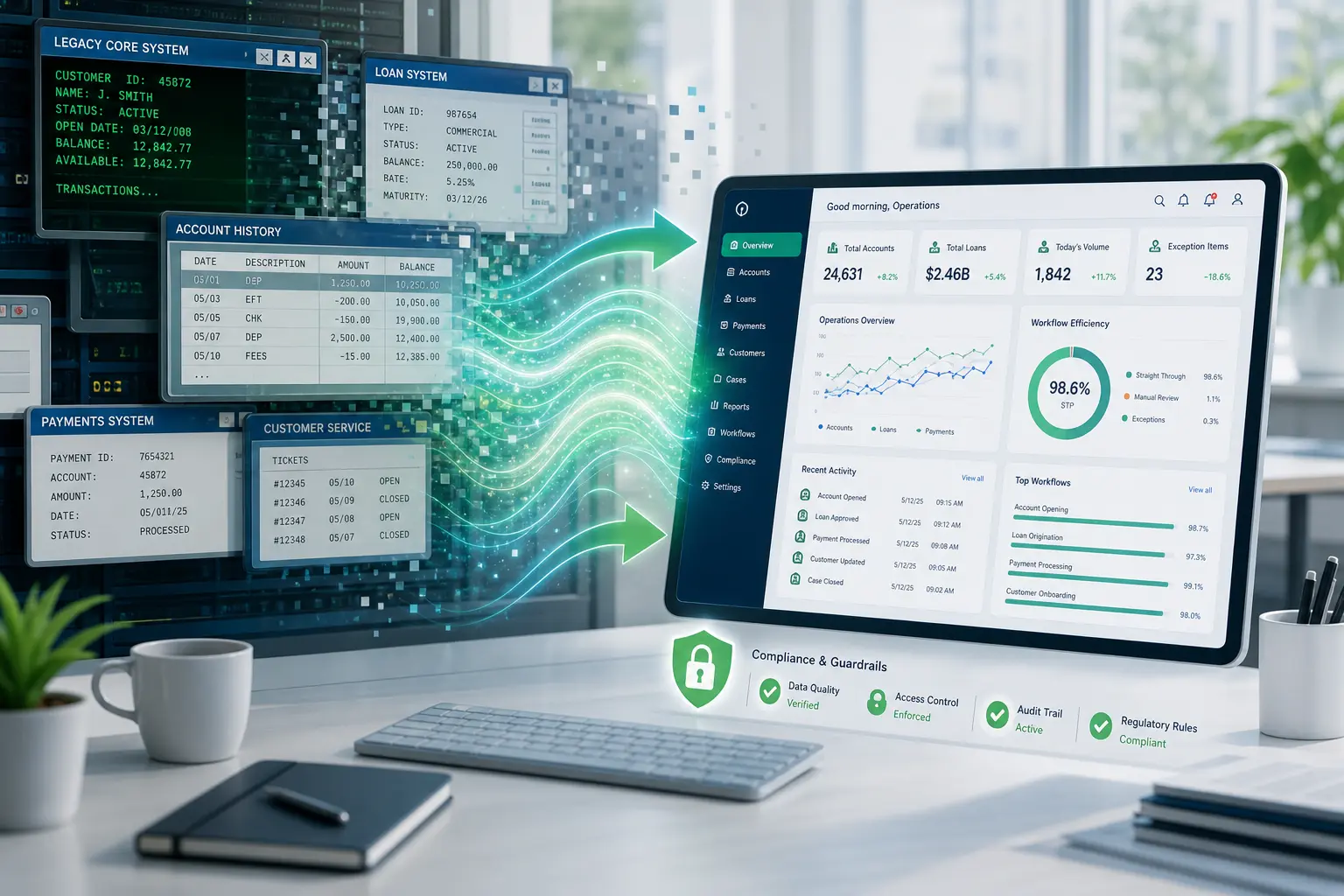
Savana’s target is a decision layer already built into every customer interaction path. Routing, entitlements, compliance guardrails and policy rules sit in place before the model acts. The AI then does the work rather than suggesting it.
“It’s routing to the right people; you’ve got the right guardrails, the right compliance,” Steele said. “If that’s already in place and you have operational AI that isn’t making suggestions but it’s actually doing the execution, that’s where real efficiency comes in.”
The three priority use cases under demonstration with bank partners are:
- Relationship management that keeps the full customer context visible across channels
- Fraud detection that operates inside existing policy and entitlement rules
- Customer service automation that closes the loop between self-service and assisted flows
Models will ingest each institution’s own policies and procedures so the output is not generic. “Then let the AI control what can be executed based on the entitlements of the banker,” Steele said. Partners see demos now and can deploy later under their own guidelines and workflows.
The mechanism is deliberate. Entitlements already define what a banker may approve, route or deny. Operational AI inherits those limits instead of inventing new ones. Compliance guardrails stay upstream of the model, so execution cannot drift outside policy.
Industry voices on X and elsewhere have begun echoing the same caution: AI functions best as governed infrastructure and orchestration rather than freestanding recommendation engines. Pure insight tools rarely fix the swivel-chair problem bankers still live with every day.
Bankers Still Glue the Stacks Together
Savana markets itself as a unified digital delivery platform that sits above any core, whether headless or legacy. It orchestrates workflows across CRM, BPM, digital channels and back-office tools so staff and customers see consistent data.
The platform ships with more than 140 preconfigured banking workflows. Steele has described a progressive renovation path rather than big-bang core replacement: start with banker experience or account opening, deliver wins in six to nine months, then expand. Customer success handles configuration; banks avoid hiring new FTEs just to run the software.
That path breaks into clear stages:
- First six to nine months: banker experience or account opening delivers visible wins
- Expansion phase: additional workflows come online across CRM, BPM and channels
- Steady state: customer success owns configuration so the bank adds no new FTEs just to run the software
In a December 2025 Finopotamus interview Steele noted the industry was still discussing the same disconnected-systems problems she had heard her entire career. Monolithic CRM tools often became data-gathering or sales-reporting engines instead of true relationship drivers. Member service reps remained blind to digital journeys already under way. Savana’s premise is that digital starts inside the institution by connecting systems of record first.
The approach complements core platforms like Finxact and works multicore, giving banks a visualization and orchestration layer without forcing a full replacement.
Multicore support matters because many institutions already run more than one system of record. A layer that orchestrates above them lets the bank keep what works and still present one view to staff and customers. The 140-plus workflows supply the starting map; configuration then ties each step to local policy.
Who Already Runs on the Platform
Named clients include Battle Bank, First Horizon Bank, Live Oak Bank, Primis Bank and Woodforest National Bank. Earlier reporting put the client count around 35 as of 2023, spanning challengers and traditional institutions.
| Institution | Notable Use | Public Comment |
|---|---|---|
| Woodforest National Bank | Universal banker experience, core-to-channel unification | EVP/CIO Richard Ferrara: frictionless workflows across departments |
| Live Oak Bank | End-to-end digital with core partners | Chairman/CEO Chip Mahan: technology enabling innovation and speed |
| Primis Bank | Digital delivery launch | President/CEO Dennis Zember: streamlined attractive experience |
| Battle Bank | Full digital banking solution for new challenger | Selected for consumer, business and account opening |
| First Horizon Bank | Platform client | Listed among active users |
These banks already live the multi-system reality Steele describes. Adding a freestanding advisory layer on top would, in her view, propagate the same dire problem of non-talking stacks.
The mix of challengers and traditional names is itself a signal. Battle Bank needed a full digital banking solution from the start. Woodforest sought universal banker experience and core-to-channel unification. Live Oak pushed end-to-end digital with core partners. Primis launched digital delivery. First Horizon appears among active users. Different starting points, same underlying need for orchestration above the core.
Rivals Ship Agent Tools While Savana Whiteboards
The contrast is deliberate. Narmi launched an agentic AI solution in July 2026 aimed at accelerating and automating account opening. Candescent embeds AI throughout the customer experience with conversational tools, summarizations and data-driven visualizations, according to chief product officer Gareth Gaston.
Both moves match the broader market push. A Federal Reserve note on AI adoption found the financial sector AI adoption near 30 percent of firms by late 2025, with work-related generative AI higher still. Deloitte reported roughly two-thirds of banks and insurers using AI or machine learning techniques in 2025, with generative AI especially strong among larger institutions. PwC has projected that full AI embrace could improve a bank’s efficiency ratio by up to 15 percentage points.
| Source | Finding | Timeframe |
|---|---|---|
| Federal Reserve note | Financial sector AI adoption near 30 percent of firms | Late 2025 |
| Deloitte | Roughly two-thirds of banks and insurers using AI or ML | 2025 |
| PwC projection | Full AI embrace could improve efficiency ratio by up to 15 points | Forward look |
Savana is not arguing against those numbers. It is arguing the sequence matters. An insight engine dropped onto fragmented cores creates another system the banker must manually reconcile. Operational AI that already knows the decision paths and can execute inside them is the piece that moves efficiency.
Narmi’s July 2026 agentic release and Candescent’s embedded conversational tools show how fast the market is moving toward visible AI features. Savana’s whiteboard phase looks slow beside those launches. The company treats that gap as a feature of its thesis, not a lag in delivery.
Where the Efficiency Lands
Steele’s critique lands hardest on the human cost of incomplete stacks. Bankers toggle among 30 to 50 systems. Customers start a process digitally and hit a wall when they call. Self-service and assisted channels remain separate. Fraud and disputes stay complex manual hand-offs.
By mapping every step and giving the model only the authority the banker’s entitlements already allow, Savana claims the AI can close those loops without inventing new policy or new screens. Relationship views stay complete. Fraud actions stay inside existing rules. Service tickets resolve rather than generate yet another recommendation queue.
The pain points cluster in familiar places:
- Bankers toggling among 30 to 50 systems each day
- Customers who start digitally and stall when they phone in
- Self-service and assisted channels that never share state
- Fraud and disputes that still require manual hand-offs
Crowd discussion on platforms like X has sharpened the same distinction. Voices argue banks should orchestrate models the way manufacturers orchestrate robots, not build freestanding chatbots or replace relationship work. Governed workflows for prep, triage and execution beat open-ended advisory interfaces. That framing matches Savana’s 18-month choice to stay out of production until the execution layer is ready.
Why the Sequence of Adoption Matters
Market figures show wide uptake. Near 30 percent of financial firms had adopted AI by late 2025. Roughly two-thirds of banks and insurers already used AI or machine learning that same year. Efficiency gains of up to 15 percentage points remain on the table for full embrace. None of those numbers settles the order of operations.
Steele’s argument is that advisory tools arrive first because they are easier to demo. They summarize, recommend and chat. They do not require the bank to finish mapping entitlements, routing and compliance into a shared decision layer. Operational AI requires that map. Without it, the model has nothing safe to execute.
The progressive renovation path already in the platform supplies a practical order. Banks start with banker experience or account opening, book wins in six to nine months, then expand. Each stage tightens the workflow map the future models will inherit. Skipping ahead to freestanding agents leaves the map unfinished and the banker still acting as glue.
Rivals shipping agent tools in 2026 are answering real demand for automation. Savana’s counter is that automation without governed execution paths recreates the swivel-chair problem in a new interface. The 18-month research window is the time spent building those paths before any model touches production traffic.
How Partners Move From Demo to Deployment
The three use cases now in partner demos share one design rule. Relationship management, fraud detection and customer service automation all read the institution’s own policies before they act. Output stays local to that bank’s rules rather than generic industry defaults.
Deployment timing stays with each bank. Partners can adopt under their own guidelines and workflows. No public production date has been set. That restraint keeps the decision architecture ahead of the model. When tools switch on, they inherit entitlements already in force.
Customer success handles configuration on the existing platform. Banks do not hire new FTEs solely to keep the software running. The same support model is meant to carry into the operational AI layer, so the cost of ownership does not jump when execution features arrive.
Named clients already running the orchestration layer give the demos a live backdrop. Woodforest’s universal banker work, Live Oak’s end-to-end digital paths and Battle Bank’s full challenger stack all illustrate multi-system reality. The AI layer is meant to extend those connections, not sit beside them as another screen.
The company is already demonstrating the three use cases to partners. Deployment timing stays with each bank’s guidelines. No public production date has been set. The bet is that when the tools finally switch on, they will run inside a decision architecture that already works rather than on top of one that does not.
For institutions still staring at swivel-chair desktops, the quieter path may prove the faster one.