
NEWS
Senate Advances a College Sports Bill Athletes Did Not Write
A 74-24 Senate cloture vote on the Protect College Sports Act would lock in a 22% player-pay cap and a lawsuit shield, over NAACP and player-ally objections.

The Senate voted 74-24 on Tuesday, September 15, to cut off debate on the Protect College Sports Act and move it toward a final up-or-down vote. The tally cleared the 60-vote bar, and it did so with a civil-rights and labor bloc still standing outside the deal.
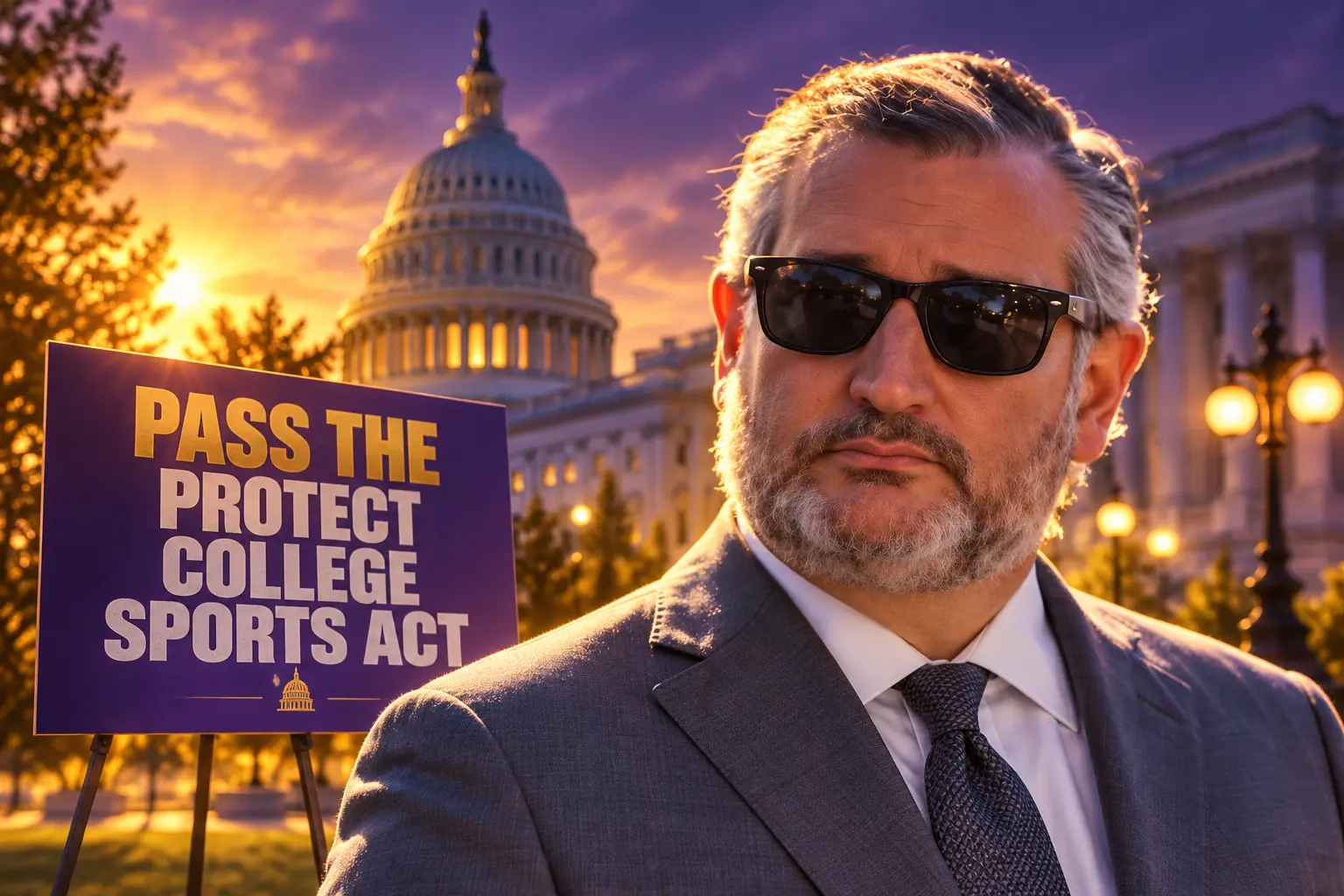
Co-sponsors Sen. Ted Cruz, R-Texas, and Sen. Maria Cantwell, D-Wash., sold the bill as order after years of name, image and likeness chaos, transfer-portal bidding and eligibility lawsuits. The same text would freeze a 22% player-pay cap into federal statute, shrink free transfers to one, and give schools, conferences and the NCAA a targeted antitrust shield those players never sat down to negotiate.
The 74-24 Cloture Vote Left a Civil Rights Bloc Outside
The roll was called at 6:20 p.m. All four Black Democrats in the Senate, Cory Booker of New Jersey, Raphael Warnock of Georgia, Lisa Blunt Rochester of Delaware and Angela Alsobrooks of Maryland, voted no. The NAACP had already asked Majority Leader John Thune and Democratic Leader Chuck Schumer not to bring S. 4668 up at all.
Booker took the floor at 4:11 p.m. and said the measure “is not protecting athletes.” He argued it puts bureaucracy between players and money while treating them “as a different class.” Sen. Chris Murphy, D-Conn., called the core of the bill a defense of “a system of exploitation.”
The no column was not only a Democratic civil-rights group. Four Republicans joined it, including former Auburn coach Tommy Tuberville of Alabama, plus Rand Paul of Kentucky, Rick Scott of Florida and Ashley Moody of Florida. Independent Bernie Sanders of Vermont voted no. Co-sponsor Chris Coons of Delaware and Sen. Jacky Rosen of Nevada did not vote.
WHO VOTED NO, IN BRIEF
- Civil rights bloc: Booker, Warnock, Blunt Rochester and Alsobrooks, matching the NAACP and Congressional Black Caucus line.
- Labor and left: Murphy, Sanders, Elizabeth Warren, Dick Durbin and several other Democrats who wanted a union path, not a cap with a shield.
- Republican dissent: Tuberville, Paul, Scott and Moody, a split inside the 53-47 GOP majority that still delivered cloture easily.
Cruz called the bill “a bipartisan solution designed to bring order to the chaos.” Cantwell said the size of the vote left her “cautiously optimistic” it could still clear the House, which has already failed to pass a different college sports bill. President Donald Trump has said he would sign it. A Texas pregame crowd had already treated Cruz’s pitch as a political ad, drowning him in boos when he took a Saturday set to sell the same bill.
AFL-CIO president Liz Shuler put the labor objection in one line the day before the roll call.
The #1 thing the Protect College Sports Act protects is the mighty NCAA. Athletes are the heart and soul of college sports, and this bill would disempower athletes and their right to join a union.
Tell the Senate: Stand with college athletes. Vote NO.https://t.co/CvkgG2CwJC
— Liz Shuler (@LizShuler) September 14, 2026
A 22% Cap Would Become Federal Law
S. 4668, the Protect College Sports Act of 2026, would write into statute the revenue-share limit that schools already accepted in the 2025 House v. NCAA settlement. That cap is 22% of a defined revenue pool, about $21.5 million per school this year. The bill would then add a $27.5 million “retention pool” that schools could use to keep current players, a device meant to pull some hard-to-police third-party NIL deals back inside the athletic department.
Cantwell released a snapshot as the vote began. It found that 94 percent of all Division I athletics programs now spend more than they take in, and that only 14 of 53 publicly reported Power 4 departments generated enough money to cover expenses in 2024-25. Among those 53 schools, institutional and government support of athletic programs rose $519.9 million between 2015 and 2025.
The cap is the tool sponsors want to put on that spiral. Critics note that the only hard lid in the package sits on the slice that goes to players, not on coach pay, facilities or the TV contracts that make football a national product.
WHAT S. 4668 WOULD LOCK IN
| Rule | What the bill would do |
|---|---|
| Pay cap | Write the 22% revenue-share limit, about $21.5 million this year, into federal law |
| Retention pool | Let schools spend up to $27.5 million more to keep players and bring NIL in-house |
| Transfers | Guarantee one free transfer; a second costs a year, with listed exceptions |
| Eligibility | Five years, with a bar on most athletes who already signed major pro contracts |
| Antitrust | Give schools, conferences and athletic associations a targeted shield to enforce those rules |
| TV pooling | Allow a voluntary media-rights pool if 75% of current FBS schools join; old contracts stay in force |
Arkansas men’s basketball coach John Calipari, speaking in Washington the day before the vote, said the package “clears up about 75-80% of our issues.” Nick Saban, Deion Sanders and Gonzaga’s Mark Few have backed it too. The people who would play under the cap did not get a vote on the 22% figure.
Medical Coverage Comes With a Lawsuit Shield
The athlete-protection chapters are not window dressing. Division I schools would have to cover sports-injury costs during a career and for five years of post-eligibility medical coverage. A $60 million national trust, which could rise by $5 million a year up to $100 million if it runs dry, would help smaller schools and players with long-term conditions such as CTE. Scholarships could not be pulled for injury or poor play, and the aid clock would run 10 years after eligibility so a player could finish a degree.
Agent fees would be capped at 5%. NIL rights would become a federal standard and wipe out the state-by-state patchwork. At least one-third of certain NCAA governing boards and rulemaking committees would have to be current or recent players. Athletes would get a private right of action on listed violations and could not be forced into arbitration to use it. Health officers would sit outside the athletic department. Football coaches would be blocked from taking over another FBS staff in the same season, the so-called Lane Kiffin rule.
ATHLETE RIGHTS WRITTEN INTO THE TEXT
- Health clock: Five years of paid follow-up care after the last game, plus a $60 million trust for smaller schools and long-term injury.
- School clock: Ten years of scholarship access after eligibility, with a ban on cutting aid for injury or performance.
- Board seats: At least one-third of listed association boards and rulemaking panels reserved for current or recent athletes.
- Employment line: The bill stays silent on whether players are employees, unlike the House SCORE Act, which tried to close that door.
Those chapters sit beside Section 118, which would give schools, conferences and athletic associations targeted antitrust protection to enforce the cap, the transfer lid, eligibility, agent rules and recruiting windows. Section 121 would preempt conflicting state NIL, transfer and eligibility laws. The combination is the product players’ lawyers have been warning about: Congress rewriting the antitrust rules that athletes have used, and doing it without a union on the other side of the table.
We are all still reading this bill, but its primary effect seems to be to limit the compensation of athletes while protecting the huge salaries of all the adults – coaches, ADs, sports industry executives – who are getting rich off the performance of the players.
Sen. Chris Murphy, D-Conn., May 27 statement
Murphy’s May line still names the fight. In that statement he said the bill’s primary effect would be to limit the compensation of athletes while shielding the adults who run the enterprise, and that it would hand the NCAA “an antitrust exemption that no other industry gets.” Cantwell has answered that the bill also creates a Commission on the Future of College Athletics, and she has said that commission should look at collective bargaining. The statute itself does not grant it.
Black Men Make Up 66% of Those Football Rosters
NAACP president Derrick Johnson’s August 4 letter to Thune and Schumer is the document the cloture tally did not answer. Over the past decade, he wrote, schools in the ACC, SEC and Big 12 generated about $16 billion in athletic revenue, excluding NIL. Black men make up approximately 66 percent of their football rosters. On many of those campuses, he added, that share bears little resemblance to the Black share of the student body.
Johnson tied the sports bill to Southern redistricting fights and to the NAACP’s “Out of Bounds” campaign, whose slogan is “No Representation. No Recruitment. No Revenue.” He said public schools cannot fill stadiums with Black talent, then claim neutrality when those players’ communities lose voting power. He also said the health, scholarship and agent chapters should be passed on their own, without the antitrust gift, the federal preemption or the expanded media bargaining authority.
There’s no instability in the game. It’s just greed by the conferences.
Derrick Johnson, NAACP president and CEO, September 15
Johnson called HBCU sweeteners in the bill a “head fake.” The Congressional Black Caucus came out against the package in August. The AFL-CIO Sports Council, including most major players’ unions, opposed it as a limit on the right to organize. A pay cap without a bargaining agent is the objection that keeps coming back, and it is the one the 74-vote majority chose not to wait on.
Cruz has warned that, without a federal rulebook, college sports shrinks to “30-50 colleges” and “a mini NFL” inside five years. Cantwell has said thousands of roster spots and about a hundred programs are already being cut. Women’s and Olympic sports get a hold-harmless in the text: large and mid-sized schools would have to keep 2024-25 grant-in-aid and roster levels in non-revenue sports. That protection is real. It is also being used to move a cap and a shield that fall hardest on the football and basketball players who generate the money.
The TV Pool Needs 75% of FBS Schools to Work
Sponsors still advertise a second pile of money. Title II would amend the Sports Broadcasting Act of 1961 so schools and conferences could form a voluntary “covered entity,” pool football and basketball media rights the way the NFL does, and, proponents say, raise $4 billion to $8 billion more. The section-by-section summary says 75% of current FBS schools would have to agree. No school would be forced in. Existing TV contracts would stay in force.
The SEC and the Big Ten, the two conferences whose football inventory would make such a pool worth those billions, say they would not join. Last-minute language was added to protect current broadcast deals with networks, the College Football Playoff and the NCAA Tournament. A pool that needs three-quarters of FBS, and that cannot break contracts already signed, is a talking point until those deals lapse. The $60 million medical trust is written so pooled TV money could fund it. If the giants stay out, that tap stays closed.
The same title tries to block a closed super league. Any conference that took in more than $1 billion in FY2025 revenue would be barred from merging with, buying or absorbing another conference’s teams or media rights. That line is aimed at a Big Ten-SEC combine. It does not make those two conferences share their TV money with everyone else. The spending spiral the Cantwell snapshot describes is concentrated in the programs that have already opted out of the bill’s biggest revenue tool.
LSU’s NFL-Camp Fight Put Eligibility Lawsuits on the Floor
Cantwell told colleagues the vote arrived a week after college football’s latest eligibility scare. LSU, under first-year coach Lane Kiffin, moved to add Dae’Quan Wright and Zxavian Harris, two players who had been in NFL training camps. A Louisiana judge had given them a path onto the roster. The SEC sued, clarified a rule that a player who signed an NFL, NBA or WNBA contract is done with college ball, and put a presidents’ meeting on the calendar that could have taken up expulsion.
THE WEEK CONGRESS SAW THE LAWSUIT PROBLEM
- September 8, 2026: The SEC files an amended federal complaint and schedules a September 10 presidents’ meeting with expulsion on the paper, a step that would have needed a two-thirds vote.
- September 8-9, 2026: LSU fills its last roster spots with other players, leaves Wright and Harris off the 105-man list, and president Wade Rousse writes that the roster issue is “moot.”
- September 10, 2026: SEC presidents meet by video, take no expulsion vote and no sanctions, and say talks on “conference expectations and responsibilities” will continue.
Cantwell called that sequence “a big lamp” for colleagues who had not watched how fast an eligibility suit can threaten a conference. The bill would put a five-year eligibility rule and a pro-contract bar into federal law and then shield the NCAA and conferences when they enforce it. The LSU fight is the kind of case that shield is built for. Calmer heads held the SEC together for now. The legal theory did not go away.
House Republicans Could Not Pass Their Own Sports Bill
S. 4668 is already a compromise with the two richest conferences. Cruz and Cantwell announced it on May 27 and introduced it on June 2. The Commerce Committee voted 19-9 on June 18, with the U.S. Olympic and Paralympic Committee on record in support. The SEC and Big Ten stayed off until an August rewrite hardened the cap, defined “associated entity” the way the House settlement does, set the $27.5 million retention pool and made media pooling explicitly voluntary. Only then did Thune have a path to the floor.
The House is the harder room. Republican leaders pulled the SCORE Act, their own college sports bill, after a coalition of Freedom Caucus votes, Democrats, state attorneys general and the Congressional Black Caucus made a floor win look unreachable. SCORE was more rigid on antitrust and tried to state that athletes are not employees. Cruz has said he would have voted for it, and that it could not pass the Senate. The Protect College Sports Act is the version written to.
Sen. Eric Schmitt, R-Mo., another co-sponsor, said before the Tuesday roll that “we’re going to get one shot at this, and I don’t know if we ever will again soon.” Democrats are trying to flip the Senate in November. The current session is slated to run through October 2. Cloture is not passage. The Senate still owes a final vote, and the House still owes a bill it has not been able to pass.
The Senate adjourned at 6:22 p.m. Tuesday with an agreement to resume S. 4668 at 10 a.m. Wednesday, September 16, and to count the downtime against the post-cloture clock. The players who fill those football rosters will not be in the chamber when that clock runs out.

The Court Revisits the Climate Nuisance Door It Left Open

ChatGPT Now Compiles Live Interfaces With GPT-6

A Tanker Attack Moves the War Into Qatar’s Waters

Personio Buys Circula to Own the DATEV Channel

Bluesky Files for .bsky and Enters the Registry Queue

Microsoft’s 96% Cyber Score Sits at 86.3% on the Board

Musk’s $914 Billion Lead Is a Public SpaceX Bet

Free Live Sports Streaming in 2026: What to Watch Without Cable

The Odyssey’s IMAX Film Run Hit a 41-Theater Limit

Endgame Encore’s $86 Million Trial for Infinity Vision
-
 NEWS3 months ago
Microsoft’s 96% Cyber Score Sits at 86.3% on the Board
-
 BUSINESS5 months ago
Musk’s $914 Billion Lead Is a Public SpaceX Bet
-
 ENTERTAINMENT3 months ago
The Odyssey’s IMAX Film Run Hit a 41-Theater Limit
-
 SPORTS4 months ago
Free Live Sports Streaming in 2026: What to Watch Without Cable
-
 ENTERTAINMENT4 months ago
Endgame Encore’s $86 Million Trial for Infinity Vision
-

 ENTERTAINMENT2 years ago
Andrew Garfield’s Spider-Man Films Are No Longer Free
-

 NEWS5 months ago
Singapore’s 3×3 and Surfing Debuts Miss the Medal Stand
-

 GAMING1 month ago
Xbox Puts 15-Hour Caps on Game Pass Cloud Play