
NEWS
White Sands Footprints Put People in Ice Age New Mexico
After three dating campaigns, White Sands footprints place people on a New Mexico lake for 2,000 years during the Last Glacial Maximum.

Human footprints at White Sands National Park in New Mexico date to 21,000 to 23,000 years ago, a range now backed by four independent materials. That places people on a shrinking Ice Age lake in the Tularosa Basin while continental ice still sealed the usual land routes from Asia.
A May 2026 U.S. Geological Survey fact sheet treats those tracks as nearly 2,000 years of activity, not a one-day crossing. The age fight that followed the 2021 Science paper is no longer the center of the record. What the mud actually shows is.
A Woman, a Toddler, and a 1.5-Kilometer Walk
The longest fossil out-and-back human trackway in the world runs more than 1.5 kilometers across the old lake margin on Alkali Flat. An adolescent or small adult female made two trips hours apart. On the outward leg she carried a child younger than 3, setting the toddler down at least three times. Her prints widen into a banana shape when the extra weight sits on one hip, then slim again when she walks unburdened.
Between those two legs of the walk, a giant ground sloth and a Columbian mammoth crossed the same mud. The human stride does not change. Park pages describe a female walking with a toddler for almost that full distance, slipping in wet gypsum, shifting the child from side to side.
That walk is one story in a much larger surface. White Sands holds the largest known collection of Ice Age fossil tracks, named a megatracksite in 2014. Human prints sit with mammoths, saber-toothed cats, dire wolves, camels, and Harlan’s ground sloths. The 2021 team called them the oldest known human footprints in North America.
How Old Are the White Sands Footprints?
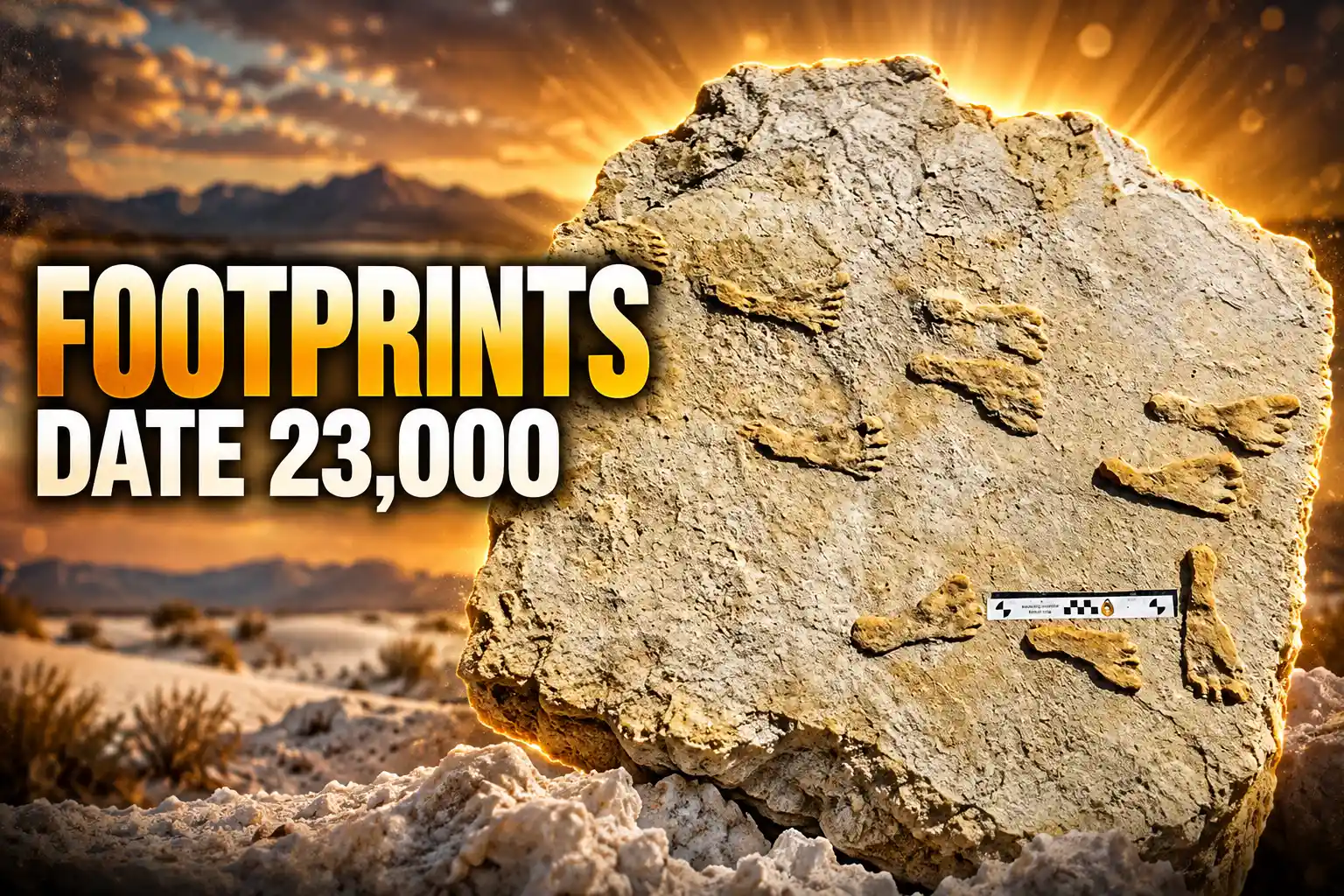
The working age is 21,000 to 23,000 years, first set by radiocarbon dates on spiral ditchgrass seeds in the footprint layers and later matched by pollen, quartz, and lake mud. At the Locality 2 trench, seeds still on their stems dated to 22,860 years (plus or minus 320) and 21,130 years (plus or minus 250). Track horizons 2 through 6 in that sequence span nearly 2,000 years during the Last Glacial Maximum.
FOUR LINES OF DATES ON THE SAME TRACKS
| Material | What it dates | Age | Published |
|---|---|---|---|
| Ruppia seeds | Spiral ditchgrass in the print layers | 21,000 to 23,000 years | September 2021 |
| Conifer pollen | Pine, spruce, and fir from the same layers | 23,400 to 22,600 years | October 2023 |
| Quartz grains | Last sunlight on buried sand | Minimum about 21,500 years | October 2023 |
| Paleolake mud | Wetland mud tied to the track-bearing beds | 20,700 to 22,400 years | June 2025 |
Those four figures are not four versions of one clock. Seeds and pollen are radiocarbon ages from the print horizons. Quartz gives a minimum burial age for one sampled bed. The mud dates a lake and wetland sequence that can be traced into the alluvium that holds the tracks.
Four Materials Now Date the Same Tracks
Critics of the 2021 paper focused on the plant. Ruppia cirrhosa grows in water and can take up old carbon from groundwater, a hard-water effect that can make a radiocarbon age too old. USGS geologist Jeff Pigati, a co-lead on the follow-up, said some archaeologists argued the first dates were not strong enough for a claim this large.
The immediate reaction in some circles of the archeological community was that the accuracy of our dating was insufficient to make the extraordinary claim that humans were present in North America during the Last Glacial Maximum. But our targeted methodology in this current research really paid off.
Jeff Pigati, USGS research geologist, October 2023 USGS release
The 2023 Science paper dated conifer pollen from the same layers, isolating about 75,000 pollen grains per sample with flow cytometry so the carbon came from land plants, not lake water. Those pollen ages matched the seeds. Quartz buried in the footprint beds had a minimum age of about 21,500 years. USGS geographer David Wahl said the pollen came from cold, wet glacial plants, unlike the desert mix on the playa now.
In June 2025, University of Arizona geoarchaeologist Vance Holliday and colleagues published a third check: paleolake Otero mud, with 26 additional radiocarbon dates from two labs that had not run the original seed work. The mud is 20,700 to 22,400 years old, and the lake-wetland-stream record around the tracks runs from more than 23,600 years to about 17,000 years. Kathleen Springer, USGS co-lead on the 2023 paper, said the team had been testing the 2021 ages even as that first study went to press.
Ground-penetrating radar at Locality 2, on the east edge of Alkali Flat, showed human footprints still in the subsurface before the trench was cut. That is the same class of imaging that reveals buried ancient ground at other U.S. sites. The May 2026 fact sheet then counted 61 footprints from 8 horizons at that locality, with thousands of unstudied tracks still in the park.
A Closed Corridor and a Coastal Problem
For most of the 20th century, Clovis sites at about 13,000 years stood as the first solid American occupation. A smaller set of older sites has pushed that floor to 15,000 or 16,000 years. White Sands sits further back, inside the Last Glacial Maximum, when ice sheets covered much of the northern continent.
The 2021 Science paper said people were already south of that ice for about two millennia while the Ice-Free Corridor and the Pacific coastal route were closed or unlikely. A 2022 cosmogenic-dating study put the full opening of the inland corridor at 13.8 thousand years, plus or minus 0.5 thousand. That is thousands of years after the White Sands walkers. If the print ages hold, these people did not come through a late-glacial gap in Canada. They were already in the Southwest while that gap was still ice.
How they got there is still open. A Pacific coast route, possibly using winter sea ice as a platform, is one working idea. Some of the earliest shoreline camps would now sit underwater. The prints do not name a culture and do not include stone tools. They only prove that someone with human feet was on this lake when the northern interior was still blocked.
Schoolhouse timelines still start with Clovis and a Bering land bridge at the end of the ice. The harder question in the field is no longer whether people were here before Clovis. It is which older sites can survive the same dating tests these tracks have now passed three times.
Teenagers and Children Left Most of the Prints
Demographic work on the Locality 2 sample found the age group most often recorded was teenagers and children between 9 and 14. Adults are scarce on those excavated surfaces. Matthew Bennett of Bournemouth University and colleagues wrote in Science that fetching and carrying may have fallen to teenagers while adults did skilled work at the lake edge, with smaller children tagging along and leaving more prints.
WHAT THE TRACKS RECORD
- The 1.5 km walk: One older person carries a child under 3, sets the child down, and returns hours later without the toddler.
- Play in the mud: Children jump, skip, and slosh, including in water pooled inside giant sloth tracks.
- A hunt that fails: Human prints sit inside sloth tracks, as if someone stepped in the animal’s steps; the park says there is no sign the hunt succeeded.
- Possible travois marks: Linear grooves beside human prints, some about 22,000 years old, match poles dragged as a simple load-carrier.
The travois paper, posted by the USGS in January 2025, sorts the grooves into three shapes. Type III traces are two parallel lines 250 to 350 mm apart that can run more than 30 meters, with human footprints between and beside them. Bennett’s team tested replicas in wet mud in Britain and Maine and concluded a single pole or crossed poles pulled by people is the simplest fit. That is still a reading of traces, not a recovered wooden frame.
People were not wading the open lake. They were walking a patchwork of wet and dry ground along the margin. The earliest print beds sit near a sharp drop in lake level dated to about 23,000 years, matching a rapid warming called Dansgaard-Oeschger 2 that began about 23,300 years ago. As the water pulled back, it left a wide shelf of mud for feet, paws, and hooves.
Mammoths, Sloths, and Tracks Inside Tracks
The Pleistocene animals that walked the same beds include dire wolves, saber-toothed cats, giant ground sloths, camels, and mammoths. In January 2016, mammoth prints sat directly on human prints, a superposition that is hard to explain unless both species used the shore in the same era. The 2021 paper said humans and these giant animals overlapped for at least two millennia, so if people were hunting them, the hunting was sustainable for a long stretch, at least at first.
Pollen from the print layers includes pine, spruce, fir, oak, sagebrush, and weeds. The Tularosa Basin then was cooler and wetter than the white dune field visitors see now. Grasslands and wetlands ringed Paleolake Otero. Wind later stripped the old lake beds, built the gypsum dunes, and left Alkali Flat, where the tracks fade in and out as the crust dries, floods, and blows.
The work has been a park, USGS, and university project from the start, with Bournemouth University, the University of Arizona, and Cornell University on the author lists, and with Tribal Nations providing cultural monitoring in the field and remotely. White Sands resource manager David Bustos is a coauthor on the footprint papers. The park consulted Native American partners as the research moved from dark spots on the playa to dated trenches.
Visitors Still Cannot Walk the Playas
The original trackways are closed. Gypsum crust that records a footstep also sheds it. Exposing more of the surface to sun, wind, and shoes would erase the thing the dates describe. A visitor-center exhibit with cast human footprints opened in January 2024. Park Superintendent Marie Sauter, on the 2021 announcement, called the site both a recreation park and a scientific laboratory.
These incredible discoveries illustrate that White Sands National Park is not only a world-class destination for recreation but is also a wonderful scientific laboratory that has yielded groundbreaking, fundamental research.
Marie Sauter, Superintendent, White Sands National Park, September 2021 NPS release
FROM DARK SPOTS TO A FACT SHEET
- 2006: Scientists notice dark spots on the old lakebed that look like tracks.
- 2009: Digs on those spots yield Harlan’s ground sloth prints and human prints.
- 2014: The park is recognized as a megatracksite.
- 2018: Researchers map the long walk of a female with a toddler.
- September 23, 2021: Science publishes the 21,000 to 23,000 year seed ages.
- October 5, 2023: Pollen and quartz ages match the seeds.
- January 2024: The visitor center exhibit opens; the playas stay closed.
- January 10, 2025: The travois-groove study is posted.
- June 18, 2025: Paleolake mud dates support a Last Glacial Maximum age.
- May 2026: USGS Fact Sheet 2025-3046 summarizes the Ice Age track record.
The May 2026 sheet is the federal summary of a debate that started with seeds in a trench and now rests on pollen, buried quartz, and lake mud as well. Thousands of tracks in the park have not been excavated. The ones that have been dated put people on this shore for nearly 2,000 years while ice still held the north. The next print that weathers out of Alkali Flat will not change that span. It will only add another step to a walk that is already longer than the old timeline allowed.
Frequently Asked Questions
What Is Paleolake Otero?
Paleolake Otero was an Ice Age lake that filled much of New Mexico’s Tularosa Basin when the climate was cooler and wetter. White Sands National Park now sits on gypsum dunes and Alkali Flat built from those lake sediments after wind stripped the old beds. The human and animal tracks formed on wet and dry ground along the lake margin, not in deep open water, and later became exposed as the surface deflated.
Why Did Scientists Doubt the First White Sands Dates?
The 2021 ages came from seeds of Ruppia cirrhosa, an aquatic plant whose carbon can come from old groundwater instead of the air, which can make a radiocarbon date too old. The seeds used for dating were often still attached to stems in thin clay layers, which argued they had not been washed in from older beds, but that did not cancel the hard-water worry until land-plant pollen and quartz ages matched the seeds.
Who Left the White Sands Footprints?
No named culture, tool type, or burial is tied to the dated trackways. Foot length and stride point to teenagers and children between 9 and 14 on most excavated surfaces, plus at least one older person carrying a toddler. They were not Clovis people, whose sites date to about 13,000 years, and the prints do not show whether these walkers left descendants among living Native nations.
Are These the Oldest Human Footprints on Earth?
No. Older human trackways are known in Africa and elsewhere. The White Sands prints are the oldest documented human footprints in North America, and they are unusual because they preserve whole scenes (a carried child, a sloth crossing, possible drag poles) rather than a few isolated steps.
How Does Gypsum Keep a Footprint and Then Erase It?
Wet gypsum mud takes a sharp print, then dries and can be buried by thin layers of sand and clay. Wind later strips those layers and brings the print back to the surface as a dark stain or a shallow mold. Once exposed, sun, rare floods, and blowing sand cut the crust apart, which is why the research trenches are reburied and why the park keeps the live trackways closed.

The Court Revisits the Climate Nuisance Door It Left Open

ChatGPT Now Compiles Live Interfaces With GPT-6

A Tanker Attack Moves the War Into Qatar’s Waters

Personio Buys Circula to Own the DATEV Channel

Bluesky Files for .bsky and Enters the Registry Queue

Musk’s $914 Billion Lead Is a Public SpaceX Bet

Microsoft’s 96% Cyber Score Sits at 86.3% on the Board

Free Live Sports Streaming in 2026: What to Watch Without Cable

Andrew Garfield’s Spider-Man Films Are No Longer Free

Endgame Encore’s $86 Million Trial for Infinity Vision
-
 BUSINESS4 months ago
Musk’s $914 Billion Lead Is a Public SpaceX Bet
-
 NEWS2 months ago
Microsoft’s 96% Cyber Score Sits at 86.3% on the Board
-
 SPORTS3 months ago
Free Live Sports Streaming in 2026: What to Watch Without Cable
-
 ENTERTAINMENT2 years ago
Andrew Garfield’s Spider-Man Films Are No Longer Free
-
 ENTERTAINMENT3 months ago
Endgame Encore’s $86 Million Trial for Infinity Vision
-

 ENTERTAINMENT1 month ago
Sterling Point Holds No. 2 on Prime Video After 32 Days
-

 NEWS4 months ago
Singapore’s 3×3 and Surfing Debuts Miss the Medal Stand
-

 NEWS1 month ago
G20 Cheers AI Investment After Bailey’s Frontier Cyber Warning