
NEWS
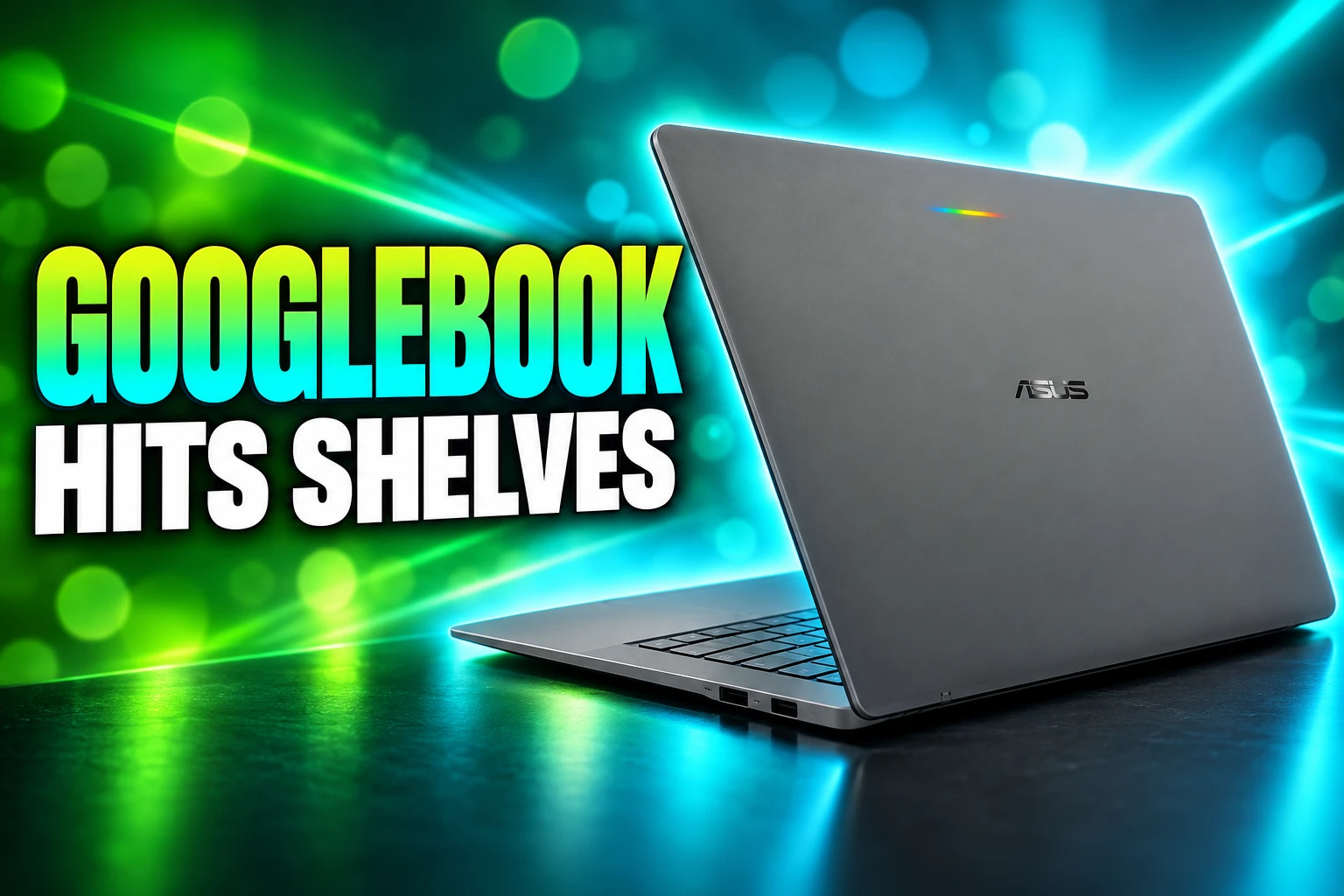
Aluminium OS Hits Shelves as Googlebook, Chrome OS Stays
Aluminium OS reaches U.S. stores on October 4 as Googlebook OS, a $899 Android laptop line, while Chrome OS remains the school machine through 2034.

Googlebook laptops running Googlebook OS, the Android desktop platform once code-named Aluminium OS, reach U.S. store shelves on October 4. Sameer Samat, president of the Android ecosystem, had already pointed to that window on March 4 at Mobile World Congress, saying he was “super excited about later this year.”
The machines start at $899 and come from Acer, ASUS, Dell, HP, and Lenovo. Chrome OS stays on sale for schools and offices. That two-track setup is the part of Samat’s answer that still governs who gets which Google laptop, and when.
Samat’s March Answer Pointed to Fall
Asked at MWC 2026 whether Aluminium OS was still due in 2026, Samat paused, then answered in a single line.
Yes, I’m super excited about later this year.
Sameer Samat, President of the Android Ecosystem, Mobile World Congress 2026
He did not name a month, a partner, or a retail brand. He did describe the product he wanted: a consumer laptop, pulled back into fashion by AI tools that reward a keyboard and a large screen. “AI is really bringing the laptop back,” he said. “We’re all using laptops, but in some ways, people had thought this form factor was yesterday’s news.”
Phone-to-laptop continuity sat next to that pitch. “A lot of Android users are excited about the ability to have their phone and their laptop interoperate and work better together,” Samat said, pointing at work already showing up in Android 17 as Handoff-style APIs. Chrome OS, he added, was not the thing being retired to make room.
“Chrome OS has done really well. Its management capability is second to none,” he said. “Development for Chrome OS will absolutely continue as is.” Then the line that now reads like a product map: “Chrome OS is its own use case, and that will remain.” The new stack, he said, was “an offer in there that goes even beyond what Chrome OS is focused on.”
Court Filings Mapped a Two-Speed Launch
A month before that interview, documents from the U.S. search case US v. Google had already drawn a slower calendar. Google’s lawyers described the “fastest path” for the new OS as putting it with “commercial trusted testers” in late 2026, then a full release in 2028. Enterprise and education, they said, would get that full release in 2028, not 2026.
Samat had been more cautious under oath. In an August 2025 transcript, he said Google hoped to launch in 2026 and was “working hard on it.” At Qualcomm’s Snapdragon Summit in September 2025 he had called the Android-Chrome combination “something we’re super excited about for next year.” The legal filings treated 2026 as a start, not a finish.
THE TWO-SPEED CALENDAR
- August 2025: Samat tells the court Google hopes to launch Aluminium in 2026 and is working hard on it.
- Late 2026: Google’s lawyers describe commercial trusted testers as the fastest path to market.
- October 4, 2026: Consumer Googlebook laptops reach U.S. retail, with six other markets on October 5.
- 2028: The filings schedule a full release, including enterprise and education.
- 2033-2034: Google says it must keep Chrome OS at least through 2033 for its 10-year support promise; the phase-out year in the filings is 2034.
Those dates do not cancel Samat’s fall window. They sort the buyers. The machines on sale in October are the consumer offer. The school and office switch the lawyers described is still a later project, and existing Chromebook hardware, they warned, will not all run the new stack.
Judge Amit Mehta’s remedies ruling also carved Chrome OS and “a successor to the ChromeOS operating system” out of some limits on default-search deals with carriers and makers. A laptop OS that is Android in the kernel and a Chrome OS successor on paper sits in that gap, which is one reason the naming fight is not cosmetic.
The School Computer Google Will Not Kill
A day after Google previewed Googlebook at I/O on May 12, Naveen Viswanatha, director of product management for Chrome OS, told administrators to keep buying Chromebooks. Schools and businesses could “continue to confidently purchase and deploy them,” he wrote, with management still running through the Admin console and Chrome OS Flex still offered at no cost to stretch old PCs.
The support promise he restated is the same one Google has sold since 2023: Chromebooks 10 years of automatic updates. The company will, he said, offer “multiple pathways to transition over to the new experience” when the time comes. He did not put a public date on that move for a district fleet.
John Maletis, Google’s head of Chrome OS, had already told interviewers that migration will not be universal. “In terms of devices being able to migrate over to the new stack, not all devices will be able to just because there are technical specifications,” he said. “But a lot of the newer devices, we will be working on an ability for customers to migrate over.” Jason Nieh, a Columbia computer science professor who testified as Google’s witness, said he had no percentage, only that “some of the hardware will not support Project Aluminium.”
That is why Samat’s “continue as is” line and the lawyers’ 2034 phase-out can both stand. Chrome OS remains the managed, browser-first product Google knows how to sell to a school board. The new OS is the consumer bet. For a stretch of years they run side by side, because the hardware already in classrooms cannot all make the jump.
Aluminium OS Arrived With a New Retail Name
Google stopped using Aluminium as a storefront word. On May 12 it introduced Googlebook as a laptop category “designed for Gemini Intelligence,” built with Acer, ASUS, Dell, HP, and Lenovo, and marked by a glowbar on the lid. On September 21 it opened preorders and named the software Googlebook OS: built on the Android technology stack, paired with desktop foundations from Chrome OS, and sold as its own platform rather than a Chrome OS version bump.
The company put the pitch on its own account the same day, with 2.8K OLED touchscreens, a 14-hour battery claim, and the promise that the laptop syncs with an Android phone out of the box.
Introducing Googlebook, a new category of laptop, available for preorder today.
💪 Crafted with 2.8K OLED touchscreen displays, 14 hour battery life and all the performance needed to power your ideas
📳 Engineered to sync effortlessly with your @Android phone, so you can jump… pic.twitter.com/13mV40KUDi— Google (@Google) September 21, 2026
Preorders are open on the Google Store, Best Buy, and other retailers. Google says devices arrive on shelves starting October 4 in the United States, and on October 5 in Canada, the U.K., Ireland, France, Germany, and Australia. Every unit includes regular feature drops and updates for up to 10 years, plus bundled trials: 12 months of Google AI Pro with 5TB of cloud storage, and three months of YouTube Premium and Adobe Photoshop.
The durability question hangs over that bundle. Google has a long record of launching a category and later walking away, and a second laptop OS is expensive to staff beside Chrome OS. If the consumer line stalls, schools are still on the old stack through the 2030s. If it sells, Chrome OS becomes the leftover brand for lockers and shared carts.
Five Partner Laptops Start at $899
Google is not building a Pixel-branded clamshell for this launch. It set a floor of 16GB of RAM and a touchscreen, then let five PC makers ship distinct chassis, with Intel Core Ultra on some models and Qualcomm Snapdragon X Elite on others. Listings above the $899 Acer have bounced around, so the only price this piece treats as firm is Google’s published start.
THE FIVE LAUNCH MACHINES
| Partner | Google’s description | Form |
|---|---|---|
| Acer | The sole convertible in the lineup | 2-in-1 |
| ASUS | Feather-light at just 2.2 pounds | Clamshell |
| Dell | Height, weight, and display balanced | Clamshell |
| HP | As beautiful closed as it is open | Clamshell |
| Lenovo | Spacious 15-inch display | 15-inch clamshell |
Those sketches come from Google’s own first-look note on the five flagship models built with the same partners named in May. Acer sits at the $899 door as the only 2-in-1. ASUS is the travel claim at 2.2 pounds. Lenovo is the 15-inch work machine. Dell and HP take the thin-metal brief, including Snapdragon options in the wider launch mix.
That is MacBook Air money, not Chromebook Plus money. Google spent a decade teaching buyers that a Google laptop is a cheap, managed, browser-first box. Googlebook OS asks those same buyers, or a new set of Android-phone owners, to pay for aluminum, OLED, and a glowbar. Acer has already called $899 an initial launch price it may revisit. The software bet has to clear a hardware bill Chrome OS never had to justify.
What Google Is Selling Against the MacBook
The competitive object is Apple’s continuity story, not another cheap Chromebook. Googlebook OS signs in with an Android account and is supposed to bring settings, passwords, and messages along, then keep working with the phone as a second screen of the same account. Early hands-on use found Gmail and Google Calendar opening as web pages rather than Android apps, which is a Chrome OS habit wearing a new name.
THE PHONE-TO-LAPTOP PITCH
- Continue on phone: Pick up a supported app task from the phone on the laptop taskbar, in the apps that actually wire it up.
- Phone files: Search and open photos and documents from the phone on the laptop without a manual copy step.
- App streaming: Run a phone app in a desktop window when the Play catalog on the laptop does not cover the job.
- Magic Pointer: Wiggle the cursor to send Gemini at whatever is under it on the display.
- Rambler: Speak a messy voice dump and get structured text in the app that has focus.
- Glowbar: The lid light that marks a Googlebook at a glance, with boot and battery tricks borrowed from older Pixel-class hardware.
Google also promises the full desktop Chrome browser with extensions, a Linux terminal, and Play apps that have been tuned for a windowed desktop. That last clause is the old Android-tablet problem in a new chassis. Phone apps that ignore large screens will look like phone apps on a $899 laptop. The company is selling “millions of Android apps” as the library; the useful set is the slice that behaves on a 14-inch panel.
Gemini is in the OS, not parked as a browser tab. Magic Pointer, Rambler, and on-device help are the features Google put on the box. They need to work when the network drops, because the MacBook comparison will be made on a plane tray, not in a keynote.
Existing Chromebooks Stay on the Old Stack
Nothing about October 4 turns a current Chromebook into a Googlebook. Google’s Auto Update policy still runs 10 years after a device platform is first released, not from the day a parent bought the unit. Devices from 2021 onward get that window automatically. Some older fleets need an admin to opt in, and the exact end date is still the model’s AUE listing.
Lawyers told the court the new OS “will not be compatible with all existing Chromebook hardware,” which is why Chrome OS has to be maintained at least through 2033, with a phase-out year of 2034. Newer Chromebooks may get a migration path; Google has not published the model list. Until it does, a district that buys Chrome OS this fall is buying Chrome OS for the life of that hardware.
That is the quiet split Samat described in March and Google is now shipping. Consumer Android laptops go on sale under a new name, at a new price, with a new 10-year clock. The education business keeps the OS it already knows how to lock down. Googlebook OS can succeed or stall without forcing a school to change carts on Monday.
U.S. stores put the first Googlebooks on shelves on October 4. A school can still order a Chromebook on Chrome OS after that date, on the support calendar Google already sold it.

Saquon Barkley’s Hamstring Leaves the Eagles Thin in London

The Online US Passport Still Needs a Witnessed Oath

Ken Urker Died on His Birthday With No Cause Named

FOX Ices Portnoy After Ohio State’s Access Fight

Micron’s Record Memory Profits Lock RAM Tight Through 2028

Musk’s $914 Billion Lead Is a Public SpaceX Bet

Microsoft’s 96% Cyber Score Sits at 86.3% on the Board

Free Live Sports Streaming in 2026: What to Watch Without Cable

Endgame Encore’s $86 Million Trial for Infinity Vision

The Odyssey’s IMAX Film Run Hit a 41-Theater Limit
-
 BUSINESS4 months ago
Musk’s $914 Billion Lead Is a Public SpaceX Bet
-
 NEWS2 months ago
Microsoft’s 96% Cyber Score Sits at 86.3% on the Board
-
 SPORTS3 months ago
Free Live Sports Streaming in 2026: What to Watch Without Cable
-

 ENTERTAINMENT4 weeks ago
Sterling Point Holds No. 2 on Prime Video After 32 Days
-
 ENTERTAINMENT3 months ago
The Odyssey’s IMAX Film Run Hit a 41-Theater Limit
-
 ENTERTAINMENT3 months ago
Endgame Encore’s $86 Million Trial for Infinity Vision
-

 ENTERTAINMENT2 years ago
Andrew Garfield’s Spider-Man Films Are No Longer Free
-

 NEWS4 weeks ago
G20 Cheers AI Investment After Bailey’s Frontier Cyber Warning