
NEWS
Germany Funds Interceptor Drones Built Inside Ukraine
Berlin will pay for tens of thousands of interceptor drones made in Ukraine, turning Quantum Systems’ wartime plants into a dual-use factory for Germany too.

Germany will pay for several tens of thousands of interceptor drones to be built in Ukraine, Chancellor Friedrich Merz said in Kyiv on October 4, 2026. The money sits inside Berlin’s military aid package for the winter of 2026/2027 and goes to Quantum Systems, the Gilching firm whose Ukrainian joint venture already flies interceptors against Russian attack drones.
The order is larger than a one-off shipment. Quantum Systems said the same plants will later feed Germany and allied forces, a claim Merz echoed when he told Ukrainians they could keep counting on Berlin while German firms learned from the war.
Germany Funds Interceptors Made in Ukraine
Merz travelled by train with Economy Minister Katherina Reiche and executives from Siemens Energy, Hensoldt, Diehl Defence and Quantum Systems. Air-raid alerts sounded over the capital during the visit. He and President Volodymyr Zelenskyy went to the National Academy of Sciences, hit by a Russian drone on September 28, 2026. Zelenskyy said that strike killed two people and injured seven.
At a joint press conference Merz said Germany was putting up around one billion euros in military aid and about €350 million for generators, substations and repairs before winter. He said Berlin would fund the joint manufacture of anti-jet drones after technical gains in recent weeks, and that this would strengthen Ukrainian air defence quickly. Zelenskyy put the wider set of 15 documents signed that day at more than €8.5 billion, a tally that also covers Ukrainian orders for German industry, IRIS-T missiles from Diehl Defence, and Hensoldt sensors.
WHAT WE KNOW
- The order: German financing for several tens of thousands of interceptors, made in Ukraine, as part of the winter 2026/2027 military package.
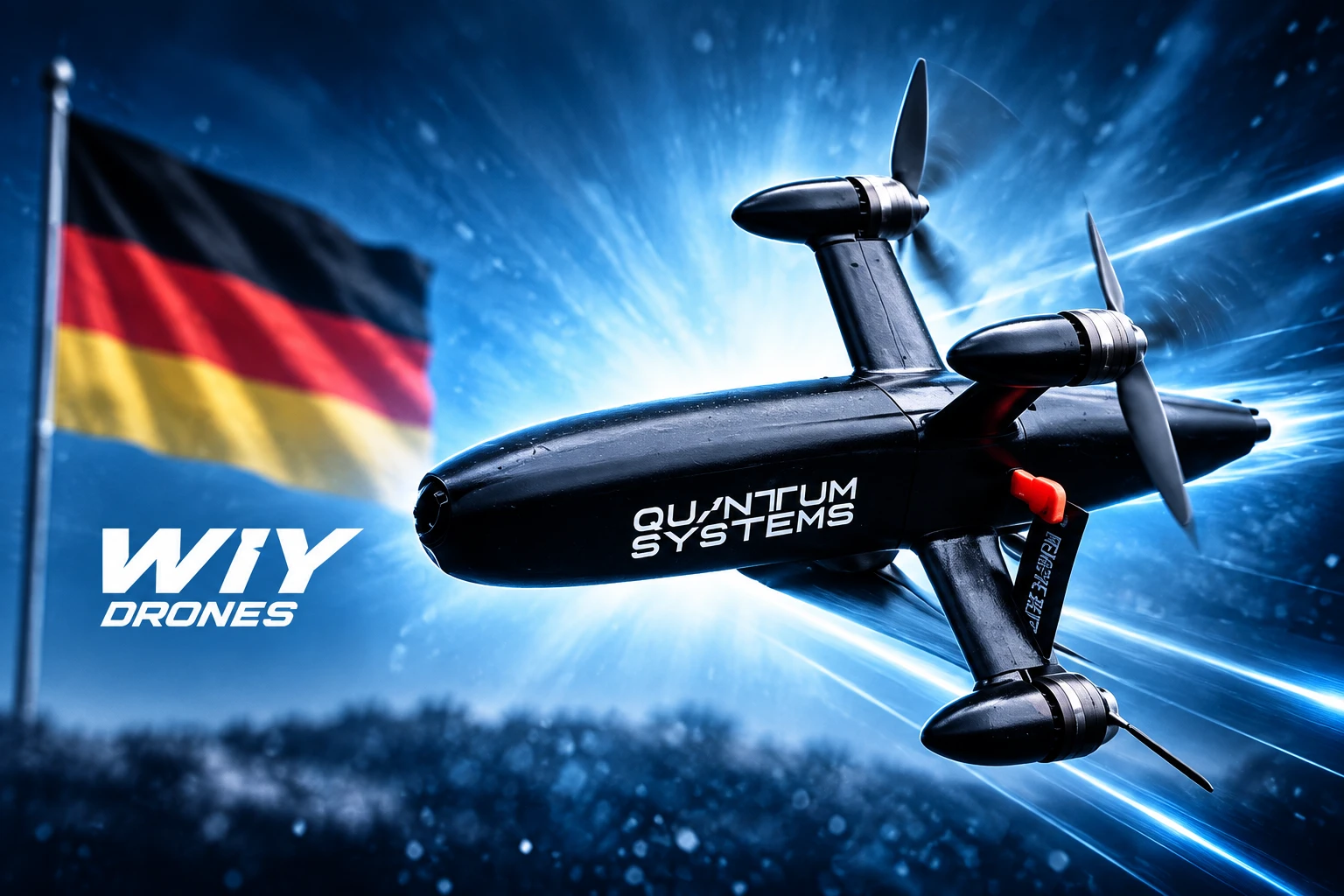
- The builder: Quantum WIY Industries, the joint venture of Quantum Systems and WIY Drones, using designs already in operational use.
- The cash Merz named: About €1 billion in further military support and about €350 million in energy aid, stated as separate lines.
- The software hook: The interceptors plug into Quantum Systems’ MOSAIC UXS mission suite.
WHAT IS UNCONFIRMED
- The headcount: Berlin and the company have not published an exact unit number, only “several tens of thousands.”
- The mix: Officials have not said how much of the new run is STRILA, already in service, and how much is the faster SPYS interceptor that passed a test the same day.
- The calendar: No public delivery schedule inside the winter window has been released.
Sven Kruck, co-chief executive of Quantum Systems, tied the plant location to speed. Building in Ukraine, he said, answers the threat now and creates industrial capacity Germany will want later.
Ukraine needs interceptor drones at industrial scale. By expanding production in Ukraine, we can respond faster to the immediate threat while building an industrial capability that will also strengthen Germany and its allies.
Sven Kruck, Co-CEO, Quantum Systems, Kyiv press release, October 4, 2026
Paul C. Strobel, the company’s spokesperson, said the firm showed Merz its jet-interceptors in Kyiv the same day.
At @quantumdrones we were honoured to show @bundeskanzler our jet-interceptors in Kyiv today and we're proud to support Ukraine with an urgently needed capability.
More media information here: https://t.co/3Ihl6HmUSX pic.twitter.com/mqfMqrltgy
— Paul C. Strobel (@PaulStrobel) October 4, 2026
Jet Gerans Opened a Speed Gap
Propeller Shaheds were slow enough for mobile guns and cheap quadcopter interceptors. Russia’s Geran family, the local build of that Iranian design, now includes jet models that close the same route in a fraction of the time. Ukrainian defence intelligence has put the Geran-4 at about 350 km/h. Newer jet Gerans have been described at up to 600 km/h, a different airframe class, not a rounding of the same aircraft.
That gap is why a jet Shahed can cross Kyiv in about three minutes, and why a European buying cycle that still runs in years is already late when the airframe changes in weeks. The cheap layer of air defence that Ukraine spent three years building was tuned to piston engines. Jet Gerans eat the time between radar track and intercept.
Merz said recent technical breakthroughs would speed serial production of anti-jet interceptors. Quantum Systems said the changing threat, including faster jet-powered attack drones, is why interceptors have to be made and fielded at much greater scale. The winter order is the industrial answer to that speed problem, not a claim that the problem is solved.
THREAT AND INTERCEPTOR SPEEDS
| Aircraft | Role | Published top speed | Status on October 4, 2026 |
|---|---|---|---|
| STRILA | Interceptor for Shahed-class targets | 415 km/h | In operational use; 15,000 ordered in March |
| SPYS | Faster interceptor | WIY has listed 600 km/h | Zelenskyy said it passed its test |
| Geran-4 | Jet attack drone | About 350 km/h | In service |
| Newer jet Gerans | Faster attack drones | Up to 600 km/h | In service in mixed strike packages |
STRILA’s own spec sheet still sits below the fastest jets. That is the hole SPYS is meant to fill, and it is why volume alone on the older airframe will not close the sky.
What STRILA Can Catch at 415 km/h
WIY STRILA is the interceptor Quantum Systems already had in production when Merz arrived. The company presents it as a battlefield-proven counter-UAV built to kill Shahed-136 and Shahed-131 class loitering munitions and reconnaissance drones, and to spare Patriot-class missiles for harder targets. Quantum’s product table lists a maximum speed of 415 km/h, a cruise of 150 to 200 km/h, a 5.7 kg take-off weight, a 700 g payload, a 34 km one-way range, 15 minutes of flight, a 6,000 m ceiling and a 50 m/s climb.
WIY, the Ukrainian partner, sells the same family as a rocket-type air-defence interceptor UAV with a 500 g warhead. Payload and warhead are different figures on the same small airframe. Radar cueing reaches about 10 km. The operator takes the last stretch by hand after the aircraft has been sent toward the track, a design that keeps a person on the trigger in jammed airspace.
HOW STRILA IS MEANT TO FLY
- Launch: eVTOL take-off from the ground, no fixed pad, compact enough for a protected position.
- Cueing: Radar hands the sector to the aircraft; daylight and thermal cameras handle identification.
- Control: Semi-autonomous run-in, then manual terminal intercept, with on-screen bearing, altitude and speed.
- Reuse: If the shot is stood down, the airframe can return, land and recharge inside a 15-minute sortie.
- Jamming: Frequency switching and radio-beacon navigation are built in for GNSS-denied flight.
On March 23, 2026, Quantum Systems said Ukraine’s security and defence forces had tasked it to deliver 15,000 STRILA interceptors to the National Guard, after the firm invested in WIY Drones. That contract is still the only public unit number. The October financing scales “systems already in operational use.” It does not replace the March figure, and it does not yet say how many extra airframes Berlin is buying.
Three Joint Ventures and a Shared Factory Bet
Quantum Systems has treated Ukraine as a second home since 2022 and now employs several hundred people there. Globally it says it has more than 1,700 staff in eight countries. The interceptor order sits inside a three-venture network the company calls Build with Ukraine: Quantum Frontline Industries with Frontline Robotics, Quantum WIY Industries with WIY Drones, and Quantum Tencore Industries with Tencore.
The pattern is the point. Interceptors are made in Ukraine, close to the units that crash-test them. Other Ukrainian designs are built in Germany and sent back east. On June 19, 2026, Quantum Tencore Industries was selected to deliver 2,000 TerMIT unmanned ground vehicles to the Ukrainian armed forces over 12 months, funded by the German defence ministry and assembled in Germany. Quantum Frontline, the first of the three, was set up to run an automated line in Germany whose entire output goes to Ukraine’s defence forces.
THE BUILD WITH UKRAINE CLOCK
- 2022: Quantum Systems puts down a permanent base in Ukraine and starts folding unit feedback into its aircraft.
- March 23, 2026: The firm is tasked to deliver 15,000 STRILA interceptors to the National Guard and invests in WIY Drones.
- April 14, 2026: During German-Ukrainian government talks in Berlin, it announces Quantum WIY Industries and Quantum Tencore Industries beside the existing Frontline venture.
- June 19, 2026: Quantum Tencore wins the 2,000-unit TerMIT ground-vehicle order, with production in Germany.
- July 2, 2026: Quantum Systems closes a $1.2 billion Series D at a valuation of about $8 billion.
- October 4, 2026: Merz announces German financing for several tens of thousands of interceptors made in Ukraine.
The July raise, co-led by Blackstone, Noteus, Airbus and Advent, is what lets a still-private Munich company talk about industrial scale rather than batches. Kruck’s line about capacity for Germany is the same model running in reverse: Ukrainian engineering, German money and plants on both sides of the border.
THE THREE VENTURES
| Venture | Ukrainian partner | What it makes | Where it builds |
|---|---|---|---|
| Quantum WIY Industries | WIY Drones | Interceptor drones, including STRILA | Ukraine |
| Quantum Frontline Industries | Frontline Robotics | Linza multi-use drones | Germany, 100% for Ukraine |
| Quantum Tencore Industries | Tencore | TerMIT ground vehicles, 2,000 on order | Germany |
Paying the Ukrainian line now, then bringing the design home, is faster than waiting for a greenfield German interceptor plant to match a threat that changes by the month. That is already how the ground vehicles are being done. The October interceptor money applies the same logic to the air.
Why the Best Interceptor Still Hits 30 Percent
Volume is the bet because the hit rates are still poor. Zelenskyy, posting from the press conference, said the Bars interceptor had the best results so far among Ukraine’s interceptor drones, with a shoot-down rate of around 30 percent. He said Ukraine would receive 2,000 Bars under joint production with Germany. That 2,000 is a different aircraft and a different contract from Quantum’s tens of thousands and from the 15,000 STRILA already on the books.
“These are long-range drones that are almost missiles,” Zelenskyy wrote. “And right now, they are showing a shoot-down rate of around 30%. But everything is improving. We are grateful to Germany.” He also said a small-missile program would show results in the second half of October, after which production could rise if the tests hold.
On the same visit he said the new Ukrainian interceptor Spys had passed its test. Earlier batches of about 50 SPYS airframes had gone to units for combat evaluation. WIY has listed a 600 km/h top speed for SPYS, a 200 to 250 km/h cruise, a 300 g warhead and a short five-minute flight. Those figures are the manufacturer’s, not Quantum’s STRILA table, and they describe a different interceptor aimed at the jet problem STRILA was not built to own.
A 30 percent score on the current best interceptor is why Berlin is buying in bulk instead of declaring a shield. Even a weak interceptor that costs a small fraction of a surface-to-air missile can still be the only mass layer Ukraine can afford against cheap one-way drones. The winter run has to be large enough that a miss is not the end of the magazine.
Fire Point Joins the Unmanned-Systems Work
At an industry round table with Zelenskyy and Merz, Quantum Systems signed a memorandum of understanding with Fire Point, the Ukrainian firm behind long-range strike drones, to develop unmanned systems and tools against advanced aerial threats. The memo is not the interceptor contract. It parks Quantum, whose recent fame is reconnaissance Vectors and now interceptors, next to a company whose FP-series aircraft have been used on deep strikes.
The rest of the German industrial file that day was conventional air defence. Ukraine signed for thousands of IRIS-T missiles and more launchers with Diehl Defence, and for radar and satellite kit with Hensoldt. Merz said Germany would also supply stand-off weapons, combat drones and satellite equipment so Ukraine could hit Russian launchers, not only the drones after they are airborne.
Zelenskyy put the exchange in labour terms. Germany was not only helping Ukraine, he said; Ukraine was sharing knowledge, experience and orders. “These are jobs for Germany.” Merz said the companies travelling with him were learning from the war, and that German and Ukrainian firms were standing up joint ventures, including on drone defence.
The Same Lines Are Meant for Germany
Merz told Ukrainians you can continue to count on our help, and he said that if Russia is not stopped its war machine will turn on Europe. He also said the partnership is not a one-way street. That second sentence is the industrial content of the interceptor announcement. Berlin is paying for airframes Ukraine will fire this winter, and it is paying to keep the line that makes them.
Quantum Systems now has interceptors in Ukraine, ground robots in Germany, a Frontline plant whose German output is reserved for Kyiv, a software layer meant to cue the lot, and a $1.2 billion cash pile from July. The October order does not publish a unit price, a monthly rate, or a date when the tens of thousands will be in magazines. It does lock in a production geography. The jets Ukraine cannot catch with last year’s interceptors are the same class of weapon European cities have already started to plan against. The factories Merz toured are being scaled as if that planning will need hardware, not only briefings.
Sirens ran while the two leaders talked. The interceptors Germany is buying are meant to meet the next wave over Ukrainian cities, and to leave a line standing when that wave is no longer only Ukraine’s problem.

The Court Revisits the Climate Nuisance Door It Left Open

ChatGPT Now Compiles Live Interfaces With GPT-6

A Tanker Attack Moves the War Into Qatar’s Waters

Personio Buys Circula to Own the DATEV Channel

Bluesky Files for .bsky and Enters the Registry Queue

Musk’s $914 Billion Lead Is a Public SpaceX Bet

Microsoft’s 96% Cyber Score Sits at 86.3% on the Board

Andrew Garfield’s Spider-Man Films Are No Longer Free

Endgame Encore’s $86 Million Trial for Infinity Vision

Free Live Sports Streaming in 2026: What to Watch Without Cable
-
 BUSINESS4 months ago
Musk’s $914 Billion Lead Is a Public SpaceX Bet
-
 NEWS2 months ago
Microsoft’s 96% Cyber Score Sits at 86.3% on the Board
-
 ENTERTAINMENT2 years ago
Andrew Garfield’s Spider-Man Films Are No Longer Free
-
 SPORTS3 months ago
Free Live Sports Streaming in 2026: What to Watch Without Cable
-
 ENTERTAINMENT3 months ago
Endgame Encore’s $86 Million Trial for Infinity Vision
-

 NEWS4 months ago
Singapore’s 3×3 and Surfing Debuts Miss the Medal Stand
-

 ENTERTAINMENT1 month ago
Sterling Point Holds No. 2 on Prime Video After 32 Days
-

 NEWS1 month ago
G20 Cheers AI Investment After Bailey’s Frontier Cyber Warning