
GAMING
Microsoft’s Xbox Hardware Denial Holds as Helix Takes Shape
Microsoft denied Xbox hardware cancellation in 2025. Project Helix is still coming, and the software-first rumor largely arrived anyway.

Microsoft said in October 2025 it was still building first-party Xbox hardware, after a forum leak claimed the future of Xbox was software publishing. A year later the next box has a name, Project Helix, and developer kits are due beginning in 2027.
The cancellation story was always the loud version of a quieter post. Microsoft told the truth about the machines. The leak told the truth about the business that has to pay for them.
The NeoGAF Post That Set Off Xbox
The spark was a NeoGAF poster, SneakersSO, who wrote that “really concrete plans for actual MS Xbox HW went from being definitive, to up in the air.” The post did not say a finished console had been killed in a meeting. It said the steps you take before a new generation were not being met, after folks had been told Microsoft wanted to pull the trigger in 2026.
Then came the line that travelled. “The future of Xbox is software publishing,” the post said, “with a significantly honed-in focus on profitable IPs (CoD, WoW, Minecraft, Candy Crush, Forza Horizon).” Cloud gaming would be “the home of the ‘Xbox platform’.” Game Pass would become “the point of entry subscription for xCloud access,” and the price would keep climbing. Software would ship “on any device that has a marketplace and users willing to buy their titles.”
Readers heard “no more Xbox.” That is the version that needed a statement. The actual claim was narrower and, in hindsight, harder to knock down: the living-room box was no longer the centre of the plan, even if a box still existed on a slide.
Microsoft Answered With Consoles and Devices
On October 5, 2025, Microsoft answered the pile-on with a short note that named hardware twice and named a chip partner once.
We are actively investing in our future first-party consoles and devices designed, engineered and built by Xbox. For more details, the community can revisit our agreement announcement with AMD.
Microsoft statement, October 5, 2025
That wording was doing two jobs. “Consoles and devices” kept a living-room machine on the books without promising that every Xbox-branded gadget would be built in Redmond. Pointing at AMD turned a rumor fight into a procurement fight. You can cancel a vibe. You cannot quietly cancel a silicon roadmap you already asked the public to re-read.
Eleven days later, the ROG Xbox Ally and Ally X went on sale in 45 countries. Those handhelds were developed with ASUS and AMD, run Windows, and put the Xbox overlay on someone else’s chassis. They are “devices” in the everyday sense. They are not the first-party handheld that leakers had sketched as a custom Xbox SoC in Microsoft’s own tooling. The statement and the Ally can both be true, and that is the split the rumor was circling.
$29.99 Game Pass and a Bruising October
The leak landed in a week when Xbox already looked like a subscription company testing how far it could push a price. In October 2025, Game Pass Ultimate rose from $19.99 a month to $29.99, a $120 jump if you paid monthly for a year. PC Game Pass moved from $11.99 to $16.49. Microsoft also pulled the old 10% checkout discount on games and DLC. Ultimate members would get 10% back in Rewards points, Premium members 5%. Ultimate still kept a 20% discount on select games from the Game Pass library.
GAME PASS PRICE MOVES
- October 2025: Ultimate rises from $19.99 to $29.99 a month in the US; PC Game Pass rises from $11.99 to $16.49.
- April 21, 2026: Ultimate falls from $29.99 to $22.99; PC Game Pass falls from $16.49 to $13.99.
- Call of Duty: New titles stop launching on Game Pass the same day, and join about a year later.
- The leftover gap: $22.99 is $7 below the peak and still $3 above the $19.99 price that started the fight.
SneakersSO had said Game Pass would become the door into cloud play and that the tag would keep rising. The October hike matched the second half of that sentence. The April 21, 2026 cut matched the backlash. Microsoft said the lower price “responds to a lot of feedback we’ve gotten so far,” and it used the same note to take future Call of Duty games off day-one Game Pass. The franchise the leak listed as a profit pillar would sell as a box product first, then land in the catalog the following holiday season.
That is a publisher decision wearing a subscription logo. It is also why a hardware-cancellation rumor found oxygen in the same week. If the money is in Call of Duty, Minecraft, and a pass, the $500 machine under the TV starts to look optional even when the company swears it is still designing one.
The AMD Deal Was the Whole Receipt
When Microsoft told people to go back to AMD, it meant a June 19, 2025 Xbox Wire post, not a new chip photo. Xbox said it was building a next-generation lineup across console, handheld, PC, cloud, and accessories, and that it had entered a multi-year partnership with AMD to co-engineer silicon “across a portfolio of devices, including future first-party consoles and cloud.”
Sarah Bond, then president of Xbox, described an Xbox experience “not locked to a single store or tied to one device.” Lisa Su, AMD’s chair and CEO, said the firms were building on two decades of work and that AMD would design a roadmap of gaming chips combining Ryzen and Radeon for consoles, handhelds, PCs, and cloud. That is a supplier speech. It is also a trap for anyone who wanted to read “software only” into the October leak. AMD does not tool a console SoC so Microsoft can publish Candy Crush.
The same weekend, a separate rumor claimed a first-party Xbox handheld died because AMD wanted a 10 million unit buy for a custom chip. Microsoft did not confirm that figure, and a competing leak said it was wrong. Treat it as unproven. What shipped instead is the Ally family, which uses AMD silicon inside an ASUS product. First-party living-room hardware stayed on the AMD slide. Portable hardware went to a partner. That is not a cancelled platform. It is a platform that will not eat a custom-chip minimum it cannot sell.
Project Helix Puts a Name on the Next Xbox
The October statement never named the machine. Xbox’s account did, on March 5, 2026.
The next generation of Xbox console: Project Helix pic.twitter.com/YQUrCgCb9J
— XBOX | Emergence Begins (@XBOX) March 5, 2026
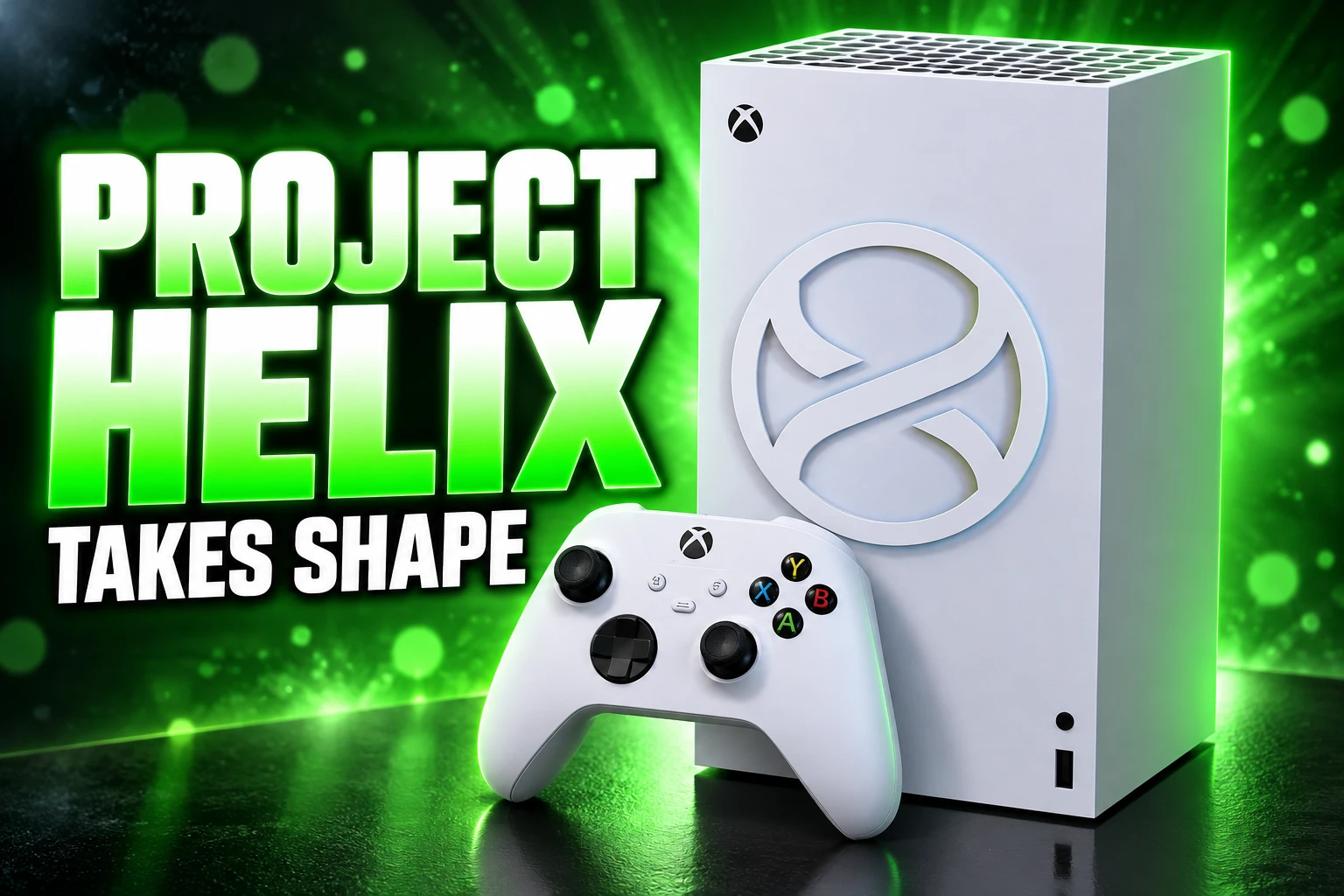
Six days later at GDC, Jason Ronald, Xbox’s VP of next generation, put paper under the name. Project Helix is the next-generation first-party console, built to play Xbox console games and PC games, on a custom AMD SoC co-designed for the next DirectX and FSR. Ronald said it delivers “an order of magnitude leap in ray tracing performance and capability,” and that Xbox plans to ship alpha versions of the hardware to developers beginning in 2027. Four generations of Xbox games stay playable. The Xbox Play Anywhere catalog is more than 1,500 games, with 500 development teams already shipping that way. About 5,000 developers are building for Xbox, he said, in the brand’s 25th year.
CONFIRMED HELIX FACTS
- The name: Project Helix is Microsoft’s next first-party Xbox console, announced in March 2026.
- The chip: A custom AMD SoC, tied to the next DirectX and FSR, not a leftover PC part.
- The kit date: Alpha hardware begins going to developers in 2027, which rules out a 2026 launch.
- The software door: Xbox mode started rolling out to Windows 11 in select markets in April 2026, after an early version on the Ally handhelds.
A kit date is a better denial than a sentence. You can argue with a spokesperson. You argue with a 2027 alpha line only if you think Microsoft will eat the cost of tooling a chip and then shelf it. Unconfirmed spec sheets floating around 56 TFLOPS and giant GDDR7 pools are still rumor; they do not belong next to Ronald’s list. What belongs there is the other cost Microsoft has already put on paper.
On June 25, 2026, Xbox said that from August 1 it would raise current consoles by $100 on 512 GB models and $150 on 1 TB models, and drop the 2 TB SKU. Storage and memory had risen more than 2.5 times, with another doubling expected by fall 2027. “Consoles are typically not sold at a profit, but instead for less than they cost to make,” the company wrote. It pointed players at trade-in programs and certified refurbished units at up to $100 off MSRP. If Series X already loses money in a memory crunch, Helix does not get cheaper while it waits for 2027 kits. Price, not a forum thread, is the live threat to the box Microsoft refused to cancel.
Asha Sharma, who became Xbox CEO in February 2026 after Phil Spencer’s exit and Sarah Bond’s departure, has described Helix as a family of devices rather than one slab. That matches the June 2025 AMD language. It also feeds the worry that a Windows-like Xbox with other storefronts cannot live on the old 30% cut, so the first-party machine has to be a performance flagship or it has no job. Naming Helix settled the “is there a next Xbox” question. It did not settle what that Xbox is for.
Most of the Software Rumor Came True
Hold the October 2025 post next to the following year and the hardware line is the part Microsoft beat. Almost everything else in that post showed up in a press note with a different headline.
THE LEAK VERSUS THE YEAR THAT FOLLOWED
| What the Oct 2025 post said | What Xbox then did |
|---|---|
| Hardware plans “up in the air” | Named Project Helix; alpha kits beginning in 2027 |
| The future is software publishing | Play Anywhere on more than 1,500 games; Xbox mode on Windows; games sold off the living-room box |
| Focus on CoD, Minecraft, and other profit IPs | New Call of Duty games leave day-one Game Pass and join about a year later |
| Cloud as the home of the Xbox platform | From November 2026, Game Pass cloud time is metered |
| Game Pass as the xCloud door, with a higher price | Ultimate hit $29.99, then settled at $22.99 |
| Software on any device with a store | Ally handhelds on Windows; Bond’s “not locked to a single store” line from June 2025 |
On September 3, 2026, Xbox said that beginning in November, Game Pass plans will include a set number of cloud hours: Ultimate 15 hours, Premium 10, Essential 5. Extra time will be for sale in the Xbox Store. Xbox expects the change to hit 4% of subscribers, the heavy streamers. Eligible members still have no monthly cap until then. The same note adds a path to buy cloud hours without Game Pass at all, including a way for Xbox One owners to stream eligible Series X|S games. Cloud is still a door. It is no longer an unlimited door bundled in the pass.
THE YEAR AFTER THE DENIAL
- June 19, 2025: Xbox and AMD announce a multi-year silicon deal for first-party consoles and cloud.
- October 5, 2025: Microsoft says it is still investing in first-party consoles and devices, and points back at that AMD post.
- October 16, 2025: The ROG Xbox Ally family goes on sale in 45 countries.
- March 11, 2026: Ronald details Project Helix at GDC and sets 2027 for alpha kits.
- April 21, 2026: Game Pass Ultimate drops to $22.99; new Call of Duty games leave day-one.
- August 1, 2026: Current Xbox consoles rise $100 or $150, depending on storage.
- November 2026: Game Pass cloud hours become a monthly allotment.
On September 30, 2026, Sharma said “Xbox is not for sale,” after months of talk that Microsoft might spin the unit out. She also said the company would look at “the right partnerships, the right operating model and everything needed” to make Xbox work. That is a CEO protecting a division, not a hardware engineer protecting a SKU. The October 2025 rumor asked whether Microsoft still wanted to stamp its own chips into a box that loses money at retail. Helix is the yes. The year around Helix is the rest of the post, executed in public, while the next Xbox waits for 2027 kits that have not shipped yet.

The Court Revisits the Climate Nuisance Door It Left Open

ChatGPT Now Compiles Live Interfaces With GPT-6

A Tanker Attack Moves the War Into Qatar’s Waters

Personio Buys Circula to Own the DATEV Channel

Bluesky Files for .bsky and Enters the Registry Queue

Microsoft’s 96% Cyber Score Sits at 86.3% on the Board

Musk’s $914 Billion Lead Is a Public SpaceX Bet

Endgame Encore’s $86 Million Trial for Infinity Vision

Free Live Sports Streaming in 2026: What to Watch Without Cable

Andrew Garfield’s Spider-Man Films Are No Longer Free
-
 NEWS3 months ago
Microsoft’s 96% Cyber Score Sits at 86.3% on the Board
-
 BUSINESS5 months ago
Musk’s $914 Billion Lead Is a Public SpaceX Bet
-
 SPORTS3 months ago
Free Live Sports Streaming in 2026: What to Watch Without Cable
-
 ENTERTAINMENT4 months ago
Endgame Encore’s $86 Million Trial for Infinity Vision
-
 ENTERTAINMENT2 years ago
Andrew Garfield’s Spider-Man Films Are No Longer Free
-

 NEWS5 months ago
Singapore’s 3×3 and Surfing Debuts Miss the Medal Stand
-

 ENTERTAINMENT3 months ago
The Odyssey’s IMAX Film Run Hit a 41-Theater Limit
-
 BUSINESS2 years ago
Retail Banking vs Commercial Banking: A Comprehensive Guide