
BUSINESS
A Tanker Attack Moves the War Into Qatar’s Waters
A tanker took multiple projectile hits 51 nautical miles off Qatar, with casualties, shifting Gulf risk from Hormuz into waters used by LNG and crude ships.

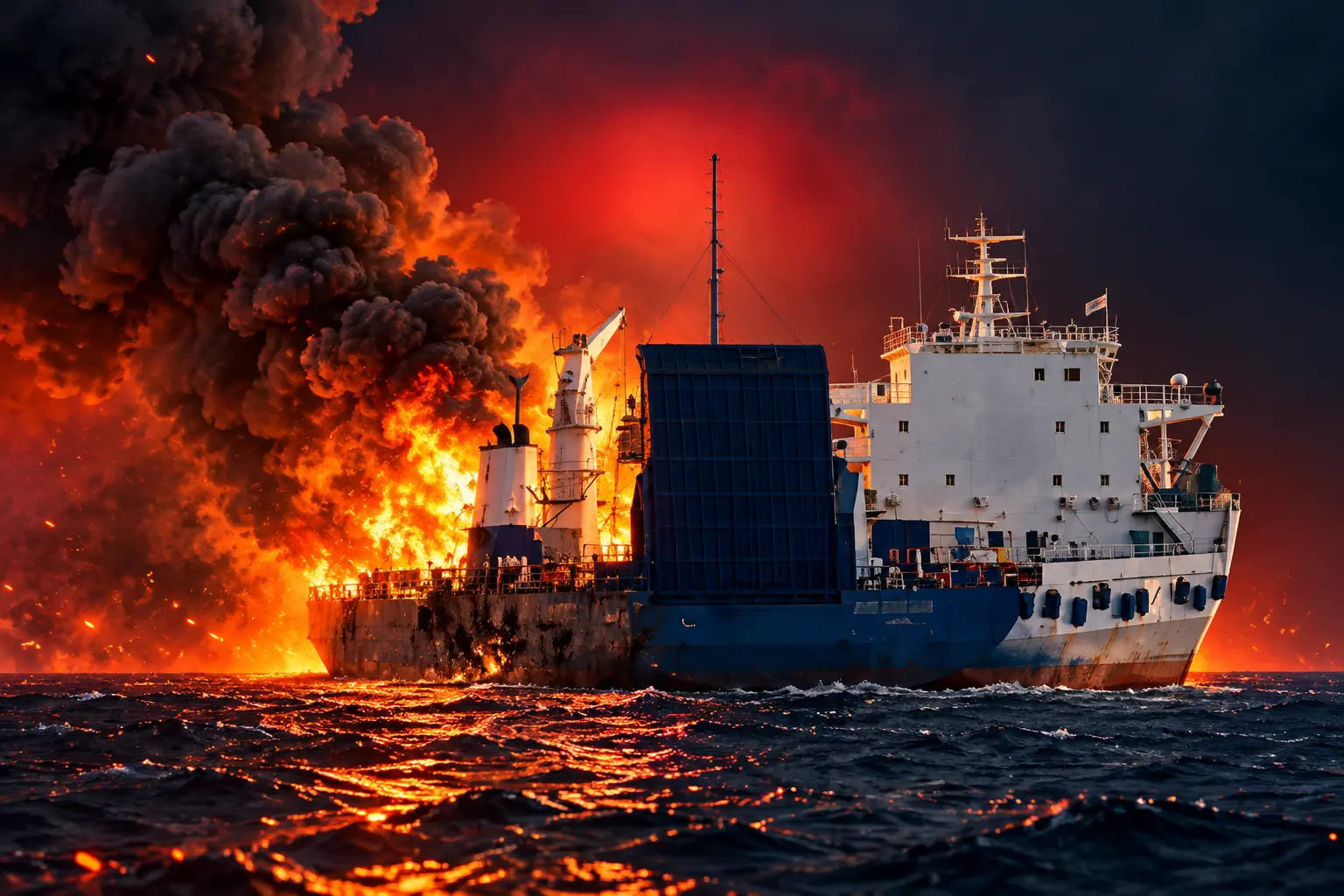
A tanker took multiple projectile hits 51 nautical miles (94 km) north of Qatar at 1900 UTC on October 7, the United Kingdom Maritime Trade Operations said. Casualties were reported. The ship was not named.
The position sits well west of the Strait of Hormuz, in waters the market had treated as the quieter side of the Gulf while crude volumes recovered and Qatar’s gas ships started to show up on trackers again.
Multiple Projectiles Hit an Unnamed Tanker Off Qatar
UKMTO logged the event as a verified attack in verified attack warning 158-26. The master reported the ship “struck by multiple projectiles” about 51 nautical miles north of Madinat ash Shamal, the town on Qatar’s northern coast, about 100 km north of Doha. Authorities are investigating, the centre said, and it told other ships to transit with caution and report anything suspicious.
UKMTO WARNING 158-26
Click here to view the full product⤵️ https://t.co/eljQkk03bG#MaritimeSecurity #MarSec pic.twitter.com/4u3X6rEHaB
— UKMTO Operations Centre (@UK_MTO) October 7, 2026
UKMTO, as it usually does in a first circular, withheld the tanker’s name, flag and cargo. It did not say how many people were killed or hurt, and it did not say who fired. By the morning of October 8 the blanks were still blanks. Qatar had not commented.
WHAT WE KNOW
- The time: The report is timed at 1900 UTC on October 7 and marked source verified.
- The place: 51 nautical miles north of Madinat ash Shamal, inside the Gulf, far from the strait.
- The ship: A tanker, unnamed in the first warning, with casualties reported on board.
WHAT IS UNCONFIRMED
- Identity: Flag, owner, cargo and destination have not been released.
- The toll: UKMTO has not said whether the casualties are injuries, deaths, or both, or how many.
- The shooter: No claim of responsibility sat on the warning, and Doha had not spoken.
An attack in the middle of the Gulf is unusual. Commercial shipping specialists said it was the first reported tanker attack in the western half of the Arabian Gulf in weeks. Most of the recent shooting has been packed into Hormuz, the narrow mouth where Iran and the United States have spent seven months arguing over who still controls the water.
The Strike Landed Hundreds of Miles From Hormuz
The reported position is about 500 kilometres (300 miles) west of the Strait of Hormuz. That is not a near miss on the Omani traffic lane. It is a ship already inside the Gulf, off a Qatari shore, in Qatar’s exclusive economic zone.
Before the United States-Israel war on Iran began on February 28, the strait typically handled about 125 large commercial vessels a day. Shipments through it accounted for about 20 percent of global crude and liquefied natural gas. Iran then choked the passage. Washington kept a blockade on Iranian ports. The fighting that followed trained owners, insurers and navies on that choke point.
American airborne patrols have been concentrated over the southern strait, where a narrow corridor has been defended with mixed results. Cover thins once a ship is west of that mouth, working the approaches to Iraq, Kuwait, Saudi Arabia, Bahrain and Qatar. Wednesday’s hit landed in that thinner belt.
North of Qatar is also where LNG and condensate traffic is densest. A projectile that finds a tanker there does not only raise Hormuz war-risk. It reprices the “safe” inner Gulf that shuttle tankers and gas ships had been using as a holding area while the strait stayed ugly.
WHAT THE LOCATION NOW PRICES IN
- Ras Laffan approaches: Gas ships loading or waiting off Qatar no longer sit outside the recent attack pattern.
- Inner-Gulf shuttles: Crude that loads in Kuwait, Saudi Arabia or Iraq and waits west of Hormuz shares the same water.
- Qatar’s mediator role: Doha has tried to keep talking to both Washington and Tehran while its own EEZ takes a verified hit.
Multiple hits, rather than a single warning round at a strait transit, read as a determined strike on a ship already inside the Gulf. That is the change in the map, even before anyone names the vessel.
Qatar’s LNG Ships Were Only Just Moving Again
Qatar, before the war, accounted for about one-fifth of global LNG. Almost all of that gas has to leave through Hormuz. In August, Kpler’s tracking showed no visible transits by Qatar-linked LNG vessels or by ships carrying cargoes from Ras Laffan. Some may have run dark. The visible fleet had stopped.
That pause started to break in late September. Ship-tracking from Kpler and LSEG showed Qatar-linked gas carriers reappearing outside the strait. GasLog Skagen showed up off Sri Lanka on September 27 with a Ras Laffan cargo after weeks of Gulf shuttle work. Al Shamal, Mesaimeer and Al Ghashamiya also left with Qatari cargoes. Around October 2-3, four more LNG ships carrying Qatari cargoes, including Bu Samra, Al Gattara, Al Sadd and Al Kharsaah, reappeared outside Hormuz.
Those sailings were a thin restart, not a return to the pre-war pace. A Qatari LNG tanker, Al Rekayyat, had already been hit in July near Hormuz, and QatarEnergy-linked ships have used ship-to-ship transfers to move cargo when the strait would not let a damaged hull through. Wednesday’s attack did not have to be an LNG carrier to matter for that restart. It landed on the doorstep of the load port those ships use.
Iranian officials spent the same day talking about Hormuz as if the argument were still only about the choke point. Mohammadreza Naqdi, an adviser to the commander of Iran’s Islamic Revolutionary Guard Corps, said Iran had full control of the strait and that routes it calls unauthorised would soon be closed. U.S. Secretary of State Marco Rubio said Iran had “lost complete control,” pointing to oil flows near pre-war levels. Esmaeil Baghaei, the Iranian foreign ministry spokesman, said Tehran and Oman had agreed coordinates for safe inbound and outbound routes. None of those lines described a tanker 51 nautical miles off Qatar.
Nine Hormuz Attacks This Month, Exports Still High
UKMTO said on Tuesday, October 6, that there had been nine attacks on tankers in the Strait of Hormuz this month, already half of the September total for the waterway and the Gulf combined. That tally is the strait. Wednesday’s ship was not in it.
A separate count from maritime security sources put at least 12 attacks on oil, LNG and LPG tankers around the strait between September 28 and October 5, the highest weekly total since the war began. India’s foreign ministry said on October 6 that the Panama-flagged tanker MT On Peace, hit while transiting Hormuz off Oman, had 12 injured among 19 crew, 17 of them Indian, 11 of those hurt. That was the strait’s human cost two days before the Qatar report.
The barrels had been moving anyway. Kpler’s seven-day moving average of Middle East crude exports reached 18.3 million barrels per day on September 30, against about 18 million bpd in the 12 months before the war. That series is regional crude, including routes that bypass Hormuz. It is not the same number as oil actually crossing the strait.
BARRELS AND HITS, TWO DIFFERENT CLOCKS
| Measure | Figure | When |
|---|---|---|
| Hormuz tanker attacks (UKMTO) | 9 | October through October 6 |
| Oil, LNG and LPG tanker attacks around the strait | At least 12 | September 28 to October 5 |
| Middle East crude exports, 7-day average (Kpler) | 18.3 million bpd | September 30 |
| Middle East crude, 12-month pre-war average (Kpler) | About 18 million bpd | Year to February 28 |
| Hormuz oil clearance, 7-day average (Kpler) | 12,652 kbd | Late September |
| Hormuz oil clearance, pre-war baseline (Kpler) | 17,134 kbd | Pre-February 28 |
| Commodity vessels through Hormuz (Kpler) | 7 | October 7 |
Kpler’s own late-September Hormuz clearance averages sat at 12,652 kbd, about 74 percent of the 17,134 kbd pre-war baseline. In a note dated October 6, the firm said crude crossing the strait had then fallen 27 percent from a wartime high the week before, to at least 10.1 million barrels a day. On October 7 it counted seven commodity vessels through the strait, the lowest since July 23.
So the recovery the oil market celebrated at the end of September was real on a regional-crude basis, incomplete on a Hormuz-clearance basis, and already fading on a daily transit basis when a tanker was hit off Qatar. The new fact is not that ships are being shot at. It is where.
The Vessel, the Flag and the Casualty Count Stay Blank
IMO Secretary-General Arsenio Dominguez told a London meeting in mid-September that the agency had verified 80 attacks on international shipping in and around the Strait of Hormuz since February 28, with at least 22 seafarers dead. “Do not use these conflicts to attack innocent seafarers,” he said. That count is older than this week’s surge and does not include Wednesday’s unnamed tanker. It is the floor the UN shipping body had already put under the war.
UKMTO’s silence on the Qatar ship’s identity is procedure, not mystery for its own sake. First warnings often withhold the name. Owners, flag states and insurers usually fill the gap within a day if the ship can still speak. On October 8 they had not. That delay, on a casualty event, is itself a signal: either the crew is still being accounted for, or the companies involved are not ready to put a hull in the open.
Seafarers have been the consistent loss-makers of this campaign. Indian crews have turned up again and again on the injured lists, as on MT On Peace. Until UKMTO or a flag state names Wednesday’s tanker, there is no way to know whether that pattern repeated 51 nautical miles off Qatar. The warning only said casualties, then stopped.
Kelly Sees a Shift in Target and Intent
Martin Kelly, head of advisory at EOS Risk Group, put the geography in one line after the warning landed.
For the first time since 9 September, Iran has struck a ship in the Gulf, away from the Strait of Hormuz.
Martin Kelly, Head of Advisory, EOS Risk Group
Kelly also said the attack came as Iran had increased the tempo of attacks against shipping since the end of September. UKMTO has not attributed Wednesday’s projectiles. Kelly did. The factual core that does not depend on his attribution is narrower and still sharp: a verified multi-hit on a tanker this far west had not shown up in the warnings for weeks.
If the aim is still to scare traffic off the Omani route through Hormuz, this is a poor fit. A ship 51 nautical miles north of Madinat ash Shamal is not queuing for that lane. If the aim is to show that inner-Gulf loadings, LNG waiting areas and Qatari waters are in play, the fit is better. Owners who had been running shuttle tankers inside the Gulf, transferring cargo in the Gulf of Oman, and parking gas ships off Ras Laffan now have a casualty event on that circuit.
U.S. Central Command, on the same news cycle, kept saying commercial traffic including crude still moved through Hormuz and that Iran had not closed the strait. That argument and Wednesday’s position can both be true. Oil can leave by a mix of dark transits, bypass pipelines and Gulf of Oman loadings while a tanker burns, or lists, or counts its wounded, off Qatar.
Oil Stayed Near $100 as the Map Changed
THE TAPE ON OCTOBER 7
- Brent, December: Settled at $100.20 a barrel, down 0.4 percent, after trading as high as $102.59.
- Hormuz attacks in October: Nine on tankers in the strait as of October 6, per UKMTO, before the Qatar hit.
- Regional crude: 18.3 million bpd seven-day average on September 30, Kpler, above the pre-war 12-month mean.
- One-day transits: Seven commodity vessels through Hormuz on October 7, Kpler, lowest since July 23.
Traders spent October 7 balancing those recovered barrels against the strait attack list. They did it at $100, not at the pre-war $70s, because insurance, extra fuel for longer routes, and the chance of a bad night are still in the price. A hit off Qatar does not show up as a missing million barrels the next morning. It shows up as a wider war-risk circle drawn around Ras Laffan, around the western Gulf shuttles, and around any owner who had been telling a crew the danger stopped at Hormuz.
UKMTO is still investigating. The tanker’s name is still withheld. Qatar still has not spoken. The warning that exists is short, verified, and geographically blunt: multiple projectiles, casualties, 51 nautical miles north of Madinat ash Shamal.

The Court Revisits the Climate Nuisance Door It Left Open

ChatGPT Now Compiles Live Interfaces With GPT-6

A Tanker Attack Moves the War Into Qatar’s Waters

Personio Buys Circula to Own the DATEV Channel

Bluesky Files for .bsky and Enters the Registry Queue

Musk’s $914 Billion Lead Is a Public SpaceX Bet

Microsoft’s 96% Cyber Score Sits at 86.3% on the Board

Endgame Encore’s $86 Million Trial for Infinity Vision

Free Live Sports Streaming in 2026: What to Watch Without Cable

Andrew Garfield’s Spider-Man Films Are No Longer Free
-
 BUSINESS4 months ago
Musk’s $914 Billion Lead Is a Public SpaceX Bet
-
 NEWS2 months ago
Microsoft’s 96% Cyber Score Sits at 86.3% on the Board
-
 SPORTS3 months ago
Free Live Sports Streaming in 2026: What to Watch Without Cable
-
 ENTERTAINMENT3 months ago
Endgame Encore’s $86 Million Trial for Infinity Vision
-
 ENTERTAINMENT2 years ago
Andrew Garfield’s Spider-Man Films Are No Longer Free
-

 NEWS4 months ago
Singapore’s 3×3 and Surfing Debuts Miss the Medal Stand
-

 NEWS1 month ago
G20 Cheers AI Investment After Bailey’s Frontier Cyber Warning
-

 ENTERTAINMENT1 month ago
Sterling Point Holds No. 2 on Prime Video After 32 Days