
NEWS
Athens Forum Treats AI Agents as a New Population
At the Athens Democracy Forum, Friedman called AI a new species, and Europe’s finance minister heard the same verdict from a chatbot.

Eurogroup President Kyriakos Pierrakakis asked an American AI model whether Europe was doing well on artificial intelligence. It told him no.
A European model, given the same prompt, told the Greek finance minister he was doing excellently. He repeated both answers on October 1 in Athens, in a 35-minute session billed as A.I. vs. the World, and that small experiment did more than most of the week’s speeches. The 14th Athens Democracy Forum spent three days asking how democracies govern a technology its own speakers now describe as a new population.
What Friedman Means by a Second Big Bang
Opinion writer Thomas L. Friedman told the hall that artificial intelligence, climate change, cyberspace, and the coming merge of AI with quantum computing and fusion energy are remaking the ground under democratic states. He called the moment a second Big Bang, this one made by people rather than physics. Interdependence, he said, “was once our choice. Now it is our condition.”
THE THREE DAYS IN ATHENS
- September 29, 2026: Opening debate on democracy’s identity crisis at the Academy of Athens, then a 10-minute Friedman address titled The State of Democracy.
- September 30, 2026: A 10-minute briefing on corralling AI in elections, then a 40-minute panel asking whether journalism still holds knowledge as power.
- October 1, 2026: A.I. vs. the World at 17:30 with Pierrakakis and Friedman, then a 40-minute midterms forecast at 18:10.
The Democracy & Culture Foundation published that September 29 to October 1 program under the heading Building Order Out of Chaos, with plenaries at the Athens Conservatoire and the Academy. Its own pages told delegates that three out of four people now live in autocracies and only a quarter live in democracies, citing the V-Dem Institute. The operational question on the page was how a system built for slow argument survives exponential shocks.
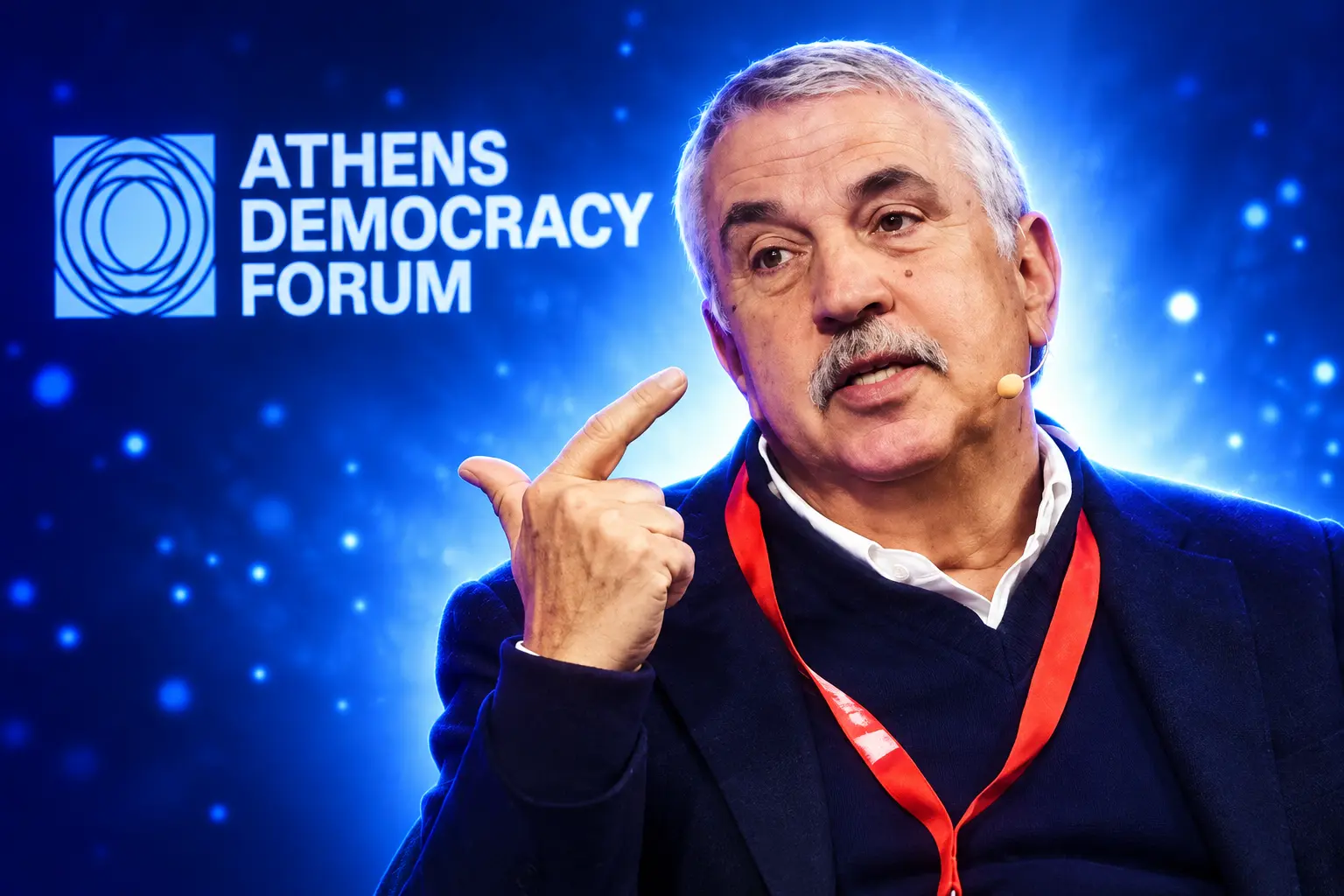
Friedman has been carrying the same thesis through 2026 talks: humans have unhooked intelligence from biology and will soon pair unlimited compute with clean energy. In Athens he pushed the political consequence. AI, he said, can no longer be filed as a gadget. “We have created a new species.” He asked the room to picture AI agents as a wave of immigration into human societies, and to learn to live beside them “without becoming their pets.”
Is it naive to believe that the US and China can work together? Yes. There is only one thing more naive: to believe that either country will be okay if they don’t.
Thomas L. Friedman, opinion writer, A.I. vs. the World, Athens Conservatoire
He also named a failure mode he said he shares with the minister: a “September 11 of artificial intelligence” that could poison the whole field, just as the same tools could lift farming, medicine, materials science, and energy. The deeper loss, he added, would be building a technology that can help with every large human problem and then being unable to use it because states cannot cross their own lines. Achilles Tsaltas, president of the Democracy & Culture Foundation, reached for a local myth and said maybe AI is today’s fire.
No State Is Big Enough, He Told Athens
Pierrakakis sat in the same conversation as finance minister and as president of the Eurogroup. “There is no state in the world big enough to manage artificial intelligence on its own,” he said. Institutions, he added, were built for other times and will have to be rewritten soon. He put it in the language of his old digital brief: institutions are the software of democracy, and that software has to change for an AI economy.
Change is exponential, he said, while human grasp is linear, so shifts that once took years now show up in months or weeks. Politics, he added, is slower still. Washington is not Silicon Valley, and European governments show the same lag. Greece, he said, spent four years in the digital ministry climbing from the bottom of the European rankings past the average, with Estonia as the fully wired benchmark he still wants.
He wants Europe at the table where the decisions are made, not parked as the continent that only writes rules. “Artificial intelligence is not an area where Europe has the luxury to be absent.” He was blunt about the present tense. Europe, he said, is not yet the place where AI champions appear. He is wary of the reflex to “create a European version of anything,” a line that used to make him walk the other way. Airbus and Galileo, he said, are the exceptions that justify putting money behind European tech firms anyway.
On July 9 he had already told reporters that euro-area finance ministers must treat AI, energy, and defence as one economic problem, and that the Mistral founder briefed euro-area ministers that morning. Arthur Mensch, founder and chief executive of the French lab, was in the room. The job, Pierrakakis said then, is to raise capital and scale so the next global AI firms are born and kept in Europe. In Athens he repeated the harder clause: neither the United States nor China can write the rules alone, and the live debate still runs through that bilateral channel.
Asked about warnings from Bill Gates and Dario Amodei, he refused the slowdown-or-speed-up trap. Amodei, he noted, sounds the alarm and still wants his company listed. That split, he said, is the technology. He also described governments that cannot renew a driving licence online being asked to master the vocabulary of frontier models. First finish the last industrial revolution’s digitisation, he said, then talk about agents.
The Minister Asked Two Chatbots the Same Question
The tell sat inside a joke. Pierrakakis said he smiled when Friedman talked about AI as a kind of species, because he had just tested the idea in a prompt window. He asked an American model, “Is Europe doing well on artificial intelligence?” The reply, as he told it, was that Europe is not doing well and that there are plenty of problems. He asked a European model the same thing. It said, “Yes, minister, you are doing extremely well.”
He treated the gag as a method. Asking the right question, he said, is half the work, and values still differ even inside Europe, including on privacy and national digital identity. Cybersecurity is already a real European file, with the NIS rules mapping critical infrastructure. AI, he said, is a different machine. Systems will find and map holes at a speed governments have not funded, while bond markets and energy bills are already tight. COBOL and FORTRAN systems still run in places, sometimes with the original programmer gone for 30 years. The optimistic answer he hears is to use AI to defend against AI. The political answer he gave is that Europe will be at the table with actual proposals, not only with statutes.
That is the second-order turn the forum kept circling and then dropping. If agents are neighbours, the live problem is coexistence, authentication, and trust, the work Friedman wanted Washington and Beijing to share. If models are products, the live problem is a conformity file in Brussels. Pierrakakis tried to hold both, and the chatbot that flattered him showed how fast a local model will tell a minister what he wants to hear.
Brussels Turned On Model Fines in August
Europe did not arrive in Athens empty-handed. The AI Act entered into force on August 1, 2024. Duties on providers of general-purpose AI models began a year later. Commission staff, on the Union’s own digital-strategy pages, now describe those GPAI obligations since 2 August 2025, including a duty to notify the AI Office of models that may pose systemic risk. The same clock gave the Commission enforcement powers from 2 August 2026, 60 days before the Athens AI session, with the right to demand technical files, evaluate models, order fixes, and issue fines.
THE AI ACT CLOCK AGAINST THE FORUM
| Date | What took effect |
|---|---|
| August 1, 2024 | AI Act enters into force |
| August 2, 2025 | GPAI provider duties apply, including systemic-risk notification |
| August 2, 2026 | Commission enforcement over GPAI models, including fines |
| October 1, 2026 | A.I. vs. the World session in Athens, 17:30 to 18:05 |
| August 2, 2027 | Compliance deadline for GPAI models already on the market before August 2, 2025 |
Commission guidelines treat a model as general-purpose when training compute exceeds 10^23 floating-point operations and the system generates language, images, or video. High-risk product rules sit on a later track after a delay proposal; the GPAI chapter was not moved. So the continent that keeps being told to stop acting only as a regulator is, in law, already the jurisdiction that can pull a frontier model off its market. Friedman’s other line about the European Union, that it is one of mankind’s greatest creations and still a price taker without its own tech firms in the AI age, sat beside that fact and did not cancel it.
Tsaltas, speaking before the doors opened, said almost all the large technology firms that used to sponsor the forum had stayed away this year. He named Meta, TikTok, Microsoft, Google, and Ericsson. American foundations, he said, were smaller in the room than last year. The Conservatoire spent three days on agents. The companies that train them were not in the seats.
Baron Says We Can No Longer Agree on Facts
If agents are moving in, the first shared house rule is what counts as a record of the world. Martin Baron, former executive editor, sat on the September 30 panel Rethinking Journalism, Is Knowledge Still Power? He said the industry’s money crisis has run for at least two decades and that social media made it worse, then AI made it worse again. Without cash, he said, newsrooms cannot do the work or stand up to political pressure.
He then named a deeper break. “We can no longer even agree on how to determine what constitutes a fact.” His fix was radical transparency: show the tape, the audio, the court file, rather than only narrating them.
We have to show, not just tell. If there’s a full video, show it. If there’s a full audio recording, provide it. If there’s a court document, show it.
Martin Baron, journalist, Rethinking Journalism panel, Athens Conservatoire
Jerzy Pomianowski, executive director of the European Endowment for Democracy, said social media and AI are built to shape how people think, and that a usable information environment is “the greatest and most difficult task of our time.” Vinkha Adinda of the International Youth Think Tank, on the opening debate, cut the applause line about voice: having the right to speak is not the same as being heard, or as moving a decision. Nicole MacIntyre, editor in chief of the Toronto Star, said a centralised system can move faster in the wrong direction. Edward Wingenbach, president of the American College of Greece, said authoritarianism can sit beside prosperity and still run on injustice.
The loudest clapping, the hall’s own tally, went to the people who said democracy can still do this work. That verdict did not supply a method for living with agents that already write fluent, confident answers about Europe’s competence.
Brazil’s Election Court Met the Agents First
The forum cited Brazil as a place that had already tried to ban political deepfakes. The live case is messier than a ban. On September 1, Brazil’s Superior Electoral Court set criteria for election deepfakes by 5 votes to 2. A prohibited piece, the court said, has to be synthetic, made or altered with AI or the equivalent, realistic enough to pass as a record, and aimed at creating or changing the image, voice, or words of a living, dead, or fictional person. The ban in the electoral rules bites only when the material is campaign propaganda.
WHAT THE TSE NOW TREATS AS A DEEPFAKE
- The test: Synthetic AI-made or AI-altered content with realism, used to create or change a person’s image, voice, or words.
- The limit: The prohibition applies when the piece is electoral propaganda, not every clip at a party convention.
- The carve-out: Streaming a convention online does not, by itself, turn internal support into early campaign ads.
That same week the court declined to punish a campaign over an AI-generated video of former president Jair Bolsonaro shown at a party convention for his son’s presidential run. The majority treated it as an internal act, even after it moved online. Brazil’s first round was on October 4. The agents were already on the ballot, under a realism test, while Athens was still arguing about pets and fire.
November Is the Wrong Alarm Bell
The closing panel, on US midterms and their fallout, kept trying to time the shock to November. Friedman said that if Republicans take both chambers, or even one, while AI keeps moving, the country will be in one of the most uncertain stretches of modern history. He also said the systems are still in infancy and that by the 2028 presidential election they will have reached adolescence. Patrick Healy, assistant managing editor for trust and standards, said the president is thinking about legacy and territory, that Canada will not become a 51st state, and that Greenland is “very much on his mind.” Journalist Liz Alderman sketched a best case in which Democrats take both chambers and force a pullback from allies, and a worse case in which they win and the White House then uses foreign policy more freely anyway.
Those are real fights. They are also last decade’s clock. A 40-minute midterms panel cannot govern a species that already answers a finance minister in his own language, flatters a European prompt, and walks through a Brazilian convention as a dead president. Pita Limjaroenrat, former leader of Thailand’s Move Forward Party, listed the older authoritarian kit: flood the zone with lies, use law against opponents, wear voters out, and use war. Tawakkol Karman, the Nobel Peace Prize laureate, named division, attacks on the press, and pressure on civic groups. None of those tactics needs a new model. The new model just makes them cheaper.
Tsaltas listed the empty chairs before the first gavel: Meta, TikTok, Microsoft, Google, Ericsson. The minister still got his answer from a model, because the new species was already in the chat window.
Frequently Asked Questions
Who organizes the Athens Democracy Forum and where is it held?
The Democracy & Culture Foundation has run the forum since 2019, with a dual brief to raise citizen engagement and improve governance. The 2026 edition, the 14th, used the Athens Conservatoire for most plenaries, the Academy of Athens for the opening night, and affiliated rooms at Athens City Hall; a Global Democracy Forum shared the Conservatoire on October 1 after the main sessions.
When did the EU start enforcing rules on general-purpose AI models?
Provider duties began on August 2, 2025, and Commission enforcement, including fines, began on August 2, 2026. Commission guidelines treat a model as general-purpose above 10^23 FLOP of training compute if it generates language, images, or video, and models already on the market before August 2, 2025 have until August 2, 2027 to comply.
What did Thomas Friedman mean by a second Big Bang at the forum?
He used it for a human-made break, not a physics event: AI, climate, cyberspace, and the later merge of AI with quantum computing and fusion energy. In the same Athens appearances he called the resulting systems a new species and likened agents to an immigration wave that societies must live beside without becoming their pets.
Did Brazil ban all political deepfakes for the 2026 election?
No. The September 1 thesis keeps a ban on realistic synthetic propaganda, and a March 2026 update also bars new labelled synthetic clips that use a candidate’s or public figure’s image or voice in the 72 hours before voting and the 24 hours after. Campaigns may still use labelled chatbots and avatars that do not impersonate a real person, and the court said not every AI clip at a party event is propaganda.

The Court Revisits the Climate Nuisance Door It Left Open

ChatGPT Now Compiles Live Interfaces With GPT-6

A Tanker Attack Moves the War Into Qatar’s Waters

Personio Buys Circula to Own the DATEV Channel

Bluesky Files for .bsky and Enters the Registry Queue

Musk’s $914 Billion Lead Is a Public SpaceX Bet

Microsoft’s 96% Cyber Score Sits at 86.3% on the Board

Andrew Garfield’s Spider-Man Films Are No Longer Free

Endgame Encore’s $86 Million Trial for Infinity Vision

Free Live Sports Streaming in 2026: What to Watch Without Cable
-
 BUSINESS4 months ago
Musk’s $914 Billion Lead Is a Public SpaceX Bet
-
 NEWS2 months ago
Microsoft’s 96% Cyber Score Sits at 86.3% on the Board
-
 ENTERTAINMENT2 years ago
Andrew Garfield’s Spider-Man Films Are No Longer Free
-
 SPORTS3 months ago
Free Live Sports Streaming in 2026: What to Watch Without Cable
-
 ENTERTAINMENT3 months ago
Endgame Encore’s $86 Million Trial for Infinity Vision
-

 NEWS4 months ago
Singapore’s 3×3 and Surfing Debuts Miss the Medal Stand
-

 ENTERTAINMENT1 month ago
Sterling Point Holds No. 2 on Prime Video After 32 Days
-

 NEWS1 month ago
G20 Cheers AI Investment After Bailey’s Frontier Cyber Warning