
NEWS
Blyth Hoard Moulds Tie Two Borders Caches Together
Clay moulds in the Blyth Hoard, seven miles from the Peebles cache, may have shaped its fittings, and a copper ingot can now be tested for origin.

Clay moulds in the Blyth Hoard, found seven miles from the Peebles cache, may have shaped fittings in that earlier Bronze Age deposit. A complete copper ingot, described as the first of its kind in Scotland, is now in Edinburgh for tests that could source the metal in both hoards.
Mariusz Stepien, a metal detectorist from Loanhead, found the Blyth material in 2022 and reported it at once. National Museums Scotland has now moved the objects to the National Museums Collection Centre for conservation and analysis, and the public case for the find was set out on 6 October 2026.
Clay Moulds Sit Seven Miles From the Harness
The wire copy treats this as a second lucky ping in the Scottish Borders. The clay is the part that changes the map. Specialists say the moulds may have been used to make some of the unusual bronze fittings in the Peebles Hoard, which Stepien found in 2020.
Dr Matthew Knight, Senior Curator of Prehistory at National Museums Scotland, put the scientific case in plain terms. The objects did not look like much in the ground. The survival of mould material, and the short gap between the two deposits, is what makes the cache count.
This is one of those classic archaeological finds that initially doesn’t look like much, but is actually really incredible and has many stories to tell. It’s really rare for mould materials to survive at all, so it’s a special find in its own right, but the proximity and relationship to the Peebles Hoard makes it all the more extraordinary.
Dr Matthew Knight, Senior Curator of Prehistory, National Museums Scotland
Seven miles is a walk, not a trade route. If the moulds and the Peebles fittings belong to the same craft tradition, the Borders hold both the workshop debris and the finished display kit from the same metal world. Knight also thanked Stepien for calling the Treasure Trove Unit at once, as he had done in 2020, so the cairn and the objects could be dug as a site rather than as a bag of loose metal.
Stepien said he already knew the ground was archaeologically rich, and that he had no idea, at the first signal, how far the second find might reach. “Having previously discovered the Peebles Hoard, it is quite extraordinary to think that two discoveries I made so close to one another could be connected,” he said.
The Ingot That Can Fingerprint Both Hoards
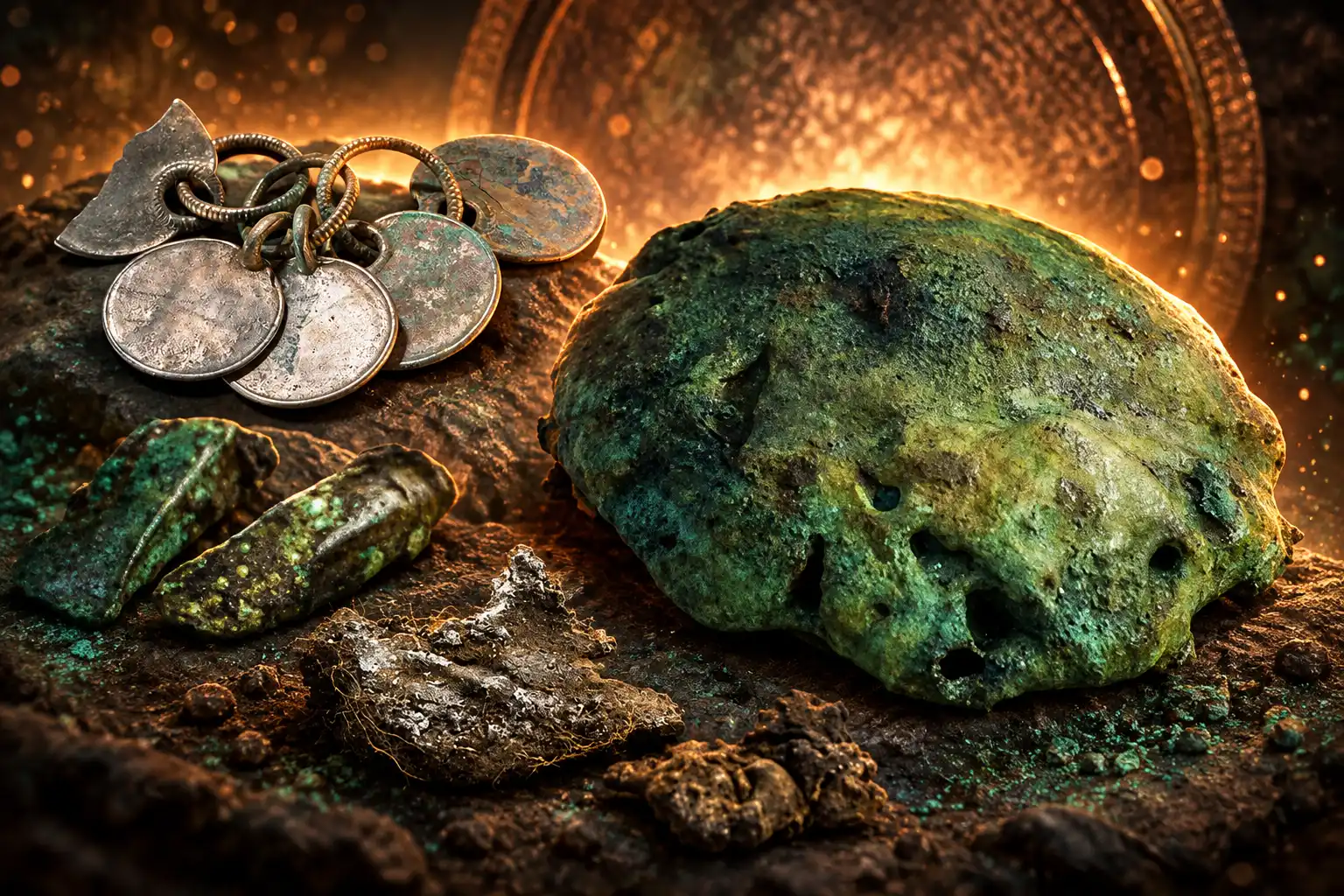
Axes are common in Late Bronze Age pits. A complete copper ingot is not. The 2026 release calls it the first of its kind found in Scotland, and it is the sample Knight’s team can actually test. Analysis of that lump, they hope, will point to the geographical source of the metals in the bronze objects from both hoards.
THE BLYTH CACHE
- Date range: Late Bronze Age, circa 1150 to 800 BC.
- Distance: seven miles from the Peebles Hoard site.
- Metal: two bronze axe-heads plus a complete copper ingot.
- Craft debris: clay moulds, with an ancient stone cairn around the deposit.
Bronze is copper plus tin. An unalloyed ingot is raw stock, not a finished tool, which is why the lab wants it. If the copper in the ingot matches the copper in the Peebles fittings, the two pits stop looking like separate accidents. They start looking like one supply line with two kinds of burial.
Stepien’s 2022 account of the dig already flagged how odd the second axe was. Close to the ingot, he said, decorative clay moulds and a second socketed axe-head sat in the ground, the axe embedded in clay and possibly never used. That is workshop language. It is also why the 2026 announcement spent more time on moulds and metal than on treasure glow.
The Peebles Horse Still Gleams With Tin
The first find is the reason anyone is watching the second. On 21 June 2020, Stepien was detecting near Peebles when he hit a bronze object about half a metre down. He stopped, camped on the field with friends, and waited. Archaeologists then spent 22 days on the site, and later lifted the deposit as a single earth block so leather, wood and cord could be saved with the metal.
Laboratory excavation at the collection centre took five weeks and produced more than 500 bronze pieces and organic parts. Among them are a complete sword still in a wooden scabbard, bronze buttons still looped on cords, and decorated straps that have stayed mostly in order after 3,000 years in the ground. The museum also recovered two rattle pendants, the first found in Scotland, of a type better known from Denmark, northern Germany and northern Poland. Two others from Britain came from Parc y Meirch in north Wales.
CT scans at the University of Southampton showed that some Peebles objects were made by lost-wax casting in Scotland, a rare method in Bronze Age Britain and among the earliest evidence of that technique north of the border. Conservation work that began in 2025 then stripped dirt and green patina from the surfaces. Instead of the usual golden bronze, many fittings came up silver-coloured. X-ray fluorescence found high tin at the surface, which Knight’s team reads as a deliberate enrichment, not silver, in a period when silver was not in use.
In a world of bronze, the horse would have flashed pale as it moved. The rattle pendants would have sounded. Blyth’s moulds now sit on the other side of that performance: the place where such fittings could have been made, a short way across the same hills.
THE TWO HOARDS
| Detail | Blyth Hoard | Peebles Hoard |
|---|---|---|
| Found | 2022 | 21 June 2020 |
| Object date | circa 1150 to 800 BC | 1000-800 BCE |
| Headline contents | Two axe-heads, clay moulds, copper ingot, cairn | Horse harness, sword in scabbard, rattle pendants, organic straps |
| Where it sits now | Collection Centre, analysis underway | Allocated May 2024; conservation 2025 to 2028 |
The date ranges overlap in the later centuries. They do not have to be the same funeral. They do have to be read together, because the mould question only exists if both assemblages stay in one research programme.
A 2022 Cairn Reaches the Edinburgh Lab
Blyth was not a secret in the detecting community. Stepien spoke about the excavation in 2022, including the unrecorded cairn and the ingot. What changed in 2026 is the museum framing: the moulds as a possible match for Peebles fittings, and the ingot as a sourcing sample for both.
That lag matches the Peebles timetable. The 2020 block was scanned, then picked apart, then passed to the museum in May 2024 after nearly four years of work. The newsroom note followed on 24 October 2024. Cleaning that can expose a tin-rich skin was never going to be a weekend job, and Knight has already said Peebles conservation is due to run three years, from 2025 to 2028. Blyth has now joined the same benches.
THE BORDERS TIMELINE
- 21 June 2020: Stepien finds unusual bronze near Peebles and reports it to the Treasure Trove Unit.
- June to July 2020: Field team spends 22 days on the site, then lifts the deposit as a block.
- 2022: Stepien finds the Blyth material seven miles away, including an ingot and moulds in a previously unrecorded cairn, and reports it again.
- May 2024: The Peebles Hoard is allocated to National Museums Scotland.
- 2025: Conservators begin cleaning Peebles metal and find tin-rich silver-coloured surfaces.
- 6 October 2026: The Blyth Hoard is presented as a related Late Bronze Age deposit now in the Edinburgh lab.
The scientific questions are still open. That is the point of moving the objects now, not a delay to be waved away.
WHAT WE KNOW
- The finder: Stepien reported both hoards instead of emptying the pits himself.
- The distance: Blyth lies seven miles from the Peebles site.
- The lab: Both assemblages are under National Museums Scotland care in Edinburgh.
WHAT IS UNCONFIRMED
- The mould match: Specialists say the clay may have made Peebles fittings; that is not yet a published proof.
- The metal source: Ingot tests have been promised, not reported.
- The Blyth allocation: The cache is in the lab; a museum destination has not been announced in the 2026 release.
Until those three points move, Blyth is a working assemblage, not a closed exhibit.
Finders Do Not Own What They Uncover
The science here is downstream of a legal habit. In Scotland, archaeological finds do not belong to the detectorist or the landowner. The 2026 Treasure Trove Code of Practice, issued for the King’s and Lord Treasurer’s Remembrancer, John Logue, states that such objects are ownerless property claimed by the Crown. Finders have a legal duty to report them. The Treasure Trove Unit, based at the museum, records and assesses the material. Significant pieces can then be claimed and offered to museums, with an ex gratia payment to the finder on advice from the Scottish Archaeological Finds Allocation Panel.
WHAT THE CODE REQUIRES
- Report everything: The duty covers more than gold and silver. Pottery, stone, base metal and organics sit in the same net.
- Leave the site: In-situ hoards are excavated by specialists, which is how Peebles kept its leather and wood.
- Crown first: Ownership does not pass through the finder on the way to a museum.
- Payment later: An ex gratia sum can follow if the Crown claims the find.
For Peebles, that sum was £80,000, set through the allocation panel when the hoard went to National Museums Scotland. Blyth has not been given a public figure. The 2026 notice only says the objects are in Edinburgh for conservation and analysis.
The restraint is why anyone can talk about moulds at all. A detectorist who bagged the axe-heads and walked off would have left the cairn unrecorded and the clay smashed. The same choice in 2020 is why a sword still sits in wood, and why buttons still sit on cord. Threads that followed the 2024 Peebles reveal kept circling that point: the objects look almost new because they were lifted as a block, not because the ground is kind. Blyth now depends on the same discipline.
Where the Copper May Have Been Mined
Knight’s hope for the ingot is not a metaphor. Bronze Age specialists already have a working map of metal, and Scotland sits on the receiving end of it for much of the period. The Scottish Archaeological Research Framework notes that early copper in the north is tied to Irish sources, with tin for bronze almost certainly coming from south-west England, most probably Cornwall. It also records that copper ingots from Burreldales and Fyvie were already known, which is why the 2026 “first of its kind” line is best read as a complete ingot of this form, not as the first copper lump ever logged in Scotland.
Tin is the clearer traveller. Work published in Antiquity in 2025 used trace elements plus lead and tin isotopes to argue that tin from Cornwall and Devon reached the eastern Mediterranean, more than 4,000 km from the farms that mined it, and that bronze typically carries about 10 per cent tin. That study is about the second millennium BC tin trade, not about Blyth in particular. It still explains why an unalloyed copper ingot in the Borders is worth a lab slot. If the copper can be fingerprinted, and if the tin in the Peebles surfaces can be compared, the two hoards become a local chapter of a much longer metal road.
Clay moulds rarely survive. When they do, they are usually fragments from settlements, not a set buried with an ingot and unused-looking tools inside a cairn. Portable moulds elsewhere in Scotland have been read as a sign that smiths moved. Blyth may be the opposite picture: stock and moulds put into a monument, close to a separate pit that held a dressed horse and a sword.
An Unused Axe Stayed in the Clay
Stepien has said he located the Blyth objects after seeing a possible round building on the ground, then following a strong detector signal and lifting stones one by one. Archaeologists later called the structure a previously unrecorded cairn. The first identified object, in his 2022 account, was the ingot. The unused-looking socketed axe, still in clay, sat nearby with the decorative moulds.
That is a different kind of burial from Peebles. Peebles is harness, sound, a sword laid in last, organics packed so tight they lasted. Blyth is stock, tools, and the gear of making. The seven miles between them is now the shortest research problem in Scottish Late Bronze Age metalwork, because the people who put an unused axe in clay and the people who put a rattling horse in a pit may have been drawing on the same furnace.
Stepien said he wants to see what further work shows about both hoards, and about the people behind them. The ingot, the moulds and the silvery fittings are in the same city. The next facts will come off a bench, not out of a field.

The Court Revisits the Climate Nuisance Door It Left Open

ChatGPT Now Compiles Live Interfaces With GPT-6

A Tanker Attack Moves the War Into Qatar’s Waters

Personio Buys Circula to Own the DATEV Channel

Bluesky Files for .bsky and Enters the Registry Queue

Musk’s $914 Billion Lead Is a Public SpaceX Bet

Microsoft’s 96% Cyber Score Sits at 86.3% on the Board

Free Live Sports Streaming in 2026: What to Watch Without Cable

Andrew Garfield’s Spider-Man Films Are No Longer Free

Endgame Encore’s $86 Million Trial for Infinity Vision
-
 BUSINESS4 months ago
Musk’s $914 Billion Lead Is a Public SpaceX Bet
-
 NEWS2 months ago
Microsoft’s 96% Cyber Score Sits at 86.3% on the Board
-
 SPORTS3 months ago
Free Live Sports Streaming in 2026: What to Watch Without Cable
-
 ENTERTAINMENT2 years ago
Andrew Garfield’s Spider-Man Films Are No Longer Free
-
 ENTERTAINMENT3 months ago
Endgame Encore’s $86 Million Trial for Infinity Vision
-

 NEWS4 months ago
Singapore’s 3×3 and Surfing Debuts Miss the Medal Stand
-

 NEWS1 month ago
G20 Cheers AI Investment After Bailey’s Frontier Cyber Warning
-

 NEWS4 weeks ago
An AI Lung Drug Shifted Biological Age Clocks in Patients