
BUSINESS
The Court Revisits the Climate Nuisance Door It Left Open
Fifteen years after shutting federal climate nuisance claims, the Supreme Court heard Boulder’s state-law suit against Suncor and ExxonMobil.

The Supreme Court opened its 2026 term on October 5, 2026 with Suncor Energy (U.S.A.) Inc. v. County Commissioners of Boulder County. At issue is whether federal law bars Colorado tort claims that ask two oil producers to pay for local climate damage.
The docket number is 25-170. With Justice Samuel Alito recused, eight justices heard the first argument of the term, and a 4-4 split would leave Colorado’s ruling in place without a national rule.
The Same Fight Came Back as State Tort
In 2011 the Court already shut one version of this case. States, New York City, and land trusts had sued power companies under the federal common law of interstate nuisance, asking judges to cap carbon dioxide from power plants.
Justice Ruth Bader Ginsburg wrote for an 8-0 Court in American Electric Power Co. v. Connecticut, 564 U.S. 410. The 2011 holding that displaced federal climate nuisance said the Clean Air Act and EPA’s authority under it occupy that field. Justice Sonia Sotomayor sat out because she had served on the Second Circuit. The justices left open whether the same statute also blocks claims under state law, because no one had briefed that question.
Cities and counties then refiled. They dropped the federal nuisance theory and pleaded state claims that look like the tobacco and opioid dockets: public nuisance, trespass, unjust enrichment, and deceptive trade practices. The product is fossil fuel. The alleged wrong is concealment of risk. The requested check is for seawalls, storm drains, wildfire work, and heat planning.
THE PATH BACK TO THE COURT
- June 20, 2011: The Court holds that the Clean Air Act displaces federal common-law climate nuisance claims and leaves state-law preemption for another day.
- April 17, 2018: Boulder County and the City of Boulder sue Suncor entities and Exxon Mobil Corporation in Colorado state court.
- January 2025: The U.S. Supreme Court declines to review Hawaii’s decision allowing Honolulu’s similar suit to proceed.
- May 12, 2025: The Colorado Supreme Court, 5-2, holds that federal law does not bar Boulder’s claims and sends the case back toward trial.
- February 23, 2026: The U.S. Supreme Court grants review in No. 25-170.
- September 28, 2026: The clerk tells counsel that Justice Alito will not continue to participate.
- October 5, 2026: Eight justices hear argument at 10:06 a.m. in Washington.
That sequence is why Monday’s case is not a first look at climate harm. It is the question AEP parked, brought back in a different caption.
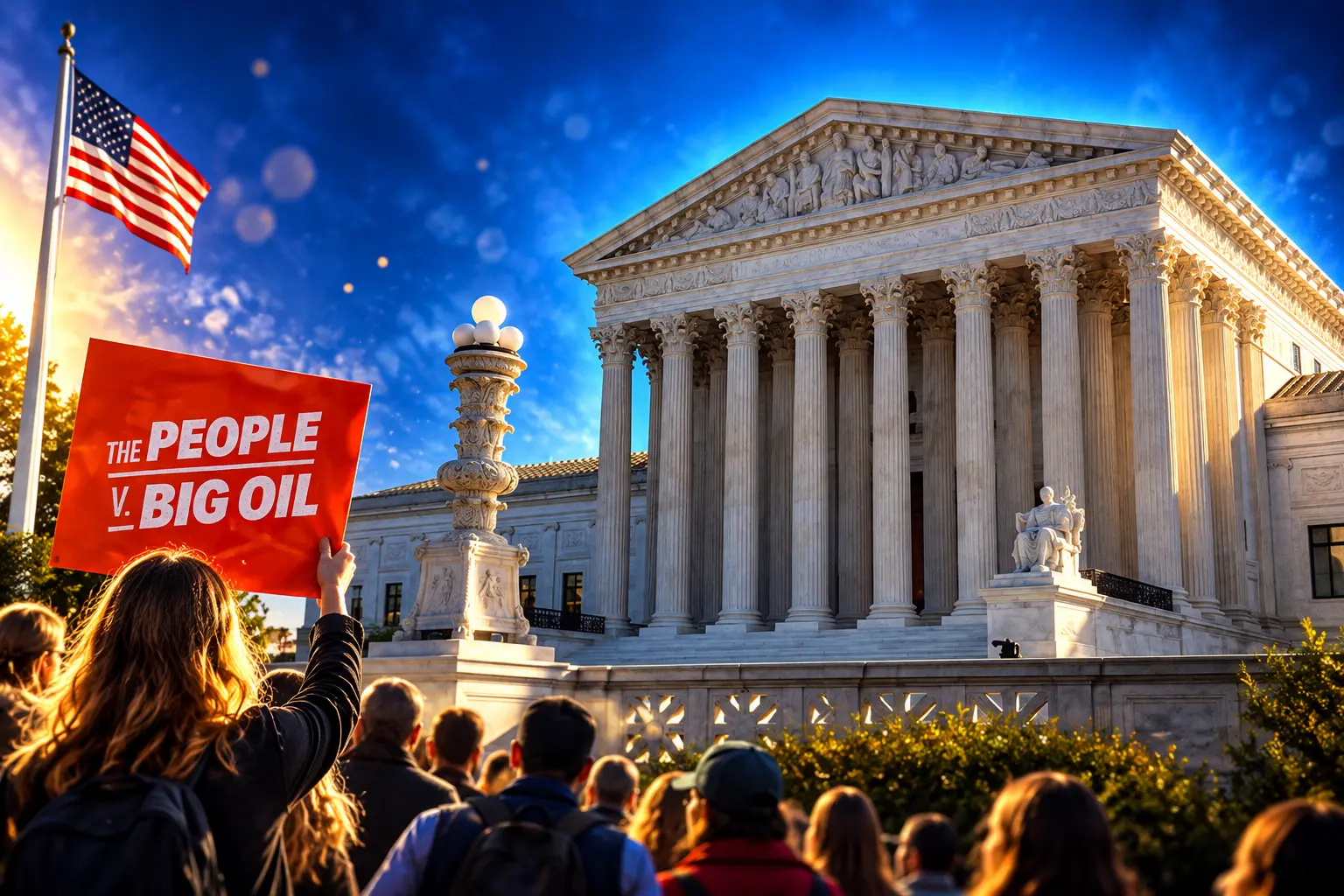
Boulder’s 2018 Suit Finally Reached the Lectern
Boulder sued on April 17, 2018. The complaint names Suncor, which runs the only two oil refineries in Colorado, and ExxonMobil. It alleges the companies promoted and sold fossil fuels while misrepresenting the dangers, and that the resulting climate change has already hit Boulder with floods, wildfire risk, heat, and thinner snowpack.
The companies removed the case to federal court. After trips through the Tenth Circuit and two earlier certiorari petitions, it returned to Boulder County District Court, which refused to dismiss on preemption. The companies then sought extraordinary review in Denver under Colorado Appellate Rule 21.
Justice Richard Gabriel, writing for a 5-2 court, said the claims could go forward. Colorado’s May 2025 ruling allowing the claims (2025 CO 21) held that the Clean Air Act had displaced federal common law and that the statute did not, by itself, wipe out Boulder’s state-law counts. Gabriel added that the court expressed no view on whether Boulder can prove its case.
Chief Justice Monica Marquez joined him, with Justices William Hood, Melissa Hart, and Maria Berkenkotter. Justices Carlos Samour and Brian Boatright dissented, warning that the majority let a Colorado county act as if it were a separate republic on a global emissions problem.
The U.S. Supreme Court took the case after the Trump administration filed an unsolicited brief in September 2025 urging review. On the merits, the United States argued as a friend of the Court in support of Suncor and ExxonMobil.
What the Justices Asked on Opening Day
After nearly two hours, it was not clear that a majority would hold that federal law kills Boulder’s claims. The questions clustered in two piles: whether the Court even has power to hear an interlocutory Colorado appeal, and whether state tort law can attach to a harm that is global by definition.
Kannon K. Shanmugam argued for the companies. Kevin K. Russell argued for Boulder. Sarah M. Harris, the principal deputy solicitor general, argued for the United States as amicus supporting the companies. The official October 5 argument transcript opens with Shanmugam’s core line.
This case involves an unprecedented effort to use state law to regulate global conduct.
Kannon K. Shanmugam, counsel for Suncor and ExxonMobil, oral argument, October 5, 2026
He told the justices that Boulder’s theory runs from global production, to global fuel use, to global greenhouse gases, to global climate change, to local harm, and that the Constitution does not let one state’s law police that chain.
THE THREE PREEMPTION THEORIES
- Constitutional structure: Equal sovereignty and a bar on extraterritorial regulation, the companies say, keep a state from using its tort law on out-of-state and foreign emissions.
- Clean Air Act: Interstate air pollution, they argue, is a federal subject unless Congress clearly says otherwise, and the Act did not reopen state law when it displaced federal common law.
- Foreign affairs: A Colorado judgment on worldwide emissions, they add, would collide with national climate diplomacy.
Boulder’s answer is that it is not setting an emissions cap. It wants money for local injuries, under Colorado law, from companies that sold a product and, it says, lied about the risk. Russell told the justices that a damages judgment “doesn’t prohibit them from engaging in the conduct.” It would, he said, make them “internalize a portion of the cost of their activities by paying for some of the damage that those activities inflict.”
Chief Justice John Roberts pressed both sides. He asked Shanmugam and Harris why this case differs from ordinary suits over out-of-state conduct with in-state effects, including internet and mass-tort cases. Harris said Colorado would, in practice, ban fossil fuel production anywhere in the country. Roberts treated that as a point about remedies, not about whether a suit may be filed at all. He also asked Russell whether the case was “an attempt to evade” the Court’s earlier climate decisions and described it as “an effort to reduce emissions.”
Tobacco, Opioids, and a Carbon Price by Jury
Justice Elena Kagan kept pulling the argument back to older public-health dockets. She told Shanmugam that Boulder’s “suit appears to be based on the old 1990s tobacco suits,” and the later opioid cases, and she asked whether those too would be barred if the companies were right.
I’m waiting to see the distinction. This is the same kind of lawsuit, against the same kind of actor for the same kind of harm.
Justice Elena Kagan, oral argument, October 5, 2026
Shanmugam said the injury here is not a Colorado consumer’s injury in the usual sense. He pointed instead to a line of interstate pollution cases, including Milwaukee, International Paper Co. v. Ouellette, and AEP, that treat cross-border air and water as federal unless Congress speaks. Kagan asked where, in text or precedent, the Constitution itself imposes a no-state-law default for air. “Where,” she asked, “is the[re] anything for that?”
Justice Brett Kavanaugh was the clearest vote for the companies. He said those older cases “make crystal-clear that interstate air and water pollution are matters for federal law” unless Congress says otherwise. When Shanmugam noted that Boulder was using the law of the affected state, Kavanaugh replied, “Okay. That resolves this case.” He called Boulder’s claim that the Clean Air Act “resurrected” state tort law after displacing federal common law an “all-time elephant in mousehole.”
Justice Amy Coney Barrett asked whether Colorado could pass a statute capping greenhouse gases in the other 49 states, then do the same thing through tort law. Russell said a direct cap would be forbidden and tried to keep the lawsuit on the damages side of that line. Barrett also said it “can’t possibly be correct” that state law “sprung into effect” in a field the Court had long treated as federal when Congress wrote the air and water statutes.
Boulder leans on the Act’s clause preserving state air authority, 42 U.S.C. § 7416, which lets states adopt standards or other requirements that are at least as strict as federal ones. The companies say a Colorado jury awarding climate adaptation costs is not a local emissions rule. It is a backdoor price on production everywhere, including Canada, where Suncor’s parent is based.
That is also the fight outside the marble. A Boulder judgment would not stay in Boulder. Russell conceded, under questioning from Justice Clarence Thomas, that “[n]othing in our theory prevents” suits against “large retailers” of fossil fuels. Shanmugam’s rebuttal went further. He said the “breadth of Boulder’s theory here is astonishing,” that Boulder could sue him “for refilling my car and thereby contributing to global climate change,” and that “[a]ny individual who has suffered the effects of climate change” could sue. Climate change, he said, is “one of the most pressing issues of the day,” and “this is exactly the wrong way to go about resolving it.”
Alito Stepped Aside a Week Before Argument
Alito participated when the Court granted review on February 23, 2026. On September 28, a week before argument, Clerk Scott Harris sent counsel a one-sentence letter: Justice Alito “will not continue to participate in this case.”
He does not hold stock in Suncor or ExxonMobil. He has reported holdings in other energy names, including ConocoPhillips and Phillips 66. After the argument he said a reasonable person, knowing that he and his wife have “a substantial investment in some companies in the oil and gas field,” and hearing the companies’ claim that a loss would start “a snowball rolling down a hill” through the industry, would expect him to sit out.
I did it reluctantly, but I thought that was what I ought to do under those particular circumstances.
Justice Samuel Alito, explaining his recusal in Suncor v. Boulder
He said court lawyers had told him recusal was not required, because he owned no stake in a named party, and that he changed his mind as he read the briefs. The practical effect is an eight-justice Court on a case that already split Colorado 5-2. A tie would automatically leave Gabriel’s opinion in force. Boulder would go back to a trial court. Other states would still lack a U.S. Supreme Court holding they can cite.
Justices Clarence Thomas, Sonia Sotomayor, Elena Kagan, and Ketanji Brown Jackson spent time on a second off-ramp: jurisdiction. Review of state cases usually follows a final judgment of the state’s highest court. Boulder’s case is still in the trial court. Sotomayor asked whether Colorado Appellate Rule 21 produced a self-contained case or an ordinary interlocutory appeal, and whether the justices should certify that question to Denver rather than guess. Jackson suggested it was “premature” to peel off the preemption defense “piecemeal” while personal jurisdiction and other issues remain below. She also noted the trial court had already found Boulder’s causation allegations plausible. “Maybe they lose because they can’t actually trace this to any particular source,” she said.
Two Dozen Live Cases Hang on This Ruling
Shanmugam told the justices there are about 60 similar cases. Michael Gerrard, director of the Sabin Center for Climate Change Law at Columbia University, puts the live pile lower and the filing pile in the same range. More than 60 state and local governments have sued, he said, about two dozen of those cases remain active, and none have gone to trial. “The stakes are extremely high for the future of all these two dozen or so pending cases,” Gerrard said. Some judges have already paused their dockets to wait.
The Sabin Center’s public tracker lists more than 3,000 tracked climate cases worldwide, across many theories. The U.S. slice of that docket is what Monday’s argument can freeze, narrow, or feed.
PARALLEL TRACKS BEHIND SUNCOR
| Matter | When it started | Where it stands |
|---|---|---|
| Boulder city and county v. Suncor and ExxonMobil | April 2018 | U.S. Supreme Court on preemption and jurisdiction |
| Honolulu, Maui, and Hawaii v. oil companies | 2020 | Hawaii Supreme Court allowed the claims; U.S. Supreme Court declined review in January 2025 |
| New York Climate Change Superfund Act | 2024 statute | Seeks $75 billion over 25 years; a federal judge blocked enforcement in late September 2026 |
| Middlesex County, N.J. v. oil companies | Early October 2026 | Newly filed, after the Boulder grant |
Hawaii has three cases in this family. Honolulu’s is among the furthest along; companies lost a bid to end it at the U.S. Supreme Court in January 2025. New York tried a different tool, a climate superfund modeled on old hazardous-waste law, and ran into the same preemption wall Boulder is now litigating as a tort case. Vermont’s parallel statute is in the same fight. Utah, Iowa, Oklahoma, Tennessee, and Louisiana have gone the other way, passing shield laws that try to block climate liability at home.
Gerrard’s larger point is institutional. “Globally, neither national legislatures nor governments are taking adequate action, and so the advocates of climate action are turning to the courts,” he said. Congress has not passed a carbon price. The current administration argued in Boulder’s case that the Clean Air Act already occupies the field. That is how a county complaint from 2018 became the first argument of a Supreme Court term.
Local Budgets Still Face the Repair Bill
Whoever wins the legal label, the invoices are already on municipal desks. Rebuild by Design’s statewide inventory puts New York’s public climate-adaptation need at $519 billion through 2050, about $26,000 per resident statewide and $50,000 in New York City, before counting the next disaster. Researchers at Climate Central put U.S. weather-disaster costs above $100 billion for last year alone.
THE UNPAID STACK
- New York infrastructure: $519 billion in identified public adaptation work through 2050, per Rebuild by Design, with sewers and stormwater among the largest lines.
- New York superfund: $75 billion over 25 years from large fossil fuel companies, written into a 2024 statute a federal judge has now blocked.
- National disaster tally: more than $100 billion in U.S. weather-disaster costs last year, according to Climate Central researchers.
- Trial record: zero completed trials in the city-and-state oil climate docket Gerrard described, so no jury has yet set a number.
If the Court sides with Suncor and ExxonMobil on a broad holding, those costs stay on local tax rolls, bond issues, insurance, and whatever federal aid still exists. If it sides with Boulder, or ties 4-4, the Colorado case returns to a trial court that has not taken evidence on whether two companies caused a particular flood or fire. Causation, damages, and personal jurisdiction would still have to be tried. Other plaintiffs would still have to survive their own motions.
A narrow opinion could decide only whether this Colorado appeal was final enough to review. A broad one could tell every state court whether climate damage is a state tort, a federal subject, or a political question dressed up as a nuisance count. The justices did not tip that choice on October 5. They did make clear they know the next caption is already on a clerk’s desk somewhere else.
A 4-4 split would leave Colorado’s green light in place, with no nationwide holding, and send Boulder back to a trial court that has never heard proof that Suncor or ExxonMobil caused a specific injury in Boulder County.
Disclaimer: This article is news reporting and legal-affairs analysis of a pending U.S. Supreme Court case. It is informational only and is not a prediction of how the Court will rule. It is not legal advice, is not an assessment of any company’s liability, and is not a recommendation about municipal bonds, insurance, or energy investments. Readers who face climate-related claims, coverage disputes, or public-finance decisions should consult a licensed attorney in the relevant jurisdiction, and where money is at stake a qualified financial adviser as well. Captions, votes, dollar figures, and case statuses reflect the public record cited in the piece and can change when the Court issues an opinion or when a trial court takes evidence.

The Court Revisits the Climate Nuisance Door It Left Open

ChatGPT Now Compiles Live Interfaces With GPT-6

A Tanker Attack Moves the War Into Qatar’s Waters

Personio Buys Circula to Own the DATEV Channel

Bluesky Files for .bsky and Enters the Registry Queue

Musk’s $914 Billion Lead Is a Public SpaceX Bet

Microsoft’s 96% Cyber Score Sits at 86.3% on the Board

Free Live Sports Streaming in 2026: What to Watch Without Cable

Andrew Garfield’s Spider-Man Films Are No Longer Free

Endgame Encore’s $86 Million Trial for Infinity Vision
-
 BUSINESS4 months ago
Musk’s $914 Billion Lead Is a Public SpaceX Bet
-
 NEWS2 months ago
Microsoft’s 96% Cyber Score Sits at 86.3% on the Board
-
 SPORTS3 months ago
Free Live Sports Streaming in 2026: What to Watch Without Cable
-
 ENTERTAINMENT2 years ago
Andrew Garfield’s Spider-Man Films Are No Longer Free
-
 ENTERTAINMENT3 months ago
Endgame Encore’s $86 Million Trial for Infinity Vision
-

 NEWS4 months ago
Singapore’s 3×3 and Surfing Debuts Miss the Medal Stand
-

 NEWS1 month ago
G20 Cheers AI Investment After Bailey’s Frontier Cyber Warning
-

 NEWS4 weeks ago
An AI Lung Drug Shifted Biological Age Clocks in Patients