
NEWS
Lauren Eckerle Is Still Starting After the Fifth-Year Stay
SDSU soccer defender Lauren Eckerle logged 90 minutes in late September, weeks after a federal stay told schools her 2022 class was no longer eligible.

Lauren Eckerle played all 90 minutes of South Dakota State’s 2-1 win over North Dakota on Sept. 27. That was 37 days after a federal appeals court stayed the order that had put her back in a Jackrabbit kit.
The graduate defender from Hugo, Minn., scored in the opener, scored again a week later, and is still in the XI while the NCAA tells schools her high school class is no longer eligible. SDSU soccer started its title defense during a three-week nationwide injunction. The stay did not send her home.
Eckerle Is Still Starting in October
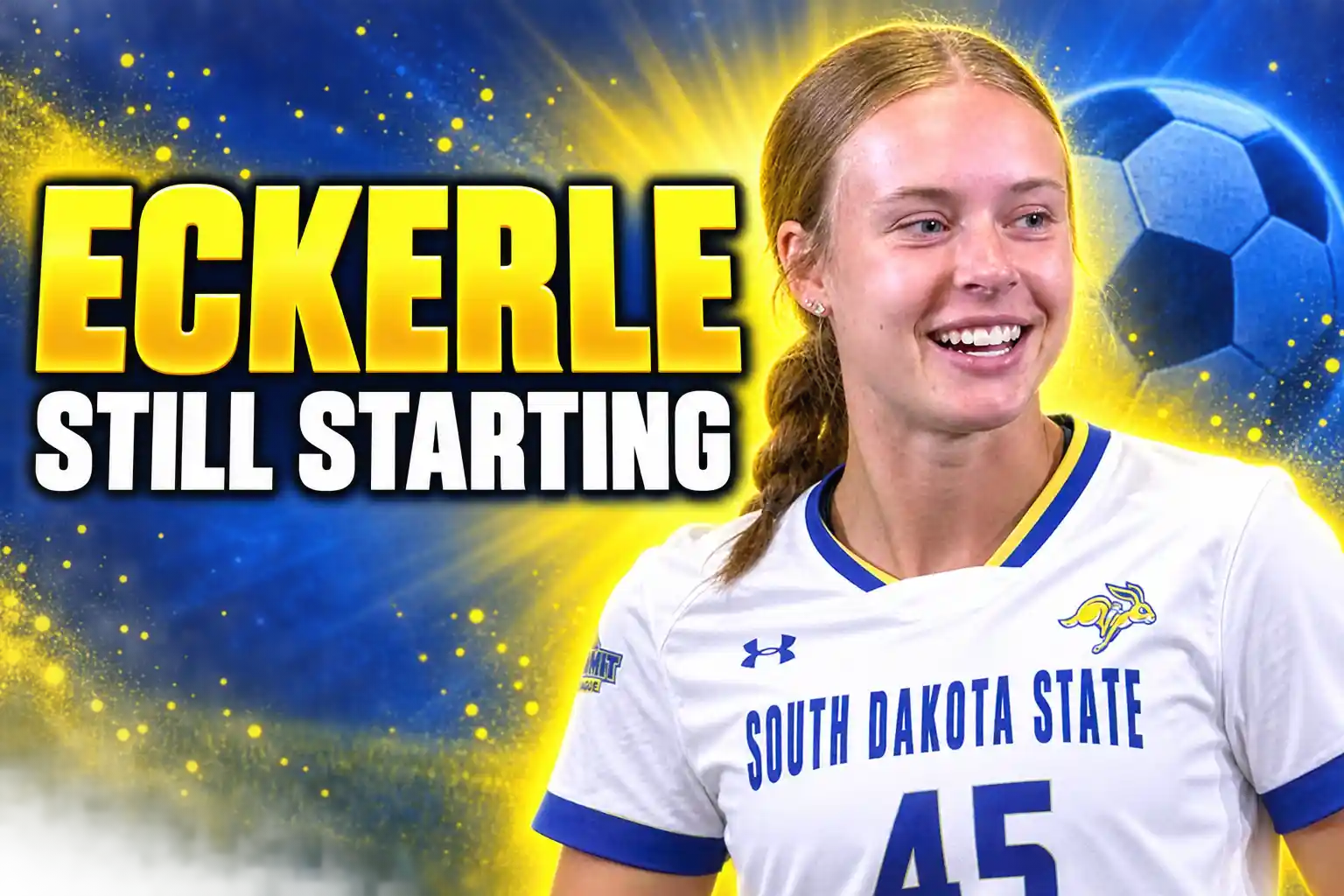
South Dakota State’s Oct. 2 game notes list the Jackrabbits at 6-2-2 overall and 1-0-1 in the Summit League. Eckerle, No. 45, is listed as a graduate student defender on the 2026 roster. Against North Dakota she started, finished, and took two shots in a comeback win at Fishback Soccer Park.
The program had treated 2025 as her last season. She captained the side, started 21 matches, and played a team-high 1,770 minutes. She was Summit League Tournament MVP, first-team all-league, and a CSC Academic All-America second-team pick, the fourth in program history. The bio still reads as if that year closed the book. The 2026 lineup says otherwise.
THE 2026 APPEARANCES ON THE RECORD
- Aug. 13: She logged 47 minutes and scored in a 6-0 win over Manitoba, the Summit League title defense opener.
- Aug. 20: She scored in the 31st minute of a 3-0 win over Washington State, the third shutout to start the year.
- Through Aug. 28: Official notes had her at 3 games, 182 minutes, 2 goals, 2 assists, and 6 points.
- Sept. 27: She played 90 minutes and took 2 shots in the 2-1 win over North Dakota.
Those are the published traces, not a full season line. They are enough to show she was not a one-night cameo under a court order that later vanished. SDSU is taking a 6-2-2 record to Fargo for an Oct. 3 match at North Dakota State, and her name is still on the sheet.
The Injunction Lasted Three Weeks
On June 23, 2026, the NCAA Division I Cabinet unanimously approved an age-based eligibility model that gives athletes up to five years if they enroll no later than the academic year after their 19th birthday. The Cabinet was explicit about the 2022 high school class. Athletes who had already used four seasons by spring 2026 would get no extra year. Schools still call the change 5-for-5. The NCAA says that nickname is not accurate.
The new clock is a five-year eligibility period tied to age and first full-time enrollment, with pauses only for pregnancy, active-duty military service, and official religious missions. Redshirts and most waivers were supposed to disappear. For current athletes with eligibility left after 2025-26, schools may use the old four-seasons-in-five-years rule or the new model, whichever helps the player. The 2022 class that had already burned four seasons sat outside that choice.
That exclusion produced the lawsuits. Former Northern Colorado basketball player Brock Wisne led a federal class action in Colorado. On July 31, U.S. District Judge Charlotte N. Sweeney granted a class-wide preliminary injunction covering Division I athletes who began in 2022-23, finished four seasons by the end of 2025-26, and were being held out of a fifth. She wrote that they would suffer irreparable harm without it. NCAA chief legal officer Scott Bearby called the order egregiously wrong and said the association would appeal.
THE THREE WEEKS THAT PUT HER IN THE XI
- June 23, 2026: The Division I Cabinet adopts the age-based model and leaves out athletes who completed a fourth season in spring 2026.
- July 31, 2026: Judge Sweeney issues the nationwide injunction in Wisne v. NCAA. Schools have the same day as the last deadline to file hardship or season-of-competition waivers for current athletes.
- Aug. 1, 2026: Eckerle’s class is treated as granted the year. She may practice. She still may not play exhibitions.
- Aug. 12, 2026: SDSU clears her the day before the opener.
- Aug. 13, 2026: She plays 47 minutes and scores against Manitoba.
- Aug. 17, 2026: An Ohio appeals court stays a separate basketball injunction in Borovicanin v. NCAA.
- Aug. 21, 2026: A 10th Circuit panel, 2-1, stays the Wisne injunction pending appeal.
The NCAA’s member notice that Friday was blunt. Age-based rules would be implemented as the membership intended. Class members who had been allowed to compete because of Wisne were no longer eligible. Schools would not be charged with violations for having played them while the injunction was live. Staff would keep processing hardship and season-of-competition waivers filed by the July 31 deadline.
NCAA statement:
The Tenth Circuit’s decision to stay the preliminary injunction issued by a Colorado federal district court judge in Wisne permits Division I to return to the status quo before the district court intervened. Effective immediately, the age-based eligibility rules…
— NCAA News (@NCAA_PR) August 21, 2026
A Husch Blackwell alert the same day mapped how appellate courts had stayed two of the three major injunctions in a single week. The stay did not wipe out every state-court restraining order. It did end the one order that had covered the entire class. Any 2022 athlete still playing after Aug. 21 needed a different hook: a named state order, a processed waiver, or a school willing to keep writing her into the 11.
Three Games Short of a Medical Redshirt
Eckerle’s reason for coming back was never the new branding. She tore up her 2023 season. The official bio says she started the first 10 matches, then had her year end with a leg injury on Sept. 24 at South Dakota. She has described it as an ACL tear. She missed a medical redshirt by three games, so that year counted as a season of competition.
Under the old four-in-five model she had used four seasons across 2022, 2023, 2024, and 2025. The fifth calendar year was sitting there. The fourth season was not. When the Cabinet voted in June, she was already in Brookings, still lifting, and asking herself if she was crazy to try.
That was a big reason I wanted to come back. I was like, you’re going to give everyone five but I only got like three-and-a-half?
Lauren Eckerle, SDSU defender
Head coach Brock Thompson had been watching the file since January and refused to get his hopes up. Once the paper moved, he still called it an emotional rollercoaster and said the situation was up in the air. He also named the person the new five-year idea was supposed to catch.
And honestly, the whole five years of eligibility was created for somebody like her, who missed half a season but not enough to get a year back. This isn’t someone who played every game for four years.
Brock Thompson, SDSU soccer coach
SDSU has not published the legal hook it is using after Aug. 21. The NCAA left the July 31 waiver window open for class members, and her 2023 file is the exact hardship those waivers were built to review. She re-enrolled for a certificate in operations management, reapplied to graduate school, and already holds bachelor’s degrees in business economics and accounting, with CPA plans. Soccer is a fall sport, so the extra class load is one semester, not a full extra year.
She was not allowed to practice at first, only to work out on the side. After Aug. 1 she could train but not play exhibitions. Clearance arrived the day before Manitoba. Thompson’s team opened so early that the three-week injunction and the season were the same window. Football programs that waited until late August had to cut names overnight. SDSU already had her in the lineup.
Why SDSU Now Recruits Five or Six a Class
Thompson is not waiting for the 10th Circuit to redraw his roster math. Fall soccer, in his telling, has already moved onto a four-and-a-half-year graduate plan. The incoming groups get smaller. The staff used to take eight in a class. It now takes five or six, and the bar is higher.
HOW THE JACKRABBITS ARE REBUILDING THE PIPE
- Class size: Recruiting drops from eight players a year to five or six, which Thompson called more selective.
- Next year’s returns: Six players could come back; four have committed, and the other two are ready to leave.
- Academic clock: The program is switching the working plan to nine semesters.
- Roster math: The 2026 notes list 13 newcomers against 9 letterwinners back and 6 starters back, a mix that only works if fifth-year returns stay rare.
He still called the shift a huge positive. The hidden cost sits with the high school players who used to get the eighth and seventh spots in a Jackrabbit class. If veterans can stay, those offers disappear. Eckerle’s return is one body. The recruiting change is the structural one, and it is already in motion while the appeal is pending.
House settlement roster caps were part of the NCAA’s original case for excluding the 2022 class. The association argued that a blanket extra year would bump incoming freshmen and scramble rosters that had been built to those caps. Sweeney’s later clarification left roster limits, transfer rules, and revenue-share caps in place. Even at the high-water mark of the injunction, a fifth year was eligibility, not a guaranteed scholarship or a guaranteed slot.
The Other Jackrabbits Have Not Followed
In mid-August, Eckerle was the first SDSU athlete to return under the July order. Cornerback Isaiah Johnson was the only name from the 2025 football roster who became eligible on the same path. There was contact with the program. The indication then was that he would not come back.
Basketball is the larger dangling file. Brooklyn Meyer, who had already said she would play volleyball for SDSU this fall, would have been eligible for another basketball season if the class-wide relief held. So would guard Madison Mathiowetz. Basketball coach Aaron Johnston had not commented by Media Day in August. Volleyball coach Dan Georgalas would not discuss it either.
That silence is the winter-sport version of Thompson’s rollercoaster. Soccer had to decide in the first half of August or forfeit the year. Basketball can wait on state-court orders, on the appeal, and on whether a star wants a fifth season more than a first volleyball season. Some of Eckerle’s classmates moved on with jobs and graduate plans. She stayed because, in her words, her teammates are fun to be around, and another year with them would be worth the doubt.
She had those doubts. Over the month of waiting she asked herself what she was doing with her life. She stayed in the weight room anyway. The 2025 defense she anchored posted 11 shutouts and led the league at 0.68 goals against. Thompson wanted four full seasons from a player who had been denied a redshirt by a three-game gap. He got her back into the XI. He did not get a settled rulebook.
The Stay Is the Federal Rule Until the Appeal Ends
On Oct. 2, a Kentucky appeals court dissolved a separate injunction that had covered a group of Class of 2022 athletes, and an Ohio court delivered another NCAA win in the basketball-focused case that had already been stayed in August. Named plaintiffs with live state orders can still play. Athletes who were riding only Wisne cannot. SDSU has kept Eckerle in the starting group anyway, on a campus that is not in those state files.
WHERE CLASS OF 2022 ELIGIBILITY STANDS
| Path | Who it covers | Status |
|---|---|---|
| Wisne v. NCAA | Nationwide class of 2022 Division I athletes who used four seasons by 2025-26 | Injunction stayed Aug. 21; appeal pending |
| Ohio basketball case | 24 named men’s basketball plaintiffs | Injunction stayed Aug. 17; later opinion left them without the extra year |
| State TROs | Named athletes in states that granted their own orders | Still protect those plaintiffs only |
| Hardship window | Class members whose schools filed by July 31 | NCAA said staff would keep processing those waivers |
Congress is trying to freeze a version of this fight. The NCAA is backing a Senate bill on five-year eligibility that would write an age-based clock into federal law and steer eligibility cases into federal court. Until something like that lands, Brookings is making a local choice with a player who already had two degrees and a captain’s armband.
Eckerle wanted the year her ACL stole. The Cabinet wrote a five-year model and left her class off it. A Colorado judge put the class back on for 21 days. The 10th Circuit took it off again. SDSU started its season inside that 21-day window, and in late September she was still on the field for 90 minutes. The Jackrabbits go to Fargo on Oct. 3 at 6-2-2. The stay is still the federal rule. She is still in the 11.

The Court Revisits the Climate Nuisance Door It Left Open

ChatGPT Now Compiles Live Interfaces With GPT-6

A Tanker Attack Moves the War Into Qatar’s Waters

Personio Buys Circula to Own the DATEV Channel

Bluesky Files for .bsky and Enters the Registry Queue

Microsoft’s 96% Cyber Score Sits at 86.3% on the Board

Musk’s $914 Billion Lead Is a Public SpaceX Bet

Endgame Encore’s $86 Million Trial for Infinity Vision

Free Live Sports Streaming in 2026: What to Watch Without Cable

The Odyssey’s IMAX Film Run Hit a 41-Theater Limit
-
 NEWS3 months ago
Microsoft’s 96% Cyber Score Sits at 86.3% on the Board
-
 BUSINESS5 months ago
Musk’s $914 Billion Lead Is a Public SpaceX Bet
-
 SPORTS4 months ago
Free Live Sports Streaming in 2026: What to Watch Without Cable
-
 ENTERTAINMENT4 months ago
Endgame Encore’s $86 Million Trial for Infinity Vision
-
 ENTERTAINMENT3 months ago
The Odyssey’s IMAX Film Run Hit a 41-Theater Limit
-

 ENTERTAINMENT2 years ago
Andrew Garfield’s Spider-Man Films Are No Longer Free
-

 GAMING2 months ago
Xbox Puts 15-Hour Caps on Game Pass Cloud Play
-

 NEWS5 months ago
Singapore’s 3×3 and Surfing Debuts Miss the Medal Stand