
NEWS
AcademyAI Raises £1.65 Million to Score Staff AI Skills
AcademyAI raised £1.65 million to score workplace AI skill after companies bought tools they cannot prove staff can use.

AcademyAI has raised £1.65 million in an oversubscribed pre-seed round to score how well staff can actually use the AI tools their employers already bought. The 15 September 2026 close named Nexus Family Office and Panthera Family Office among the investors, and the product is a test with short lessons attached, not another chatbot seat.
Co-founders Alex Packham, Andy Lambert, Michael Walton and Rob Barnett are pitching the round at firms that have already handed out ChatGPT and Microsoft Copilot. Packham, who is also chief executive of the behavioural-health company JAAQ, said bosses still cannot see the skill they think those licences purchased.
The Round Exists Because Tool Licences Came Without Proof
Packham’s sales call is blunt, and it is the reason a pre-seed buyer exists at all. Companies opened the tools. Almost none of them can show whether people can use them on the job, so they are now being asked to fund a second layer of software that measures the first.
Every company and CEO we talk to has given their teams access to AI tools. Almost none of them know if their people can use them properly. It’s a measurement problem first: leaders don’t know what their teams are capable of, so they can’t close the distance between buying a tool and getting value from it. Closing the gap between AI adoption and AI outcomes is what we built AcademyAI to do
Alex Packham, co-founder, AcademyAI
He also said the round closed oversubscribed because investors see the same hole. That hole is not a missing model. It is a missing score. Usage logs can show that someone opened a chat pane. They cannot show judgement, a safe prompt, or a clean check of what the model just wrote.
Lambert put the same complaint in plainer words when the company started onboarding pilots in July 2026. Organisations are putting money into AI faster than their people can learn it, he said, and almost nobody is seeing the return. “Everyone’s got access.” The cheque for access has already cleared. This new cheque is for evidence.
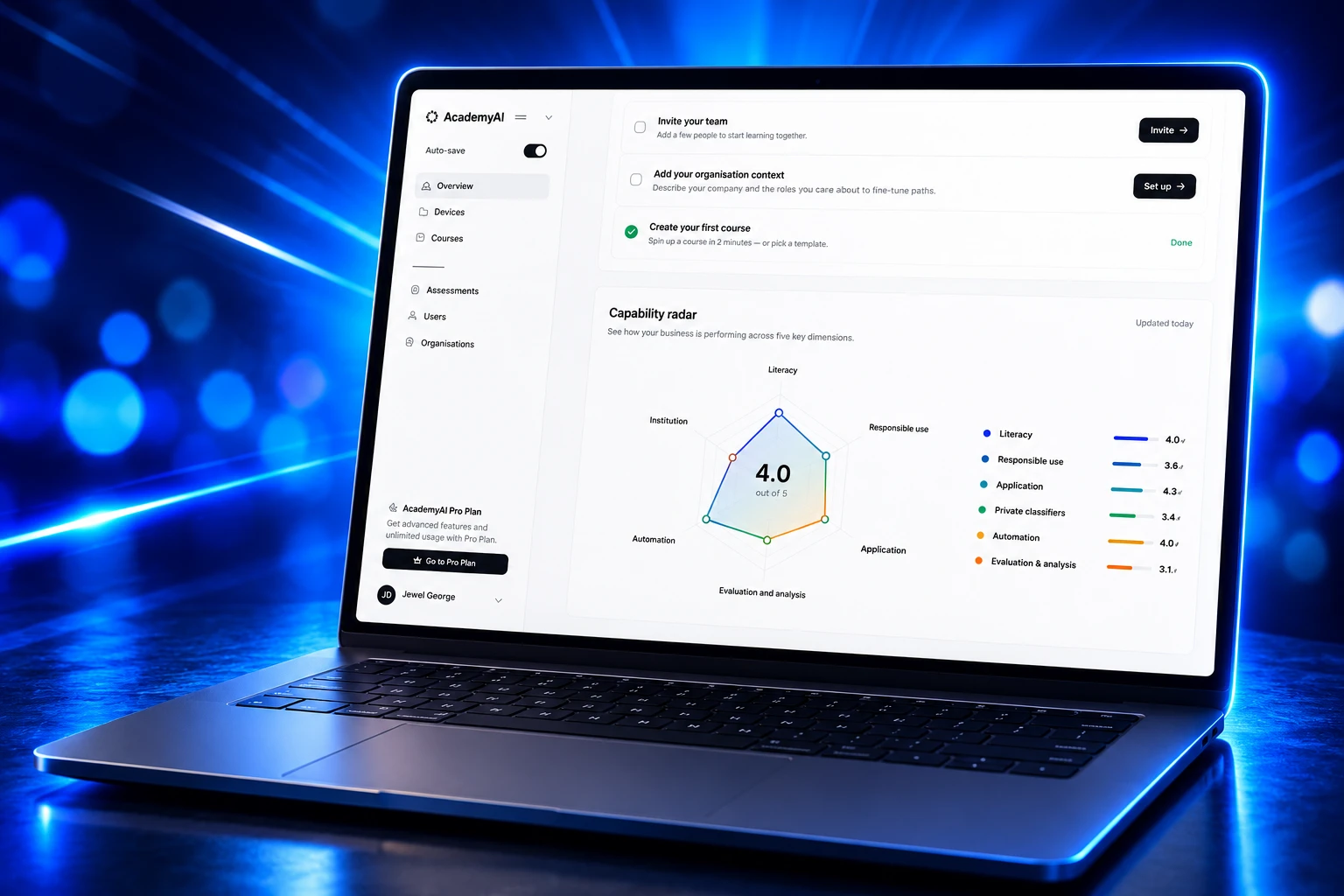
What AcademyAI Scores Across Six Capabilities
AcademyAI runs staff through a six-axis test, then builds short lessons around the weak spots and the person’s actual job. The axes in the company’s own materials are literacy, safe and responsible use, framing, specification, application, and evaluation and reflection, mapped by person, team and role, with examples that include product manager, data analyst, designer and engineer.
THE SIX AXES ON THE TEST
| Capability | What it tests |
|---|---|
| Literacy | What AI can and cannot do |
| Safe and responsible use | Privacy, security and bias |
| Framing | Whether someone can judge an opportunity and set a clear goal |
| Specification | Whether AI is applied to a workflow in a way that holds up |
| Application | Whether the person can put AI into real tasks |
| Evaluation and reflection | Whether they can judge accuracy, quality and risk in the output |
The company says the test was developed with Alan Turing Institute methodology. That is not the same object as the Institute’s public AI Skills for Business Competency Framework, which groups people into four audiences, AI Citizens, AI Workers, AI Professionals and AI Leaders, rather than these six product axes. The Turing work, led by Dr Matt Forshaw, Senior Advisor for Skills, is funded by the Department for Science, Innovation and Technology and Innovate UK’s BridgeAI programme, and the May 2024 version of the framework is the published baseline. A Version 3 consultation opened in December 2025, with comments due by 19 January 2026.
The overlap that matters for buyers is the shared premise. Both efforts treat AI at work as a skill you can describe, not a feature you switch on. AcademyAI then sells the score, the lesson and a dashboard. Turing publishes a national reference that employers, trainers and officials can argue over.
The Same ContentCal Team, a Different Product
The founding group is a ContentCal reunion with extra operators, not a first-time campus team. Packham founded ContentCal, sold ContentCal to Adobe in 2021, and then spent three years leading the Adobe integration. Lambert co-founded ContentCal with him, stayed at Adobe for four years, and worked on Adobe Express as a principal product manager. Walton and Barnett, who had backed ContentCal, are named as co-founders this time.
Packham still runs JAAQ as chief executive. On his own site he lists AcademyAI as a co-founder, board and seed-investor role, and he counts more than 60 companies through ASTP Ventures, plus a founding-partner seat at Digital First Capital. The new company is a side bet by people who already sold a collaboration tool into a giant software house, and who watched, from the inside, how a bought product does not automatically become a used skill.
FROM CONTENTCAL TO A SKILLS SCORE
- December 2021: Packham sells ContentCal to Adobe and stays to run the integration.
- June 2026: Lambert, Packham, Walton and Barnett found AcademyAI.
- July 2026: The company onboards its first pilot customers ahead of a launch later in 2026.
- 15 September 2026: An oversubscribed pre-seed of £1.65 million is announced, with Nexus Family Office and Panthera Family Office among the investors.
Lambert’s July line was that most teams use AI and few can prove they are genuinely good at it. That is the product thesis in one sentence, and it is why the company refuses to sell prompt tips as the whole job. “Using AI well isn’t about more tools or more prompts,” he said. “It’s about the fundamentals AI amplifies: judgement, critical thinking, analysis. Throw AI at today’s processes without those, and nothing changes.”
Five-Minute Modules Replace the Webinar Habit
Once the test flags a gap, AcademyAI serves applied lessons in five-minute modules written in the firm’s own tools, policies and language. Underlying models generate and refresh that content as the tools change, which is the practical answer to a market that still ships hour-long webinars about a product that shipped a new model last week.
Lambert has called the loop “Duolingo for AI.” The company also describes a three-step machine rather than a course catalogue, and it says it is not a learning-management system and not a consultancy. The pitch is always-on infrastructure that measures, teaches and then shows the score moving.
ASSESS, TRAIN, PROVE
- Assess: Staff sit a role-mapped test across the six capabilities, so the firm can see people, teams and jobs rather than a single completion tick.
- Train: Short modules and use cases are built around the gaps, the role and the company’s own wording, then updated as the models move.
- Prove: Managers get capability scores, dashboards and certification, which is the artefact the original software licence never produced.
The intended buyer is not a Fortune 500 Copilot rollout. AcademyAI is aiming at firms with 30 to 500 employees, typically $50 million to $500 million in revenue, and a large share of knowledge work. Listed sectors are professional services, legal, consulting, investment management, education, technology and proptech. That is a mid-market problem dressed as an AI problem: small enough that a messy rollout hurts, large enough to have bought the tools already.
A Family-Office Cheque for a Skills Ruler
Classic AI venture names do not appear in the 15 September announcement. Nexus Family Office and Panthera Family Office do. Family offices write patient cheques and they also run their own lean staffs, which makes a product that claims to tell you who can actually use the tools a more natural object than another model wrapper.
The round is still only a pre-seed. £1.65 million buys product work and a wider offer as more firms switch tools on. It does not buy a category. The category, if it holds, is the unglamorous one that shows up after the licence: inference got cheaper, search is being rebuilt around answers, and someone still has to show a board that the people on the payroll can use the thing without leaking a client file or pasting a bad summary into a live matter.
That is where this money is going, and it is a smaller cheque than the ones that put Copilot on every laptop. The irony is the point of the deal, not a side effect. Firms spent on access. They are now being asked to spend on a ruler.
Staff Are Buying Their Own AI Tools Anyway
On 16 September 2026, the day after AcademyAI’s round landed, Deloitte published its inaugural GenAI Workforce Survey, conducted with Ipsos. UK workers are already paying. Deloitte put own-pocket spend on work AI at nearly £1 billion ($1.4 billion) a year. 17% of workers are paying for at least one generative tool to do their job. Two thirds have tried ChatGPT, Claude, Google Gemini or Copilot. Nearly a quarter use them every working day. 31% are using generative AI without their employer knowing, the shadow-AI share.
WHAT DELOITTE COUNTED IN THE UK WORKFORCE
- Own-pocket spend: Nearly £1 billion a year of staff money, with 17% paying for at least one generative tool for work.
- Daily habit: Nearly a quarter of workers use those tools every day, and two thirds have tried them.
- Shadow use: 31% are using generative AI without the employer’s knowledge.
- Time saved: The most common jobs are search, email drafts and summaries, at 70 minutes a week.
Hayley McKelvey, Deloitte UK’s chief AI officer, said workers are not waiting for permission. “Many are already using free tools or pay for premium versions themselves to help them get work done.” That finding cuts two ways for AcademyAI. It confirms that skill is forming in the wild, off the books. It also confirms that a lot of the “adoption” executives boast about is happening in personal accounts their security teams cannot see.
Deloitte’s own UK findings from its 2026 human capital research, published on 8 June 2026, make the measurement gap uglier. 81% of UK leaders, managers and workers worry that colleagues are using AI to look more productive. 44% of UK workers have used AI to automate part of their job, often without the employer knowing. 34% say their organisation rarely evaluates the impact of AI on people. Only 11% feel the organisation meets their continuous learning needs. A dashboard that scores skill is, in that light, also a dashboard that can catch theatre.
Dashboards for the People Who Signed the Licences
For managers, AcademyAI sells visibility across people, teams and departments: where scores are rising, where they are not, and where another round of five-minute lessons might still be required. That is the artefact a chief executive can take into a budget meeting when the original software vendor is asked what the seats produced. It is also a new kind of HR record, and firms that buy it will have to decide whether a low score is a training need, a hiring filter, or a problem for the person who approved the tools in the first place.
The money, Packham said, will go into the assessment engine and the role-specific lessons, and into widening the offer as more companies switch more tools on. Lambert’s pilots were already sitting in that gap in July, inside firms that had the licences and did not have the proof. The £1.65 million does not close the skills gap. It funds a company whose entire pitch is that the gap was never measured.

The Court Revisits the Climate Nuisance Door It Left Open

ChatGPT Now Compiles Live Interfaces With GPT-6

A Tanker Attack Moves the War Into Qatar’s Waters

Personio Buys Circula to Own the DATEV Channel

Bluesky Files for .bsky and Enters the Registry Queue

Microsoft’s 96% Cyber Score Sits at 86.3% on the Board

Musk’s $914 Billion Lead Is a Public SpaceX Bet

Free Live Sports Streaming in 2026: What to Watch Without Cable

The Odyssey’s IMAX Film Run Hit a 41-Theater Limit

Endgame Encore’s $86 Million Trial for Infinity Vision
-
 NEWS3 months ago
Microsoft’s 96% Cyber Score Sits at 86.3% on the Board
-
 BUSINESS5 months ago
Musk’s $914 Billion Lead Is a Public SpaceX Bet
-
 SPORTS3 months ago
Free Live Sports Streaming in 2026: What to Watch Without Cable
-
 ENTERTAINMENT3 months ago
The Odyssey’s IMAX Film Run Hit a 41-Theater Limit
-
 ENTERTAINMENT4 months ago
Endgame Encore’s $86 Million Trial for Infinity Vision
-

 ENTERTAINMENT2 years ago
Andrew Garfield’s Spider-Man Films Are No Longer Free
-

 NEWS5 months ago
Singapore’s 3×3 and Surfing Debuts Miss the Medal Stand
-

 NEWS1 month ago
An AI Lung Drug Shifted Biological Age Clocks in Patients