
NEWS
Google’s Kairos Deal Turns a Test Reactor Into a Product
Kairos will sell TVA 50 MW from a resized Oak Ridge test reactor, the first slice of Google’s 500 MW nuclear order.

Kairos Power will sell the Tennessee Valley Authority up to 50 megawatts from Hermes 2 in Oak Ridge, Tennessee, under an August 18, 2025 power purchase agreement. Google will take the plant’s clean energy attributes on that grid for data centers in Montgomery County, Tennessee, and Jackson County, Alabama, with operations scheduled to begin in 2030.
The electrons go into TVA’s system. The 50 megawatts is also the first slice of Google’s order for 500 MW of Kairos plants by 2035, and it starts as a test reactor the Nuclear Regulatory Commission permitted as two small units.
TVA Buys the Power, Google Buys the Credits
The power purchase agreement between Kairos Power and TVA is the contract that moves the electricity. Amanda Peterson Corio, Google’s global head of data center energy, described a three-party setup in which the customer, the utility, and the reactor developer each take a different piece of the same plant.
TVA, a self-supporting federal utility that sells power to more than 10 million people across seven states and takes no annual appropriation, is the offtaker. Google said it will procure clean energy attributes from the plant through TVA so the Tennessee and Alabama campuses can claim local carbon-free energy every hour of every day.
HOW THE THREE-PARTY DEAL SPLITS THE POWER
- Kairos Power: Builds and runs Hermes 2 in Oak Ridge and sells electricity to TVA under the PPA.
- TVA: Buys that output, puts it on the regional grid, and remains the utility of record for Google’s load in its territory.
- Google: Buys the clean energy attributes in this first phase rather than a private wire into a server hall.
That split is why a 50-megawatt demo can be booked against a hyperscale power problem. It is also why TVA President and CEO Don Moul could talk about AI and national security without promising that Hermes 2 will cover a whole campus on its own.
Energy security is national security, and electricity is the strategic commodity that is the building block for AI and our nation’s economic prosperity.
Don Moul, President and CEO, Tennessee Valley Authority
Kairos posted the same announcement the day the PPA was signed.
Today, Kairos Power, @Google, and @tvanews announced a collaboration to help meet growing energy demand and bolster U.S. nuclear leadership.
Through a new PPA, the Hermes 2 plant in Oak Ridge, TN will deliver up to 50 MW of clean, reliable energy to the TVA grid to further… pic.twitter.com/6A3NuWRgxB
— Kairos Power (@KairosPower) August 18, 2025
The Permit Was Written for Two Small Test Reactors
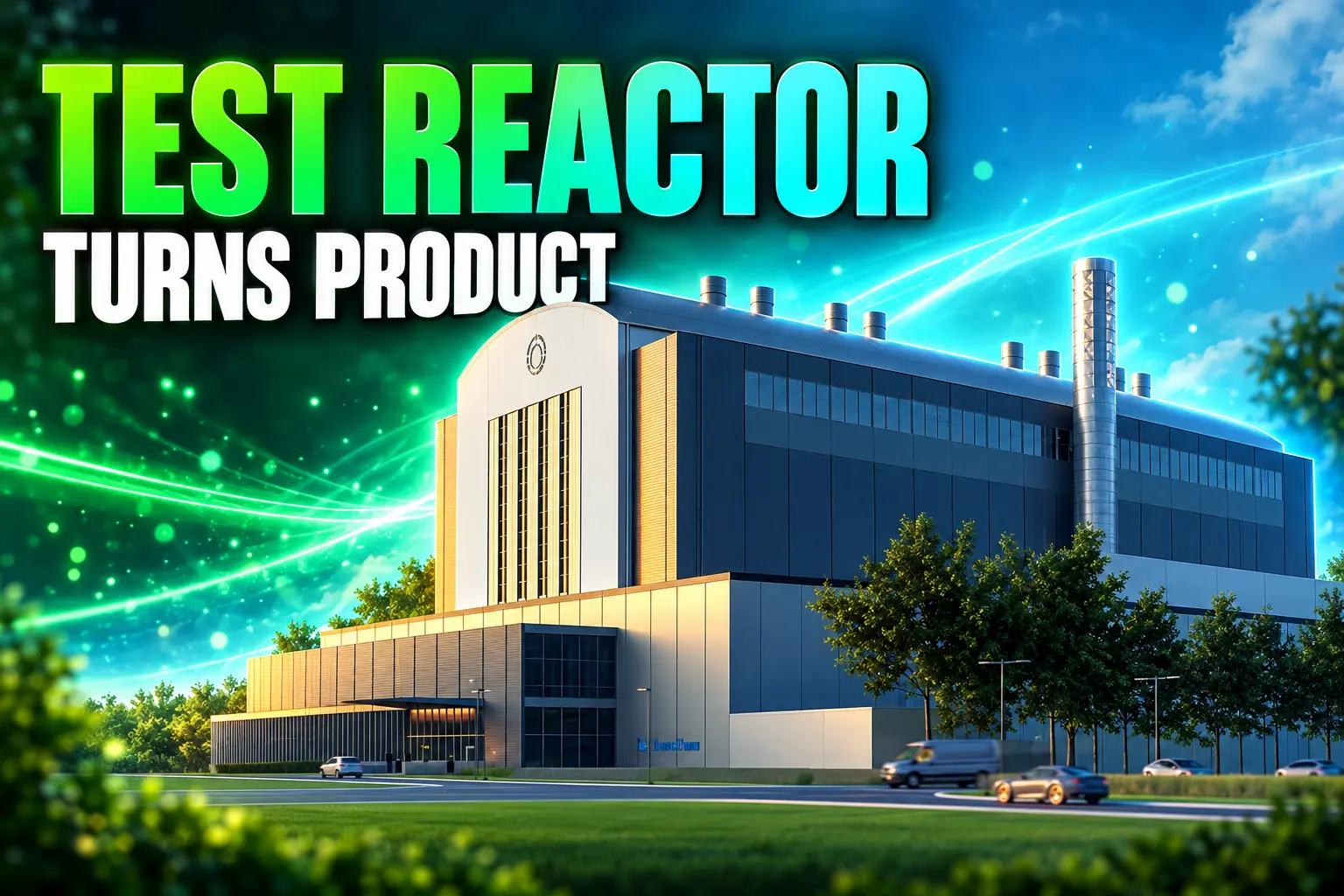
The NRC issued construction permits CPTR-7 and CPTR-8 on November 21, 2024, after Chair Christopher Hanson said the staff finished the job in less than 18 months. The agency’s project page still describes Hermes 2 as two 35-megawatt thermal test reactors that share a power generation system, using TRISO pebble fuel and fluoride salt coolant, built to feed data into a later commercial design.
Kairos then told the market it would enlarge Hermes 2 from 28 MW to 50 MW generated by a single reactor. A company note on October 21, 2025, called that a step change from the smaller 14 MWe units in the original dual-unit concept, two of which add to the same 28 MW. The PPA cap of up to 50 megawatts sits on that enlarged plant output.
THE LICENSED PLANT VERSUS THE GOOGLE PLANT
| Item | NRC construction permits, 2024 | PPA announcement, 2025 |
|---|---|---|
| Reactor count | Two low-power test reactors | One reactor |
| Thermal rating | 35 MW thermal per unit | Not restated as a new thermal figure |
| Electrical output | 28 MW (two 14 MWe units) | 50 MW, PPA up to 50 MW |
| Legal paper | CPTR-7 and CPTR-8, test reactor facility | Same permits; company said no new application was required |
| Job of the plant | Operational data for a larger KP-FHR | First 50 MW under Google’s 500 MW order |
Unit 2’s permit still lists December 31, 2028 as the latest construction completion date. The NRC has also said it must review and approve operating licenses before Hermes 2 can start up. The stretch from a two-unit test facility to a 50-megawatt offtake story is the part of the deal that does not show up in a headline about data centers.
Nuclear engineer Rod Adams argued on X that Kairos’s “first-ever power-producing Gen IV” construction-permit line was a superlative that needed parsing, because TerraPower’s Natrium plant in Wyoming had already received its own NRC construction permit in 2026. Hermes 2’s permits did come first, in November 2024. They came as test-reactor paper, which is the technicality the argument turns on.
Who Pays If Hermes 2 Overruns?
Kairos said the structure protects electricity customers by limiting development costs to first movers and letting later units bring costs down. Mike Laufer, the company’s CEO and co-founder, called the collaboration “an important enabler to making advanced nuclear energy commercially competitive” and said the re-envisioned Hermes 2 “gets us closer to the commercial fleet sooner.”
TVA’s 10 million customers are the group that usually eats first-of-a-kind nuclear overruns. The PPA is written to keep that bill on the early parties, Google and Kairos, while the utility still sits on the power contract. Energy Secretary Chris Wright said the Department of Energy has already helped Kairos through the Advanced Reactor Demonstration Program and will keep pushing the work.
That DOE help is real money, and it is attached to the sibling machine. Kairos said a Technology Investment Agreement is investing up to $303 million in Hermes 1 construction and operations, not in the 50-megawatt PPA unit. Hermes 1 is the low-power demonstration reactor on the same Oak Ridge campus, and Kairos asked the NRC to move its latest construction date from December 31, 2026, to April 30, 2029, while saying it still expects to finish that reactor in 2028.
If Hermes 1 slips, Hermes 2 loses the operating data it is supposed to inherit. The 2030 commercial date then depends on a test reactor that has already used up its original completion deadline.
Fifty Megawatts Against a 500-Megawatt Promise
Google’s October 14, 2024 master plant development agreement asked Kairos for up to 500 MW of new nuclear capacity by 2035, with a first unit targeted for 2030. Hermes 2 is 10 percent of that order. Official notices name only Oak Ridge as a site.
GOOGLE’S KAIROS ORDER, IN FOUR LINES
- The cap: Up to 500 MW of Kairos plants by 2035, Google’s first nuclear deal and the first multi-plant corporate agreement for one advanced design.
- The first 50 MW: Hermes 2, a 50-megawatt Oak Ridge unit under the TVA PPA, aimed at 2030.
- The rest: 450 MW with no public sites in the company notices that accompanied the PPA.
- What Google buys now: Clean energy attributes on TVA’s system for Montgomery County, Tennessee, and Jackson County, Alabama.
Corio said lessons from building and running Hermes 2 should drive down the cost of later reactors in the TVA region and beyond. That is the fleet argument. It only works if the next plants actually get sites, permits, and fuel at a price Google will still pay.
Samsung C&T Joins a Plant Already in the Dirt
Kairos broke ground on Hermes 2 on April 17, 2026 at the Heritage Center, on the K-33 footprint of the former Oak Ridge Gaseous Diffusion Plant, land the company bought in 2021. Barnard Construction is general contractor for both Hermes reactors. Equipment modules are supposed to be built at Kairos’s Manufacturing Development Campus in Albuquerque, New Mexico, and shipped to Tennessee for assembly.
The coolant and fuel are old Oak Ridge ideas in a new wrapper. TRISO particles sit in graphite pebbles about the size of a golf ball. Flibe, a molten fluoride salt, carries the heat. Kairos notes that the 1960s Molten Salt Reactor Experiment at Oak Ridge National Laboratory ran on Flibe with liquid fuel; Hermes 2 keeps the salt and switches to solid TRISO pebbles.
FROM ORDER BOOK TO DIRT
- October 14, 2024: Google and Kairos sign the master plant development agreement for up to 500 MW by 2035.
- November 21, 2024: NRC issues test-reactor construction permits CPTR-7 and CPTR-8 for Hermes 2.
- August 18, 2025: TVA, Kairos, and Google announce the PPA and the jump from 28 MW to 50 MW.
- April 17, 2026: Groundbreaking on the 50-megawatt plant in Oak Ridge.
- September 21, 2026: Samsung C&T signs a binding term sheet for up to $100 million plus a seat on the EPC team.
Samsung C&T Engineering & Construction Group agreed to provide up to $100 million in investment and services, subject to regulatory approvals, and to join the integrated engineering, procurement, and construction team. Kairos keeps the nuclear island. Samsung starts on power-generation systems and the balance of plant, after an August memorandum with Barnard. Ed Blandford, Kairos’s co-founder and chief technology officer, said commercial-scale deployment “requires strong, capable partners across the full project lifecycle.”
The construction campus is already a test bed. Kairos used 3D-printed forms with ORNL and Barnard on a bioshield mockup, installed a seismically isolated foundation with hydraulic dampers on Hermes 1, and recycled about 70,000 pounds of lead and copper left from K-33’s old power system. ETU 2.0 in Albuquerque stacks more than 30 equipment skids into a non-nuclear Flibe loop that the company calls a template for the modular Hermes design.
Kairos Still Needs an Operating License Before 2030
A construction permit is not permission to make power. The NRC’s 2024 notice said staff would still have to review a future operating-license application before Hermes 2 could run. Kairos has not published that application alongside the PPA.
WHAT WE KNOW
- The offtake: A signed TVA PPA for up to 50 megawatts, with Google taking the attributes for two named data-center counties.
- The dirt: Hermes 2 groundbreaking on April 17, 2026, with Barnard on site and modules planned from Albuquerque.
- The money around it: Up to $303 million of DOE ARDP funds on Hermes 1, and up to $100 million from Samsung C&T aimed at Hermes 2 delivery.
WHAT IS UNCONFIRMED
- The operating license: No public NRC operating-license approval for Hermes 2.
- The other 450 MW: No sites named for the rest of Google’s 500 MW order.
- The single-reactor uprate: The 50 MW design still sits on permits written for two test reactors; Kairos has said that paper is enough, and the NRC has not posted a matching rewrite.
Hermes 2 can still be the plant that teaches Kairos how to pour a foundation, weld a vessel, and write a utility invoice. Google can still count 50 megawatts of attributes against a much larger AI load. What the August 18, 2025 pact does not do is put a licensed commercial reactor on a private bus to a data hall, or lock in the other 450 MW. Those steps remain on the 2030 calendar, behind an operating license the NRC has not issued.

The Court Revisits the Climate Nuisance Door It Left Open

ChatGPT Now Compiles Live Interfaces With GPT-6

A Tanker Attack Moves the War Into Qatar’s Waters

Personio Buys Circula to Own the DATEV Channel

Bluesky Files for .bsky and Enters the Registry Queue

Musk’s $914 Billion Lead Is a Public SpaceX Bet

Microsoft’s 96% Cyber Score Sits at 86.3% on the Board

Endgame Encore’s $86 Million Trial for Infinity Vision

Free Live Sports Streaming in 2026: What to Watch Without Cable

Andrew Garfield’s Spider-Man Films Are No Longer Free
-
 BUSINESS4 months ago
Musk’s $914 Billion Lead Is a Public SpaceX Bet
-
 NEWS2 months ago
Microsoft’s 96% Cyber Score Sits at 86.3% on the Board
-
 SPORTS3 months ago
Free Live Sports Streaming in 2026: What to Watch Without Cable
-
 ENTERTAINMENT3 months ago
Endgame Encore’s $86 Million Trial for Infinity Vision
-
 ENTERTAINMENT2 years ago
Andrew Garfield’s Spider-Man Films Are No Longer Free
-

 NEWS4 months ago
Singapore’s 3×3 and Surfing Debuts Miss the Medal Stand
-

 ENTERTAINMENT1 month ago
Sterling Point Holds No. 2 on Prime Video After 32 Days
-
 NEWS6 months ago
White Sands Footprints Put People in Ice Age New Mexico