
NEWS
Prisma Photonics Bets $30 Million on Fiber Already Installed
A defense fund led Prisma Photonics’ $30 million round because the same optical fiber can rate a power line and watch a perimeter.

Prisma Photonics closed an oversubscribed $30 million growth round on October 15, 2025, taking total capital to $80 million. The Tel Aviv company sells an AI system that turns optical fiber already hanging on power lines into a sensor.
Protego Ventures, a defense-tech fund, led the round. A Latin American transmission operator invested too, and the money was meant to push the same box into U.S., European, and Latin American control rooms.
A Defense Fund Led the Grid-Sensing Round
Lee Moser, managing partner at Protego, said the platform “addresses critical needs across multiple infrastructure sectors, from physical security to grid resilience.” That pairing is the point of the check. Protego, founded by Lital Leshem and Moser, invests in sensors, drones, and critical-infrastructure tools, not climate funds.
Adara Ventures, a European deep-tech firm founded in 2005, joined. So did Insight Partners, Chione Switzerland, and SE Ventures, the venture arm of Schneider Electric. The unnamed Latin American transmission operator put in capital as a buyer with skin in the next market, not as a tourist in a press release.
On September 29, 2026, Protego closed a $125 million debut fund and listed Prisma Photonics in the portfolio beside autonomy and contested-navigation companies. The filing cabinet is defense. The customer on the power side is still a utility.
THE ROUND IN FOUR FIGURES
- New capital: $30 million, described by the company as oversubscribed, closed October 15, 2025.
- Capital to date: $80 million, the figure Prisma Photonics stated at the close.
- Lead: Protego Ventures, an Israel-based defense and security fund.
- Known operators at close: 15 Tier-1 transmission system operators in the U.S. and Europe.
Alberto Echeverri, a partner at Adara, said the company had already proven its value to U.S. and European utilities and was “poised to support operators in emerging markets.” Latin America was named as the new geography in the same breath as the U.S. and Europe.
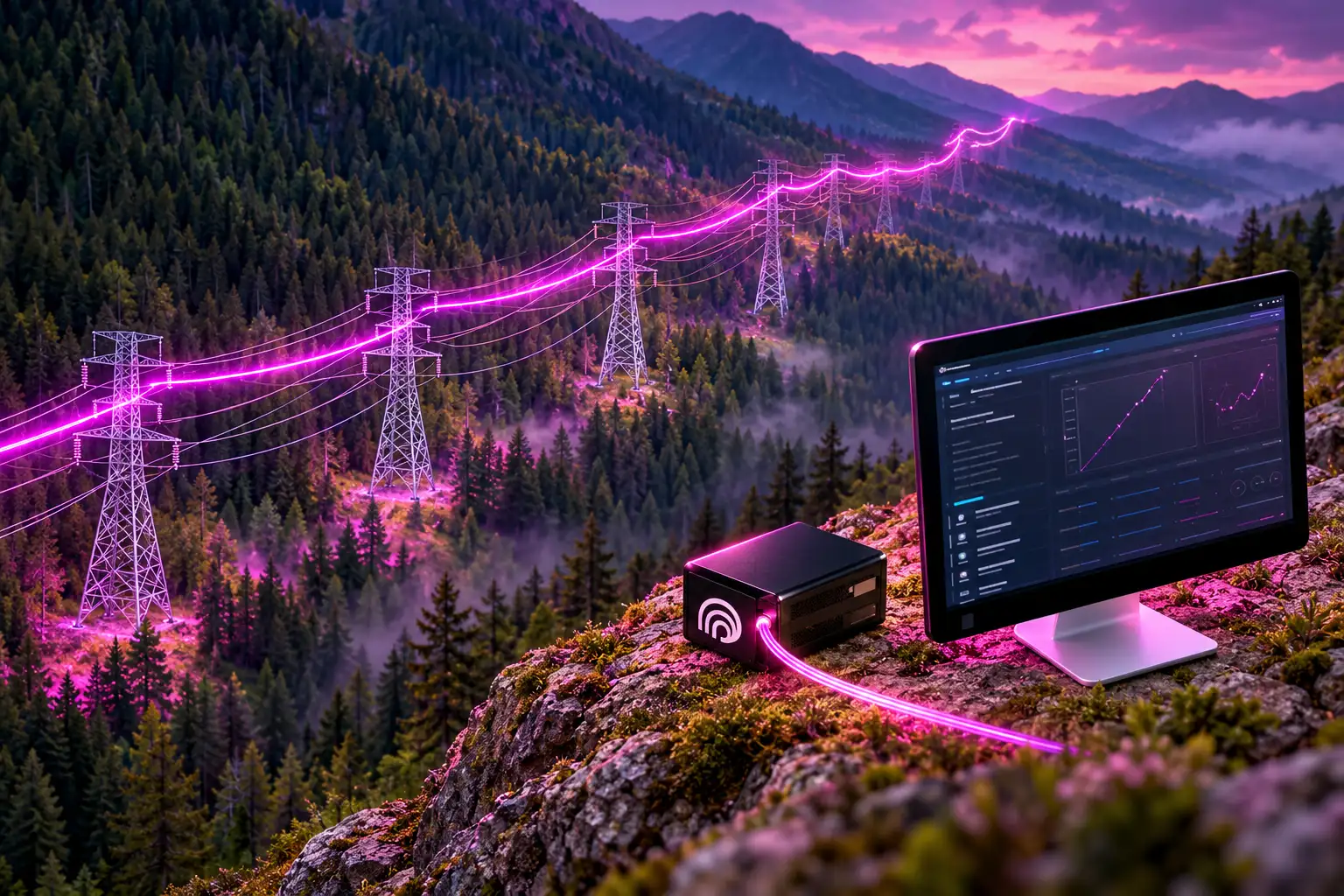
One Dark Fiber Replaces a String of Sensors
Hyper-Scan Fiber-Sensing, Prisma Photonics’ name for the stack, does not put cameras or weather stations on towers. An optical interrogator in a substation is spliced onto one dark fiber inside the optical ground wire that already rides the line. Light pulses go out. The return scatter is the signal.
Dr. Eran Inbar, the chief executive, said the company’s AI “translate[s] raw optical fiber signals into actionable intelligence in real time.” Classification is the product, not a squiggle on a spectrogram. Events are tagged and placed to meter-level accuracy across hundreds of kilometers, the company said, with the model improving as more lines are added.
Other vendors sell distributed acoustic sensing for pipelines, rails, and fences. Prisma Photonics’ pitch to transmission operators is that the same fiber can rate the line, flag a fault, and watch the corridor. Incumbent fiber-test vendors have started shipping their own AI interrogators, so the category is not empty.
WHAT THE FIBER IS ASKED TO HEAR
- Ice and wind: Icing on spans, galloping conductors, and high winds that change how much current a line can carry.
- Electrical faults: Flashovers, short circuits, and partial discharge that wear hardware before it fails.
- Physical hits: Vegetation strikes, tower climbing, vandalism, and, in New York tests, a helicopter hovering over the right of way.
- Fire and weather: Heat and acoustic change along the corridor that the company says can flag a wildfire even where no camera is installed.
The hardware live on the line is the fiber the utility already paid for. Crews still roll to a tower. They are supposed to roll to the right one.
Ice on a Catskill Span, Then 1,000 km in Israel
The New York Power Authority began work with Prisma Photonics after the 2021 NYPA and Israel Smart Energy Challenge. The first live stretch was a 35-mile stretch of NYPA’s 345 kV grid from Gilboa to Fraser, climbing the Catskills. NYPA runs 1,400 miles of transmission and about one-third of the state’s major lines.
Alan Ettlinger, NYPA’s senior director of research, technology development, and innovation, wrote that icing detection mattered most in the cold belts. Data from the fiber was matched to weather feeds, and the control room got a notice while ice was still forming. The company said the Catskill box ran 24 hours a day for 24 months across two winters. On June 12, 2024, NYPA took an APPA Energy Innovator Award for the Catskill trial.
Israel Electric Corporation had been on the fiber since 2020. On January 12, 2023, IEC extended the work so Prisma Photonics would monitor 1,000 km of the national grid, over 620 miles, which IEC put at 20 percent of transmission. Amir Livne, IEC’s senior vice president of strategy and innovation, said the expansion was about keeping supply reliable while demand grew. Inbar called 1,000 km a span “no one has attempted before.”
FROM A TEL AVIV LAB TO THREE CONTINENTS
- 2017: Prisma Photonics is founded in Tel Aviv, with Inbar as chief executive.
- 2020: Israel Electric Corporation begins monitoring transmission fiber with the company.
- 2021: NYPA selects Prisma Photonics in its Israel smart-energy challenge and instruments the Gilboa-to-Fraser line.
- February 9, 2022: A $20 million Series B led by Insight Partners, with SE Ventures and Future Energy Ventures, takes disclosed capital above $30 million at that time.
- January 12, 2023: IEC extends coverage to 1,000 km, 20 percent of its transmission grid.
- September 13, 2023: An approximately $20 million Series C, again led by Insight Partners, takes disclosed capital above $50 million at that time.
- June 2025: The Electric Power Research Institute takes the fiber system into its GET SET grid-enhancing-tech work.
- October 15, 2025: The $30 million growth round closes, taking stated total capital to $80 million.
- December 12, 2025: An 18-month PG&E trial starts on three California corridors.
- March 4, 2026: TransnetBW begins a two-year evaluation on 120 kilometers in southwest Germany.
Those dates are the path the $30 million was hired to extend, not a new invention in 2025.
How Dynamic Line Rating Uses Existing Fiber
Static line ratings assume a hot, still day and leave megawatts on the table for every other hour. Dynamic line rating, or DLR, raises or cuts the limit as wind and heat change. The catch for older DLR kits is local weather stations and point sensors that miss the span that is actually the bottleneck.
Prisma Photonics’ DLR stack, which it also brands PrismaCapacity, claims to measure wind and condition on every span from the same OPGW fiber. The critical span, the hottest or least cooled piece, moves as weather moves. Inbar has described the job as finding that span continuously rather than guessing from a few stations.
EPRI selected the fiber system for GET SET to test whether that span-level rating holds up in independent lab work. Tiffany Menhorn, the company’s sales director, has told industry briefings that partners regularly see 15 to 25 percent more ampacity, and up to 40 percent at a given moment, while staying inside thermal and clearance limits. Those are company figures, not a regulator’s stamp.
In a late September 2026 company update, Prisma Photonics said it was deployed across 20 utilities in North America, EMEA, and Latin America, a wider count than the 15 Tier-1 U.S. and European transmission operators it cited at the October 2025 close. On September 29 and 30, 2026, it presented a wildfire case study at GridFWD in Utah. A booth is planned for the CEATI Transmission and Distribution Conference in Denver on November 17 and 18, 2026.
PG&E Opens Three Corridors to an 18-Month Trial
On December 12, 2025, Prisma Photonics said it had begun an 18-month trial with Pacific Gas and Electric Company on three transmission corridors in San Luis Obispo and Humboldt counties, from coast to mountain. The stated aim is DLR and asset-health data without hanging a new sensor farm on remote towers. Only the interrogator goes in at the substation.
Inbar called the platform “the Swiss Army knife for grid challenges,” a line that covers rating, weather, and resilience in one clause. PG&E did not publish its own technical results with that announcement. The trial is still a trial.
Germany is the other post-close test that can be named. On March 4, 2026, Prisma Photonics announced an evaluation across 120 kilometers in southwest Germany with TransnetBW, one of the country’s four transmission system operators. The program runs two years on three circuits. TransnetBW has been building weather-dependent overhead-line operation since 2019 and already runs about 300 weather stations. Gernot Tuschewitzki, head of the DLR project there, said fiber sensing could let the operator “dynamically control transmission capacity based on actual operating conditions” and also locate lightning and other events “with a single measurement method.”
FOUR LIVE DEPLOYMENTS
| Operator | Place | Reach | Status |
|---|---|---|---|
| New York Power Authority | Gilboa to Fraser, Catskills | 35 miles (56 km), 345 kV | Live monitoring since 2021; APPA award in 2024 |
| Israel Electric Corporation | Israel transmission grid | 1,000 km (over 620 miles) | Live since 2020; 1,000 km deal in January 2023 |
| PG&E | San Luis Obispo and Humboldt, California | Three corridors | 18-month trial announced December 12, 2025 |
| TransnetBW | Southwest Germany | 120 kilometers, three circuits | Two-year evaluation announced March 4, 2026 |
Two of those four are still evaluations. The $30 million did not buy a finished U.S. or German fleet. It bought time on real circuits in fire country and in a grid that is trying to swallow more wind and solar without building every new tower first.
Why a Perimeter and a Power Line Share One Box
Critical infrastructure everywhere is under strain, whether from security threats, extreme weather, or the energy transition. Our AI capabilities allow us to translate raw optical fiber signals into actionable intelligence in real time. That means our technology can protect a military installation one day, and optimize renewable energy integration the next.
Dr. Eran Inbar, CEO, Prisma Photonics, October 15, 2025 announcement
That sentence is why a defense fund led a grid round. The same scatter that flags a climber on a tower can flag a person on a fence. The same wind read that lifts a line rating can warn that a span is galloping. Prisma Photonics lists secured compounds, long remote boundaries, and military perimeters next to power grids and pipelines in its own description of the product.
Defense-tech watchers filed the October 2025 close beside perimeter and drone names, which is the right drawer. Energy investors in the same round, Adara and SE Ventures among them, are buying the DLR and congestion story. Both groups are looking at one interrogator.
False alarms still decide whether a control room trusts the feed. A bad wildfire trip or a bad capacity boost is expensive. Independent EPRI testing and the TransnetBW and PG&E clocks are how that trust gets built, if it does.
Latin America Bought a Seat in the Round
The company has not named the Latin American transmission operator that invested. The structure is the signal. A grid owner that already sits on thousands of kilometers of OPGW is paying for software that lights up fiber it already owns, while it adds wind and solar onto aging lines.
Fiber-sensing trials are already running on South American high-voltage corridors, so the region is not an empty map. Prisma Photonics’ advantage, if it holds, is the library of events from IEC, NYPA, and the 15 U.S. and European operators it counted at the close, plus whatever the 20-utility update later included. The model only compounds if those labels are right.
The $30 million is working capital for a product that does not need a new cable. PG&E’s 18-month trial and TransnetBW’s two-year evaluation are the next public tests of whether that product is a rating tool, a security tool, or both when a dispatcher has to act.
Frequently Asked Questions
Who Founded Prisma Photonics, and What Did He Build First?
Dr. Eran Inbar, who holds a Ph.D. in physical electronics from Tel Aviv University, founded the company in 2017 and remains chief executive. He previously founded V-Gen, a fiber-laser firm that Spectra Physics later acquired, which is the photonics pedigree behind the interrogator rather than a software-only origin story.
What Commercial Model Does Prisma Photonics Use With Utilities?
The company sells on a pay-as-you-grow basis, adding coverage as an operator lights more fiber rather than forcing a full-network hardware buy on day one. That matches a product whose main field kit is a substation interrogator and a spare dark fiber, not a tower-by-tower install.
Which Investors Were on the Cap Table Before the $30 Million Round?
Insight Partners led both the February 2022 Series B and the September 2023 Series C. Earlier and overlapping names include i3 Equity Partners, SE Ventures, Future Energy Ventures (E.ON’s venture platform), Elements, Chione Switzerland, Israel Electric Corporation, and Israel Natural Gas Lines, several of them customers as well as shareholders.
What Product Names Sit on Top of Hyper-Scan Fiber-Sensing?
PrismaPower is the line-monitoring system used in the NYPA and TransnetBW write-ups. PrismaCapacity is the dynamic line rating layer. Beacon is the name used for the units TransnetBW is evaluating on its three circuits, all running on the same underlying fiber-sensing stack.
Where Does Prisma Photonics Sit Outside Tel Aviv?
The company says it is headquartered in Tel Aviv with offices in the United States and Europe. Its September 2023 Series C was framed around U.S. hiring and Austin-based offices, which is the American footprint the 2025 round was meant to scale, alongside the European and Latin American push.

The Court Revisits the Climate Nuisance Door It Left Open

ChatGPT Now Compiles Live Interfaces With GPT-6

A Tanker Attack Moves the War Into Qatar’s Waters

Personio Buys Circula to Own the DATEV Channel

Bluesky Files for .bsky and Enters the Registry Queue

Microsoft’s 96% Cyber Score Sits at 86.3% on the Board

Musk’s $914 Billion Lead Is a Public SpaceX Bet

Free Live Sports Streaming in 2026: What to Watch Without Cable

The Odyssey’s IMAX Film Run Hit a 41-Theater Limit

Endgame Encore’s $86 Million Trial for Infinity Vision
-
 NEWS3 months ago
Microsoft’s 96% Cyber Score Sits at 86.3% on the Board
-
 BUSINESS5 months ago
Musk’s $914 Billion Lead Is a Public SpaceX Bet
-
 SPORTS4 months ago
Free Live Sports Streaming in 2026: What to Watch Without Cable
-
 ENTERTAINMENT3 months ago
The Odyssey’s IMAX Film Run Hit a 41-Theater Limit
-
 ENTERTAINMENT4 months ago
Endgame Encore’s $86 Million Trial for Infinity Vision
-

 ENTERTAINMENT2 years ago
Andrew Garfield’s Spider-Man Films Are No Longer Free
-

 NEWS5 months ago
Singapore’s 3×3 and Surfing Debuts Miss the Medal Stand
-

 NEWS7 months ago
White Sands Footprints Put People in Ice Age New Mexico