
BUSINESS
Sweden Puts 130,000 Companies on a War Footing
Sweden mailed 130,000 workplaces a blue war guide, calling firms integral to total defence while most of that duty stays voluntary and unpaid.

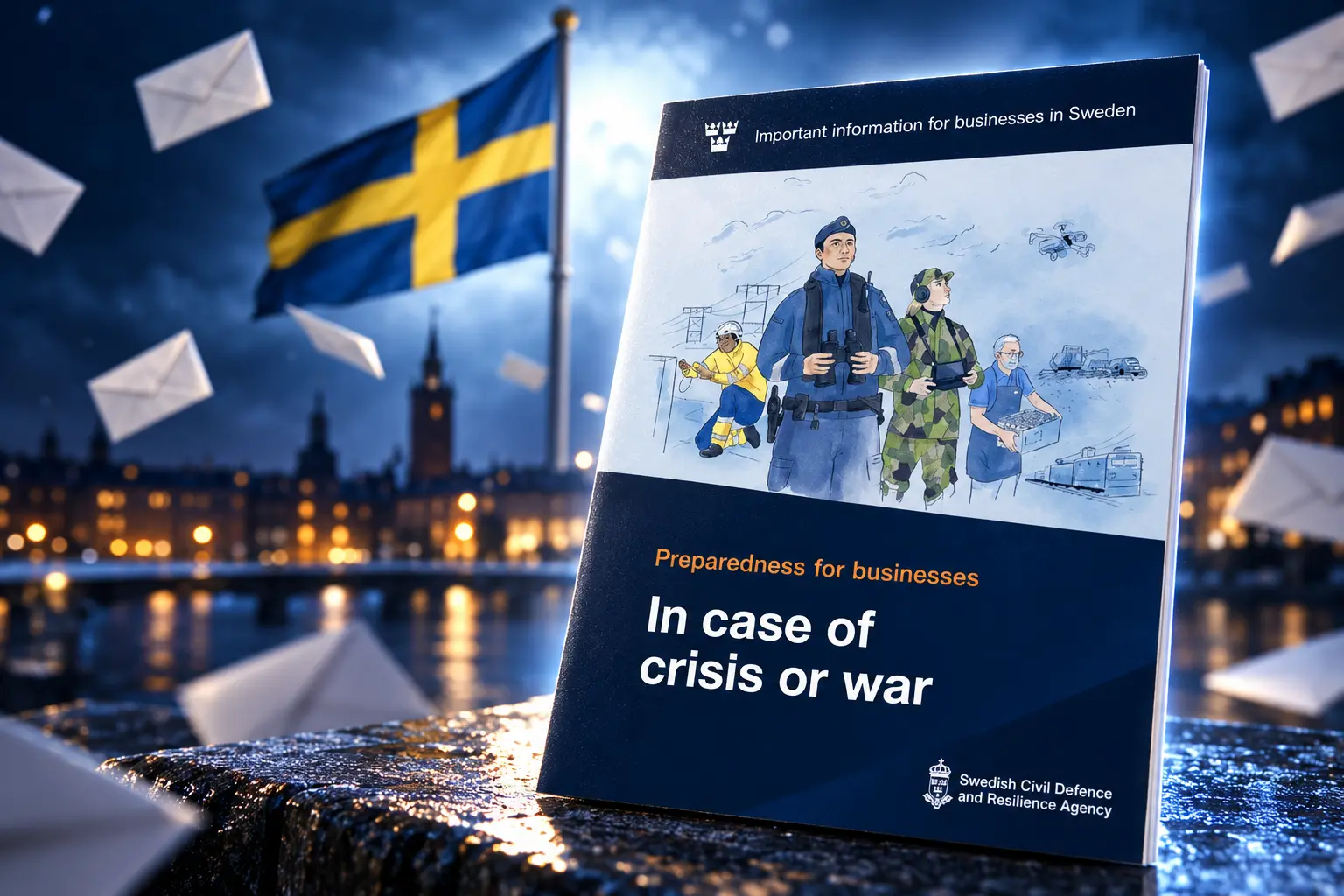
Sweden mailed a crisis-and-war guide to 130,000 workplaces in January 2026, pulling private firms into total defence. The blue booklet tells owners they help the country function if fighting starts, then says most of that job is still voluntary.
The same morning, Civil Defence Minister Carl-Oskar Bohlin ordered 24 agencies to line up supply contracts with companies that can actually deliver. The pamphlet is the public layer. The deals are where the state picks who is in.
A Blue Brochure for 130,000 Workplaces
The Swedish Civil Defence and Resilience Agency mailed to 130,000 workplaces a booklet titled Preparedness for businesses, In case of crisis or war, starting on 20 January 2026. The drop covered sites with five or more staff, about 85 percent of employees in Sweden, and ran through 23 January.
Director-General Mikael Frisell said the military threat had risen and that the country was preparing for an armed attack. “When we are prepared for war, we can also cope with crises,” he said. The agency, still called MSB until 31 December 2025, had been October 2025 order for a business leaflet from the government. It went out under the new name, MCF, three weeks after the switch.
Households already knew the yellow sister booklet, last posted in November 2024 and first sent in 2018. Elisabeth Braw, a senior fellow at the Atlantic Council, noted that the business edition is blue. Civil Defence Minister Carl-Oskar Bohlin had described it in October 2025 as a guide for help to self-help. The printed run is MCF0002, dated January 2026.
FROM COMMISSION TO MAILBOX
- October 2025: The government asks MSB to write a preparedness booklet for companies.
- 1 January 2026: MSB becomes the Swedish Civil Defence and Resilience Agency.
- 13 January 2026: MCF and the Defence Ministry announce the drop.
- 20 January 2026: Mail starts to 130,000 workplaces, and 24 agencies get a contract assignment the same day.
Bohlin said Swedish companies are indispensable for preparedness, and that private actors now carry a large share of the functions society depends on, unlike in the Cold War. The booklet was written with people from business. A functioning private sector, it says, is basic to keeping the country running.
Firms Are Told to Last Three Months
The planning assumptions issued in September 2025 by the Armed Forces and MSB set a hard endurance line. Society should be ready, even in peacetime, to withstand a war in Europe for at least three months. Anyone in critical infrastructure must keep the most vital functions going for at least two weeks, mainly with their own stocks, staff and kit.
Households, in the 2024 public booklet, are told to manage on their own for at least a week. The business text is asking firms for a much longer grind, including power cuts that last days, weeks or months, broken electronic payments, fuel shortages, hits to foreign trade, and staff who cannot get to work.
HOW LONG EACH LAYER IS TOLD TO HOLD
| Who | Endurance asked | Where it is written |
|---|---|---|
| Households | At least one week on their own | 2024 public booklet |
| Critical infrastructure | At least two weeks on their own resources | 2026 business booklet |
| Society as a whole | At least three months in a European war | 2025-2030 planning assumptions |
The seven planning situations behind that clock are hybrid threats, NATO host-nation support, a limited attack on northern Sweden, an attack on Gotland, remote strikes, reinforcement of NATO’s northern flank, and NATO reinforcement in the Baltic region. A company may be asked to help host-nation support with transport, health care, energy or food for allied forces moving through Sweden.
The booklet lists critical infrastructure in plain terms: food, electronic communications, letters and parcels, fuels, metals and construction materials, health and social care, electricity, heat and cooling. Keep the shop open, it argues, and people still have somewhere to go, which feeds the will to defend the country. Experience from Ukraine and from covid is cited for that point.
A 1982 Law Still Binds the Firms
The security situation is serious. The military threat to Sweden has increased and we are now preparing for the worst-case scenario, an armed attack. When we are prepared for war, we can also cope with crises.
Mikael Frisell, Director-General, Swedish Civil Defence and Resilience Agency
Two pages later the same booklet states a largely voluntary total defence role. “It is in your interest that your operations can continue even under disrupted conditions,” it tells the reader. That sentence is doing a lot of work for a state that has just called business a cornerstone of resilience.
The next paragraph points to Act (1982:1004) on the obligation for business operators, labour market organisations and others to take part in total defence planning. If a total defence agency asks, a company must join that planning and hand over facts on staff, premises, machines, production, energy, raw materials, stocks, purchases and deliveries. Some public contracts already raise the bar for force majeure in a raised alert or war.
WHAT THE STATE CAN STILL DO
- Planning duty: A firm must take part in total defence planning when a total defence agency requests it, under the 1982 act.
- Emergency powers: After an emergency alarm, the government may ration goods, regulate prices or commandeer private property.
- Contract lock-in: Deals with public bodies can require performance in war and make it harder to walk away.
- Shelter duty: A property owner must make a civil defence shelter ready within 48 hours.
Staff aged from the year they turn 16 to the year they turn 70 carry total defence duty from 16 to 70. Most employees are expected to keep working. People with a wartime posting in the Armed Forces, in civil defence service, or in a voluntary defence organisation can be pulled away. Peacetime employment contracts remain valid. A five-person workshop can lose its electrician to a wartime post and still be told to keep producing.
The booklet’s political line is blunt. “If Sweden is attacked, we will never surrender. Any suggestion to the contrary is false.” That is printed in a pamphlet for shopkeepers and plant managers, not only for conscripts.
27 Percent Have a Plan for War
MCF released a Novus survey on 4 February 2026, fielded among 1,047 organisations between 26 November and 9 December 2025, just before the booklet landed. The figures show why a mail-out was cheap compared with the work it asks for.
WHAT NOVUS FOUND
- War plan: 27 percent had a plan for heightened alert or war.
- Crisis plan: 41 percent had a plan for a major societal crisis.
- Biggest block: 36 percent named lack of time as the main obstacle.
- Direction of travel: 56 percent said they work more on preparedness than they did two to three years earlier.
Anna Rinne, who leads MCF’s unit on supply preparedness, said companies are decisive for keeping goods and services flowing. “We know that all companies cannot do everything, but everyone can do something,” she said. Time, not a missing pamphlet, is the constraint those numbers describe. Backup generators, extra stock and a second supplier cost money and calendar space that a small plant often does not have.
A government mapping in May 2026 counted about 1.2 million companies in Sweden, most of them one-person firms, and about 40,000 with more than 10 staff. The mail-out starts at five employees, so it reaches far beyond the large operators that already sit in total defence forums. The Business Council for total defence and crisis preparedness was set up in 2023, and a national adviser on public-private work was named in 2024. Those rooms are not where a five-person firm spends its Tuesdays.
The Contract Round Starts at 24 Agencies
On 20 January 2026, the day the booklet began to land, Bohlin 24 agencies to review supply deals that would keep necessary goods and services flowing in a peacetime crisis, a raised alert, or war. “There is not a single task within total defence that can be solved long-term without the business sector,” he said. All 67 preparedness agencies were told to work more systematically on supply. MCF is to write method support and keep a national register.
I en orolig omvärld prioriterar regeringen att bygga ett stöttåligt land. Nu ger regeringen 24 myndigheter i uppdrag att teckna försörjningsberedskapsavtal med företag som kan leverera samhällsviktiga varor och tjänster och därigenom stärka försörjningsberedskapen. Bit för bit…
— Carl-Oskar Bohlin (@CarlOskar) January 20, 2026
The 24 named bodies include Svenska kraftnät, the National Food Agency, the Swedish Transport Administration, the Post and Telecom Authority, the National Board of Health and Welfare, the Police, the Coast Guard, the Civil Defence and Resilience Agency itself, and the energy, agriculture and veterinary agencies. They are to identify what they must have, then sign with firms if they need to. That is a different instrument from a booklet. A contract can pay for stock, set delivery times and close the force majeure door. A pamphlet cannot.
The funding sitting behind the rebuild is public money for the state, not a cheque to every mailbox. The government in September 2025 put about SEK 12 billion for 2026-2028 (about $1.1 billion) into civil defence, including stockpiles of health products, food reserves, shelter repairs, and help for municipalities and regions. That is the extra package on top of a wider climb from about SEK 2.7 billion in 2022 toward SEK 19.4 billion in 2028. None of those lines automatically buys a bakery a second flour mill.
The Transport Companies’ group has told members there is no general preparedness duty that hits every firm the same way. Formal requirements arrive through law, a contract, or an agency decision. A wartime organisation is normally required only if an agency designates the company. That reading matches the booklet. It also matches the 20 January assignment: the state will bind the firms it cannot do without, and advise the rest.
What Happens to a Five-Person Firm?
The booklet is written so a family shop and a multinational can both use it. That is the design. It is also the strain. A listed energy company can hire a continuity team. A five-person workshop is being asked to map dependencies, drill a crisis group, train staff against disinformation, and think about NATO transit, with the same eight headings and no extra staff.
THE EIGHT THINGS THE BOOKLET ASKS
- Plan and drill: Practise for serious crises and war, using the seven planning situations.
- Map dependencies: Find what the operation needs, then add backup power, stocks and spare routines.
- Staff the gaps: Name key posts, remote work, redistribution and extra people, including wartime absences.
- Stand up a crisis group: Give clear roles and contact lines, and print lists because networks may die.
- Lock down cyber: Review logins, keep backups, treat information as a vital asset.
- Train for lies: Teach source criticism and how to handle disinformation.
- Exercise often: Even a short drill counts.
- Be ready to switch: Adapt to what society needs, and talk to agencies before the crisis.
Those steps are rational. They are also a transfer of Cold War state work onto company time. In the old total defence system the state owned more of the stocks, the shelters and the plans. After the 1990s much of that was wound down. Private operators now run large parts of energy distribution, food, logistics and communications. Bohlin said so himself. The blue booklet is how Stockholm tells those operators the gap is theirs to close.
Some of that is already happening in the open. Co-operatives in food, fuel and housing have been putting their own preparedness on paper. Tech employers have pointed members at the MCF site. Sports clubs and churches were on the distribution list beside companies. Preparedness talk has left the defence ministry and reached ordinary boards. That spread is real. So is the split between a firm that will be offered a paid supply deal and a firm that will not.
The pamphlet went to 130,000 workplaces. The binding work now sits in contracts those 24 agencies were told to write. For everyone else, the war plan is still a blue booklet and a 1982 law that sleeps until someone knocks.
Frequently Asked Questions
Can Companies Still Order the 2026 Business Brochure?
Yes. MCF posted Swedish and English files for download, and workplaces that had not received a printed copy by week 6 of 2026 could order one. Organisations may order up to 1,200 copies and private persons up to five, sent only to Swedish addresses. The same drop also went to foundations, churches and sports clubs, not only to limited companies.
Must Every Swedish Company Create a Wartime Organisation?
No. The transport employers’ group says there is no general rule that every firm must build a wartime organisation or a formal crisis staff. That duty normally appears only if an agency designates the company or writes it into a contract. Public deals can also raise the threshold for force majeure, so a supplier may have to keep delivering when an ordinary commercial clause would have let it stop.
Who Is Covered by Sweden’s Total Defence Duty?
Everyone who lives in Sweden, from the year they turn 16 to the year they turn 70, and Swedish citizens abroad in the same age band. The duty can be military service, civil defence service, or general national service in the job a person already holds. In a raised alert the government can declare general compulsory national service so essential work continues. Employers are told to check wartime postings with the Swedish Defence Conscription and Assessment Agency before they assume a key person will be at the bench.
How Many Civil Defence Shelters Does Sweden Have?
About 64,000 registered shelters, with room for about 7 million people. They must be usable within 48 hours of a raised alert, and the property owner is responsible for making that possible. No new public shelters have been built since 2002, and inspections now run on a national queue rather than on demand. The business booklet reminds employers that workplace shelters are public, not reserved for staff.
How Much Has Sweden Raised Civil Defence Spending?
The government describes a sevenfold rise, from about SEK 2.7 billion in 2022 to about SEK 19.4 billion in 2028. On top of that path, the Budget Bill for 2026 added a package of about SEK 12 billion across 2026, 2027 and 2028 for medical stocks, food reserves, shelter repairs and municipal preparedness. That money flows through agencies and local government. It does not land as a grant in every company that received the blue booklet.

The Court Revisits the Climate Nuisance Door It Left Open

ChatGPT Now Compiles Live Interfaces With GPT-6

A Tanker Attack Moves the War Into Qatar’s Waters

Personio Buys Circula to Own the DATEV Channel

Bluesky Files for .bsky and Enters the Registry Queue

Microsoft’s 96% Cyber Score Sits at 86.3% on the Board

Musk’s $914 Billion Lead Is a Public SpaceX Bet

Free Live Sports Streaming in 2026: What to Watch Without Cable

The Odyssey’s IMAX Film Run Hit a 41-Theater Limit

Endgame Encore’s $86 Million Trial for Infinity Vision
-
 NEWS3 months ago
Microsoft’s 96% Cyber Score Sits at 86.3% on the Board
-
 BUSINESS5 months ago
Musk’s $914 Billion Lead Is a Public SpaceX Bet
-
 ENTERTAINMENT3 months ago
The Odyssey’s IMAX Film Run Hit a 41-Theater Limit
-
 SPORTS4 months ago
Free Live Sports Streaming in 2026: What to Watch Without Cable
-
 ENTERTAINMENT4 months ago
Endgame Encore’s $86 Million Trial for Infinity Vision
-

 ENTERTAINMENT2 years ago
Andrew Garfield’s Spider-Man Films Are No Longer Free
-

 NEWS5 months ago
Singapore’s 3×3 and Surfing Debuts Miss the Medal Stand
-

 NEWS1 month ago
An AI Lung Drug Shifted Biological Age Clocks in Patients