
BUSINESS
State Delays Split India’s Four Labour Codes This Autumn
Ten months after India’s four Labour Codes took effect, only six of 37 jurisdictions have a full rulebook, and the Centre wants the rest gazetted by 31 October.

Labour Secretary Chandra Bhushan Kumar has asked every state and Union Territory to publish rules under India’s four Labour Codes by 31 October 2026. Ten months after the codes took effect on 21 November 2025, that date is a hope the Centre cannot flip on its own.
Labour sits on the Concurrent List. Most factories, shops and warehouses answer to a state government, and most of those governments still have draft rules, not gazetted ones.
October 31 Is a Centre Date on a State Subject
Kumar said it at a PHD Chamber of Commerce and Industry seminar in New Delhi on 24 September 2026, while launching a Grant Thornton Bharat report titled “India’s new labour codes: From reform to readiness.” He had already met the states, he said, and he wanted their rules printed by month-end.
I had a personal meeting with all the states and UTs, and we are hoping we will have the rules at the state level by October 31. So this is going to be a major, major exercise because the appropriate government in most of the cases where our industries operate and trade operates is the state government.
Chandra Bhushan Kumar, Secretary, Ministry of Labour and Employment, PHDCCI seminar, 24 September 2026
He put the published-some count at 10 states and UTs. Barring one state, the rest had at least pre-published drafts for comment. The ministry, he added, would issue master FAQs and was still talking to states about a statutory floor wage.
The four codes merged 29 central labour laws covering wages, industrial relations, social security, and occupational safety. They have been law since 21 November 2025. The Centre notified matching Central Rules on 8 May 2026, including the Wages Central Rules of 8 May as G.S.R. 343(E), with the Industrial Relations (Central) Rules as G.S.R. 342(E) the same day.
Official messaging still treats that consolidation as the story. Make in India’s account posted the same simpler-codes line on 2 October 2026.
29 legacy labour laws brought together under 4 Labour Codes.
Simpler work rules are supporting clearer compliance and easier business operations.#12YearsOfMakeInIndia pic.twitter.com/CI36qwLQGF— Make in India (@makeinindia) October 2, 2026
The fight that actually landed on HR desks is narrower. Until a state gazette matches the Centre, payroll, leave, contract labour and inspections in that state still run on a mix of new code text and old state rules.
Andhra Pradesh Has a Full Set; Maharashtra Does Not
A state-by-state gazette tracker last verified on 2 October 2026, compiled from central and state notifications, puts the full-set count at 6 of 37 jurisdictions. Four have a partial set. Twenty-seven have notified none. Those 6-plus-4 also add to the 10 that have notified at least one code, which is the same cut Kumar described as published final rules.
WHERE THE FOUR CODES STAND
| Jurisdiction | Wages | IR | OSH | Social Security | Set |
|---|---|---|---|---|---|
| Centre | Notified | Notified | Notified | Notified | 4 / 4 |
| Andhra Pradesh | Notified | Notified | Notified | Notified | 4 / 4 |
| Gujarat | Notified | Notified | Notified | Notified | 4 / 4 |
| Bihar | Notified | Notified | Notified | Notified | 4 / 4 |
| Arunachal Pradesh | Notified | Notified | Notified | Notified | 4 / 4 |
| Ladakh | Notified | Notified | Notified | Notified | 4 / 4 |
| Rajasthan | Notified | Notified | Notified | Draft | 3 / 4 |
| Lakshadweep | Notified | Draft | Draft | Draft | 1 / 4 |
| Maharashtra | Draft | Draft | Draft | Draft | 0 / 4 |
| Karnataka | Draft | Draft | Draft | Draft | 0 / 4 |
| Tamil Nadu | Draft | Draft | Draft | Draft | 0 / 4 |
| Haryana | Draft | Draft | Draft | Draft | 0 / 4 |
The finished list is not the factory belt. Gujarat is the large industrial exception. Maharashtra, Karnataka, Tamil Nadu, Telangana, Haryana, Punjab and Delhi remain on drafts. A multi-state payroll now keeps two clocks: the Central Rules for mines, railways, central public sector and other central-sphere units, and whatever each host state has actually printed.
Uttar Pradesh has been briefing industry anyway. Labour minister Anil Rajbhar held a state seminar on the new codes at India Expo Mart in Greater Noida on 28 September 2026 and walked factory health camps the same day. Briefings are not gazettes. Until a notification lands, a plant in Noida still has to read the old Uttar Pradesh rulebook against the new code text.
What the Four Codes Already Changed for Payroll
Some of the statute does not wait on a state rule. Minister of State for Labour and Employment Shobha Karandlaje told the Lok Sabha that provisions which need no rules are already in force, in a written Lok Sabha reply on implementation. That is why wage definitions, headcount gates and fixed-term gratuity showed up in CTC reviews months before most states finished drafting.
CHANGES ALREADY IN THE STATUTE
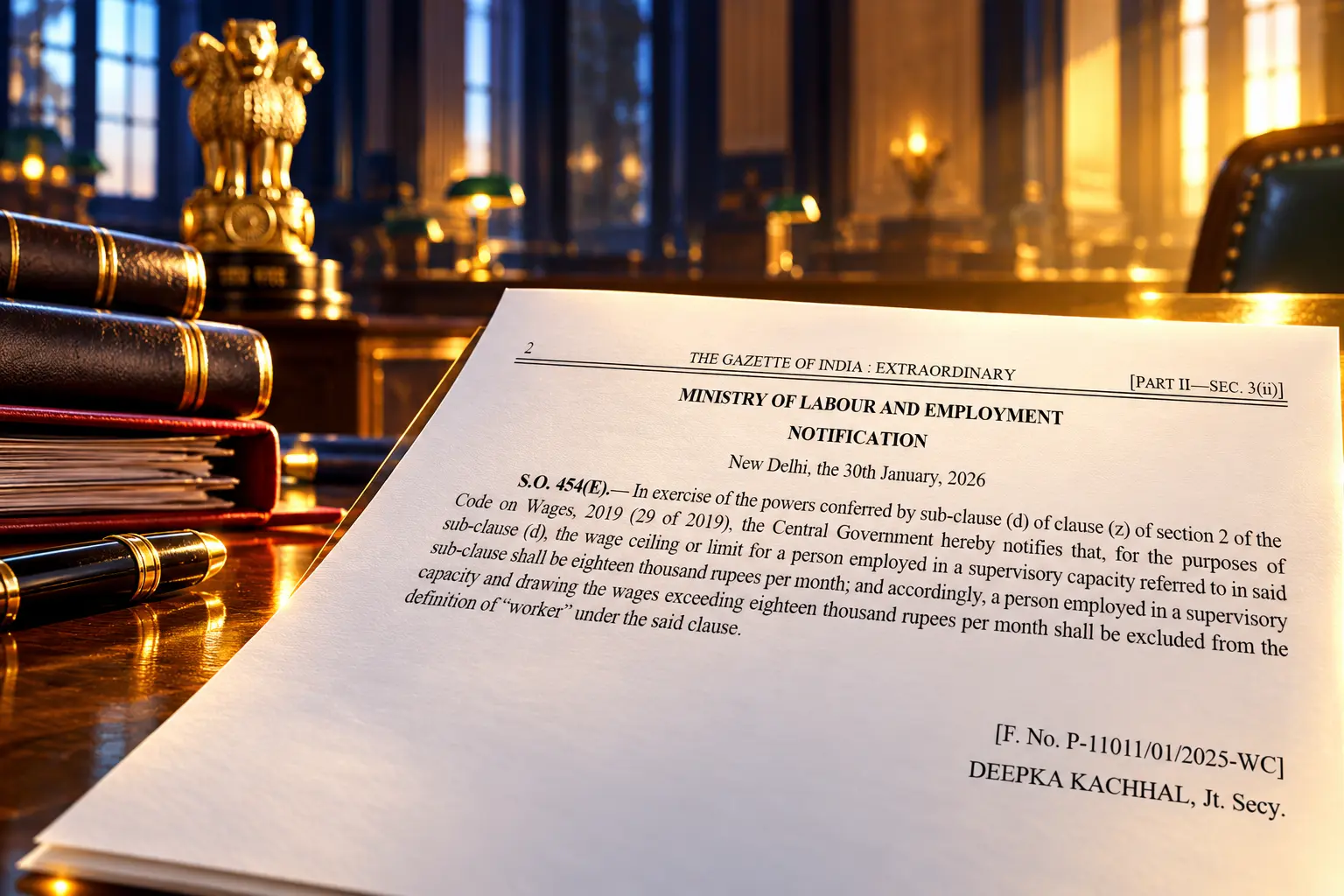
- Who counts as a worker: Supervisory staff earning up to ₹18,000 a month now fall inside the worker definition, along with sales promotion staff and journalists, which pulls more people into retrenchment math.
- Fixed-term gratuity: A fixed-term employee becomes eligible for gratuity after one year of service and takes other statutory benefits on a pro-rated basis.
- Layoff permission: Factories and other industrial establishments need prior government permission for layoff, retrenchment or closure only at 300 or more workers, up from 100.
- Standing orders: The certified standing-order duty now starts at 300 workers, not 100, so mid-size units drop out of that certification net.
- Full and final pay: Wages due on termination, resignation or retrenchment are to be paid within two working days.
- Overtime: Extra hours are paid at twice the regular wage, with daily hours still capped at eight and spread-over at 12 unless a state sets the roster another way.
- Re-skilling fund: An employer who retrenches a worker must credit 15 days of last-drawn wages to that worker’s account within 45 days, on top of retrenchment compensation.
- Grievance desks: Establishments with 20 or more workers must run a grievance redressal mechanism.
The wage definition is the change that hits every payroll file. Basic pay, dearness allowance and retaining allowance sit inside “wages.” Housing, medical attendance, travel concessions and sales commissions sit outside, subject to a 50 percent test that pulls excess allowances back in. Gratuity on that new base applies from 21 November 2025. Companies that booked December as year-end still had to cut the line on the enforcement date, the ministry has said.
PAPER THE CENTRE SAYS IT CUT
- Rules: 1,436 down to 351.
- Returns: 31 filings replaced by one electronic return.
- Registers: 84 down to 8.
- Forms: 181 down to 73.
Those cuts are real for a central-sphere establishment that already files on the Shram Suvidha stack. They do not travel to a Pune or Hosur plant until Maharashtra or Karnataka gazette their own rules and plug the same single return. Grant Thornton Bharat told the same seminar that wage mapping, worker classification and contract-labour coverage were still the live headaches ten months in, because HR systems were built for the old acts.
Factories Between 100 and 300 Workers Lost the Old Gate
The 300-worker line is the clause unions will not drop. Under the Industrial Disputes Act, 1947, a unit with 100 or more workers needed government permission before a layoff, retrenchment or closure. The Industrial Relations Code, 2020 lifts that gate, and the standing-order duty, to 300. Notice and retrenchment pay still apply below that line. Prior permission does not.
Mallikarjun Kharge, Congress president and Leader of the Opposition in the Rajya Sabha, put the opposition case on the record when the codes were notified, and the same numbers are still the ones CITU chants at district chowks.
Layoff threshold raised from 100 to 300 workers i.e. more than 80% of factories in India can now lay off or retrench workers without government approval, reducing job security.
Mallikarjun Kharge, Congress president and Leader of the Opposition, Rajya Sabha, 3 December 2025
He also flagged the 14-day strike notice plus a 60-day wait, the 51 percent rule for a sole negotiating union, and the treatment of a 50 percent mass leave as a strike. The ministry’s reply has been that eight-hour days remain, that compensation remains, and that the higher threshold is flexibility with notice, not a free hand.
On the street the argument has not moved. CITU burnt copies of the codes after the May rules, joined a 12 February 2026 general strike, and marked 1 April as a “Black Day.” On 29 September 2026 more than 5,000 workers marched in Guwahati under the CITU Assam committee, demanding a halt to the codes in the state, a ₹800 daily minimum wage, and worker status for Anganwadi, ASHA and mid-day-meal staff. State general secretary Tapan Sarma gave the labour department until October, then threatened to shut its offices from 1 November.
A plant with 180 workers sits in the gap those marches are about. It no longer needs permission to retrench. It also no longer needs certified standing orders. That is a cleaner exit for the employer and a thinner file for the worker, and it is already in force whether or not the host state has finished its rules.
Floor Wage Machinery Exists, the Figure Does Not
The Code on Wages, 2019 created a floor wage under Section 9, a device the 1948 Minimum Wages Act never had. The Central Government must fix it against a worker’s minimum living standards. States may not notify a minimum rate below it, and they may not cut a higher rate down to it. Different floors may be set for different areas. Employers never pay the floor. They pay the state or central minimum, which the floor is supposed to prop up.
Rule 10 of the Wages (Central) Rules, 2026, in force since 8 May 2026, sets the method: consult the Central Advisory Board on food, clothing and housing, circulate that to the states, then fix and revise on an ordinary five-year cycle, with cost-of-living top-ups in between. Section 9 is in force. Rule 10 is in force. No floor wage figure has been notified. Law stated as on 20 July 2026 records the machinery and does not record a number. On 24 September Kumar said a committee had been formed and talks with states were on. That is still a process, not a rate.
Until a figure exists, the old pattern holds. Each state keeps its own minimum, revised on its own calendar, which is why Andhra Pradesh could move rates from 1 October 2026 while a neighbouring draft-rule state still pays last year’s schedule. The first national number a multi-state payroll could sanity-check against has not been printed.
Gig Aggregators Owe a Levy Before Benefits Land
The Code on Social Security, 2020 is the first central law to define gig workers and platform workers. Aggregators can be told to pay between 1% and 2% of annual turnover into a social security fund, capped at 5% of the amount paid to those workers. Draft and then final central rules set a 90-day engagement test for a worker on one platform, and 120 days across several, before scheme eligibility. Registration runs through e-Shram, with Aadhaar seeding and a duty on aggregators to update entries in real time.
Labour Minister Mansukh Mandaviya told the Rajya Sabha in late July 2026 that NITI Aayog had counted 80 lakh gig workers and that 10 lakh were already on e-Shram. NITI Aayog has separately projected 23.5 million by 2030. Identity cards and a path into Ayushman Bharat PM-JAY health cover have been announced around that database. The levy and the 90-day test are in the rules. The monthly payout a rider can point to is not.
Shaik Salauddin, national general secretary of the Indian Federation of App-Based Transport Workers, put the worker question in one line when aggregator onboarding deadlines were running in June 2026: workers were asking what they would get from e-Shram, when it would arrive, and whether it would beat cover the platforms already sell. That gap is why an earlier briefing for startups and gig platforms read the codes as a clarity play, and why the file in 2026 reads more like a registration drive.
India also abstained in June 2026 when the International Labour Conference adopted Convention No. 193 on decent work in the platform economy. Mandaviya’s defence was that India had already given gig workers legal status and needed flexibility for its own model. The abstention leaves classification, algorithmic management and a global pay floor outside any treaty a worker could sue on. Rajasthan’s 2023 platform-worker Act, and similar bills in Karnataka and Telangana, remain the sharper state-level tools while the central fund is still being built.
How Old Labour Rules Still Apply During the Switch
Karandlaje’s Lok Sabha answer is the operating instruction for every factory manager who asked which Act to open on Monday morning. During the switch, existing rules, notifications and schemes under the repealed laws continue so far as they are not inconsistent with the codes, so there is no vacuum. The ministry FAQs on the transition rest that on Section 6 of the General Clauses Act, 1897: old rules stay until new ones are finally notified, to the extent they line up with the codes.
THE SWITCH FROM NOTIFICATION TO STATE GAZETTES
- 21 November 2025: All four Labour Codes take effect nationally.
- 30 December 2025: Draft Central Rules published, including G.S.R. 936(E) on wages, with a 45-day comment window on three codes and 30 days on industrial relations.
- 12 February 2026: Central trade unions hold a nationwide general strike against the codes.
- 8 May 2026: Final Central Rules notified under all four codes.
- 15 July 2026: Corrigendum G.S.R. 629(E) corrects the short title of the wages rules.
- 24 September 2026: Labour Secretary Kumar asks states to publish rules by 31 October 2026.
- 31 October 2026: Centre’s target date for state and UT rules to be in the gazette.
The clashes that produce dual files are small and expensive. The codes let workers carry forward 30 days of leave and encash the rest. Maharashtra’s Shops and Establishment Act still speaks of 45 days carried, with unused casual leave lapsing. The OSH Code wants one electronic registration. Haryana’s 1958 Shops Act still wants its own intimation. ESI cover, the ministry has said, keeps the ₹21,000 monthly wage threshold until a fresh notification, even though the wage definition itself changed on 21 November 2025.
Kumar said the ministry is running awareness drills across 316 industrial-cluster districts and training state officers. PHDCCI’s Ranjeet Mehta asked for rules simple enough that an MSME does not need a lawyer to read them. Both can be true at once. The Centre has cut the central paper. The states that host the plants have not finished the matching set. A unit in Gujarat can close the old registers. A unit in Maharashtra, Karnataka or Tamil Nadu still runs two books, and 31 October 2026 will only change that if those gazettes actually print.
Disclaimer: This article is news reporting and analysis of India’s Labour Codes and related state rules. It is informational only and is not legal, payroll, tax or human-resources advice. It does not tell any employer how to rewrite contracts, wage structures, gratuity, provident-fund or ESI calculations, and it does not tell any worker how to file a claim. Readers should consult a qualified labour-law practitioner or chartered accountant licensed in the relevant state before acting on any provision. Notification counts, wage bases and scheme statuses follow the gazettes, ministry replies and tracker cited here and will change when a state or the Centre issues a fresh notification.

The Court Revisits the Climate Nuisance Door It Left Open

ChatGPT Now Compiles Live Interfaces With GPT-6

A Tanker Attack Moves the War Into Qatar’s Waters

Personio Buys Circula to Own the DATEV Channel

Bluesky Files for .bsky and Enters the Registry Queue

Microsoft’s 96% Cyber Score Sits at 86.3% on the Board

Musk’s $914 Billion Lead Is a Public SpaceX Bet

The Odyssey’s IMAX Film Run Hit a 41-Theater Limit

Free Live Sports Streaming in 2026: What to Watch Without Cable

Endgame Encore’s $86 Million Trial for Infinity Vision
-
 NEWS3 months ago
Microsoft’s 96% Cyber Score Sits at 86.3% on the Board
-
 BUSINESS5 months ago
Musk’s $914 Billion Lead Is a Public SpaceX Bet
-
 ENTERTAINMENT3 months ago
The Odyssey’s IMAX Film Run Hit a 41-Theater Limit
-
 SPORTS4 months ago
Free Live Sports Streaming in 2026: What to Watch Without Cable
-
 ENTERTAINMENT4 months ago
Endgame Encore’s $86 Million Trial for Infinity Vision
-

 ENTERTAINMENT2 years ago
Andrew Garfield’s Spider-Man Films Are No Longer Free
-

 NEWS5 months ago
Singapore’s 3×3 and Surfing Debuts Miss the Medal Stand
-

 NEWS7 months ago
White Sands Footprints Put People in Ice Age New Mexico