
NEWS
Eseye Hera Routers Sell One Global Connectivity Contract
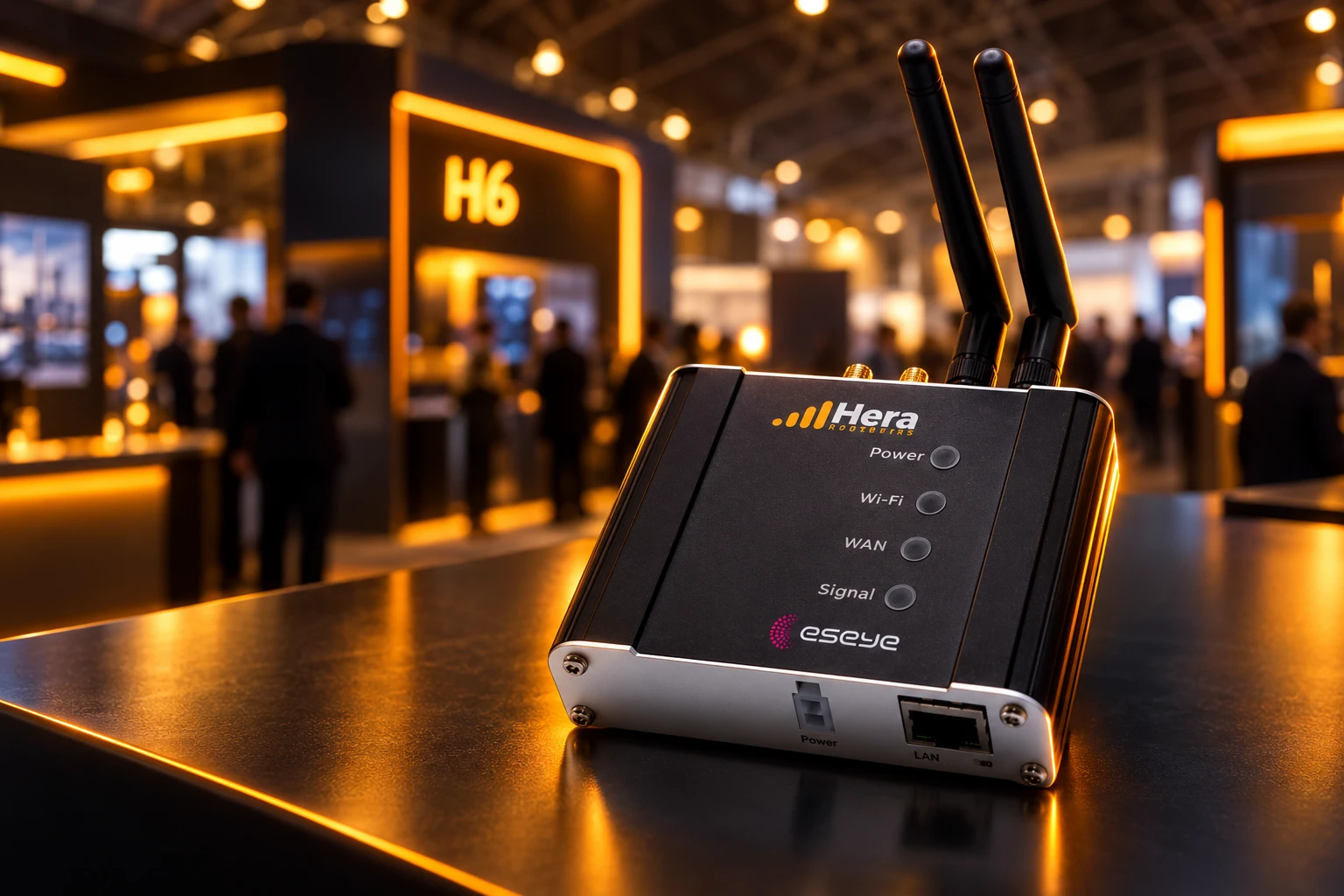
Eseye’s Hera 200 and 600 series, shown in London in April 2025, wrap AnyNet eSIM into the box so fleets can run one connectivity contract across 190 countries.

Eseye put Hera 200 and Hera 600 IoT routers on booth H6 at Hardware Pioneers MAX on 23 April 2025, and offered new customers up to 35% off recommended retail price. The Guildford company, which has built cellular IoT gear since 2007, called the aluminium boxes a plug-and-play fix for firms that still juggle regional SIMs and operator contracts.
The boxes were not new. The Hera 200 had already been launched in April 2024. What the London stand was really moving was the contract wrapped around them: Eseye’s AnyNet eSIM, sold with the router, with access to over 800 mobile networks across 190 countries.
A Two-Day London Stand for an Older Box
Hardware Pioneers MAX ran on 23 and 24 April 2025 in London at the Business Design Centre on Upper Street. The show billed itself at about 5,000 visitors and 150 exhibitors, a compact UK stop for embedded and IoT teams rather than a global launch pad.
Eseye’s own notice that morning listed Wi-Fi, Bluetooth Low Energy and serial ports on the Hera series, plus an MQTT agent and device management over TR-069 or LwM2M. It also pushed in-house hardware design and rapid prototyping from the same booth. Ian Marsden, Eseye’s co-founder and CTO, put the pitch in one line about SKUs, not radios.
Customers face a fragmented landscape of connectivity options, leading to significant complexity, deployment delays and increased costs. Our Hera series directly tackles this challenge by offering a true plug-and-play global IoT solution. With our AnyNet+ eSIM providing access to hundreds of networks, businesses can now deploy their IoT devices anywhere in the world with a single SKU, simplifying operations and accelerating time to market.
Ian Marsden, CTO, Eseye announcement, 23 April 2025
That “single SKU” line is the claim the stand was built to sell. Eseye’s own radio tables, and the way Costa Express now buys the stack, show what it does and does not cover.
HERA DATES AROUND THE LONDON STAND
- 9 April 2024: Eseye launches the Hera 200 at Embedded World on World IoT Day, calling it the smallest router it has shipped, with AnyNet+ eUICC built in.
- 23 April 2025: The Hera 200 and 600 series go on booth H6 at Hardware Pioneers MAX, with a show discount of up to 35% off RRP for new customers.
- 24 April 2025: The second day of the London show closes; the discount is tied to attendance, not to a new product family.
- February 2026: Eseye’s HeraConnect pages sell the same combination as fully managed fixed wireless access, router plus eSIM plus central management under one service.
A year before the London stand, the Hera 200 was already the compact, DIN-mount unit in the range. The 600 series, whose LTE model is the Hera 604, had been in customer machines for years. Hardware Pioneers was a sales window, not a birth announcement.
What the Hera 200 and 604 Ship
The Hera 200 is Eseye’s smallest 4G router, a Cat 4 LTE unit rated at 150 Mbps down and 50 Mbps up, with dual-SIM cellular (an embedded AnyNet+ eUICC plus a removable card), one fast Ethernet port, and optional 802.11ac Wi-Fi that cannot run 2.4 GHz and 5 GHz at the same time. Remote admin on the 200 pages is TR-069, SSH, CLI, HTTP, HTTPS or SMS. The case is rugged aluminium, and the unit is meant to sit on a DIN rail or in an outdoor cabinet.
The Hera 604 is the LTE model in the 600 series. Eseye’s current specifications give it Cat 13 LTE, 400 Mbps down and 150 Mbps up, an embedded AnyNet SIM plus two Mini (2FF) slots, four 10/100/1000 Ethernet ports, and concurrent 2.4 GHz and 5 GHz 802.11ac Wave 2 Wi-Fi. Two serial ports can be RS232, RS422 or RS485. Wall-mount dimensions are 155 x 140 x 28 mm at 0.5 kg, on 12 VDC, drawing up to 10 W, between minus 20 C and 55 C.
HERA 200 VERSUS HERA 604
| Attribute | Hera 200 | Hera 604 (600 series LTE) |
|---|---|---|
| LTE class | Cat 4, 150 Mbps down / 50 Mbps up | Cat 13, 400 Mbps down / 150 Mbps up |
| SIM layout | Dual-SIM, including embedded AnyNet+ | Embedded AnyNet plus two Mini 2FF slots |
| Local ports | One fast Ethernet; optional non-concurrent Wi-Fi | Four gigabit Ethernet; concurrent dual-band Wi-Fi; two serial ports |
| Onboard apps | Routing, firewall, TR-069 management | Serial/Modbus to MQTT, serial to IP, Health Monitor, LwM2M and TR-069 |
| How it is sold | Compact IoT router with AnyNet+ | Also on a hardware-as-a-service basis, minimum order applies |
The 604’s hosted apps are the tell. Serial to IP, UDP/TCP to MQTT, serial to MQTT and Modbus to MQTT sit on the box so a coffee machine or a fuel controller can push sensor data without a second gateway. Eseye’s 600-series pages still talk about “fast Ethernet” and older Wi-Fi letters; the Hera 604 specification sheet is the current radio and port list, and it is the one that matches the Costa Express install.
The eSIM Does the Border Work the Radio Cannot
AnyNet is an eUICC SIM. Profiles can be rewritten over the air, so a device can leave a factory with a bootstrap network and later take a local operator profile where permanent roaming is restricted. Eseye’s own eSIM notes say Hera units (EU, USA and rest-of-world models) carry that embedded chip plus a physical SIM. Hardware teams elsewhere describe the same pattern as eUICC-enabled SIMs with remote profile switching: one commercial SKU for the subscription, even when the plastic card is still there as a fallback.
That is the job Marsden was selling as a single SKU. It is also why chip and module vendors spend so much time on consolidating multiple SKUs into a single global model. The expensive part of a multi-country rollout is rarely the router bill of materials. It is the operator contracts, the SIM stock by region, and the site visit when a roaming rule changes after the box is on a wall.
WHAT THE BUNDLED CONTRACT IS MEANT TO REMOVE
- Per-country operator deals: Gilbarco Veeder-Root’s European problem, in Eseye’s telling, was a fresh negotiation in each territory plus patchy UK coverage on a single home network.
- SIM stock by market: Shell Recharge’s case study says the estate uses one AnyNet+ SIM rather than a different card at each site, with the card able to hold up to ten IMSI profiles.
- Site-owner broadband: Costa Express rejected shop Ethernet because a failed modem at a forecourt or convenience store meant a truck roll and a dead machine.
- A second invoice for management: TR-069, LwM2M, SSH and Eseye’s Infinity platform are sold with the airtime, so firmware and failover policy sit in the same console as the SIM.
None of that deletes radio physics. Eseye’s Hera 200 datasheet still prints a USA-only LTE band list and a rest-of-world list. The eSIM can change the operator profile. It cannot add Band 71 to a module that was never designed for it, and it cannot stamp a CE mark onto a unit built for FCC filing. The connectivity SKU collapses. The radio SKU does not, not fully.
Costa, Gilbarco and the Shell Recharge Estate
Costa Express is the cleanest proof, because the machine count and the hardware model are both on the record. The company runs 13,500 machines in 17 international markets, each fitted with a Hera 604 and an AnyNet+ SIM. Eseye now files that estate under HeraConnect, a fully managed fixed wireless access service, rather than as a pile of routers the customer has to babysit.
Each Costa unit aggregates over 90 sensors, including health monitoring and time sync, and raises alarms when water flow fails or beans and milk run out. Ethernet on the shop floor was the rejected option, because the site owner’s circuit was a single point of failure. Cellular with multi-network failover was the replacement. Paul Borrett, then Costa Express systems and data director, tied that choice to expansion, not to a lab demo.
Eseye’s fully redundant fault-tolerant network provides a managed connectivity service with a global footprint, whilst support for multiple cellular networks in each geographical region enables close to 100% connectivity uptime. This means that we can deploy connected devices and deliver premium quality drinks virtually anywhere in the world.
Paul Borrett, Systems and Data Director, Costa Express, Eseye case study
Gilbarco Veeder-Root took the same stack onto fuel dispensers and forecourt systems across Europe. Eseye’s case study says the company wanted one SIM and one contract instead of a patchwork of mobile operators, and that it put Hera-series routers behind that SIM. The UK had been the warning: a single home operator did not give UK-wide coverage, so a “home” SIM was already a roaming problem inside one country.
Shell Recharge is the third named estate in the April 2025 notice. Eseye describes it as Europe’s largest charging partner, live in 35 countries, with thousands of public charge points on the partnership and a hard commercial limit: a one-minute wait for the session to come online was treated as a threat to the business. The published Shell write-up leans on the AnyNet+ SIM and roaming limits, not on a named Hera model, which is worth keeping straight. The coffee machines and the fuel dispensers are documented Hera installs. The charge points are documented AnyNet installs. The London stand lumped all three under the same “Hera series” banner anyway.
HeraConnect Turns the Router Into a Contract
By February 2026, Eseye was no longer leading with a show SKU. HeraConnect is sold as router, airtime and management in one service, including LTE and 5G fixed wireless options, with automated failover across those over 800 networks. Costa’s public case study now opens on that service name. The aluminium box is still in the machine. The invoice is for an SLA.
That packaging is the second-order move. A specialist industrial router is a crowded shelf; Teltonika, Robustel, Cradlepoint and a dozen others already ship 4G and 5G edge units, some with their own eSIM slots. Eseye’s edge is that it already operates the AnyNet federation and the Infinity management platform, so the Hera is a delivery vehicle for airtime it owns. Hardware-as-a-service on the 600 series, with a minimum order, pushes the same way: the customer is meant to stop thinking of the router as a capital line.
Self-healing is the other half of the pitch. The 604’s Health Monitor watches the WAN and can change connectivity preferences, reset interfaces or switch SIM profiles when a link degrades. HeraConnect’s own pages describe the same loop as primary and backup wireless access with automated failover. For a vending estate, that is how you avoid the engineer visit Costa was trying to kill. For an EV charger, that is how you keep the session from hanging on a single operator’s outage.
The April 2025 discount, up to 35% off RRP for new customers who came to the stand, was the short-term hook. Show pricing expires. A managed FWA contract does not. Eighteen months after booth H6, the public argument around Eseye has drifted toward eSIM standards and operator partnerships, and almost nobody is still talking about the metal case. That silence is the product working as designed: the router is meant to disappear into the connectivity plan.
Why Hera Units Still Split by Radio Band
Marsden’s single-SKU sentence is true for the SIM and the commercial contract, and it is incomplete for the radio. Eseye documentation still names EU, USA and rest-of-world Hera models. The Hera 200 datasheet splits LTE bands the same way, with a USA-only set that includes 600 MHz Band 71 and a rest-of-world set built around Bands 1, 3, 7, 8, 20 and 28. Anyone shipping into both markets still holds more than one hardware variant, even if both variants boot onto AnyNet.
Frequency files, product approvals and antennas remain country-level work. Eseye says as much in its own band guidance: it prototypes, tests and certifies devices so the modem and antenna actually support the networks the SIM can see. The London copy that said the Hera series eliminates “region-specific hardware” was doing sales work. The datasheets are doing engineering work.
So the stand sold a real simplification, just a narrower one than the headline. Costa can power a machine in another market without a new mobile contract and without asking the shop for Ethernet. Gilbarco can stop running a SIM programme per territory. Shell Recharge can issue one AnyNet+ card instead of a drawer of local SIMs. The factory still needs the right LTE SKU for the destination, and someone still has to file the right mark.
That is the deal a visitor to booth H6 was actually being offered: an aluminium router whose interesting part is the eSIM contract living inside it, proven on coffee, fuel and charge points, with a show discount on the box and a long bill for the airtime.
Frequently Asked Questions
When and where was Eseye at Hardware Pioneers MAX 2025?
Eseye exhibited on booth H6 at the Business Design Centre, 52 Upper Street, London N1 0QH, on 23 and 24 April 2025, with the first day running 09:00 to 18:00 BST and the second day 09:00 to 17:00 BST. The company used the stand to show the existing Hera 200 and 600 series, to sell a limited show discount, and to talk about IoT hardware design and rapid prototyping rather than to launch a new router family.
When did Eseye launch the Hera 200 IoT router?
Eseye introduced the Hera 200 on 9 April 2024 at Embedded World, on World IoT Day, as the smallest router it had built to that point. The 2024 launch already included the embedded AnyNet+ eUICC SIM, Cat 4 LTE at 150 Mbps down and 50 Mbps up, and CE and FCC as the core compliance targets, which is why the April 2025 London appearance was a showcase with pricing, not a first look at the hardware.
How many SIM sockets does a Hera router have?
The Hera 200 is a dual-SIM design with an embedded AnyNet+ eUICC and a removable card. The Hera 604 adds two Mini (2FF) push-to-release slots on top of the embedded AnyNet SIM, so a unit can carry the factory eSIM and still take local plastic SIMs for commissioning or a fallback operator. Eseye’s eSIM documentation describes that mix as the EU, USA and rest-of-world Hera pattern.
What are the Hera 604’s size, power and temperature limits?
Eseye’s Hera 604 specification lists a 155 x 140 x 28 mm wall-mount case at 0.5 kg (1.3 kg packed), a 12 VDC input, a 10 W maximum draw, an operating range of minus 20 C to 55 C, and 5% to 95% non-condensing humidity. Those figures sit on the current 604 documentation and are the envelope Costa-style cabinet installs have to meet; they are not printed on the Hera 200 compact unit, which Eseye positions as a DIN-mount, lower-port Cat 4 box.

The Court Revisits the Climate Nuisance Door It Left Open

ChatGPT Now Compiles Live Interfaces With GPT-6

A Tanker Attack Moves the War Into Qatar’s Waters

Personio Buys Circula to Own the DATEV Channel

Bluesky Files for .bsky and Enters the Registry Queue

Microsoft’s 96% Cyber Score Sits at 86.3% on the Board

Musk’s $914 Billion Lead Is a Public SpaceX Bet

Free Live Sports Streaming in 2026: What to Watch Without Cable

The Odyssey’s IMAX Film Run Hit a 41-Theater Limit

Andrew Garfield’s Spider-Man Films Are No Longer Free
-
 NEWS3 months ago
Microsoft’s 96% Cyber Score Sits at 86.3% on the Board
-
 BUSINESS5 months ago
Musk’s $914 Billion Lead Is a Public SpaceX Bet
-
 SPORTS4 months ago
Free Live Sports Streaming in 2026: What to Watch Without Cable
-
 ENTERTAINMENT3 months ago
The Odyssey’s IMAX Film Run Hit a 41-Theater Limit
-
 ENTERTAINMENT2 years ago
Andrew Garfield’s Spider-Man Films Are No Longer Free
-

 ENTERTAINMENT4 months ago
Endgame Encore’s $86 Million Trial for Infinity Vision
-

 NEWS5 months ago
Singapore’s 3×3 and Surfing Debuts Miss the Medal Stand
-

 NEWS7 months ago
White Sands Footprints Put People in Ice Age New Mexico