
BUSINESS
Data Centers Are Filling Mass Timber Mills Housing Never Could
About 10% of 2025 U.S. mass timber sales went to data-center-related work, filling idle CLT presses and rewriting who the mills now serve.

About 10% of all mass timber sold in the United States in 2025 went to data-center-related projects, according to Vittorio Salvadori, director of design at TimberBLDR. He floated the share after the International Mass Timber Conference in Portland, Oregon, in early April 2026, and called it crazy for a market of that size.
Amazon and Meta, he said, are the names pulling that volume. Microsoft had already put a hybrid timber hall in the ground in northern Virginia. The surprise is not that tech wants a greener shell. It is that this offtake arrived while North American CLT lines were still running well below their rated output, and mill ledgers are now filling around it.
About 10% of 2025 Mass Timber Went to Data Centers
Salvadori’s line was specific: data-center-related work, calendar 2025, United States sales. David Stallcop, managing director of The Stallcop Group, had been making the construction case before the same Portland meeting, arguing that CNC-cut panels show up on site ready to hang and beat steel and concrete on speed.
THE 2025 SHARE AGAINST A SOFT 2024
- Tech take: About 10% of U.S. mass timber sold in 2025 went to data-center-related projects, per Salvadori.
- Project count: The 2025 Mass Timber Performance Index logged 155 mass timber projects that began construction or were built in 2024, a 20 percent reduction from 197 in 2023.
- Design queue: Another 1,168 projects sat in design in the United States as of December 2024, per WoodWorks data cited in that index.
- Spare presses: Panel plants were operating at less than 40% of capacity, the same index found, after a high-rate year that starved ordinary developers of cheap money.
Assembly, business, educational, and multifamily buildings still made up more than 80% of new mass timber construction in 2024. Data halls were not the category the mills were built to serve. They are becoming the category that can pay for a second shift.
About 10% of mass timber sold in 2025 went to data center related projects. Amazon and Meta alone are leading this shift. For a market as big as US, ten percent is crazy. And they are not slowing down.
Vittorio Salvadori, Director of Design, TimberBLDR, after the International Mass Timber Conference
Stallcop put the same thought in plainer jobsite language. “Mass timber is the smartest structural choice available right now for Data Centre construction,” he said, pointing at prefabricated panels that arrive cut and ready to install. Salvadori has also said his team delivered 100,000 square feet in 12 weeks on one job, because timber skips the cure time of precast and is about four times lighter to move.
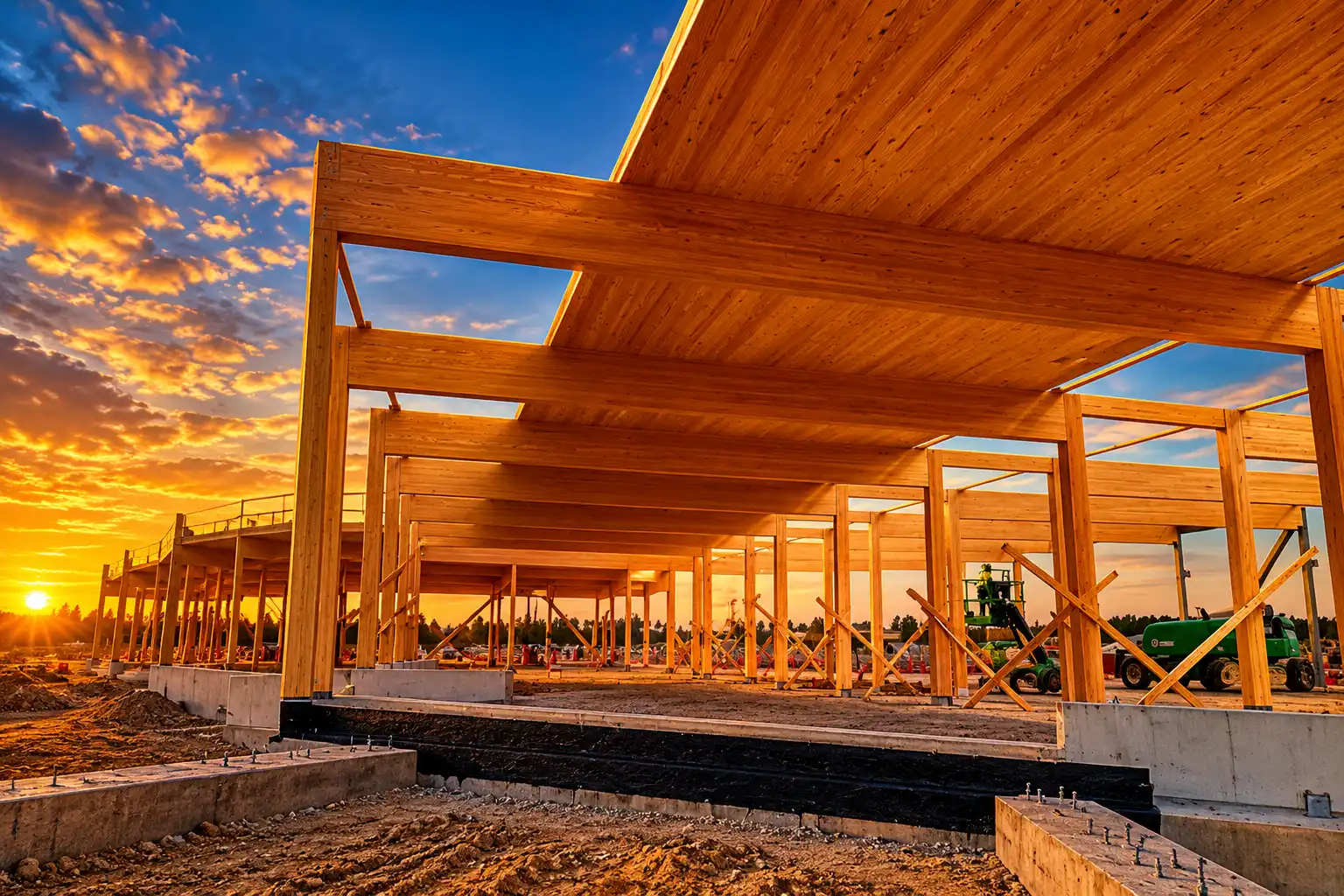
Microsoft’s Virginia Hybrid Set the Pattern Others Copied
Microsoft was first among the U.S. hyperscalers to put engineered wood into a working data hall. In late October 2024 the company said it was building two northern Virginia facilities with a hybrid of cross-laminated timber, steel, and concrete, a mix it estimated would cut the carbon in the structure by 35 percent compared with conventional steel and by 65 percent compared with typical precast concrete.
Gensler designed the pair with Thornton Tomasetti. The CLT goes into floors and ceilings. A thinner concrete topping still handles wear and water, so the halls are not all-wood boxes. Microsoft had already used CLT at its Silicon Valley campus in 2021. The Virginia jobs were the test of whether the same panels could live in a hyperscale hall, not an office.
That hybrid, a timber sandwich on a heavier base, is the template later campus work keeps citing. It is also a reminder that the servers still sit on steel and concrete. Wood took the pieces that could be made in a factory and craned in, which is where the schedule gain lives.
The Aiken Admin Building Came First, Data Halls Later
Meta’s published pilot is more cautious, and more honest about where timber actually stands on a campus. On July 31, 2025, Patrick Nease and Matthew Smith wrote that the company had started putting mass timber into data-center campus buildings that year, beginning with an administrative building at Aiken, South Carolina. DPR built it. SmartLam supplied the wood.
The Aiken campus is a separate set of numbers from that office wing: more than $800 million of investment, about 715,000 square feet of buildings on hundreds of acres, with two large data halls carrying most of the floor area. The timber job Meta completed in 2025 is the human building beside those halls. Cheyenne, Wyoming, was lined up next with Fortis Construction and Mercer Mass Timber. Montgomery, Alabama, was lined up with Hensel Phelps and Binderholz.
Meta’s carbon math is also narrower than a full-hall claim. Incorporating mass timber in those admin buildings will cut approximately 41% less embodied carbon in the materials being replaced, the company said, and prefabrication can shave several weeks of site welding. In some cases the lighter frame cuts the concrete in the foundations by half. Looking ahead, Meta said it would push the same kit into more office buildings, warehouses, “and even the critical data halls that house the servers.” That last clause is still a plan, not a photograph of a live hall.
Meta is focused on constructing innovative and sustainable data centers to accommodate the growth of our business. We’ve started piloting mass timber (which typically entails less emissions than with manufactured steel/concrete) in construction at our data center campuses,… pic.twitter.com/coZGUoSJ6n
— Engineering at Meta (@Meta_Engineers) July 31, 2025
Fire is handled as a char layer, which Meta describes as reliably resistant once the outer wood is designed to burn slowly. Third-party audits have to trace the logs to a forest of origin. The company’s net-zero date across the value chain is 2030, which is why a material that stores carbon in the beam is attractive even while the chips inside the hall keep drawing power.
Amazon Turned an Indiana Delivery Station Into a Lab
Amazon’s first large owner-occupied mass timber logistics building is not a data center. It is a last-mile station, DII5, in Elkhart, Indiana, a 171,000-square-foot warehouse and office block with two long van-loading canopies. Graycor built it. ZGF Architects led the design. Amazon opened it in 2025 as a testbed for more than 40 sustainability moves at once, from the structure to the paving.
The timber package is industrial, not decorative. Crews replaced precast walls with 3-ply CLT and swapped as many members as they could for glulam. The job used more than 500,000 board feet of CLT, SFI-certified southern yellow pine, listed on the WoodWorks Innovation Network as more than 1,100 CLT panels. The network also records the first CLT shear-wall system in a U.S. warehouse in seismic design category B or greater.
Daniel Mallory, vice president of Global Realty at Amazon, said the point was to earn comparative data at logistics scale. “Before mass timber, we didn’t have a bio-based structural solution that could compete with concrete and steel at scale,” he said. Kristen Dotson, Amazon’s principal for sustainable buildings, has framed the carbon case as storage: the carbon the tree pulled down stays in the panel for as long as the building stands. The Climate Pledge date behind that experiment is net-zero carbon by 2040.
Mill Order Books Are Now Anchored by Hyperscalers
The second-order effect shows up in mill accounting, not in a sustainability slide. Mercer International closed the second quarter of 2026 with a mass timber order book of $151 million. Management told investors that large data-center projects sponsored by hyperscalers made up roughly 70% of that backlog, with work starting in late 2026 and running into 2027. Juan Carlos Bueno, the chief executive, called the book robust and anchored by those infrastructure jobs.
Realizations moved with the mix. Manufactured-product prices rose to $2,206 per cubic meter in the second quarter of 2026 from $1,318 a year earlier, about 67%, which Mercer tied to higher-value projects rather than a broad list-price jump. The work runs through plants in Spokane Valley, Washington; Conway, Arkansas; and Okanagan, British Columbia.
WHO IS ADDING PRESSES
| Producer | What changed | Capacity or book |
|---|---|---|
| Mercer Mass Timber | Q2 2026 order book, hyperscaler-heavy mix | $151 million; about 70% data-center work; $2,206 per cubic meter |
| SmartLam | New Dothan glulam hall plus CLT automation in Dothan and Columbia Falls | $50 million glulam line rated at 84 million board feet a year; $24 million to lift each CLT line to 2 million cubic feet |
| Timberlab and Swinerton | Independence Hall, Millersburg, Oregon, topped out Nov. 20, 2025 | 192,000-square-foot plant due in early 2027 to make 7 million to 9 million square feet of CLT a year |
Those bets landed on a market that still had empty press time. The Performance Index put modeled CLT panel prices around $42 to $44 per cubic foot through 2024, with lumber about 40% of manufacturing cost, and warned that glulam lamstock, not CLT billets, is the tighter input because of kiln drying and wide-board supply.
THE MILL BUILD LIST
- Federal grants: The USDA Forest Service counts 13 new mass timber plants in the United States since 2015, aimed at commercial, institutional, and multifamily work long before data halls joined the queue.
- SmartLam aid: Recent awards include a $250,000 Wood Innovations Grant in Columbia Falls, a $1 million CNC grant, and a $1 million Community Wood Grant to split CLT and glulam lines in Dothan.
- Headcount: SmartLam CFO Brian Davidson said the firm employed 223 people and expected to add up to 40. Timberlab’s Oregon plant is pegged at 100 jobs when it is full.
- Pinch point: Chris Evans, Timberlab’s president, said Independence Hall exists to take pinch points out of the chain, with certification and equipment due in the next year and product shipping after that.
Independence Hall is itself a glulam building, 192,000 square feet, with 240 columns between 32 and 45 feet and 260 beams between 90 and 110 feet. Swinerton says the plant will turn out 7 million to 9 million square feet of CLT a year, from 2-inch to 12-inch panels, once it is certified and running in early 2027. Brian Brashaw, wood innovations assistant director at the Forest Service, has said mass timber and CLT have been priorities precisely because commercial and multifamily markets needed domestic supply. Hyperscale offtake is what now makes a second shift look rational.
Fifty-Five-Week Steel Lead Times Open a Door for Timber
Carbon is the public reason. The private reason on many job meetings is the metals queue. Tom Park, vice president of strategic supply chain at Skanska, said in a September 10, 2026, webinar that steel prices had climbed 25% over the prior year and that lead times had more than doubled, to 55 weeks. He blamed data-center and semiconductor demand. Steel mills and fabricators, he said, were already running full.
Dean Lewis, Skanska’s director of mass timber and prefabrication, said clients were asking about wood because every other material was strained. The timber frame still costs more up front on many jobs. The offset, when it appears, is schedule: panels made off site, fewer welders on the pad, a lighter foundation. Salvadori has described electrical gear waits past 100 weeks on campus jobs, which is a different queue from Park’s 55-week steel, and one reason some teams are studying CLT decks on light-gauge steel instead of an all-timber hall.
Greg Bauer, managing director and global head of development management at Prologis, has called mass timber more sustainable and increasingly cost-competitive for modern industrial design. That is the warehouse cousin of the data-hall argument. Both building types want speed and a lower carbon invoice, and both can write a purchase order large enough to hold a mill’s attention through 2027.
Homebuilders Share the Same Softwood Pile
Single-family builders almost never specify CLT. They do buy the same underlying softwood that gets graded, dried, and glued into those panels, and they hire from the same local trades. In markets where AI campuses are rising, the fight is less about who gets the next CLT billet and more about who keeps the carpenters and the land. A Wyoming builder told a housing-market researcher at the NAHB International Builders’ Show that crews had already left for nearby data-center jobs. That pattern is still local. It is also how a 10% industrial take starts to show up in a town that never ordered a mass timber floor.
The 2024 Performance Index already flagged a log-side squeeze in British Columbia, Oregon, and Washington from harvest rules and fire, plus sawmill closures, before tech volume showed in the sales mix. If lumber demand rises, the report said, the spigot is harder to open. Glulam feels that first, because lamstock has to be drier and cleaner than the boards in a CLT press. A data hall that wants wide, fire-rated beams is bidding in that tighter pocket, not in the commodity stud market homebuilders live in, but it is still the same forest.
THE BUILD SEQUENCE
- October 31, 2024: Microsoft announces two hybrid CLT hyperscale data centers in northern Virginia, with a 35% carbon cut versus steel and 65% versus precast.
- July 31, 2025: Meta posts its mass timber pilot, an Aiken office building first, with Cheyenne and Montgomery next and data halls described as a later step.
- 2025: Amazon opens DII5 in Elkhart, a 171,000-square-foot timber logistics station using more than 500,000 board feet of CLT.
- April 2026: Salvadori puts 2025 U.S. data-center-related sales at about 10% of mass timber sold.
- August 2026: Mercer reports a $151 million mass timber order book, roughly 70% hyperscaler work, at $2,206 a cubic meter.
- Early 2027: Timberlab’s Independence Hall is scheduled to start making 7 million to 9 million square feet of CLT a year.
Independence Hall is due to ship panels in early 2027, which is the same window Meta has described for moving timber from office wings toward data halls. Until those halls are actually framed in wood, the 10% share is still mostly hybrid floors, admin buildings, and warehouses. The presses being stood up in Oregon and Alabama will run for whoever keeps writing the orders.

The Court Revisits the Climate Nuisance Door It Left Open

ChatGPT Now Compiles Live Interfaces With GPT-6

A Tanker Attack Moves the War Into Qatar’s Waters

Personio Buys Circula to Own the DATEV Channel

Bluesky Files for .bsky and Enters the Registry Queue

Microsoft’s 96% Cyber Score Sits at 86.3% on the Board

Musk’s $914 Billion Lead Is a Public SpaceX Bet

Free Live Sports Streaming in 2026: What to Watch Without Cable

The Odyssey’s IMAX Film Run Hit a 41-Theater Limit

Andrew Garfield’s Spider-Man Films Are No Longer Free
-
 NEWS3 months ago
Microsoft’s 96% Cyber Score Sits at 86.3% on the Board
-
 BUSINESS5 months ago
Musk’s $914 Billion Lead Is a Public SpaceX Bet
-
 SPORTS4 months ago
Free Live Sports Streaming in 2026: What to Watch Without Cable
-
 ENTERTAINMENT3 months ago
The Odyssey’s IMAX Film Run Hit a 41-Theater Limit
-
 ENTERTAINMENT2 years ago
Andrew Garfield’s Spider-Man Films Are No Longer Free
-

 ENTERTAINMENT4 months ago
Endgame Encore’s $86 Million Trial for Infinity Vision
-

 NEWS5 months ago
Singapore’s 3×3 and Surfing Debuts Miss the Medal Stand
-

 NEWS7 months ago
White Sands Footprints Put People in Ice Age New Mexico