
NEWS
The Vatican Olympic Cross Has Traveled Since the London Games
Athletica Vaticana brought the Cross of Athletes to Milan’s San Babila before the 2026 Winter Games, continuing a host-city rite that began in London.

Athletica Vaticana set the Cross of Athletes on the altar of Milan’s Basilica of San Babila on Jan. 29, 2026, eight days before the Winter Olympics opened. Pope Leo XIV sent his apostolic blessing that same day, and the wooden cross stayed in the basilica through the Paralympics that closed March 15.
The object has followed Olympic host churches since the London Games, and Milan was the first Winter stop after the Vatican’s sports association took custody of it in 2025.
A Wooden Cross Reached San Babila Before the Flame
Evening Mass began at 6:30 p.m. Archbishop Mario Delpini of Milan presided, with Bishop Paul Tighe, secretary of the Dicastery for Culture and Education, and the president and vice president of Athletica Vaticana in the sanctuary. A procession on corso Monforte came first. Members of the Vatican sports group then handed the Cross to Delpini before it was placed beside the altar.
Cardinal Pietro Parolin, the Vatican secretary of state, signed the apostolic blessing in a Jan. 29 telegram addressed to Delpini. The Holy See released the text as the basilica received the Cross for the Milan-Cortina Olympic and Paralympic Games.
He hopes that this important event will inspire sentiments of friendship and fraternity, strengthening awareness of the value of sport in the service of the integral development of the human person. The Holy Father gives the assurance of his prayers that these days of healthy competition may contribute to building bridges between cultures and peoples, promoting acceptance, solidarity and peace.
Pope Leo XIV, telegram signed by Cardinal Pietro Parolin, Jan. 29, 2026
A second telegram went the next day to the Diocese of Como, which hosted some of the competitions and an Olympic Village. Parolin said the pope valued local help with the event and named loyalty, respect, team spirit, sacrifice, social inclusion and the joy of meeting as the sporting goods he wanted on display. He also asked parish communities in that territory to offer a Christian witness of fraternity.
The telegram to Delpini was read at Mass. In his homily, the archbishop called sports a “school of asceticism, morality, humanity, life, courage, and imagination,” language the Archdiocese of Milan put out after the liturgy.
Athletica Vaticana posted the service time the day before, with photographs of the Cross already on the road to the basilica.
Domani #29gennaio, ore 18.30, nella basilica di San Babila, l’arcivescovo di Milano, mons. Mario Delpini, presiederà Messa per l’accoglienza della “Croce degli sportivi” in occasione delle Olimpiadi e Paralimpiadi invernali #MilanoCortina
Continua qui👉https://t.co/mnUcCKXfRU pic.twitter.com/hUitOY9w6z— Athletica Vaticana (@AthVaticana) January 28, 2026
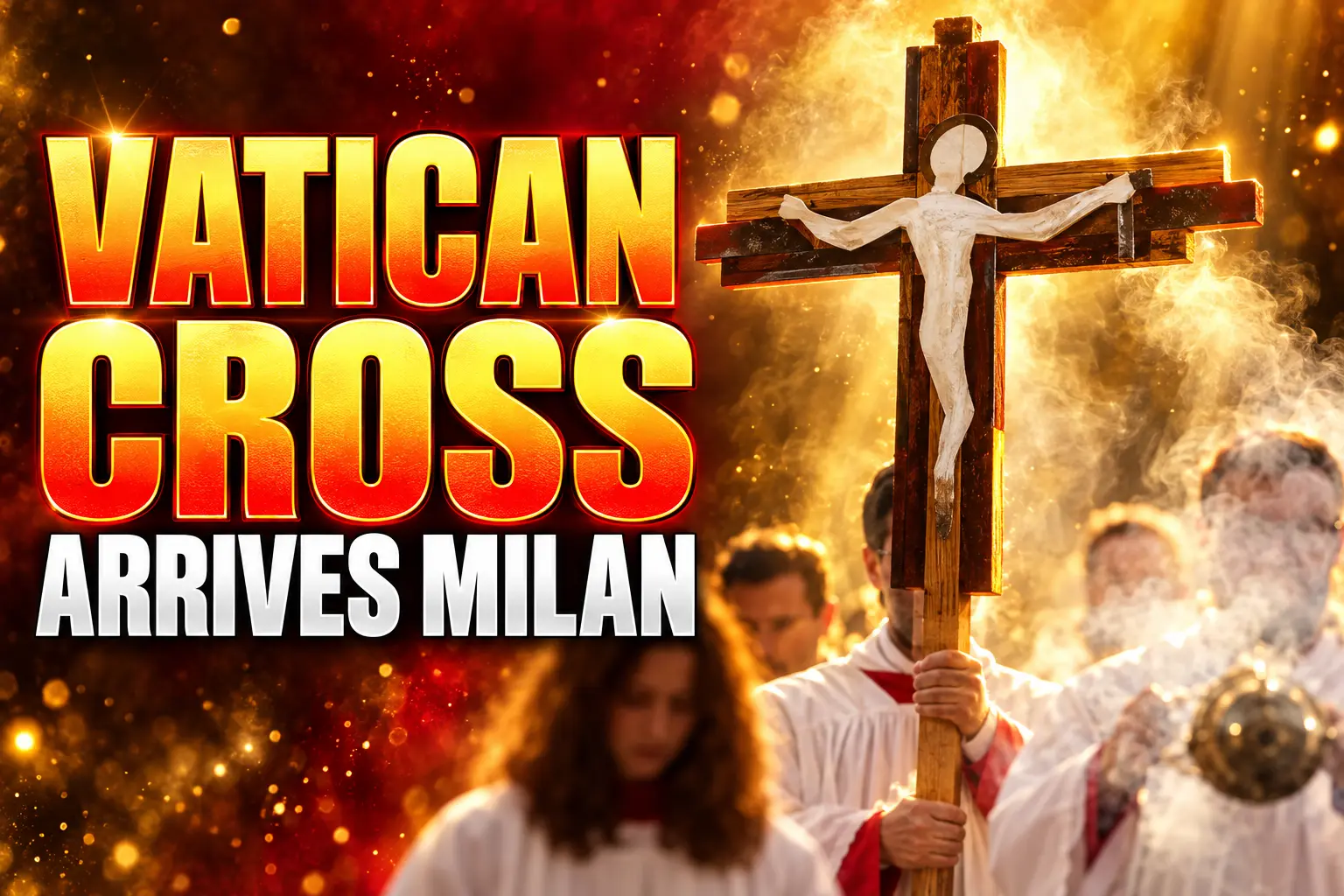
Fifteen Woods From Five Continents
English artist Jon Cornwall made the Cross for the London 2012 Games. It is a Latin cross of mixed grain, not a metal Olympic prop, and it travels with a low wooden stand. Vatican briefers describe fifteen pieces of wood from around the world, including that podium, as the whole object.
WOOD IN THE CROSS
- The maker: Jon Cornwall, an English artist, built the Cross for the London Games.
- The count: Fifteen pieces of wood make up the Cross, including the podium that holds it.
- The map: The pieces were taken from the Holy Land, China, Russia, North Africa, South Africa, India, Australia, Brazil, Argentina, Jamaica, North America and the United Kingdom.
The geography is the point the Church keeps repeating. Five continents sit in one object, the way five rings sit on a flag, and host dioceses are asked to treat it as a prayer stand for athletes rather than as a trophy.
Pope Francis blessed the Cross in 2013 during World Youth Day in Brazil, a year before it appeared at the 2014 World Cup in Rio. That older blessing stayed with the wood when Athletica Vaticana carried it into San Babila.
London, Rio, Paris, Then a Vatican Handover
After London closed, the Cross was entrusted to the Archdiocese of Rio de Janeiro for the 2016 Olympics and Paralympics. Tokyo was the break in the chain. Vatican officials say the COVID pandemic blocked a public program there, so the Cross later went to Lisbon for World Youth Day in 2023 and then to Paris for the 2024 Games, where it stood in the Chapel of Athletes at the Church of La Madeleine.
THE CROSS, HOST TO HOST
| Stop | Year | Setting |
|---|---|---|
| London Summer Games | 2012 | Made for the host-church circuit |
| Rio de Janeiro | 2016 | Archdiocese of Rio; also seen at the 2014 World Cup |
| Tokyo Summer Games | 2020 | No public program, COVID travel limits |
| Lisbon | 2023 | World Youth Day |
| Paris Summer Games | 2024 | Chapel of Athletes, Church of La Madeleine |
| Vatican | 2025 | Jubilee of Sport, Holy Door, handed to Athletica Vaticana |
| Milan-Cortina | 2026 | Basilica of San Babila, Jan. 29 to March 15 |
The Milan stop did not invent the rite. It put a now-familiar object into a winter host city after a summer run in Paris, with the same small Vatican sports body doing the carrying.
Why Athletica Vaticana Now Carries the Cross
Athletica Vaticana is the Holy See’s official sports association, recognized in 2019 among Vatican employees, lay and clergy. It promotes sport as a tool for education, inclusion and peace, and it represents the Holy See at international sporting events. On June 14, 2025, during the Jubilee of Sport, the Cross was entrusted to that group after a French church delegation brought it from the Paris Games.
Thomas Bach, then president of the International Olympic Committee, carried the Cross through the Holy Door of St. Peter’s Basilica with Cardinal José Tolentino de Mendonça, prefect of the Dicastery for Culture and Education. Athletica Vaticana received it at that pilgrimage, which began with prayer in Piazza Pia and walked Via della Conciliazione to the basilica.
Giampaolo Mattei, the association’s president, was in Milan for the San Babila Mass. Tighe, traveling with the dicastery, told an EWTN reporter the gesture said something about the Church’s interest in sport and about celebrating the human spirit, including in forms of faith. “Sport speaks a common language,” he said, tying the Cross to Pope Leo’s early stress on peace.
Vatican City still has no National Olympic Committee and does not send a team to the Games. The Cross is how the Holy See shows up in a host diocese, a pastoral stand rather than a parade of athletes in Vatican colors. Public argument about the Milan handover stayed thin. The object reads as church furniture beside the flame, and the people who fight over Olympic politics rarely fight over this piece of wood.
San Babila Ran as the Church of Athletes
For the length of the Games, the basilica was named the Church of Athletes. It held the Cross and panels on sporting values, with educational and cultural notes, and it hosted liturgies and meetings tied to the event. The Archdiocese of Milan said the wood would remain on the altar until the Paralympics ended.
Jan. 29 fell on the eve of the Olympic Truce window that the United Nations General Assembly had backed for these Games. Delpini wrote a prayer for the night and had it read in church. “The Games are a time of grace, prophecy, sharing,” he wrote, a line the Milan church circulated with the rite.
The San Babila Mass also opened For Each Other, an archdiocesan project run through the Fondazione oratori milanesi and the Service for Oratories and Sport. Fr. Stefano Guidi, who directs that sport service, said the Church thinks of sport as something that unites rather than separates. The program aimed events at young people across the city while the Cross sat in the basilica.
In this church, we welcome the sign of the crucified body. The Athletes’ Cross is more of a crack of light than a figure: the body of Christ, crucified for love, is the opening to go beyond and embrace the mystery. The absent body encourages questions, observation and attention.
Archbishop Mario Delpini, homily, Basilica of San Babila, Jan. 29, 2026
Cardinal Tolentino later called the Cross “a wordless message” that every life, even through sweat and suffering, deserves love and respect. That line traveled with the object when it left Milan.
Life in Abundance Opened the Winter Games
On Feb. 1, after the Angelus, Leo came back to the Games before they started. “I hope that all those who care about peace among peoples and are in positions of authority will take this opportunity to make concrete gestures of détente and dialogue,” he said, adding good wishes for organizers and athletes.
He dated a letter on sport titled Life in Abundance to the opening day, Feb. 6, 2026, citing the Gospel line about life to the full. The letter greeted people bound up in the Olympics, held Feb. 6 to 22, and the Paralympics, held March 6 to 15, and asked nations to rediscover the Olympic Truce in “a world thirsting for peace.”
In that text he wrote that sport “teaches us that we can strive for the highest level without denying our own fragility; that we can win without humiliating others; and that we can lose without being defeated as individuals.” He also warned that when sport claims to replace religion, it stops being a game that helps a life and turns absolute. He pointed to Athletica Vaticana, under the Dicastery for Culture and Education, as one way the Church already treats sport as a form of service.
The Games then ran their course in Milan, Cortina d’Ampezzo and the mountain venues. The Cross did not move with the torch. It stayed on the San Babila altar while the races, jumps and ice events filled the rest of the map.
The Same Cross Then Went to Taranto
The Paralympics closed March 15. The wood came off the Milan altar after that and went back to Rome, still in Athletica Vaticana’s care, still treated as a working object rather than as a closed exhibit.
THE 2026 ROUTE OF THE CROSS
- Jan. 29, 2026: Athletica Vaticana presents the Cross at Mass in San Babila; Parolin’s telegram is read.
- Feb. 1, 2026: Leo, at the Angelus, asks people in authority for gestures of détente and dialogue.
- Feb. 6, 2026: The letter Life in Abundance is dated as the Olympics open; the Cross remains on the altar.
- March 15, 2026: The Paralympics close; San Babila’s run as the Church of Athletes ends.
- April 8, 2026: Milan oratory children hand the Cross to Leo at the general audience in St. Peter’s Square.
- April 9, 2026: The same Cross stands in the Clementine Hall as Leo meets Olympic and Paralympic athletes.
- Aug. 21, 2026: The Cross is welcomed in Taranto cathedral for the Mediterranean Games, which run through Sept. 3.
At the April 8 general audience, 4,000 Milan children returned the Cross to the pope. Fr. Stefano Guidi, who led the trip with episcopal vicar Fr. Giuseppe Como, called it a sign of faith, brotherhood and respect, given by young people he described as a sign of trust in a peaceful future. The Archdiocese of Milan said the Cross would stand the next day in the Clementine Hall.
Leo returned to that theme in an address to Milan-Cortina athletes in April, with the same Cross standing in the hall. He thanked the dicastery and Athletica Vaticana for organizing the meeting, and he thanked CONI president Luciano Buonfiglio and Italian Paralympic Committee president Marco Giunio De Sanctis. “Today, in this hall, we look upon the Cross of Sport, the Olympic and Paralympic Cross, which, from the London 2012 Games to those of Milan-Cortina, embodies the prayers, expectations and hopes, fears and sufferings of the men and women of all ages who share their sporting experiences,” he said.
He called Jesus Christ “God’s true athlete,” borrowing a phrase from St. John Paul II’s 2000 Jubilee of Sports People, and he told the group to keep the person at the center of sport. After the audience, Mattei and Tighe took a delegation that included Federico Pellegrino, Federica Brignone, Michela Moioli, Francesca Lollobrigida, Arianna Fontana, Davide Ghiotto and several Paralympic athletes to the Santa Marta pediatric dispensary.
The Cross did not stay in a Vatican cupboard after that. Four Athletica Vaticana athletes went to the Mediterranean Games in Taranto, held Aug. 21 to Sept. 3, and the wood stood in the city’s cathedral for those days. At the Angelus on Aug. 16, Leo called that meeting a hoped-for “prophecy of peace and fraternity.” On Sept. 2 he received the Vatican team back in Rome.
Host dioceses for later Games, including Los Angeles in 2028, are already on Athletica Vaticana’s delivery list. The Milan altar was a station, not the end of the line.
Frequently Asked Questions
Who asked for the Cross of Athletes to be made?
The Cross was requested by organizers of the Joshua Camp, an international Catholic Olympic gathering in London, who asked Jon Cornwall to make a sign athletes could gather around during the 2012 Games. Cornwall’s brief was a single wooden cross built from many places, not a local parish crucifix, which is why later host dioceses could receive the same object without it reading as England’s souvenir.
When was Athletica Vaticana founded, and who joined first?
The association launched on Jan. 10, 2019, after a Sept. 11, 2018, deal between the Holy See and the Italian Olympic Committee that let it affiliate with Italian athletics. About 60 Vatican workers joined at the start, among them Swiss Guards, nuns, priests, museum staff, firefighters and clerks, plus two young Muslim migrants named as honorary members.
Does Vatican City compete in the Olympics?
No. Vatican City is not an International Olympic Committee member and has no National Olympic Committee, so it cannot enter a team. Athletica Vaticana still fields people in some events off the Olympic program; at Taranto in 2026 those athletes were Fabrizio Peloni, Tiziano Lucarelli, Daniele Fontana and Emiliano Morbidelli, in padel, fencing and cycling.
What was the Olympic Truce window around Milan-Cortina 2026?
The United Nations General Assembly adopted the truce resolution on Nov. 19, 2025. Vatican briefers said it ran from one week before the Feb. 6 opening, which is Jan. 30, to one week after the March 15 Paralympic closing ceremony, which is March 22, covering travel and competition rather than only the medal days.
Is the Cross of Athletes going to Los Angeles?
That is the next Olympic delivery Athletica Vaticana was given at the 2025 Jubilee handover, when a French church delegation, with Bishop Emmanuel Gobilliard, passed the Paris Cross on with Milan-Cortina 2026 and Los Angeles 2028 named as the coming host dioceses. No public date for the Los Angeles Mass has been set in the material released with the Milan rite.

Saquon Barkley’s Hamstring Leaves the Eagles Thin in London

The Online US Passport Still Needs a Witnessed Oath

Ken Urker Died on His Birthday With No Cause Named

FOX Ices Portnoy After Ohio State’s Access Fight

Micron’s Record Memory Profits Lock RAM Tight Through 2028

Musk’s $914 Billion Lead Is a Public SpaceX Bet

Microsoft’s 96% Cyber Score Sits at 86.3% on the Board

Free Live Sports Streaming in 2026: What to Watch Without Cable

Endgame Encore’s $86 Million Trial for Infinity Vision

The Odyssey’s IMAX Film Run Hit a 41-Theater Limit
-
 BUSINESS4 months ago
Musk’s $914 Billion Lead Is a Public SpaceX Bet
-
 NEWS2 months ago
Microsoft’s 96% Cyber Score Sits at 86.3% on the Board
-
 SPORTS3 months ago
Free Live Sports Streaming in 2026: What to Watch Without Cable
-

 ENTERTAINMENT4 weeks ago
Sterling Point Holds No. 2 on Prime Video After 32 Days
-
 ENTERTAINMENT3 months ago
The Odyssey’s IMAX Film Run Hit a 41-Theater Limit
-
 ENTERTAINMENT3 months ago
Endgame Encore’s $86 Million Trial for Infinity Vision
-

 ENTERTAINMENT2 years ago
Andrew Garfield’s Spider-Man Films Are No Longer Free
-

 NEWS4 weeks ago
G20 Cheers AI Investment After Bailey’s Frontier Cyber Warning