
NEWS
Starboard’s NZ$23 Million Round Serves Pacific Watchfloors First
Wellington’s Starboard Maritime Intelligence raised NZ$23 million to export a Pacific ocean watch, with Samoa, Tonga and cable owners still the core users.

Starboard Maritime Intelligence closed an oversubscribed NZ$23 million Series A on 8 September 2025, about US$13.6 million, to take a Pacific-built ocean watch into new markets. The Wellington company sells software that fuses ship tracks, satellites and sensors so agencies can watch exclusive economic zones they cannot cover with patrol boats alone.
The raise is easy to file as another defence-tech cheque. The people who already pay for the product sit somewhere else: Pacific crime units with huge waters and thin fleets, a New Zealand ministry buying licences for neighbours, and a North Sea cable operator trying to hear a ship before an anchor bites fibre.
A Wellington Round With Pacific Customers Already on the Books
Altered Capital, Starboard’s first backer, co-led the round with OIF Ventures and King River Capital. Co:Act Capital, Icehouse Ventures and the Whakatupu Aotearoa Foundation came in alongside. The company said the money would speed hiring and product work for classified and commercial users in North America, Europe and the Indo-Pacific.
THE SERIES A BACKERS
| Investor | Base | Role |
|---|---|---|
| Altered Capital | New Zealand | Co-lead; earliest investor |
| OIF Ventures | Sydney | Co-lead; Vu Tran joins the board |
| King River Capital | Sydney | Co-lead; Jonty Kelt becomes chair |
| Co:Act Capital | Melbourne | Additional |
| Icehouse Ventures | Auckland | Additional |
| Whakatupu Aotearoa Foundation | New Zealand | Additional; also on the seed |
Whakatupu is the name most wire write-ups skip. It is a New Zealand foundation that puts money into early technology with an environmental and social brief, and it was on the cap table before the Australians arrived. That is a hint about who Starboard was built for: fisheries officers and border teams, not a slide about total ocean spend.
Jonty Kelt, a King River venture partner and an early Palantir executive, called the job “protecting oceans, trade, and critical infrastructure in real time.” He said the company was “already trusted by government agencies and commercial operators across the Pacific.” Trent Fulcher, Starboard’s chief executive, said the cheque lets the firm “extend that reach globally” and help partners “make faster, better-informed, and more secure decisions.”
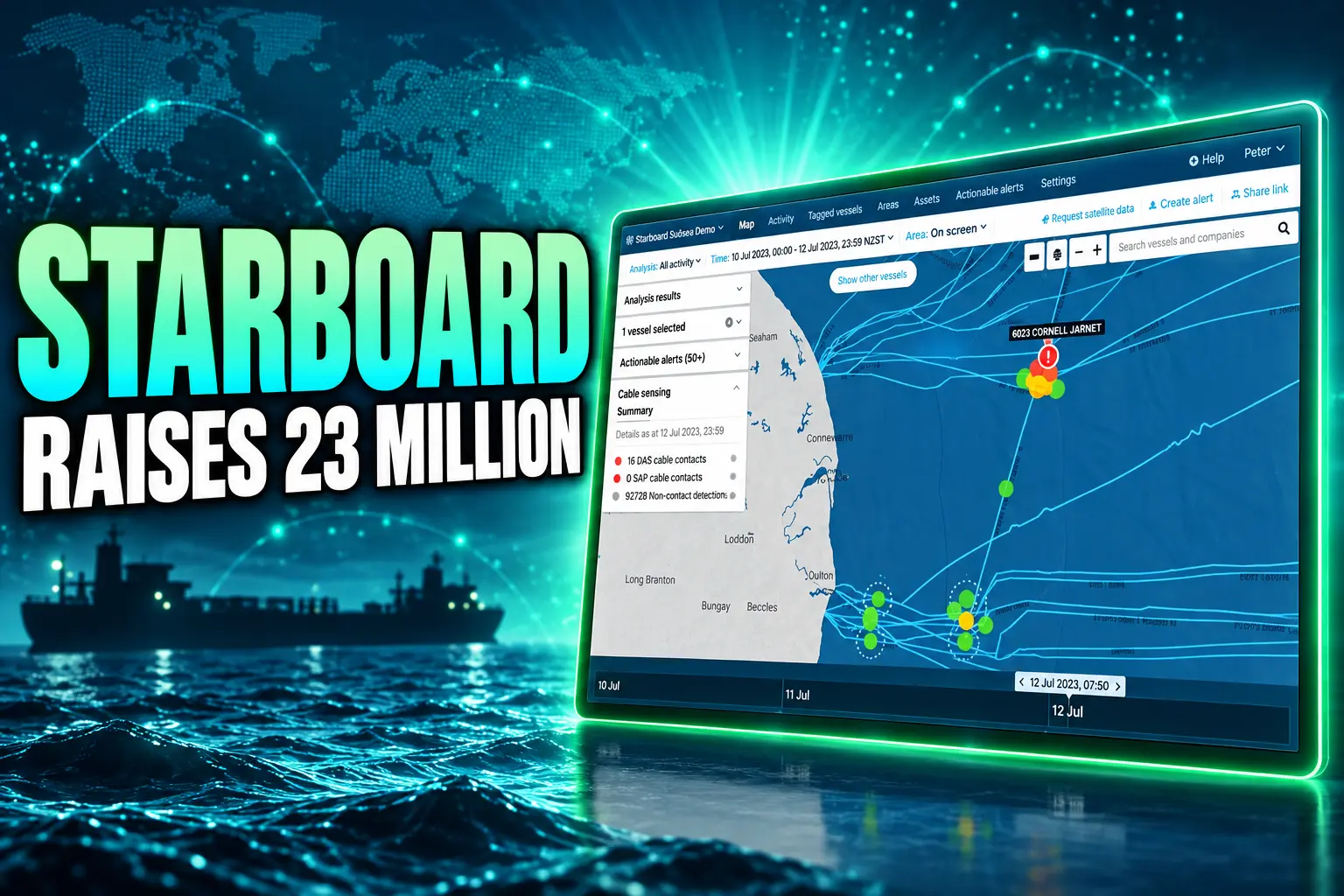
Who Pays When Island States Cannot Patrol Their Waters?
Pacific governments sit on some of the largest exclusive economic zones on Earth and run some of the smallest patrol fleets. Starboard’s first paying habits formed around that mismatch: New Zealand agencies watching arriving ships, then fisheries and crime teams across the Tasman and the islands. The Series A did not create that market. It tried to productise it.
On 12 July 2024, the Ministry of Defence said a project for better protection against maritime threats had received $14.6 million in Budget 24, and that Cabinet had approved the business case. After a contract after an international search, the subscription went to Starboard. Sarah Minson, deputy secretary of capability delivery, called it “a New Zealand technology success story” and said the service “will benefit not only Defence, but all of New Zealand.” The National Maritime Coordination Centre would run it, mixing global commercial feeds with New Zealand government data, and Defence said the platform would be up immediately for several agencies.
FROM LAB CUSTOMER TO ISLAND WATCHFLOOR
- 12 July 2024: New Zealand Defence awards Starboard the maritime awareness subscription tied to the Budget 24 project.
- 8 September 2025: The company closes the NZ$23 million Series A.
- 13 November 2025: Prime Minister Christopher Luxon opens the new Wellington headquarters at 10 Brandon Street.
- 18 March 2026: Wellington funds Starboard licences for Samoa and Tonga transnational crime units.
- 26 May 2026: Tampnet and Starboard put fibre-optic sensing into the same operational map, in Tampnet’s testing environment.
At the headquarters opening, the company said it was already in more than 30 countries, with staff in New Zealand, Australia, the United Kingdom and the United States, and that it was watching cables in the North Sea while Singapore had just put the software on drug trafficking and cross-border crime. Luxon talked about meth moving through Samoa, Tonga, Fiji, Australia and New Zealand, and about ships and submarines that try to use the islands as a quieter path.
The sharper follow-through came in Nuku’alofa. On 18 March 2026, Luxon announced two-year subscriptions for Samoa and Tonga, paid by the Ministry of Transport for those countries’ transnational crime units. Transport is funding a package of seven Starboard licences for Pacific crime monitoring, with Samoa and Tonga the first two units to come online. Officials said they were working through the Pacific Transnational Crime Network on who joins next, and that each country keeps control of its own workflows and data.
Pacific security is New Zealand’s security. By investing in practical tools that our partners can use every day, we’re helping Pacific law-enforcement agencies protect their people, their economies and our shared ocean.
Christopher Luxon, Prime Minister of New Zealand, 18 March 2026
Fulcher, speaking in Nuku’alofa, put the same problem in patrol-budget terms. A country might have 5,000 vessels in its zone on a given day and only a handful of aircraft or ships. The software, he said, lays risk flags on that list so the expensive hull goes to the few boats that look wrong. He also said the drug flow through the islands had moved from hundreds of kilograms a few years ago to tons, on yachts, fishing boats, narco-subs and drop-off points.
The Platform Turns a Billion Daily Points Into a Shortlist
Starboard describes a cloud picture that fuses more than 1 billion maritime data points a day. The promise is not another map of every ship that wants to be seen. It is a ranked list of ships that do not, or that behave as if they would rather not be boarded.
WHAT THE MODEL READS
- AIS tracks: Cooperative position reports from ships that keep their transponders on, including gaps when those sets go quiet.
- Satellite imagery: Optical and radar pictures used to check a hull that has stopped talking, or that is talking from the wrong patch of water.
- Radar and ocean sensors: Feeds that sit beside weather and sea-state so a loiter is not confused with a storm dodge.
- Ownership files: Licensing and company data stacked on the track, so a meeting at sea has a name behind it.
- Cable sensors: Acoustic and polarisation signals from live fibre, now in Tampnet’s test map, tied to nearby traffic.
For governments the pitch is adversarial behaviour, illegal, unreported and unregulated fishing, and classified operations. For commercial operators it is supply-chain risk and a live view of traffic near assets they cannot see from a control room. The company says it already safeguards more than 840,000 km of subsea cable and watches a large share of commercial fleet traffic. Those figures are its own operating claims; it has not published revenue, remaining contract value, or a paid-customer split.
The product people actually sit with is still a watchfloor screen. Analysts used to spend days reconstructing a voyage. Fulcher’s older line was that the same work now takes minutes, so a boarding team gets a better reason to leave the dock. That is a fisheries and customs story first. Cable sabotage and dark tankers arrived later, when those same pattern flags started to look like a navy problem.
Tampnet Plugs Fibre Sensing Into the Same Map
On 6 August 2025, a month before the round closed, Starboard and Tampnet, which runs the world’s largest offshore high-capacity communications network, said they would combine fibre-optic sensing with the maritime picture. On 26 May 2026 they said operators could finally read fibre sensing on a single map, Distributed Acoustic Sensing next to State of Polarization, colour-coded by strength and laid against AIS and inferred tracks.
DAS listens for vibration along the fibre: engines, propellers, an anchor walking, fishing gear. SoP watches the polarisation of light inside the glass, which shifts when something actually disturbs the cable. Together they are meant to separate a ship that merely passed from a hull that made contact. The release is careful on one point. The dual view is live in Tampnet’s testing environment, not described as a paid, network-wide commercial rollout.
Following a successful trial with @tampnet, DAS and SOP are officially integrated in Starboard Maritime Intelligence in a single operational view.
Details here:https://t.co/U6ZslG7q2G#SubseaCables #FibreSensing #MaritimeIntelligence #ICPC2026 #CableProtection pic.twitter.com/JQcrDrtmMt
— Starboard Maritime Intelligence (@StarboardIntel) April 12, 2026
Anders Tysdal, Tampnet’s chief infrastructure officer, said fibre sensing was already on most of the firm’s subsea network and that the job was to make it useful from day one, “using infrastructure that already exists.” Fulcher said analysts could judge several sensing modes “directly in the context of maritime activity” without jumping tools.
Integrating SoP into Starboard alongside DAS gives operators better tools to understand what is happening on and around their cables, enabling faster, more reliable decisions using infrastructure that already exists.
Anders Tysdal, Chief Infrastructure Officer, Tampnet
That is the commercial stakeholder the Series A was chasing: cable owners who already buried the glass and now want a name on the ship that loitered. Detection of a cut is old. Attribution is the scarce bit, because a vessel can go dark, spoof a flag, or drag an anchor and call it an accident. Informed readers of the Tampnet work keep asking whether a test map survives weather, shipping noise and false alarms once it is on a live route. Until Tampnet or Starboard publish hit rates, that question stands.
The software is already leaking into public tracking. From 15 to 22 September 2026, analysts following a Russian-flagged tug near Danish cable routes cited Starboard tracks showing the Sarmat working between Læsø and the Jutland coast, with seabed gear in tow, before it headed toward Murmansk. That is not a finding of sabotage. It is a sign that a Wellington watchfloor product now sits in the same argument as Baltic cable cuts and shadow-fleet loitering.
What the Series A Capital Is Meant to Buy
The company was explicit about the spend: expansion into North America, Europe and the Indo-Pacific, more engineering, and a platform that can live in classified networks as well as commercial ones. Kelt was named chair. Vu Tran of OIF, who co-founded Go1 and the defence startup Black Sky Industries, joined the board with existing directors Craig Mawdsley, Nick Fogarty and Fulcher. Outgoing chair Maria King was thanked, as were early seed names Soul Capital and Invest South.
WHAT WE KNOW
- The cheque: NZ$23 million, about US$13.6 million, closed 8 September 2025 and described as oversubscribed.
- The footprint: More than 30 countries, more than 840,000 km of cable, staff in four countries, company-reported.
- The named users: New Zealand Defence and other Wellington agencies, Samoa and Tonga crime units on two-year Transport-funded licences, Tampnet on fibre sensing in test.
WHAT IS UNCONFIRMED
- The next islands: Five further Pacific licences are funded; the next countries have not been named.
- The fibre feed: DAS and SoP are in Tampnet’s testing environment; a live, paid network rollout has not been announced.
- The books: Revenue, annual recurring revenue and remaining contract value have not been published with the round.
A raise of this size is a sales-and-product round, not a navy replacement budget. Starboard does not claim to find submarines at range or to replace patrol aircraft. It claims to tell a small team which of thousands of tracks is worth a flight hour. That is why Pacific crime units and cable operators matter more than the slide about global maritime spend: they are the buyers who already live with too much ocean and too few hulls.
A Palantir Veteran Now Chairs the Board
Kelt’s Palantir years are doing a lot of work in investor conversations. The comparison is a fusion layer, not a sonar. Starboard is software that sits on other people’s sensors and tries to turn a mess of tracks into a decision. An OIF Ventures note names four Starboard founders, putting Christopher Laing, Brendon Wright and Mat Brown alongside Fulcher. Mat Brown, the chief revenue officer, was the person walking ministers through live fishing tracks at the Wellington opening.
Founded in 2019 and still private, the company is trying to sell a Pacific working habit to places that have more ships, more lawyers and more classified networks. The Series A pays for that translation. The test is whether a Tonga watchfloor and a North Sea cable desk can share a product without the Pacific user becoming a brochure.
Frequently Asked Questions
Who Was Starboard Maritime Intelligence’s First Overseas Customer?
The Australian Fisheries Management Authority took a contract on 9 February 2022, Starboard’s first international sale, to hunt illegal, unreported and unregulated fishing. The company also said the software had already been used in a trial during Operation Kurukuru in October 2021, a 12-day fisheries patrol involving 17 Pacific nations including Australia and New Zealand.
How Much Did Starboard Raise Before the Series A?
On 4 April 2024 the company closed a NZ$5 million seed round led by Altered Capital, with Icehouse Ventures, Invest South, Soul Capital, Whakatupu Aotearoa Foundation and US-based SeaAhead. That release said the platform processed over 4,000 vessel positions a second to flag meetings at sea, odd behaviour and fishing.
What Is a Dark Vessel in Maritime Tracking?
A dark vessel is a ship that stops sending a cooperative AIS position, or broadcasts a false one, so coastal plots go blank or lie. Starboard’s models also watch legal ships that still look wrong: a rendezvous at sea to move fish, fuel or crew, a slow crawl over a cable, or a track that does not match the flag on the stern.
Where Did Starboard Maritime Intelligence Come From?
The product began inside Xerra Earth Observation Institute, a New Zealand research group that had Ministry of Business, Innovation and Employment regional research institute funding, before standing up as its own Wellington company. Fulcher’s earlier roles included strategy work at Kiwibank and as chief executive of AirShare, Airways New Zealand’s drone-tracking hub.
In Nuku’alofa in March 2026, Fulcher told reporters those same island waters now carry tons of narcotics where they once carried hundreds of kilograms. The Series A pays for the people who will sell that watch in North America and Europe. The licences already running in Tonga and Samoa are the proof that a small national desk can use it.

Saquon Barkley’s Hamstring Leaves the Eagles Thin in London

The Online US Passport Still Needs a Witnessed Oath

Ken Urker Died on His Birthday With No Cause Named

FOX Ices Portnoy After Ohio State’s Access Fight

Micron’s Record Memory Profits Lock RAM Tight Through 2028

Musk’s $914 Billion Lead Is a Public SpaceX Bet

Microsoft’s 96% Cyber Score Sits at 86.3% on the Board

Free Live Sports Streaming in 2026: What to Watch Without Cable

Endgame Encore’s $86 Million Trial for Infinity Vision

The Odyssey’s IMAX Film Run Hit a 41-Theater Limit
-
 BUSINESS4 months ago
Musk’s $914 Billion Lead Is a Public SpaceX Bet
-
 NEWS2 months ago
Microsoft’s 96% Cyber Score Sits at 86.3% on the Board
-
 SPORTS3 months ago
Free Live Sports Streaming in 2026: What to Watch Without Cable
-

 ENTERTAINMENT4 weeks ago
Sterling Point Holds No. 2 on Prime Video After 32 Days
-
 ENTERTAINMENT3 months ago
The Odyssey’s IMAX Film Run Hit a 41-Theater Limit
-
 ENTERTAINMENT3 months ago
Endgame Encore’s $86 Million Trial for Infinity Vision
-

 ENTERTAINMENT2 years ago
Andrew Garfield’s Spider-Man Films Are No Longer Free
-

 NEWS4 weeks ago
G20 Cheers AI Investment After Bailey’s Frontier Cyber Warning