
NEWS
Creative Cancels the Sound Blaster Re:Imagine Modular Hub
Creative cancelled the Sound Blaster Re:Imagine Linux audio hub on May 31, 2026, after a funded Kickstarter, and began full refunds ten days later.

Creative cancelled Sound Blaster Re:Imagine on May 31, 2026, a month before the June 2026 delivery it had sold on Kickstarter. The modular Linux audio hub never left the factory.
718 backers pledged S$310,858 (about $240,000) against a S$20,000 goal, 1,554% funded, then Creative said supply limits and market swings made the project unsustainable. On June 10, 2026, it told those backers it had started sending the money back through Kickstarter.
Creative Cancelled Its Modular Sound Blaster Hub Before Delivery
The May 31 cancellation update did not blame demand. Creative wrote that it had been watching its supply chain and part availability, then ran into a mix of market swings and missing parts it could not work around at a cost it was willing to carry.
encountered a combination of extreme market volatility and critical component supply constraints that have made it increasingly difficult to proceed with the project in a sustainable way
Creative Technology, Kickstarter update, May 31, 2026
It said every pledge would be refunded in full through Kickstarter, and it followed up on June 10, 2026 with a second note: “We have started refunding your pledges through the Kickstarter platform.” That is the last campaign update on the public feed. The page still shows 718 backers and S$310,858 pledged, with a last-updated stamp of June 10, 2026.
This was not a paper mock-up that died on a slide. A March 2, 2026 campaign video showed a working prototype, the screen interface, and modules locking onto the base while the software recognised them. The hardware claims were still untested in a review lab, because no retail unit exists, but the cancellation hit after a funded campaign and a live demo, not before.
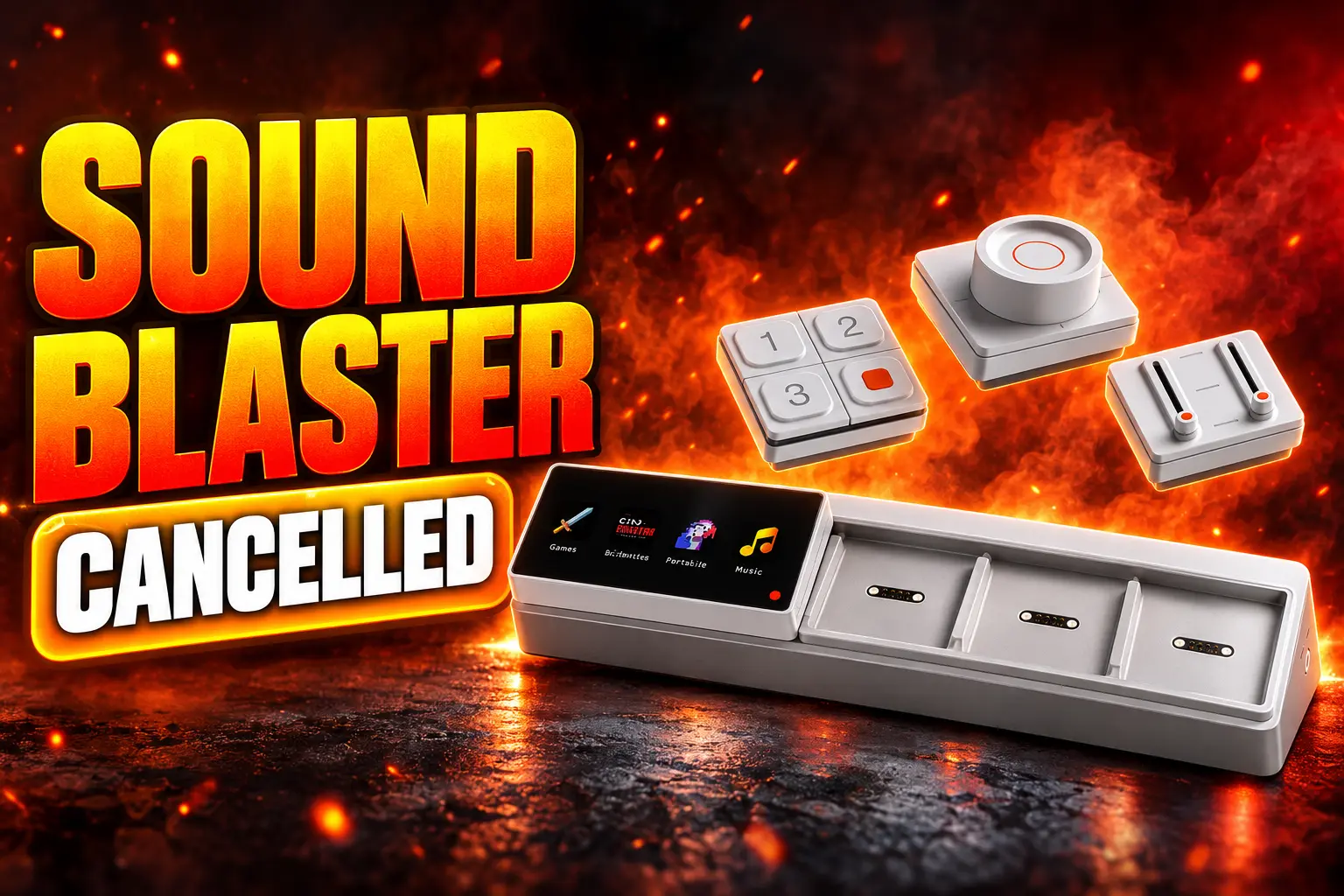
Magnetic Modules on a Linux Audio Hub
Re:Imagine was sold as a desk slab that mixed a DAC, a headphone amp, a routing box, and a control surface. Creative priced the finished kit at US$500. The Horizon base had five magnetic slots. One slot had to hold the 3-inch touchscreen. The rest could take a button pad, a knob, and dual sliders, in any order you liked.
Darran Nathan, Creative’s VP of Operations and Products, tied the pitch to the old brand in the launch statement.
The original Sound Blaster changed the way millions experienced sound.
Darran Nathan, VP of Operations and Products, Creative Technology
He also said the company was trying to make Sound Blaster matter again “for today’s generation, in today’s multi-device world.” The campaign copy went further than a card in a PC. The unit ran Linux on an octa-core ARM chip with a 6-TOPS neural unit, 8 GB of LPDDR4 memory, and 16 GB of eMMC storage, plus a microSD slot. Creative promised root access, an SDK, and room for apps on the little screen, including a DOS emulator, an AI DJ, and new takes on the old Sound Blaster Parrot and Dr. Sbaitso.
WHAT THE HUB WAS BUILT TO DO
- Play high-res audio: Campaign specs listed playback up to 32-bit / 384 kHz, with an amp rated for headphones up to 300 ohms and large desktop speakers.
- Route any source: The pitch was tap-to-send audio from a PC, phone, console, mic, or instrument to headphones, speakers, or another box without crawling behind the desk.
- Run without a PC: Linux on the unit meant it could sit on its own, with Wi-Fi 6 and Bluetooth for wireless headphones, and USB-C video out for an extra monitor.
- Act as a shortcut deck: Buttons, the knob, and the sliders were meant to mute calls, launch apps, start a recording, fire macros, and talk to Matter smart-home gear.
The port list was the other half of the pitch. New Atlas, working from Creative’s materials in October 2025, described two USB-C ports, a 3.5 mm headphone out, mic in / line in, line out, TOSLink optical in, a Type-C port for power, and a dedicated USB port for the host computer. Creative said it would work with Windows, macOS, Linux, consoles, and phones.
That stack is why the device was hard to build at Kickstarter volume. An octa-core board, a converter and amp, custom magnetic modules, a touchscreen, radios, and a Linux image is a small computer with audio parts glued on, not a simple sound card.
718 Backers Put Up S$310,858
The campaign ran 60 days, from October 28, 2025 to December 27, 2025. All four paid tiers bundled the same Horizon Cluster: base, smart screen, dual slider, buttons, and knob. Shipping, duty, and tariffs were extra, collected later, and Creative’s own range was $20 to $50 depending on country.
THE KICKSTARTER PRICE TIERS
| Tier | Campaign price | Off US$500 | Backers |
|---|---|---|---|
| Super Duper Early Bird | S$388 (US$299) | 40% | 72 |
| Super Early Bird | S$426 (US$329) | 34% | 231 |
| Early Bird | S$453 (US$349) | 30% | 338 |
| Kickstarter Special | S$491 (US$379) | 24% | 48 |
Those four tiers add to 689 people. The campaign total is 718, so a slice of pledges sat outside the named kits. No tier was fulfilled.
Ship-to countries were the United States, Canada, the United Kingdom, Germany, France, Italy, Australia, and Singapore. On the comments thread, the Sound Blaster creator account said it was limiting that list “in order to ensure timely delivery of the reward tiers,” while it looked at adding regions. People outside those eight countries still wanted in. Japan was a frequent ask, and Creative never put it on the list. A six-slot Vertex base sat behind a $1 million stretch goal and was never unlocked.
Production was supposed to start in Singapore, with Malaysia, Vietnam, and China as backups once the team knew the order size. For a 718-unit run of a new mechanical design, that is a lot of tooling for a short batch. The money looked large next to a S$20,000 goal and small next to a factory that has to cut magnets, boards, and plastics.
The March Note Already Flagged Memory Supply
Creative had been warning about cost shocks before it pulled the plug. The campaign FAQ said tariffs could jump, which is why shipping was not billed up front. “Due to the geopolitical situation, tariffs may change at any time, and some countries may impose tariffs that exceed this estimate.”
THE PUBLIC TIMELINE
- October 28, 2025: Kickstarter opens at 10am EST. Creative’s pressroom frames Re:Imagine as the next Sound Blaster, a line that has shipped more than 400 million devices worldwide since 1989.
- December 27, 2025: Campaign closes at S$310,858 from 718 backers, 1,554% of the S$20,000 goal.
- March 2, 2026: Update 5 shows the prototype and a “Supply Chain Pulse Check” that already flags industry memory supply as a risk.
- May 31, 2026: Update 6 cancels the project, five months after the campaign closed and still inside the month before the June 2026 delivery window.
- June 10, 2026: Update 7 says refunds have started through Kickstarter. No later public note appears on the campaign.
The March memory warning sits in plain sight. By late spring Creative decided the parts, the price, and the volume did not add up. A funded campaign does not buy you DRAM, converters, or a clean tariff bill. It buys you a list of 718 people waiting on a product that still has to be tooled, certified, and shipped to eight countries.
Public talk about the hub was already thin during the campaign, and it went quiet after May. That silence is the other half of the scale problem. There was never a loud owner community, a flood of unboxings, or a second wave of orders that might have justified a bigger factory run. Creative refunded the money. It did not keep a zombie product page alive.
Elgato Sells the Control Surface Without a DAC
The comparison everyone reached for in October 2025 was Elgato’s Stream Deck line. Re:Imagine tried to be that deck plus a real audio path. Elgato never had to win that fight, because the control surface already sells on its own.
The closest Elgato unit, with keys, dials, and a touch strip, is the Stream Deck+ listed at $179.99 on Elgato’s US store. It has eight LCD keys, four 360-degree dials with a push action, and a 108 x 14 mm touch strip. The page lists Windows 11 and macOS 13. It does not list Linux.
HOW THE TWO DESKS COMPARED
| Item | Re:Imagine (campaign claim) | Stream Deck+ |
|---|---|---|
| Price | US$500 planned retail | $179.99 |
| On-device computer | Linux, octa-core, 8 GB RAM, root access | Host app on the PC or Mac |
| Audio hardware | 32-bit / 384 kHz DAC and 300 ohm amp | None; it is a controller |
| Controls | 3-inch screen plus magnetic buttons, knob, sliders | 8 LCD keys, 4 dials, touch strip |
| Linux | Native OS on the unit | Not listed on the US product page |
| Status in 2026 | Cancelled May 31, never shipped | On sale |
Linux users who want a Stream Deck already patch one together with unofficial tools. Creative’s opening was a deck that spoke Linux out of the box and also converted audio. That is a fair idea on a whiteboard. At US$500, with custom magnets and a full SoC, it had to be cheaper to tool than a 718-piece Kickstarter run could support once memory and tariffs moved.
Audio shortcuts already live as software on Elgato’s hardware. The missing piece Re:Imagine offered was the DAC, the amp, and the physical routing. Those are the expensive pieces, and they are the pieces that never reached a desk.
Creative Kept Shipping Sound Blaster Cards
The cancelled hub does not mean Sound Blaster left the catalogue. On March 16, 2026, while Re:Imagine was still a live campaign with a June delivery date, Creative announced the Audigy FX Pro for S$99. That is an internal PCIe card with 32-bit / 384 kHz playback, up to 120 dB SNR, discrete 7.1, and a headphone amp, sold through creative.com the same day as the announcement.
The company behind both products was founded in 1981. The Sound Blaster name dates to 1989. A $99 card that slots into a desktop is a known factory recipe. A Linux slab with magnetic modules, a neural unit, and eight-country Kickstarter logistics is not. Creative chose the recipe it could still run.
New Atlas, in the October 31, 2025 launch piece, noted that Creative already sells a dual-camera webcam it had crowdfunded earlier, the Project Watcher. That earlier campaign is the contrast. Re:Imagine was the one that did not make it from pledge to parcel.
Backers were supposed to receive a 1-year hardware warranty and, on ordinary Creative store orders, a 30-day return. Neither policy was tested, because no unit shipped. Anyone now listing a Re:Imagine for sale is listing a product Creative said it would not make.
Frequently Asked Questions
Did Creative charge shipping before it cancelled Re:Imagine?
No. The campaign said shipping, duty, and tariffs would be collected later through a pledge manager, just before boxes went out, because rates were moving. That second bill never went out. The June 10 refunds covered the pledge amounts Kickstarter had already collected when the campaign closed on December 27, 2025.
What warranty would Re:Imagine have carried?
Creative’s campaign FAQ promised a 1-year warranty for manufacturing faults. It excluded wear, scratches, breakages, and damage from user programming, including code that made the hardware unusable. It also pointed at a 30-day return window on Creative’s own store for ordinary orders, which never applied because no units shipped.
Was this Creative’s first Kickstarter project?
The Sound Blaster Kickstarter account was created in September 2025 and lists Re:Imagine as its first and only created project. Creative itself is a 1981 hardware company; the crowdfunding login was new. The wind-down was a public cancel note plus a refund notice, which is cleaner than many first-time hardware campaigns, and it still did not produce a product.
Can you buy a Sound Blaster Re:Imagine now?
There is no retail model and no leftover Kickstarter stock. The six-slot Vertex base was a stretch goal tied to a $1 million campaign total, not a SKU that reached a warehouse. Treat any listing that claims to sell a Re:Imagine unit as unverified.
The last public word from Creative on the hub is the June 10, 2026 refund note. The Sound Blaster name is still on cards and speakers. Re:Imagine is not.

Saquon Barkley’s Hamstring Leaves the Eagles Thin in London

The Online US Passport Still Needs a Witnessed Oath

Ken Urker Died on His Birthday With No Cause Named

FOX Ices Portnoy After Ohio State’s Access Fight

Micron’s Record Memory Profits Lock RAM Tight Through 2028

Musk’s $914 Billion Lead Is a Public SpaceX Bet

Microsoft’s 96% Cyber Score Sits at 86.3% on the Board

Free Live Sports Streaming in 2026: What to Watch Without Cable

Endgame Encore’s $86 Million Trial for Infinity Vision

The Odyssey’s IMAX Film Run Hit a 41-Theater Limit
-
 BUSINESS4 months ago
Musk’s $914 Billion Lead Is a Public SpaceX Bet
-
 NEWS2 months ago
Microsoft’s 96% Cyber Score Sits at 86.3% on the Board
-
 SPORTS3 months ago
Free Live Sports Streaming in 2026: What to Watch Without Cable
-

 ENTERTAINMENT4 weeks ago
Sterling Point Holds No. 2 on Prime Video After 32 Days
-
 ENTERTAINMENT3 months ago
The Odyssey’s IMAX Film Run Hit a 41-Theater Limit
-
 ENTERTAINMENT3 months ago
Endgame Encore’s $86 Million Trial for Infinity Vision
-

 ENTERTAINMENT2 years ago
Andrew Garfield’s Spider-Man Films Are No Longer Free
-

 NEWS4 weeks ago
G20 Cheers AI Investment After Bailey’s Frontier Cyber Warning