
NEWS
Sikorski Warns AfD Win Puts NATO’s German Roads at Risk
After the AfD’s 43.8 percent win in Saxony-Anhalt, Radosław Sikorski warns Magdeburg could slow NATO troop movements even as Warsaw still wants a stronger.

Polish Foreign Minister Radosław Sikorski said an AfD government in Saxony-Anhalt could hinder allied troop movements toward Poland. The far-right Alternative for Germany took 43.8 percent in the 6 September state vote, more than double its 2021 share, while Chancellor Friedrich Merz’s Christian Democrats fell to 17.2 percent.
Warsaw still wants a stronger German army. Sikorski’s warning is about who runs the roads that army, and NATO, would use.
39 Seats, Three Short of a Majority
Saxony-Anhalt elected its ninth Landtag on 6 September. It was the first time the AfD finished first in a German state election. Provisional figures from the state returning officer, complete in the early hours of 7 September, give the party 576,037 second votes and 39 of 83 seats, three short of the 42 needed to govern alone.
Merz’s CDU, which had led every government in the state since 2002, crashed from 37.1 percent in 2021 to 17.2 percent and 15 seats. It won none of the 41 constituencies. The AfD took 38 of them; Die Linke held the other three in Halle and Magdeburg. Turnout jumped to 77.8 percent from 60.3 percent five years earlier.
SAXONY-ANHALT PROVISIONAL RESULT
| Party | Vote share | Seats | Change vs 2021 |
|---|---|---|---|
| AfD | 43.8% | 39 | +23.0 points |
| CDU | 17.2% | 15 | -19.9 points |
| SPD | 9.3% | 8 | +0.9 points |
| Greens | 8.9% | 8 | +3.0 points |
| Die Linke | 8.6% | 8 | -2.4 points |
| BSW | 5.3% | 5 | new |
The certified second-vote result is due on 22 September. Until then the arithmetic is already brutal. The CDU, SPD, Greens, Linke and the Sahra Wagenknecht Alliance hold 44 seats together, and that is the only majority that does not include the AfD. Any four of those five fall short of 42. The CDU plus the three next-largest parties also total 39, the same as the AfD.
Ulrich Siegmund, 35, the AfD lead candidate and a Landtag member since 2016, said he would stand for minister-president if he can show a stable majority. Sven Schulze, the CDU minister-president since January, said the mandate to govern now sits with the AfD. Saxony-Anhalt’s domestic intelligence office has listed the state AfD as a confirmed right-wing extremist organisation since 2023.
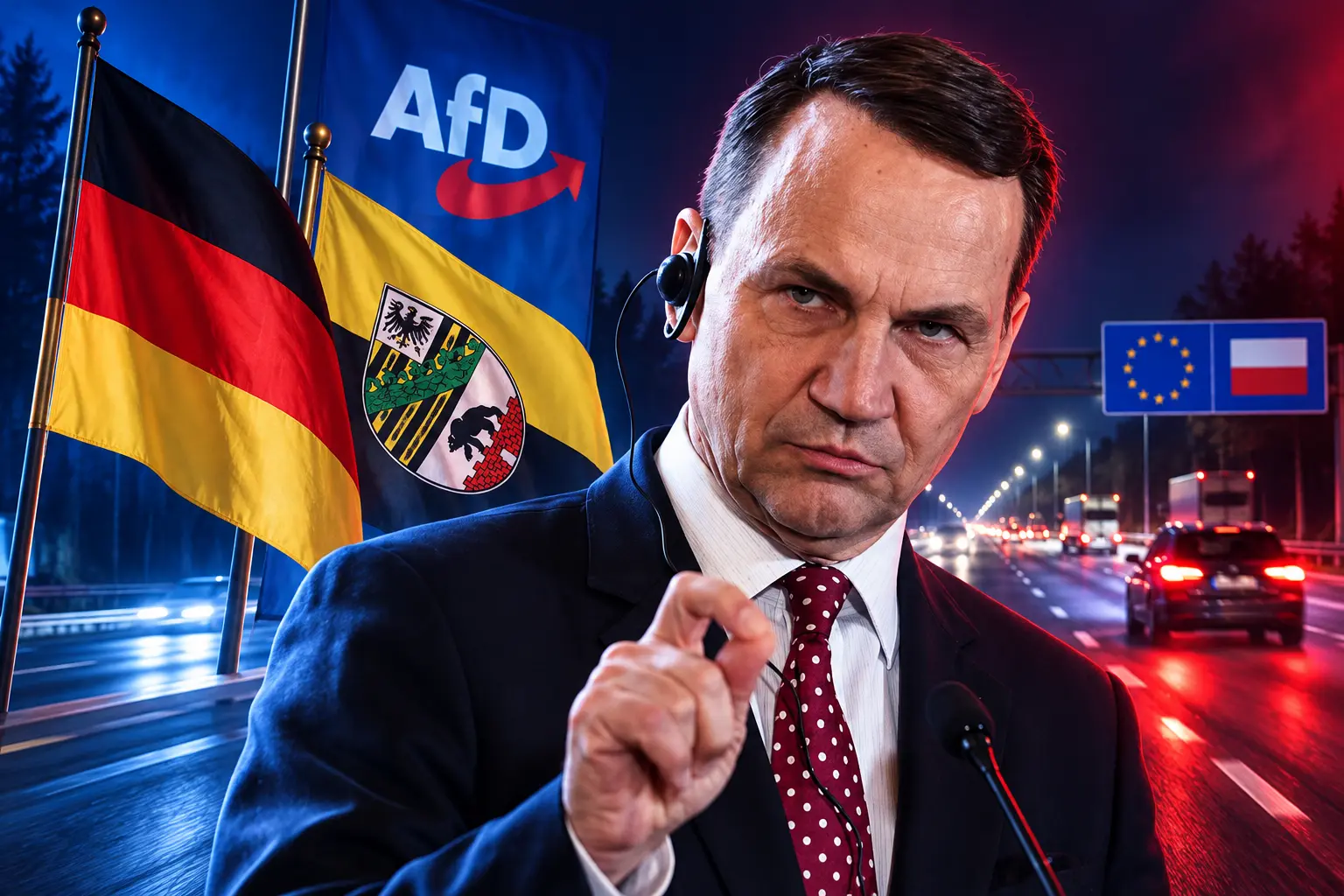
Sikorski Points at the Road Through Magdeburg
Sikorski split the message on purpose. In an interview published on 8 September he backed the German buildup under democratic leadership, then tied the AfD to a memory Warsaw does not treat as history-class colour.
We want Germany to play a strong role in securing our common security under democratic leadership and as Europe’s largest economy. But we remember all too well where a rearmed Germany in the hands of a far-right, pro-Russian party can lead, and that is exactly what the AfD represents.
Radosław Sikorski, Polish foreign minister, interview published 8 September
The sharper operational claim came a day earlier. On 7 September Sikorski called the result “a very worrying sign” and said the AfD had come “just a few votes short of an absolute majority.” He then put a map under the warning. If American, French or other troops wanted to reach Poland, he said, “we have a problem, because Saxony is between Berlin and the old West German border.”
An AfD government in Magdeburg could not halt German support for Poland or the Baltic states, he said. It could still “hinder military transits passing through the state’s territory.” He also tied AfD co-leader Alice Weidel’s line on the European Union to remarks by Krzysztof Bosak, a Confederation politician and deputy speaker of the Sejm, and said he has warned Polish nationalists for years to be careful what they wish for “because when nationalists win elsewhere, it could get rough.”
French Finance Minister Roland Lescure called the same result a “very, very worrying signal” and said German business leaders he had just seen were extremely concerned. The German Marshall Fund noted, correctly, that a state government cannot set federal foreign policy. Sikorski is not arguing that Magdeburg can scrap NATO. He is arguing that it can slow the column.
Why Saxony-Anhalt Sits on the NATO Corridor
Germany sits in the middle of the alliance’s land routes. Almost all transport to NATO’s eastern and southeastern flanks crosses German ground, including reinforcements from the United States, Canada and Britain that arrive through North Sea ports. In June, Poland and Germany signed a military-mobility deal covering infrastructure and Baltic cooperation, though the text was trimmed amid right-wing opposition at home.
GERMANY AS A NATO HUB
- Peak flow: Berlin’s joint force command says it must be able to move 800,000 allied troops across Germany within 180 days, with weapons, vehicles and supplies.
- Annual load: The Bundeswehr handles about 1,000 host-nation support requests a year, from a few hours of escort work to weeks around big exercises.
- Who helps: Large moves of several thousand troops need close work with the interior offices of the federal states, plus police, towns and private firms.
- Legal catch: Foreign forces still need prior authorisation to enter or cross Germany; the support is granted on request, case by case.
That is the second-order problem. The AfD does not get the chancellery from a Magdeburg win. It does get, if it forms a state government, the police and interior machinery that issues escorts, rest areas and heavy-load permits on a stretch of the eastbound road.
HOST NATION SUPPORT ON THE GROUND
- Entry papers: Diplomatic clearance and movement credits for heavy convoys.
- Escorts: Military and civilian police to move columns through towns and onto the autobahn.
- Rest and fuel: Guarded stops, rations, workshops and fuel, including at public service areas.
- Ammunition rules: Safe overnight sites when weapons and explosives are on the road.
- Sabotage watch: Protection of rest points and railheads, which the Bundeswehr lists as part of the job.
Host nation support is a whole-of-government task, written into Germany’s operational plan. It runs in peacetime, not only in a declared emergency. A hostile interior ministry cannot lawfully tear up NATO. It can make the 1,000 annual requests slower, narrower and louder.
A Federal Signature on Every Column
The legal ceiling is still in Berlin, and it is older than the AfD. The Two-plus-Four settlement at German unity says foreign forces cannot be stationed in the east, including Saxony-Anhalt. The 1954 stationing treaty that covers American, British and French bases in the old West does not apply in the five new Länder and Berlin. The federal government may approve only temporary stays that do not amount to stationing or relocation, and it does so case by case.
The Streitkräfteaufenthaltsgesetz, the 1995 law on short stays, puts the pen in the cabinet’s hand. The government may bring transit, exercise and training deals into force by regulation, without a Bundesrat vote. The same article says the affected states are involved in transit deals. Involved is not the same as a veto. It is a seat at the table for the Land that would have to police the convoy.
What an AfD Interior Ministry Could Slow
Movement credits, rest areas, civilian police escorts and sabotage protection all run through state offices. The Bundeswehr already flags that large multinational moves need that regional work. An AfD-run interior ministry would still face federal law and alliance duty. It would also face a party programme that wants German weapons for Ukraine stopped and sanctions on Russia rolled back.
So the Magdeburg risk is not a new Wehrmacht. It is friction on the one piece of German territory that already cannot host permanent NATO bases, now governed, if Siegmund gets in, by a party that treats the Ukraine war as someone else’s mistake. For a Polish planner watching American and French units roll east, that is a practical problem even if the legal answer is “Berlin decides.”
A $114 Billion Army With Long-Range Missiles
That friction lands on a German military that is no longer small. The Stockholm International Peace Research Institute says Germany spent $114 billion on defense in 2025, a 24 percent real rise, 2.3 percent of GDP, and fourth in the world behind the United States, China and Russia. Merz pledged at the start of his term in 2025 to make the Bundeswehr the strongest conventional army in Europe. Berlin is also planning nearly €12 billion in long-range weapons able to hit military targets hundreds or thousands of kilometres away.
MILITARY SPEND IN 2025, SIPRI
| Country | Outlay | World rank |
|---|---|---|
| United States | $954 billion | 1 |
| China | $336 billion | 2 |
| Russia | $190 billion | 3 |
| Germany | $114 billion | 4 |
Poland asked for this. A bigger Bundeswehr, German troops heading to Lithuania, and long-range strike kits aimed at Russia were Warsaw’s answer to a war on its border. The AfD’s Bundestag group wants the opposite: stop German weapons for Ukraine, ease sanctions on Moscow, and treat Nord Stream as an energy file rather than a wreck. The party remains in opposition at federal level. Mainstream parties still refuse to govern with it, the firewall built to keep 1933 from repeating as coalition maths.
Saxony-Anhalt does not elect a chancellor. It does show what happens to Merz’s party in the east while that army is being paid for. The CDU more than halved its vote in a state it had run for 24 years. The spending is federal. The voters who just doubled the AfD’s score live on the same map as the railheads and autobahns the alliance needs.
Wagenknecht’s Five Votes Could Open Magdeburg
The AfD cannot govern on 39 seats. The party that can unlock the door is the Sahra Wagenknecht Alliance, which crossed 5 percent for the first time in this state and holds five seats. BSW lead candidate Thomas Schulze said the AfD won and should form the government, and that his group would not vote against Siegmund if he stands. Founder Sahra Wagenknecht said the policy of keeping the AfD out has failed, and that the CDU, as the election loser, must be replaced.
She still rules out a formal coalition and has rejected Siegmund as minister-president, pushing instead for an “overpartisan” head of government. AfD federal co-chair Tino Chrupalla said there can be “only a minister-president Ulrich Siegmund.” Wagenknecht also said Siegmund seemed to be hunting votes among CDU deputies. The AfD has already appealed to individual Christian Democrats to break the firewall.
WHAT WE KNOW
- The numbers: AfD 39, BSW 5; 42 wins a majority, so the two parties together would have 44 if they ever voted as a bloc.
- The talks: Wagenknecht has accepted exploratory talks on energy, Ukraine aid and public broadcasting, and said “Nord Stream must be turned on.”
- The Ukraine file: BSW wants Magdeburg to press the Bundesrat to stop German weapons and big financial transfers to Kyiv, a federal signal even from a state that cannot run foreign policy.
- The CDU line: Schulze has conceded the governing mandate; no CDU decision to put Siegmund in office has been announced.
WHAT IS UNCONFIRMED
- Abstention: Whether BSW actually sits on its hands in a third-round vote for minister-president.
- Defectors: Whether any CDU members vote for Siegmund against the party line.
- The other majority: Whether CDU, SPD, Greens, Linke and BSW can stand a five-party cabinet of 44 seats.
- The job: Whether Siegmund becomes the first AfD minister-president in Germany.
Even without a cabinet, 39 plus 5 is enough to pass Landtag motions. A state cannot lift EU sanctions or recall the Lithuania brigade. It can still put Magdeburg on the record against weapons for Kyiv, and it can make the interior ministry a political actor on every NATO convoy that needs a German police car in front of it.
PiS and Confederation Take Tusk’s Fire
Polish Prime Minister Donald Tusk did not wait for the Handelsblatt interview. On 6 September he wrote on X that “in Poland, only idiots or traitors can rejoice at the triumph of the AfD in Germany,” and that “quite a few of them have gathered in Confederation and PiS.” Former prime minister Mateusz Morawiecki shot back that there are no idiots and traitors, only a different view, and asked who had backed the German-Russian pipeline.
That is where a slice of the Polish argument is now stuck: not on autobahn permits, but on Tusk using Magdeburg to brand the domestic right. Sikorski’s transit warning is more precise than the insult, and easier to lose in a party fight. The AfD’s own line, that it is a party of peace rather than a Kremlin vehicle, is already the reply from Polish activists who liked the result. It does not answer the host-nation file.
Parts of today’s Poland were occupied by Imperial Germany in the First World War. Nazi Germany invaded in 1939. Those facts are why Tusk reached for “traitors,” and why Sikorski reached for a rearmed Germany in the wrong hands. The live problem is narrower, and closer. Magdeburg still has no government. Berlin and Mecklenburg-Vorpommern vote on 20 September. The returning officer certifies Saxony-Anhalt on 22 September. Until someone forms a cabinet, the corridor Sikorski named is a Land in limbo with 39 AfD seats sitting on the road east.

The Court Revisits the Climate Nuisance Door It Left Open

ChatGPT Now Compiles Live Interfaces With GPT-6

A Tanker Attack Moves the War Into Qatar’s Waters

Personio Buys Circula to Own the DATEV Channel

Bluesky Files for .bsky and Enters the Registry Queue

Microsoft’s 96% Cyber Score Sits at 86.3% on the Board

Musk’s $914 Billion Lead Is a Public SpaceX Bet

Free Live Sports Streaming in 2026: What to Watch Without Cable

The Odyssey’s IMAX Film Run Hit a 41-Theater Limit

Endgame Encore’s $86 Million Trial for Infinity Vision
-
 NEWS3 months ago
Microsoft’s 96% Cyber Score Sits at 86.3% on the Board
-
 BUSINESS5 months ago
Musk’s $914 Billion Lead Is a Public SpaceX Bet
-
 SPORTS4 months ago
Free Live Sports Streaming in 2026: What to Watch Without Cable
-
 ENTERTAINMENT3 months ago
The Odyssey’s IMAX Film Run Hit a 41-Theater Limit
-
 ENTERTAINMENT4 months ago
Endgame Encore’s $86 Million Trial for Infinity Vision
-

 ENTERTAINMENT2 years ago
Andrew Garfield’s Spider-Man Films Are No Longer Free
-

 NEWS5 months ago
Singapore’s 3×3 and Surfing Debuts Miss the Medal Stand
-

 NEWS7 months ago
White Sands Footprints Put People in Ice Age New Mexico