
NEWS
Salazar Left Novelis as the $5 Billion Mill Comes Online
Regina Salazar left Novelis in April 2026 as the $5 billion Bay Minette mill entered commissioning, leaving her digital stack to run the plants.

Regina Salazar left Novelis on April 6, 2026, after the company had begun commissioning the cold mill at its $5 billion Alabama plant. She had spent nearly five years as chief digital and information officer, tying IT, data, and shop-floor AI into one function across a global rolling and recycling network.
Bay Minette, two fires at the Oswego, New York, mill, and a 2030 recycled-content target now sit on that stack. The plants have to throw off clean data for those goals to hold, and they have to do it without the person who designed the model.
Regina Salazar Left Before the Mill Came Online
Salazar joined Novelis in November 2020 as deputy chief information officer and took the top IT seat in June 2021, after a North America CIO post at Whirlpool and earlier systems jobs at Delphi, Goodyear, and Meritor. In an April 2025 interview she said her group was “responsible for all that Novelis needs in terms of technology,” from infrastructure and cybersecurity to analytics.
She ran a federated setup: four regional IT leaders sat with regional business presidents, and six global teams owned architecture, security, data, and related services. Every business leader got an IT partner. She merged digital and traditional IT, stood up enterprise architecture, and rebuilt the project office. “We had to integrate the digital and IT teams to deliver capabilities for the company, period,” she said.
On April 6, 2026, Dycom Industries named her chief information and digital officer, effective that day. Dycom, a U.S. contractor for telecom and utility work, said she would scale digital programs and fold AI into field operations. Dan Peyovich, Dycom’s president and CEO, pointed to her record running large enterprise systems. Salazar said she wanted to use AI-powered insights to help crews building infrastructure that connects communities.
Novelis has not named a successor in public materials. The digital operating model she described, including the new manufacturing execution system meant to debut in Alabama, remains the company’s stated path for copying plant software across the network.
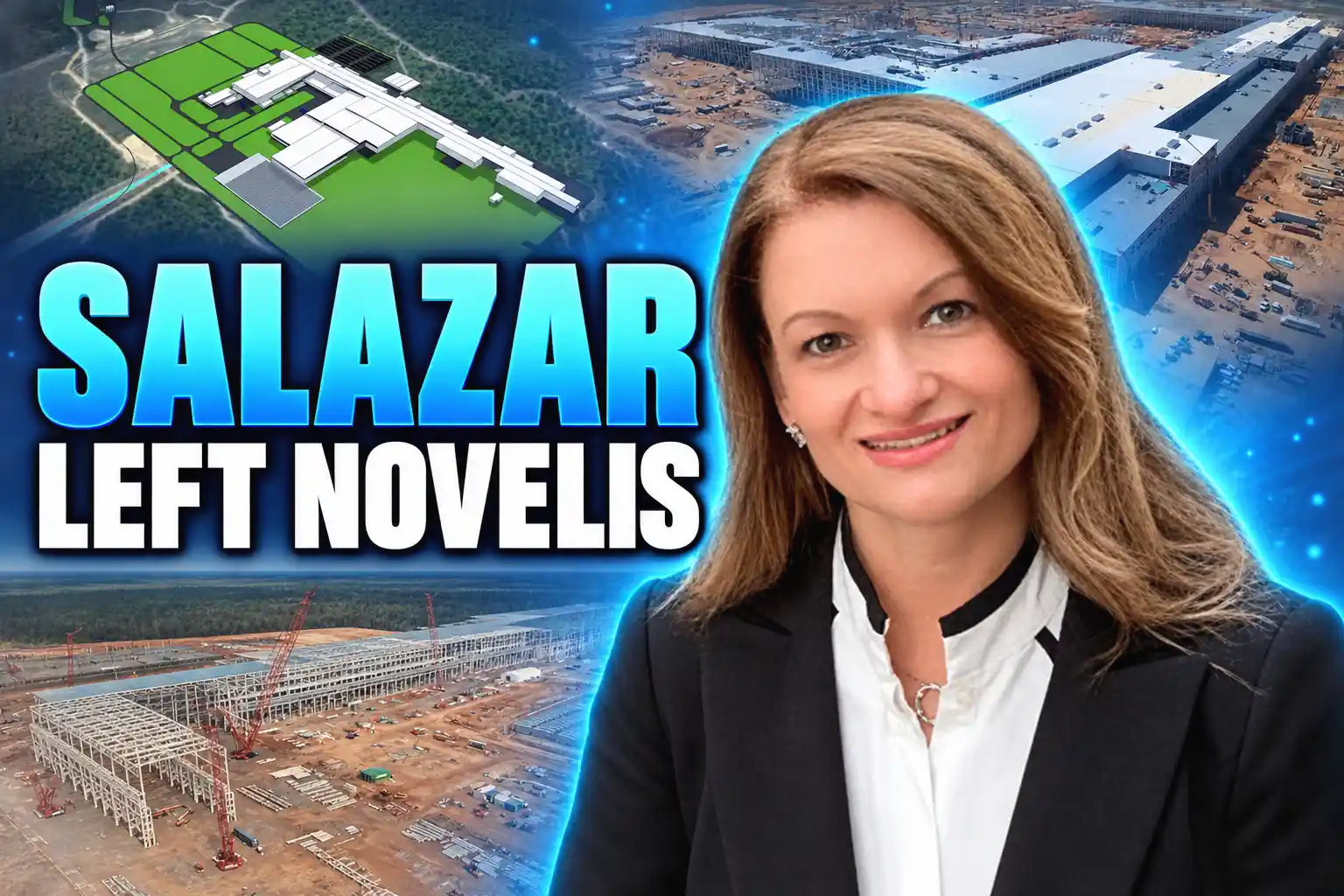
A $5 Billion Mill and a Doubled Price Tag
When Novelis broke ground in Bay Minette on October 7, 2022, the company put the investment at $2.5 billion and aimed to start the mill in mid-2025. The current company page for the $5 billion Alabama recycling mill lists commissioning in the second half of 2026. Finished-goods capacity is unchanged at 600,000 metric tons a year. The cost doubled.
The mill is the first fully integrated aluminum recycling and rolling plant built in the United States in more than 40 years. It is designed to serve beverage packaging and auto sheet, with long-term customer contracts already in place. Novelis says the line will need 17 billion used beverage cans a year as feedstock. In 2025, Salazar put the recycling-capacity add at 15 billion more cans a year, a related but different figure: one is metal the mill must eat, the other is extra can-loop volume she said the project would create.
BAY MINETTE THEN AND NOW
| Item | 2022 announcement | Company figures now |
|---|---|---|
| Investment | $2.5 billion | $5 billion |
| Jobs | Up to 1,000 | Up to 1,000 |
| Finished goods | 600,000 metric tons a year | 600,000 metric tons a year |
| Beverage sheet | Main focus of the mill | 420,000 tons |
| Automotive sheet | Flexible mix | 180,000 tons |
| Commissioning | Mid-2025 | Second half of 2026 |
| Can loop | 15 billion more cans of recycling capacity | 17 billion used cans a year to feed the plant |
Beverage sheet is 420,000 tons, or 70 percent of output, with 180,000 tons aimed at auto. Steve Fisher, Novelis president and CEO, has told investors the United States is short of beverage-packaging capacity and that tariffs make the project more strategic. Can-sheet volume was contracted before startup, which is why the mill is now discussed as a volume lever, not a software demo.
The original state announcement called for about 1,000 jobs in Baldwin County. That headcount target is still on the company site. Novelis began commissioning the cold mill in March 2026. In early October 2026 the company said construction remained on track to wrap later in the year, with plant commissioning still due before the end of 2026. Its June 30, 2026 quarterly report also shows the firm began stripping non-capitalizable Bay Minette start-up costs out of Adjusted EBITDA in fiscal 2026, so the mill is already a P&L event, not only a construction site.
This new plant adds capacity to recycle 15 billion more cans per year and brings all our latest technologies together.
Regina Salazar, then CDIO of Novelis, April 2025 interview
On the digital side, her team built an internal simulation so operations staff could test material flow and layout before steel was in the ground. The Alabama site was also set to debut a new manufacturing execution system, replacing older plant software and serving as a template for other mills. Those tools are what the company will turn on as crews move from construction into production.
Two Oswego Fires Hit While She Was Still CDIO
The other load on the network arrived in New York. A fire broke out at the Oswego plant on September 16, 2025. A second fire on November 20 hit an area where repair work from the first blaze was underway. Novelis said no employees, contractors, or first responders were injured. Both events stayed in the hot mill and the building around it. Recycling and casting, cold rolling, auto finishing, and shipping kept running.
THE ROAD FROM DEPUTY CIO TO A LIVE MILL
- November 2020: Joins Novelis as deputy chief information officer after Whirlpool.
- June 2021: Takes the chief information officer role and later the combined digital title.
- October 7, 2022: Novelis breaks ground in Bay Minette on a $2.5 billion mill.
- 2024: The company launches Novelis 3×30, its 2030 circularity plan.
- April 2025: Salazar describes the federated IT model, shop-floor AI, and the Alabama digital twin.
- September 16, 2025: First fire hits the Oswego, New York, hot mill.
- November 20, 2025: Second fire strikes the same mill during repairs.
- March 2026: Novelis begins commissioning the Bay Minette cold mill.
- April 6, 2026: Salazar joins Dycom; Novelis has not named a public successor.
- June 10, 2026: Novelis says the Oswego hot mill is back online.
- Second half of 2026: Company timetable for Bay Minette plant commissioning.
Fiscal 2026 showed the bill. Novelis’s June 2026 fact sheet lists $18.4 billion in annual revenue, $1.6 billion in adjusted EBITDA, and 3,557 kilotons of flat-rolled shipments, down 5 percent. Reported net income was $15 million. Company results put pre-tax losses related to the fires, net of insurance, at $925 million, with about 145 kilotons of lost shipments and an estimated $104 million hit to adjusted EBITDA. Tariffs took another $143 million off that earnings measure.
Fisher said the company rerouted metal through its global mills and third parties to keep auto and packaging customers supplied, including Ford, which issued a joint update with Novelis after the November fire. The Oswego hot mill restarted in June 2026. Alongside the restart, Novelis said it was speeding up a standardized operating system, a plant-floor cousin of the execution-system template Salazar had tied to Alabama. The fires did not wait for a digital roadmap; they forced the network to behave like one.
How Novelis Uses AI on the Shop Floor
The program behind those tools predates the Alabama mill. Around 2021, Salazar’s group reset a method already in house, Plant of the Future, because the company had use cases but no plan to copy them across mills. IT and operations staff pick a high-value problem, pilot it, then roll the playbook to other sites. Deloitte’s Plant of the Future manufacturing program materials describe eight work areas and 25 improvement targets, built around machine data, computer vision, and predictive maintenance.
SHOP FLOOR AI ALREADY IN THE PLANTS
- Collision alerts: Video models at mills in Ohio and Brazil watch mobile equipment and pedestrians and warn them in real time.
- Mill vibration: A Kentucky line uses a model to predict vibration so operators can change speed before the mill chatters.
- Predictive work orders: Sensor, process, and product data feed models that open maintenance jobs before a breakdown.
- Precision cutting: Vision systems automate cutting, which Salazar said cuts waste and raises throughput.
- Wearables: Computer vision and wearables flag shop-floor hazards and store the events for wider safety review.
Hindalco, Novelis’s parent, cited a predictive-maintenance project at the Pinda mill in Brazil as worth $6.5 million a year in avoided unplanned downtime. Salazar also said the company built a contained GPT on Azure, tried Microsoft Copilot and Moveworks for help desks, HR, and analysis, and kept a person in the loop. “We’re just scratching the surface,” she said of generative AI. Those office tools are the easy layer. The harder layer is the mill, where a bad prediction is scrap, injury, or downtime, not a messy email.
Robotic Dogs Walk the Confined Spaces
Inspection is where the safety case is blunt. Salazar said Novelis was piloting robotic process automation in the back office and mobile robots in the plants. “We use robotic dogs for quality inspections in confined spaces,” she said. The point was frequency and exposure: a quadruped can collect more readings, more often, and keep people out of tight, hot, or awkward spots while the data feeds the same analytics stack.
In the April 2025 conversation she said the company had two proofs of concept, one in Europe and one in the United States, with a robotics partner. Coverage of ANYbotics’ 2024 funding round listed Novelis among industrial customers placing large orders for ANYmal, a dog-sized inspection robot used in metals, energy, and chemicals. The robots carry cameras, thermal sensors, and mics, and they walk stairs and grated floors that wheeled carts cannot. That is a shop-floor job, not a lab demo, and it only pays if the readings land in the same data layer as the rest of Plant of the Future.
Salazar also said Novelis recycled about 82 billion used beverage cans in the year before that interview. The Alabama mill is supposed to add another large can loop on top of that base. A robot that walks a cellar and a vision system that watches a cut line are how a recycler tries to raise quality and uptime without putting more people into the hottest corners of a mill.
Vision 3×30 Runs Through the Data She Built
Novelis 3×30, launched in 2024, is the commercial reason the data work exists. Salazar called becoming a data-driven company a core enabler and named three supports: a stronger tech stack, tighter data governance, and data literacy across the firm. The public targets sit on the company’s 3×30 page and do not mention a CIO. They mention metal.
THE 3X30 SCOREBOARD
- Recycled content: Reach 75 percent average recycled content in products by the end of 2030.
- Carbon: Be the lowest-emissions flat-rolled supplier, under 3 tonnes of CO2e per tonne shipped.
- Capex: Keep making first-mover bets on recycling, rolling, and finishing kit.
- Company scale now: 12,750 employees, 29 plants including 15 recycling centers, nine countries, per the June 2026 fact sheet.
Fisher has said customers are asking for lower-carbon metal with more scrap in it. Meeting 75 percent average recycled content is also the main lever for the carbon target, alongside low-carbon primary metal and cleaner furnaces. Hydrogen trials in recycling furnaces, scrap-sorting work, and closed-loop take-back deals with auto and can customers all need the same thing from IT: a reliable picture of what metal is where, at what quality, in which mill.
That is a less photogenic job than a new greenfield line, and it is the job that remains. A federated model with four regional leaders only works if the six global teams keep the stack common enough that a vision model trained in Ohio can run in Brazil, and that a new execution system in Alabama does not become a one-off. Data literacy is the unglamorous third pillar: operators have to trust the vibration alert enough to change speed.
Novelis Must Finish Commissioning Without Her
Bay Minette will not be judged as a digital twin. It will be judged on whether 420,000 tons of can sheet and 180,000 tons of auto sheet show up on contract, at the recycled-content levels customers bought, without the downtime that wrecked Oswego’s year. Construction is winding down. The cold mill is already in commissioning. The rest of the equipment is due through the second half of 2026.
Salazar’s fingerprints are on the simulation model, the execution-system template, the Plant of the Future playbooks, the shop-floor vision work, and the contained Azure model. Those assets do not walk out with a CDIO. They also do not tune themselves when a hot mill burns, when start-up costs hit earnings, or when a greenfield line twice the original budget has to talk to 28 other plants.
She is now paid to put AI next to fiber crews, not next to a can loop. Novelis still lists Bay Minette commissioning in the second half of 2026, with up to 1,000 jobs attached to a mill that has to swallow 17 billion used cans a year once it is running.

Saquon Barkley’s Hamstring Leaves the Eagles Thin in London

The Online US Passport Still Needs a Witnessed Oath

Ken Urker Died on His Birthday With No Cause Named

FOX Ices Portnoy After Ohio State’s Access Fight

Micron’s Record Memory Profits Lock RAM Tight Through 2028

Musk’s $914 Billion Lead Is a Public SpaceX Bet

Microsoft’s 96% Cyber Score Sits at 86.3% on the Board

Free Live Sports Streaming in 2026: What to Watch Without Cable

Endgame Encore’s $86 Million Trial for Infinity Vision

The Odyssey’s IMAX Film Run Hit a 41-Theater Limit
-
 BUSINESS4 months ago
Musk’s $914 Billion Lead Is a Public SpaceX Bet
-
 NEWS2 months ago
Microsoft’s 96% Cyber Score Sits at 86.3% on the Board
-
 SPORTS3 months ago
Free Live Sports Streaming in 2026: What to Watch Without Cable
-

 ENTERTAINMENT4 weeks ago
Sterling Point Holds No. 2 on Prime Video After 32 Days
-
 ENTERTAINMENT3 months ago
The Odyssey’s IMAX Film Run Hit a 41-Theater Limit
-
 ENTERTAINMENT3 months ago
Endgame Encore’s $86 Million Trial for Infinity Vision
-

 ENTERTAINMENT2 years ago
Andrew Garfield’s Spider-Man Films Are No Longer Free
-

 NEWS4 weeks ago
G20 Cheers AI Investment After Bailey’s Frontier Cyber Warning