
NEWS
NoaConecta Puts School Pickup Liability on a Ledger
NoaConecta’s August 2026 launch logs who may take a child from school and which van they boarded, shifting legal risk onto inspectors, drivers and a new data law.

August 4, 2026 is when Chilean startup NoaConecta opened national cloud software that logs who may take a student off campus and which children boarded which van. Academic systems already hold grades, classroom attendance and invoices. The people who need the new file are inspectors, receptionists and drivers, because Chilean rules already make them prove that handoff on paper.
The Staff Who Sign the Exit Book
Every school day, inspectoría general, convivencia and the portería have to do three jobs the gradebook never sees. They stamp arrivals for hundreds of students, they check the adult at the counter against the enrollment card before an early exit, and they absorb last-minute changes that parents phone in while the vans idle outside.
NoaConecta’s launch note says those jobs still run, in most buildings, on paper registers, stray spreadsheets, reception phone trees and paper communication books. That split slows the reply when a family asks where a child is, and it slows the file when education authorities ask for the same answer.
The company’s pitch is not a smarter classroom. It is a second screen for the people who already carry the legal risk if the wrong adult walks out with a minor, or if a student who should have been on the yellow van is still in the yard.
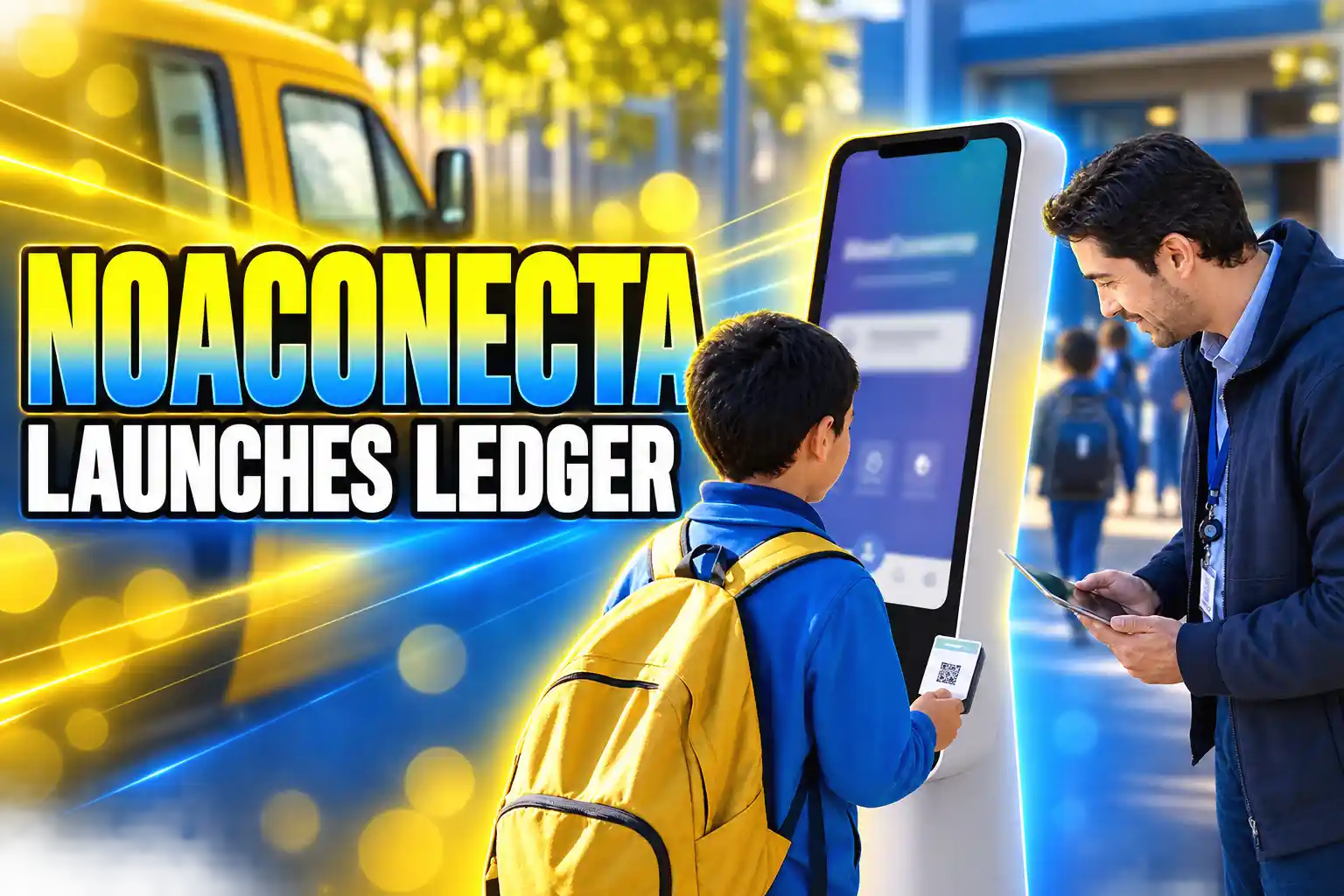
Who May Take a Child Off Campus?
Chilean schools write the answer into internal rules that cite the General Education Law’s duty to protect a student’s physical integrity, and they enforce it at the door with a cédula and a signature. The adult at the counter is not a guest. Until the book is signed, the school still has the child.
THE PICKUP RULES ON PAPER
- Titular guardian: The primary apoderado comes in person with a national ID and signs the exit book with the student’s name, course, reason and time.
- Listed substitute: Only a suplente already named on the enrollment card can stand in, and that person also shows ID.
- Third adult: A neighbor or relative needs a written poder from the titular, copies of both IDs, and a prior place on the student’s file.
- Hard stop: Internal rules say an unauthorized person does not take the child, even if someone has called ahead.
- Staff counter-sign: The inspector or designated official signs beside the adult, creating the paper trail Superintendencia visits later ask to see.
Custody fights make the counter harder, not easier. Some school protocols ask families for family-court papers that show who holds cuidado personal, then they keep that file next to the enrollment card. The porter is then asked to referee a legal status that was decided in a courtroom, using a binder and a phone.
NoaConecta says a staff member with a device can see at once whether the adult standing in the lobby has current permission from the main guardians. That does not invent a new right. It moves the same permission check off the paper list that gets photocopied at the start of the year and goes stale by April.
School Vans Carry a Duty the Software Now Logs
Dismissal is a second transfer of care, and Chilean transport law already names who holds it. CONASET’s published duty of care from pickup to drop-off runs from reception into the vehicle, through the trip, into the school, and back to the home or another agreed point. The duty ends when the student enters the building or home, or is received by the responsible adult at the agreed place.
Drivers need a professional A3 license (or the old A1), a visible ID card, and a clean check against the register of people barred from working with minors. Vehicles sit on the Registro Nacional de Servicios de Transporte Remunerado de Escolares. Skipping that list is treated as a very serious breach of the traffic law, and MINEDUC’s own national school transport registry rules tell parents to look the operator up before they pay.
THE HANDOFF THE VAN ALREADY OWES
| Moment | Who holds the child | What has to be true |
|---|---|---|
| Early exit at the portería | School staff until the book is signed | Adult on the enrollment list, ID in hand, reason and time written down |
| Boarding after the last bell | School until the student is on the van | A clear list of who got on which vehicle |
| The trip itself | Driver, and a second adult if more than 5 parvularia children ride | RENASTRE papers, seat belts on vans built from 2007, no child under 12 in a front seat, trip kept to 60 minutes |
| Drop at home or an agreed stop | Driver until an agreed adult receives the student | Door opened and closed by the driver or the extra adult, delivery on the correct side of the street |
A ministry school transport safety brief repeats the same chain for families: yellow or white paint, the “Escolares” sign, current technical review, and a copy of the registry certificate left with the school. The software’s transport module, as NoaConecta describes it, writes down which students boarded which vehicle at the end of the day, so the legal pass of care between the school and the driver is no longer a verbal wave at the curb.
That curb has a political file attached. On January 6, 2025, the Chamber of Deputies approved, with 113 votes in favor, a Chamber bill on transporter liability and sent it to the Senate. The text grew out of the 2022 crash that killed 12-year-old Martín Navarro Jorquera. It would spell out that drivers and accompanying adults are responsible during reception, the ride and delivery, and that the obligation ends at the school door, the home, or the agreed adult. The bill is not a finished statute. It is a map of the exact minute NoaConecta says it will stamp.
Perimeter Logs Without Touching Grades
The product is sold as a cloud service whose only job is physical movement: automated daily entries, documents for early exits, and live oversight of school transport. Developers framed it as microservices on purpose. They did not write a replacement for the academic or finance systems schools already run.
No venimos a reemplazar el sistema de gestión del colegio, sino a ser esa capa operativa esencial que garantiza la trazabilidad del estudiante desde que entra hasta que regresa seguro a su hogar.
NoaConecta, national launch statement, August 4, 2026
That split matters to a director who has spent years putting grades, billing and the digital class book into one vendor. A second platform that never touches curricular databases is easier to buy than a full migration. It is also a narrower product. If the academic system already logs a retiro as an attendance event, the missing piece is still the identity check in the lobby, not another column in the gradebook.
NoaConecta says the resulting file is hard to alter: exit time, reason, and the verified identity of the adult. The company presents that archive as backup for legal trouble, administrative reviews and emergencies. Superintendenta (s) Pamela Adriazola told the agency’s 2026 public account that schools already live under 3,092 separate duties, that the Superintendencia took more than 22,000 citizen complaints in 2025 (up 18% from the year before) and that it ran 20,286 inspections across all 16 regions. A door log that can be pulled in one search is, in that climate, a staff-protection tool as much as a parent app.
What the launch does not say is how many schools have signed, who founded the company, or whether anyone outside the firm has audited the claimed gains. Those figures are absent from the public record, so they are not facts of the rollout.
Ley 21.719 Will Police the Movement File
The same archive that helps an inspector is a file of minors’ daily routes. NoaConecta says it encrypts that data and locks it behind role-based access, so only staff the principal authorizes can see it. From December 1, 2026, that design sits under a statute with its own regulator.
THE DATES THAT NOW TOUCH THE GATE
- March 14, 1992: Decreto 38 sets paid school-transport rules, including the driver’s duty from reception in the vehicle to delivery at school or home.
- November 9, 2002: Ley 19.831 creates the national register of paid school-transport services, today’s RENASTRE.
- 2022: Martín Navarro Jorquera, 12, dies in a school-transport crash that later seeds a liability bill in Congress.
- January 6, 2025: The Chamber passes boletín 16433 with 113 votes in favor and sends it to the Senate.
- August 4, 2026: NoaConecta starts national operations of its perimeter software.
- December 1, 2026: Ley 21.719 takes full effect and opens the Agencia de Protección de Datos Personales.
Chile’s new personal data statute, published on December 13, 2024, rewrites Ley 19.628 and puts a special regime on the personal data of children and adolescents. School software vendors already warn directors that the establishment, not the contractor, is the party that answers for student data processed through a rented platform. Movement logs, pickup permissions and van manifests are not grades. They are a map of when a child leaves a building and with whom.
A paper libro de retiro was always personal data. A national cloud copy of every entry and every boarding list is the same data with a longer memory. The launch’s privacy language is therefore part of the product, not a footnote. If the encryption and the role locks fail, the harm is not a wrong mark on a report card. It is a leak of a minor’s routine.
Chile Counts 10,945 Schools With Students
The addressable door is large and still analog. MINEDUC’s Centro de Estudios counted 10,945 functioning schools with at least one student in 2025, and school enrollment of 3,541,790, down 1.1% from 2024. IMARC Group put the wider Latin American EdTech market at 16.26 billion dollars in 2024, a figure built mostly around learning platforms, classroom tools and full academic systems.
CHILE’S SCHOOLS BY DEPENDENCE, 2025
| Dependence | Schools with students | Share |
|---|---|---|
| Particular subvencionada | 5,379 | 49.1% |
| Municipal | 3,194 | 29.2% |
| Servicio local de educación | 1,707 | 15.6% |
| Particular pagada | 595 | 5.4% |
| Corporación de administración delegada | 70 | 0.6% |
Paid private schools are the thin slice most able to buy another SaaS seat for the portería. The bigger groups, municipal, SLEP and subsidized private, are the buildings where a paper exit book and a driver with a clipboard still close the day. NoaConecta is asking those staffs to keep their current academic vendor and add a perimeter layer that turns the signature at the gate into a record the school can later show a regulator, a court or a parent.
At 16:00 the van is still yellow, the adult at the counter still owes a cédula, and the inspector still has to look that adult in the face. The new software only stores that the check happened, who boarded, and when the school’s care ended. On December 1, 2026, that store becomes a children’s-data file with a new agency attached.

The Court Revisits the Climate Nuisance Door It Left Open

ChatGPT Now Compiles Live Interfaces With GPT-6

A Tanker Attack Moves the War Into Qatar’s Waters

Personio Buys Circula to Own the DATEV Channel

Bluesky Files for .bsky and Enters the Registry Queue

Musk’s $914 Billion Lead Is a Public SpaceX Bet

Microsoft’s 96% Cyber Score Sits at 86.3% on the Board

Endgame Encore’s $86 Million Trial for Infinity Vision

Free Live Sports Streaming in 2026: What to Watch Without Cable

Andrew Garfield’s Spider-Man Films Are No Longer Free
-
 BUSINESS4 months ago
Musk’s $914 Billion Lead Is a Public SpaceX Bet
-
 NEWS2 months ago
Microsoft’s 96% Cyber Score Sits at 86.3% on the Board
-
 SPORTS3 months ago
Free Live Sports Streaming in 2026: What to Watch Without Cable
-
 ENTERTAINMENT3 months ago
Endgame Encore’s $86 Million Trial for Infinity Vision
-
 ENTERTAINMENT2 years ago
Andrew Garfield’s Spider-Man Films Are No Longer Free
-

 NEWS4 months ago
Singapore’s 3×3 and Surfing Debuts Miss the Medal Stand
-

 ENTERTAINMENT1 month ago
Sterling Point Holds No. 2 on Prime Video After 32 Days
-

 NEWS6 months ago
White Sands Footprints Put People in Ice Age New Mexico