
NEWS
The NHL’s New CBA Lands First on Staff Goalies
The NHL’s new CBA starts Sept. 16 with 13-day camps, traveling emergency goalies, and an 84-game season that teenagers and staffers will feel first.

The NHL’s new collective bargaining agreement takes effect Sept. 16, cutting training camp to 13 days as the league moves to an 84-game season. Camps open the same morning. The regular season follows on Sept. 29.
Fans will see two extra games and a September that used to belong to exhibitions. The first people who have to live the deal are traveling staff goalies, 19-year-old first-rounders who can now go to the AHL, and a union that already caught coaches trying to keep the old suit rule.
Two Extra Games Bought a Shorter Camp
NHLPA executive director Marty Walsh has been blunt about the swap. Players agreed to 84 games. In return they took fitness tests off the table, shortened camp, cut the preseason, and killed the jacket-and-tie rule.
Fitness testing was given up because we have 84 games. So we got no dress code, a 13-day training camp, four-game preseason (per team) and no fitness testing for additional games. We want to make sure that’s all implemented properly and that there’s nobody trying to get around that.
Marty Walsh, NHLPA executive director
Experienced players used to sit through 20 days of camp. They now get 13, a cut of seven days, with the whole league still trying to be ready when the puck drops on Sept. 29. Players with at least 100 NHL games, including games dressed for goaltenders, may play only two exhibitions. Each club is limited to four preseason games.
The June 27, 2025 memorandum of understanding set those working conditions. Players ratified the deal on July 6, 2025. The NHLPA lists a term starting on September 16, 2026 and running through Sept. 15, 2030.
THE SEPTEMBER CLOCK
- Sept. 16, 2026: New CBA takes effect and main training camps open.
- Sept. 19, 2026: An eight-day, 65-game preseason begins, with a four-game maximum per team.
- Sept. 26, 2026: Preseason ends.
- Sept. 29, 2026: The 84-game regular season opens with five nationally televised games.
Walsh has said most players already train, eat, and skate through the summer, so the lost testing week should not show up in October. Some veterans still want the old benchmarks. They will not get them, at least not as a required camp event the union can see.
Who Gets the Traveling Goalie Job?
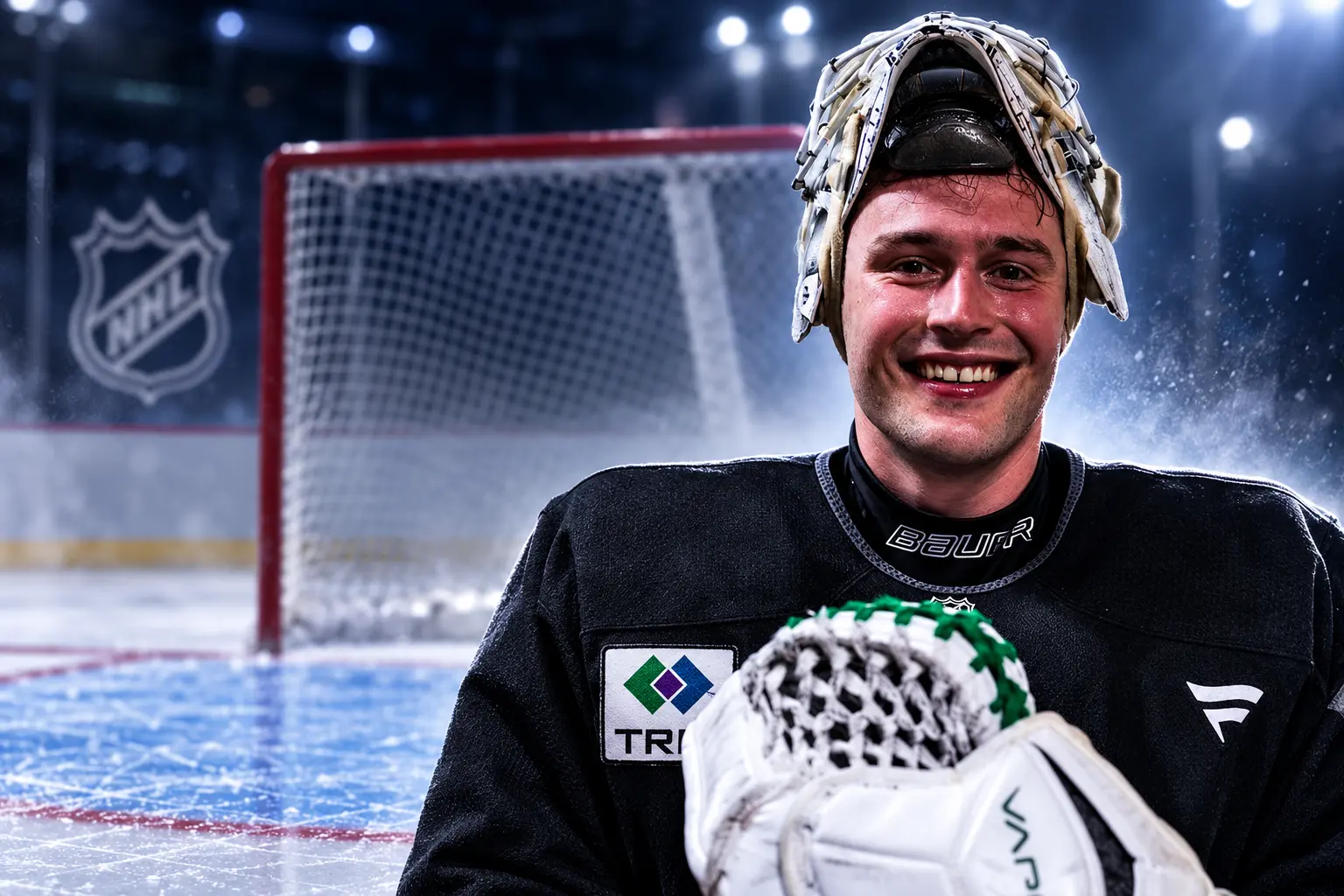
Every club must now carry an emergency backup goaltender prepared to enter home and away games. The old model, a local amateur in the stands who might never leave his seat, is gone. The new one is a staff job that travels.
Deputy commissioner Bill Daly has pointed to a rise in goalie injuries, especially in pregame warmup, that used to send the league office scrambling for a warm body. The traveling backup is the fix. Clubs have until 48 hours before the regular-season opener to file a name and a playing history.
The emergency backup eligibility rules are tight on purpose. The goalie cannot have played an NHL game on a standard player contract, cannot have more than 80 professional games, cannot have been a pro in the past three seasons, cannot hold another deal that blocks the assignment, and cannot sit on any club’s reserve list. The pool is college, junior, and people who left the pro game years ago.
That is why the hires look like hockey-ops résumés, not lottery tickets. The Minnesota Wild signed Peter Thome, 29, as hockey operations analyst and emergency backup. Bill Guerin, the club’s president of hockey operations and general manager, announced the deal on Aug. 25. Thome went 19-14-4 at North Dakota with a 2.24 goals-against average and a.904 save percentage in 45 games, then worked video for the AHL’s Coachella Valley Firebirds. He will wear sweater No. 00.
Calgary is putting the same job on Dustin Nickel, a 35-year-old construction company owner who had been the local fill-in on practice days. He used to be paid $100 a night and spent it on 50-50 tickets. Radio host Jason Gregor has added a practical wrinkle: if a club is already carrying three goalies, the emergency backup does not have to be in the building that night.
STAFFERS ALREADY NAMED TO THE CREASE
| Team | Emergency backup | Day job |
|---|---|---|
| Boston | Kyle Chauvette | Assistant video coordinator |
| Buffalo | Jack McNaughton | Goalie scout |
| Carolina | Jorge Alves | Head equipment manager |
| Colorado | Will Slohm | Assistant strength coach |
| Minnesota | Peter Thome | Hockey operations analyst |
| Seattle | Dolan Gilbert | Research and development |
Puckpedia’s tracker had 16 clubs listed by early September, including Washington’s Connor Leslie, a 24-year-old Leesburg, Va., native the Capitals called the first full-time emergency backup in franchise history, and Winnipeg’s Cole Kehler. San Jose signed Nathan Airey, who played 35 games at the University of Minnesota. Several listings remain unofficial. The other 16 clubs still have until late September.
Every Emergency Goalie Wears Number 00
Thome’s No. 00 is becoming the staff mark around the league. The number keeps the emergency goalie visually separate from the roster, the way a bullpen catcher is separate from the batting order. Alves already has keys to Carolina’s room as head equipment manager. Chauvette is in Boston’s video booth. The pads go on after the day job, if they go on at all.
You hope you never have to use one, but we’ve been having more and more goalie injuries, particularly in pregame warmup. We don’t really know what’s behind that, but it causes a lot of indigestion for our clubs and for our central registry department, who had to figure out who they have and how to deploy a backup in certain situations. This should help alleviate some of those concerns.
Bill Daly, NHL deputy commissioner
The beer-league romance is the casualty. David Ayres winning a game as a Zamboni driver in 2020 is the story people still tell. The 2026 job is a known quantity on a plane, not a stranger in Section 304. Daly’s “indigestion” line is the league’s real motive. Warmup injuries will still happen. The paperwork is supposed to be done before they do.
First-Round Teenagers Can Go to the AHL
For decades, a 19-year-old drafted out of the Canadian Hockey League had two doors: the NHL roster or a bus back to junior. The AHL was closed. That barrier drops with this deal for first-round CHL players, which is why Daly put the rule on his watch list.
“It will be interesting to see how that’s utilized,” he said. The first draft of the idea capped clubs at one such assignment a year. The finished language does not.
“Teams aren’t limited to one per club,” Daly said. “If they meet the criteria for assignment, they meet the criteria. You might have two of those players. You might have three of those players. So that’s how it’s going to play out.”
The change had to be cut into the NHL’s agreement with the CHL, not only the CBA, which is why general managers were still arguing through the wording in March. San Jose general manager Mike Grier called it a matter of having more say in a prospect’s path. Eighteen-year-olds still cannot go to the AHL.
WHAT THE NEW AHL PATH REQUIRES
- The draft slot: The player must have been a first-round pick out of the CHL.
- The age band: He must be in his 19-year-old season; 18-year-olds stay ineligible for the AHL.
- The old rule: Those teenagers had to be offered back to their junior clubs and could not take a full AHL assignment.
- The club limit: There is no one-per-team cap if more than one prospect meets the test.
GMs wanted the extra door because the old binary produced two bad outcomes. A teenager who had outgrown junior either sat in the NHL too soon or spent another year dominating a league he had already finished. The AHL is the middle rung they could not use. How many clubs actually send a 19-year-old there in 2026-27 is the experiment Daly is waiting on. People around the league do not expect a flood. They also refused a numerical lid in case a draft class dumps two CHL first-rounders on one roster.
The Suit Rule Still Needs a Union Tour
The jacket-and-tie requirement died during the 2025-26 season as an early transition item, months before this CBA’s start date. Clubs are not allowed to write their own replacement. Players “are required to dress in a manner that is consistent with contemporary fashion norms,” which is a wide gate on purpose.
Walsh still had to spend last season reminding rooms that the old rule was dead. Some coaches, general managers, and even teammates wanted the suits back.
“There was a little hiccup with the dress code,” Walsh said. “Some coaches and GMs and other players wanted players to wear suits and that’s not the rule anymore. Players can wear whatever they want.”
He plans to hammer that again on the NHLPA’s fall tour, the early-season swing through every locker room. David Pastrňák’s walk-ins in Boston and William Nylander’s clothes in Toronto are the examples he uses. Nylander has said guys can wear whatever they feel comfortable wearing into games. Plenty of veterans still put on a suit because that is their routine, and the deal allows that too.
Walsh’s shorter version for traditionalists is “Hockey’s changing.” The union did not negotiate a fashion show. It negotiated a ban on clubs setting clothing rules, then watched some clubs try anyway. That is why a dress code that is already a year old is still on the monitoring list for September.
Fitness Tests Leave With the Old Camp
The beep test, the air-bike sprints, the timed two-mile run: none of it is a required camp event anymore. Walsh treats that as part of the same 84-game invoice. The union also had a dry run. When the 2019-20 season stopped in March and restarted with an August playoff, there was no fitness testing in front of those games, and Walsh said he could not tell a difference in the product.
“A lot of the players these days, they’re working out all the time,” he said. “They’re eating right all the time. They’re skating still. They come to camp in great shape.”
The leftover worry is not conditioning. It is clubs running the same tests under another name, or veterans losing a private number they used to chase. Walsh’s job in the first month is to hear about the workaround, if one shows up, before it becomes the new normal.
What the Playoff Cap Does to a Roster
The same Sept. 16 date resets the contract shop. Re-signing a player maxes out at seven years. Signing him somewhere else maxes out at six. Deferred compensation is gone. Those term cuts hit the next wave of extensions, not the deals already on the books.
The other mechanical change is the one general managers who used long-term injured reserve to load a playoff roster will feel. In the playoffs, teams must keep the cap hit of dressed players under the regular-season ceiling. The full roster can sit over the cap. The lineup that actually takes the ice cannot.
THE NEW MONEY FLOOR AND CEILING
- Salary cap: The upper limit is $104 million for 2026-27, with a $76.9 million floor and a $20.8 million individual maximum.
- Minimum salary: The floor pay rises to $850,000 from $775,000, then to $900,000, $950,000, and $1 million over the rest of the deal.
- Contract term: Seven years to re-sign, six years for a player leaving, starting Sept. 16.
- Playoff cap: Only the 20 dressed players, dead-cap charges included, must fit under the regular-season ceiling.
Existing contracts that sit below the new minimums get lifted to $850,000, which also lifts those cap hits. The people who notice first are fourth-liners and extra defensemen, not the stars whose deals already clear the floor by millions.
Carolina Raises a Banner on Opening Night
The compressed September exists so the league can add two divisional games without shoving the Stanley Cup deeper into June. NHL Public Relations put the new slate at an all-time high of 1,344 games played across 194 days, with 185 game nights, 42 home and 42 away for every club, and a finish on April 10. It is the third 84-game season in the league’s 109-season history, after 1992-93 and 1993-94, and the first in 33 years. It is also only the second time the regular season has opened in September, after the 2007-08 London premiere.
OPENING NIGHT, SEPT. 29
- 5 p.m. ET, ESPN: Florida at Carolina, with the Hurricanes raising a Stanley Cup banner.
- 7 p.m. ET, Sportsnet: Montreal at Toronto, an Original Six game that could include Gavin McKenna’s debut.
- 8 p.m. ET, ESPN: the Rangers at Boston.
- 10 p.m. ET, Sportsnet: Vancouver at Edmonton.
- 10:30 p.m. ET, ESPN: Chicago at Vegas.
By then the 13-day camp will be over, the four exhibitions will be in the books, and 32 emergency backups will be on staff whether or not anyone has seen them in a crease. The 84-game season is the product the league sold. The people who have to make the first month work are the ones in 00, the 19-year-olds who might skip junior, and Walsh walking into rooms to say the suit rule is still dead.

The Court Revisits the Climate Nuisance Door It Left Open

ChatGPT Now Compiles Live Interfaces With GPT-6

A Tanker Attack Moves the War Into Qatar’s Waters

Personio Buys Circula to Own the DATEV Channel

Bluesky Files for .bsky and Enters the Registry Queue

Microsoft’s 96% Cyber Score Sits at 86.3% on the Board

Musk’s $914 Billion Lead Is a Public SpaceX Bet

The Odyssey’s IMAX Film Run Hit a 41-Theater Limit

Free Live Sports Streaming in 2026: What to Watch Without Cable

Andrew Garfield’s Spider-Man Films Are No Longer Free
-
 NEWS3 months ago
Microsoft’s 96% Cyber Score Sits at 86.3% on the Board
-
 BUSINESS5 months ago
Musk’s $914 Billion Lead Is a Public SpaceX Bet
-
 ENTERTAINMENT3 months ago
The Odyssey’s IMAX Film Run Hit a 41-Theater Limit
-
 SPORTS4 months ago
Free Live Sports Streaming in 2026: What to Watch Without Cable
-
 ENTERTAINMENT2 years ago
Andrew Garfield’s Spider-Man Films Are No Longer Free
-

 ENTERTAINMENT4 months ago
Endgame Encore’s $86 Million Trial for Infinity Vision
-

 NEWS5 months ago
Singapore’s 3×3 and Surfing Debuts Miss the Medal Stand
-

 GAMING1 month ago
Xbox Puts 15-Hour Caps on Game Pass Cloud Play