
NEWS
Microsoft Strips Copilot Buttons as the Copilot+ Badge Dies
Windows 11 is cutting Copilot buttons and dropping the Copilot+ PC badge in 2026, even as Microsoft still builds agentic features and sells Copilot as an OS.

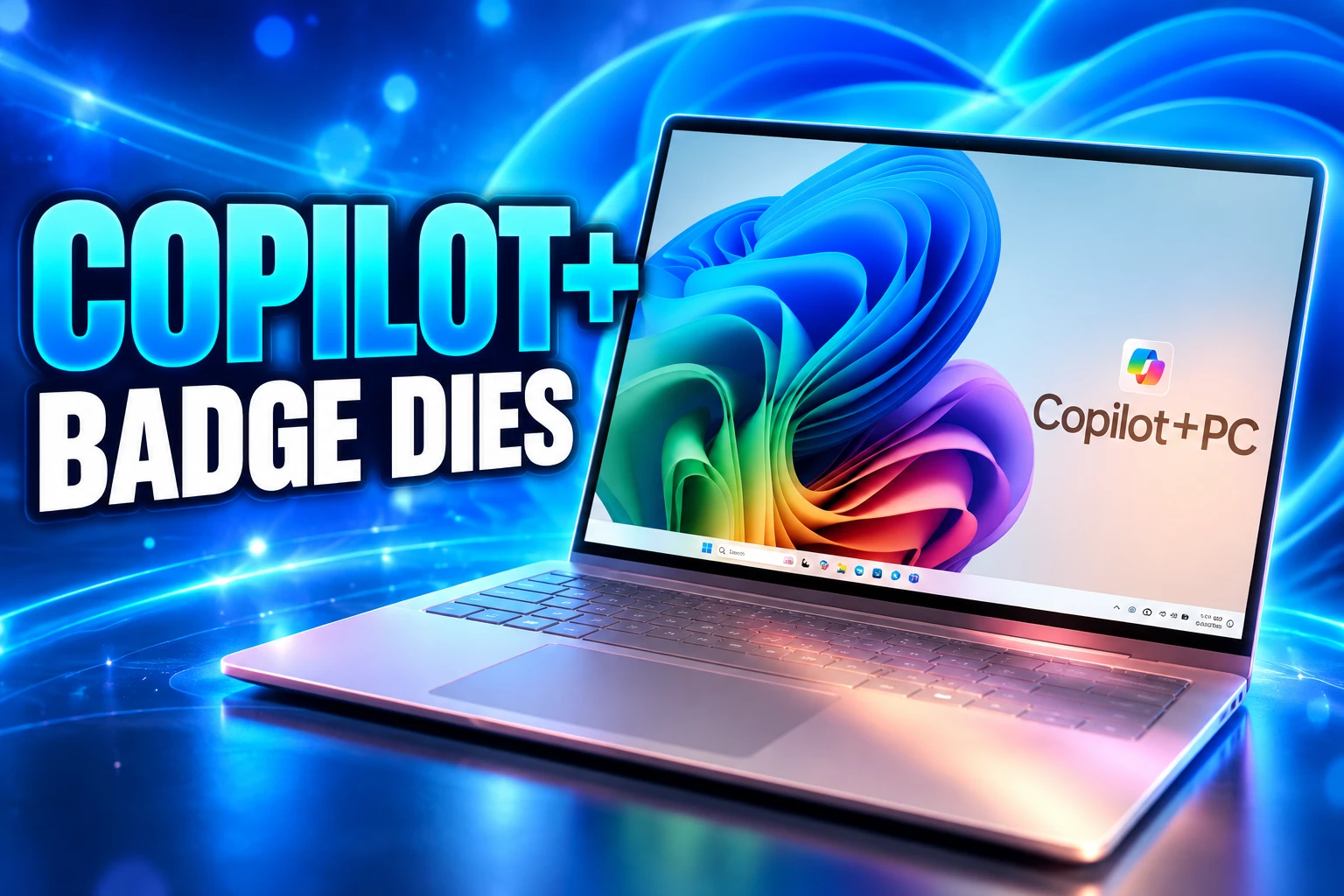
Microsoft spent 2026 cutting Copilot buttons out of Windows 11 while new Surface PCs lost the Copilot+ name. The quality reset Pavan Davuluri promised in March is showing up in Insider builds. The AI PC pitch those machines were sold on is the part that did not survive contact with buyers.
Davuluri, executive vice president of Windows and Devices, still wants agents running on the PC. Satya Nadella still talks about Copilot as a new OS for work. The public product, for now, is a quieter desktop, a movable taskbar, and a badge that no longer appears on the box.
The March Letter That Cut Copilot Buttons
On March 20, 2026, Davuluri published a letter to Windows Insiders after months of reading Feedback Hub and sitting with users in Seattle. He wrote that the company had heard people who care about Windows and want it to be better, and he named three jobs for the year: performance, reliability, and well-crafted experiences.
The letter was the on-the-record version of a quieter January shift, when Windows engineers were pulled off new features in a process described internally as swarming. Early 2026 patches had to deal with shutdown failures, crashes in cloud apps, and the sudden removal of legacy modem drivers. That was the Windows 11 trust crisis after AI reforms landing on the same PCs Microsoft had just counted as a user milestone.
The first preview items were not a new Copilot surface. They were the complaints that had piled up since Windows 11 shipped.
THE MARCH QUALITY LIST
- Taskbar placement: Move the taskbar to the top or sides of the screen, a request that dated to the Windows 10 layout.
- Copilot trim: Pull extra Copilot buttons from Snipping Tool, Photos, Widgets, and Notepad.
- Update control: Skip updates during setup, shut down or restart without installing, and pause updates for longer, with fewer forced restarts.
- File Explorer: Faster launch, less flicker, smoother navigation, and more reliable copy and move jobs.
- Widgets and feeds: Quieter defaults and more control over when the Discover feed appears.
- Insider channels: Clearer program rules and a rebuilt Feedback Hub.
- Memory and speed: A smaller baseline memory footprint so apps keep more of the machine.
Davuluri also said core shell pieces, including Start, would move onto WinUI 3 so clicks and menus feel less laggy. That is plumbing. It is also the opposite of adding another Copilot entry on a context menu.
What Reached Insider PCs by July
Four months in, Davuluri posted a progress note. Many of the March items were in Insider flights, and he said they would start a fall rollout across Windows 11 PCs. He added that there was more to do, especially in getting the work to everyone, and that the team was not slowing down.
The July note is the document that separates a press cycle from a shipping plan. Search was getting a calmer home screen and less promotional junk in web results. File Explorer work covered launch time, blurry Home thumbnails, the address bar, and renaming. Widgets were quieter by default. Taskbar positions and more Start personalization had begun previewing in May.
In May the company also launched a Driver Quality Initiative with hardware partners. Davuluri said USB4 docks, Bluetooth gear such as AirPods, and in-network printer discovery had already improved. At Build 2026 in June, Windows showed developer-focused pieces including a public preview of WSL containers and Microsoft Execution Containers, the sandbox work meant to hold untrusted agent code.
Gaming got a parallel shell rather than another AI overlay. The Xbox full screen experience on startup boots a controller-first home, holds back extra background apps, and is rolling out in stages on Windows 11 24H2 and 25H2 rather than as a single global switch.
THE 2026 WINDOWS RESET
- November 2025: Davuluri describes Windows as becoming an agentic OS, then turns off replies on the post after the backlash.
- January 2026: Engineers swarm on reliability. Nadella tells investors Windows 11 has 1 billion users, up over 45% year over year.
- March 20, 2026: The quality letter names Copilot buttons to cut and puts performance first. Davuluri becomes EVP of Windows and Devices the same month.
- May 2026: Taskbar placement, quieter widgets, inbox Copilot trim, and the Driver Quality Initiative hit Insider builds.
- July 29, 2026: Fiscal fourth-quarter results show PC licensing going the wrong way even as the rest of Microsoft grows.
- July 31, 2026: Davuluri says the March work will move beyond Insiders in the fall, and adds setup speed plus memory work for 8GB PCs.
- September 2026: New Surfaces stop using the Copilot+ name. Davuluri tells an interviewer the user of Windows will still be a person, and also agent workloads.
The remaining test is boring on purpose. If Start can find a local Downloads folder before it finds a web page, the letter did something. If the fall builds still reboot a family PC on a school night, it did not.
Copilot Leaves Notepad, and Recall Stays
The Copilot cut was specific. Davuluri did not say the assistant was leaving Windows. He said the company would be more careful about where it shows up, and he started with inbox apps that never needed a chat button.
You will see us be more intentional about how and where Copilot integrates across Windows, focusing on experiences that are genuinely useful and well-crafted. As part of this, we are reducing unnecessary Copilot entry points, starting with apps like Snipping Tool, Photos, Widgets and Notepad.
Pavan Davuluri, EVP, Windows + Devices, Windows Insider Blog
That sentence is why the March letter landed. Copilot in Notepad had become shorthand for an operating system that advertised at you while File Explorer stuttered. Pulling those buttons is the visible apology. Edge still has a Copilot mode, and Copilot still sits in the taskbar. The trim is about how often the brand interrupts a simple job.
Recall did not get the same burial. January talk that Microsoft might drop the name did not hold. The feature is still called Recall, still a preview, and still tied to Copilot+ class hardware. Microsoft’s own application card says you must opt in to saving snapshots, which stay encrypted on the local drive and are gated by Windows Hello. Snapshots pause when free space falls under 25 GB, and you need 50 GB free to turn the feature on.
Sensitive-info filters are on by default. Users can exclude apps and sites, and later builds made Recall removable as an optional feature rather than only a toggle. Click to Do still sits on top of those snapshots and can send a selected action to Copilot, Bing, or another app after you choose it. The privacy fight did not end. The company answered it with an off switch and a Hello prompt, then kept shipping the feature on Snapdragon, AMD, and Intel machines that meet the bar.
Why New Surfaces Lost the Copilot+ Badge
Two years after Microsoft invented the Copilot+ PC label, Surface stopped using it. Brett Ostrum, corporate vice president of Surface, said the new 12-inch Surface Pro and 13-inch Surface Laptop still clear the old hardware bar and are simply not called Copilot+ PCs. Qualcomm’s Kedar Kondap, senior vice president of compute, said machines with the same experiences would probably drop the terminology too.
These are not called Copilot+ PCs. They do meet all the requirements of our previous bar for what Copilot+ devices are. We still lean into the narrative around AI on the edge and being able to have a hybrid solution out there.
Brett Ostrum, corporate vice president of Surface
The badge was supposed to sell a refresh cycle. Recall was the headline feature, then it slipped, and the first wave of PCs shipped without the thing the NPU was bought to run. A Copilot key showed up on keyboards, including odd places like mini PCs, and became another thing people wanted to remap. Dell spent 2026 talking less about AI PCs than it did in 2025. Nvidia’s RTX Spark laptops are arriving without the Copilot+ name even when they meet the spec.
Owners of last year’s machines do not lose Click to Do, Studio Effects, or live captions because the logo left the box. They do lose the story they were told at the register.
THE HARDWARE BAR THAT OUTLIVED THE NAME
| Requirement | Copilot+ bar (still in docs) | What changed in 2026 |
|---|---|---|
| NPU | 40 TOPS or more | Still the gate for Recall and related features |
| Memory | 16 GB RAM | Unchanged |
| Storage | 256 GB, 50 GB free to enable Recall | Unchanged |
| Security | Secured-core, BitLocker or Device Encryption, Windows Hello | Unchanged |
| Brand on new Surfaces | Copilot+ PC | Dropped; Ostrum says the PCs are not called that |
| Inbox Copilot buttons | Spread across system apps | Cut first in Snipping Tool, Photos, Widgets, Notepad |
Microsoft’s own quality letter had already started reducing unnecessary Copilot entry points in those four apps. The hardware team then stopped printing the matching badge on new Surfaces. That is a coordinated retreat from a name, not from the silicon. The NPU is still in the bill of materials. The box just no longer tries to make it the reason you buy.
Windows OEM Sales Fell After the Windows 10 Deadline
The installed base and the money moved in different directions. Nadella said in the fiscal second-quarter call that Windows 11 had reached 1 billion users, faster than Windows 10, and that the count was up over 45% year over year. A large share of that jump sat next to October 14, 2025, when consumer Windows 10 support ended.
By the quarter ended June 30, 2026, the hangover was in the filing. More Personal Computing revenue was $12.9 billion, down 4%. Microsoft’s press release said Windows OEM and Devices revenue decreased 7%. On the call, the company said Windows OEM alone fell 5%, and it blamed lower PC demand plus a hard comparison with the Windows 10 end-of-support wave. For fiscal 2027 it guided Windows OEM and Devices to a decline in the high teens.
The rest of the company was not in the same weather. Full-year fiscal 2026 revenue was $331.8 billion, up 18%. Cloud carried the print. Windows was the mature licensing stream that had already cashed the forced upgrade.
WINDOWS 11 USERS VERSUS PC LICENSING
| Metric | Figure | Period |
|---|---|---|
| Windows 11 users | 1 billion, up over 45% year over year | Fiscal Q2 2026, per Nadella |
| More Personal Computing revenue | $12.9 billion, down 4% | Fiscal Q4 2026 |
| Windows OEM and Devices | Down 7% | Fiscal Q4 2026 |
| Windows OEM | Down 5% | Fiscal Q4 2026 |
| Company revenue | $331.8 billion, up 18% | Fiscal 2026 |
| Windows OEM and Devices outlook | Decline in the high teens | Fiscal 2027 |
Copilot+ was the extra story layered on that upgrade wave. If AI features had been the reason people bought new PCs, licensing would not be falling the year after Windows 10 went dark. Microsoft’s own comparison says the spike was the deadline. Quality work in 2026 is, among other things, an attempt to keep those 1 billion installs from feeling like a trap.
San Francisco Gets a Local AI Pitch on October 7
Davuluri has not dropped the agent idea. He has dropped the phrase. In a September interview he said he learned not to call Windows an agentic OS after the November 2025 post, then described the same direction in plainer words: people remain the users, and agent workloads get added. The work he pointed to is under the hood, identity for agents through Entra, and Execution Containers that run untrusted code in a sandbox. File system, security, and PowerShell are on that list. The UX layer is not the first stop.
That split is how Microsoft can cut Copilot from Notepad and still spend June’s Build conference on agent primitives. It is also how Nadella can call Copilot a new OS for work, spanning models, form factors, and tasks, without putting Windows 11 in the sentence. The assistant is being promoted as a workplace layer. The desktop is being told to stop nagging.
Davuluri’s July update, posted from his own account, is the public record of the cleanup. It is also a reminder that most of those fixes were still in preview when he wrote it.
— Pavan Davuluri (@pavandavuluri) July 31, 2026
On October 7 in San Francisco, Nadella, Davuluri, and Nvidia chief Jensen Huang are due to talk about how local AI will shape the next chapter of the PC. The last major Windows stage of that size, in May 2024, invented Copilot+ PCs. The next one has to sell NPUs and RTX Spark machines without the badge, and without stuffing another Copilot button into Paint. The quality letter bought Microsoft a quieter year on the desktop. The hardware channel still needs a reason to buy a new one.

Saquon Barkley’s Hamstring Leaves the Eagles Thin in London

The Online US Passport Still Needs a Witnessed Oath

Ken Urker Died on His Birthday With No Cause Named

FOX Ices Portnoy After Ohio State’s Access Fight

Micron’s Record Memory Profits Lock RAM Tight Through 2028

Musk’s $914 Billion Lead Is a Public SpaceX Bet

Microsoft’s 96% Cyber Score Sits at 86.3% on the Board

Free Live Sports Streaming in 2026: What to Watch Without Cable

Endgame Encore’s $86 Million Trial for Infinity Vision

The Odyssey’s IMAX Film Run Hit a 41-Theater Limit
-
 BUSINESS4 months ago
Musk’s $914 Billion Lead Is a Public SpaceX Bet
-
 NEWS2 months ago
Microsoft’s 96% Cyber Score Sits at 86.3% on the Board
-
 SPORTS3 months ago
Free Live Sports Streaming in 2026: What to Watch Without Cable
-

 ENTERTAINMENT4 weeks ago
Sterling Point Holds No. 2 on Prime Video After 32 Days
-
 ENTERTAINMENT3 months ago
The Odyssey’s IMAX Film Run Hit a 41-Theater Limit
-
 ENTERTAINMENT3 months ago
Endgame Encore’s $86 Million Trial for Infinity Vision
-

 ENTERTAINMENT2 years ago
Andrew Garfield’s Spider-Man Films Are No Longer Free
-

 NEWS4 weeks ago
G20 Cheers AI Investment After Bailey’s Frontier Cyber Warning