
BUSINESS
LMW Bets Machine Tools and AI Against a Textile Slump
LMW is wagering CNC shops, aerospace parts and an AI overhaul can carry a group whose textile machines no longer drive growth.

LMW Limited sold 1,902 textile machines in the year ended 31 March 2026 and still lost money in that segment on a consolidated basis. The Coimbatore group, formerly Lakshmi Machine Works Limited, booked ₹1,675.30 crore from that franchise, down 2.36% from ₹1,715.80 crore.
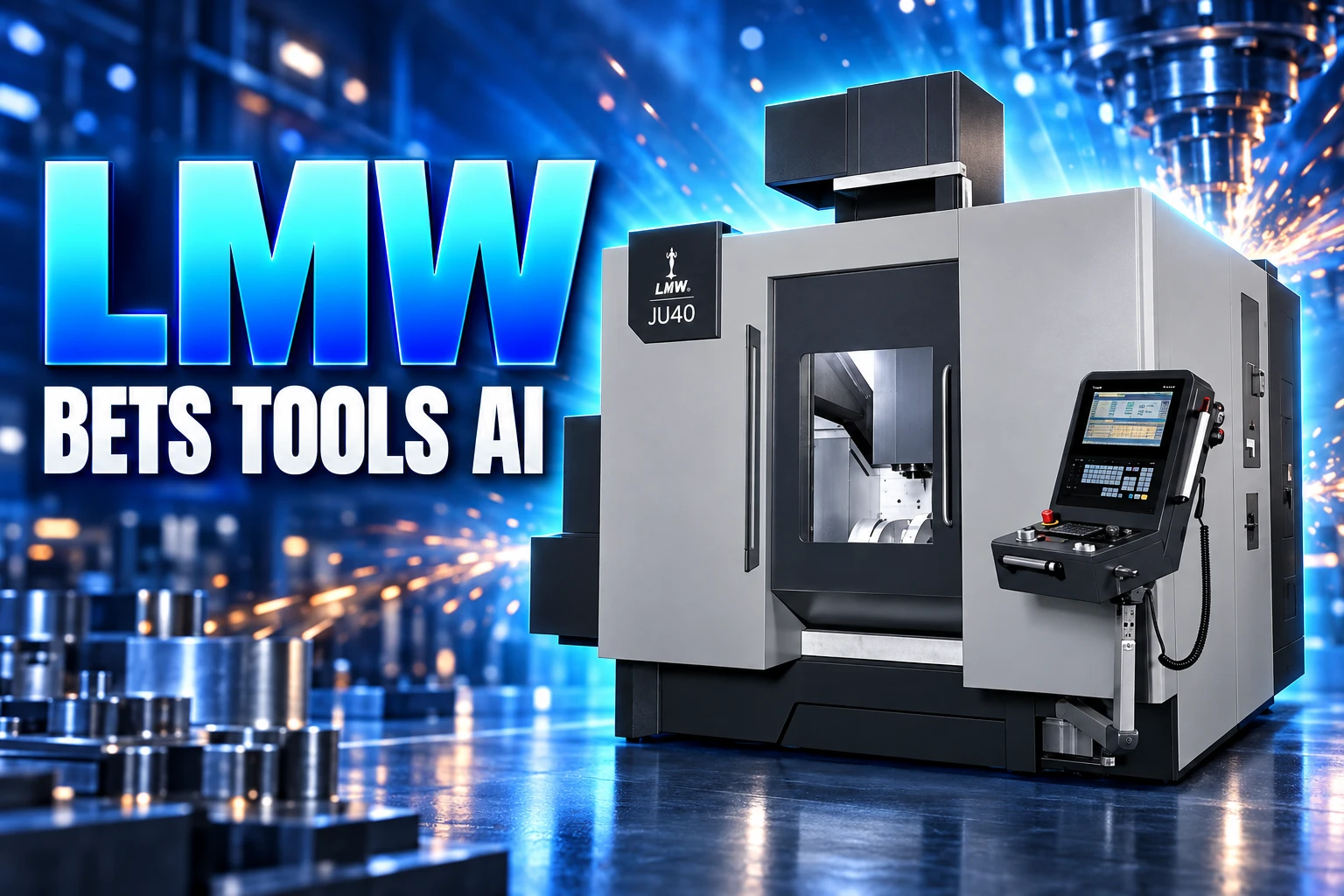
The machine tool shop sold 4,231 units and brought ₹1,032.66 crore, up 22.02% from ₹846.33 crore. Chairman and Managing Director Sanjay Jayavarthanavelu is putting the next cycle on that shop, on aerospace work, and on an AI overhaul of a spinning business that still fills the yard.
The Annual Report Reads Like a Wager
Jayavarthanavelu’s message to shareholders for 2025-26 called the year a period that tested the company’s resilience while reaffirming the strength of its fundamentals. The letter then spends its working pages on something else: a redesign of how LMW runs, and a bet that software can squeeze more out of plants that spinning mills are not filling.
We are deepening our organisational understanding of Artificial Intelligence (AI) and driving its responsible adoption across our operations. In parallel, we are integrating AI into our products and services to enhance their intelligence, performance, and overall value proposition.
Sanjay Jayavarthanavelu, Chairman and Managing Director, 2025-26 annual report
Standalone revenue from operations rose to ₹3,081.84 crore from ₹2,909.40 crore. Profit before tax, before exceptional items, rose 42.38% to ₹221.06 crore from ₹155.26 crore. Profit after tax after exceptional items fell to ₹153.92 crore from ₹238.24 crore, because the prior year included ₹131.61 crore from the sale of stakes in the China and UAE subsidiaries, against an exceptional charge of ₹13.18 crore in FY26.
The board recommended a dividend of ₹35 a share, 350% on a ₹10 face value, aggregating ₹37.39 crore. It also approved Jayavarthanavelu’s reappointment as managing director for five years from 1 April 2027, subject to shareholders, a signal that the same hand will run the wager.
Textile Machinery Still Fills the Order Book
Textile machinery remains the original product line and the largest rupee book. Mills, the annual report said, were running at about 80% to 85%, yet new capital spending stayed frozen. Cotton supply, tariffs, and weak export demand pushed spinning companies to wait.
LMW answered that wait with fewer shipments. Unit sales fell to 1,902 machines from 2,225 the year before. Export’s share of textile machinery turnover has shrunk to 9% to 10% from a historical 20% to 25%. Of ₹143.72 crore of textile machinery exports, ₹142.98 crore went to the group’s own step-down companies in China and the UAE, so almost all of that export line never left the family.
THE FY26 SPLIT IN FOUR FIGURES
- Textile units: 1,902 machines sold, against 2,225 in FY25.
- CNC units: 4,231 machines sold, the heavier count at a lower ticket.
- Plant use: the machine tool shop ran at about 70% to 75%.
- Segment loss: consolidated textile PBIT was a loss of ₹16.32 crore, after a loss of ₹20.66 crore.
That loss sits in the audited results for the year ended 31 March 2026. Machine Tool and Foundry made ₹97.20 crore at that profit line, up from ₹59.29 crore. The Advanced Technology Centre made ₹28.74 crore, up from ₹16.98 crore. Volume is still spinning. The profit engine is not.
How CNC Sales Offset a Weak Spinning Year
The machine tool division sold 4,231 machines and raised turnover 22.02% to ₹1,032.66 crore, and the annual report names it LMW’s growth engine for FY26, offsetting the textile cycle. It ran at about 70% to 75% of capacity on demand from auto, electronics manufacturing services, aerospace and defence buyers under the Atmanirbhar Bharat push, while the foundry added ₹114.89 crore on 5,593.70 tonnes.
FY26 DIVISION TURNOVER
| Division | FY26 (₹ crore) | FY25 (₹ crore) | Volume |
|---|---|---|---|
| Textile machinery | 1,675.30 | 1,715.80 | 1,902 machines |
| Machine tools | 1,032.66 | 846.33 | 4,231 machines |
| Foundry | 114.89 | 97.63 | 5,593.70 tonnes |
| Advanced Technology Centre | 171.29 | 147.64 | Aerospace parts |
Gross turnover across those lines rose 6.65% to ₹2,994.14 crore from ₹2,807.40 crore. The CNC shop, set up in 1988 with Japan’s Mori Seiki, now lists more than 15,000 customers and more than 50,000 turning and machining centres in the field. It is building loaders, gantries and robot arms so plants can run lights-out, and it is writing IoT-linked machines for jobs beyond auto parts, including mobile-phone making, defence and locomotives.
The public face of that shift is a trade-stand, not a spinning shed. LMW’s machine tool team took the INTEC 2026 show in Coimbatore from 4 to 8 June 2026, then a Pune show in September, where the stall was opened by a capital-purchase head from Hirschvogel Components India.
We were honored to welcome Mr. Deepak Ghanwat, Head – Capital Purchase, Hirschvogel Components India Pvt. Ltd., who inaugurated the LMW Stall at #PMTX2026.
Day 1 witnessed insightful conversations, & a strong response to our advanced manufacturing solutions. pic.twitter.com/5gzRwkF6A9
— LMW Machine Tool Division (@LmwCnc) September 7, 2026
Aerospace Parts Now Beat Textile Exports
The Advanced Technology Centre, opened in 2010, is the quieter half of the same wager. Product turnover rose 16.02% to ₹171.29 crore from ₹147.64 crore. Aerospace parts exports were ₹163.85 crore, up from ₹139.05 crore, and they beat the entire textile machinery export line of ₹143.72 crore.
The Coimbatore campus machines structures up to 10 metres, runs more than 25 special processes with NADCAP and OEM approvals, and sells into HAL, DRDO, ISRO and aircraft programmes in the United States and Europe. A composites hall opened in 2018. The composites plant on 7,450 square metres is laid out in a U-flow from cold storage to large-structure assembly, with a 12-metre high bay.
CNC machine tools and castings exports more than doubled to ₹36.84 crore from ₹16.31 crore. Total exports were ₹344.41 crore against ₹299.50 crore. On 20 May 2026 the board named Chandrashekar R, a mechanical engineer with an IIM Ahmedabad MBA and time at Infosys, Boeing and Adani, as head of foundry and ATC. The group is hiring composites technicians as far from Coimbatore as Hyderabad, which is how a spinning-machine company now staffs a aero shop.
Idle Textile Hours Fund an AI Rebuild
The annual report is blunt about how TMD used the slack. It started a business process re-engineering programme, reviewed every process, and pushed automation into the gaps. The stated aim is a controlled-room spinning plant, with AI and machine learning on both the machines and the factory that builds them.
WHERE THE CODE IS GOING
- Core processes: a group-wide BPR rewrite of workflows, meant to cut duplicate steps and tighten execution.
- Planning stack: sales and operations planning, supply chain, a source-to-pay loop, CRM, and human lifecycle systems, already on automated feeds.
- Spinconnect: an IoT and AI platform on textile machines, plus self-correcting “smart” frames aimed at labour gaps and power use.
- CNC side: IoT-linked tools and lights-out cells, sold into auto, electronics, defence and mobile-phone lines.
Seventeen patent applications went in during the year in India, with more overseas. About 97.50% of LMW’s own power came from 28 wind machines totalling 36.80 MW and 15 MW of solar. The foundry holds a GreenCo Platinum+ certificate. Those are real plants. They are also what a company does when the spinning hall is not running full and the CNC hall is.
The June Quarter Kept the Same Split
The first test of the wager after the annual report came in the quarter ended 30 June 2026. The board cleared those numbers on 24 July 2026, the same day as the 63rd annual general meeting. Standalone total income was ₹891.47 crore against ₹721.73 crore a year earlier. Profit before tax before exceptional items was ₹85.01 crore against ₹33.82 crore. Consolidated profit after tax was ₹55.52 crore against ₹11.47 crore, after a ₹2.41 crore voluntary retirement charge, per the unaudited results for the June quarter.
Chief Financial Officer V. Senthil, on the 27 July 2026 call, put textile machinery revenue at ₹482 crore against ₹415 crore a year earlier, machine tools and foundry at ₹343 crore against ₹251 crore, and ATC at ₹60 crore against ₹46 crore. Foundry was about 8% of that machine-tool figure. About 56% of the CNC mix was still automotive. Textile plant use, he said, hovered around 60%.
The textile order book stood at ₹3,200 crore, with about ₹2,400 crore active and backed by a 10% deposit. Two years earlier the shop was full, with deliveries stretching 14 to 15 months. That queue has shortened. Senthil pointed to state policies in Gujarat, Odisha and Madhya Pradesh, and to free trade deals, as the path back, and said cotton spinning margins were decent while synthetics were tighter. China turnover in the quarter was ₹11 crore against ₹76 crore a year earlier. LMW Holding Limited in Dubai, the material subsidiary, lost ₹23.13 crore on ₹313.80 crore of turnover for the full year.
THE DATES THAT LOCKED THE BET
- 20 May 2026: Board clears FY26 accounts, a ₹35 dividend, the managing director’s next five-year term from 1 April 2027, and Chandrashekar R as head of foundry and ATC.
- 24 July 2026: 63rd annual general meeting and the June-quarter print, with machine tools again growing faster than textile machinery.
- 1 October 2026: Trading window shuts pending results for the quarter and half year ended 30 September 2026.
The board also passed an enabling change to the objects clause covering pharmaceuticals, specialty chemicals, electric vehicles, renewables, electronics and robotics. Senthil called it an option list, not a launch. Anything material, he said, would come back to shareholders.
Markets Still File LMW Under Spinning
Official textile-division posts in August and September 2026 were still mill contracts, Maral Overseas for a melange unit and Chowdary Spinners on a compact ring frame, because that book is not gone. It is simply no longer the line that lifts the year. Screeners that watch breakouts already slot LMW next to Macpower and Jyoti, the listed CNC names, even as research notes still introduce the company as a textile-machinery maker with a side engineering book.
The annual report already chose a different order. Textile machinery is described as the original DNA. Machine tools are described as the growth engine. Aerospace parts now earn more export rupees than spinning machines. The AI programme is the attempt to make the first of those facts cheaper to carry until the third and second get large enough that the label has to move.
The next public number is the September quarter. Until that print, the FY26 accounts and the June follow-through are the prospectus: a Coimbatore group that still ships ring frames, and is spending idle hours, software and a CNC order book to make sure it does not have to live on them.
Disclaimer: This article is news reporting and analysis of LMW Limited’s published accounts, exchange filings and management commentary. It is for information only and is not investment advice, a research report, or a recommendation to buy, sell or hold any security. Readers who are considering a position in LMW or related stocks should consult a SEBI-registered investment adviser or other qualified professional who can judge their own objectives and risk. Revenue, profit, order-book and capacity figures are those given in the company’s reports and calls as of the dates named above and can change with later results, restatements or market conditions.

The Court Revisits the Climate Nuisance Door It Left Open

ChatGPT Now Compiles Live Interfaces With GPT-6

A Tanker Attack Moves the War Into Qatar’s Waters

Personio Buys Circula to Own the DATEV Channel

Bluesky Files for .bsky and Enters the Registry Queue

Microsoft’s 96% Cyber Score Sits at 86.3% on the Board

Musk’s $914 Billion Lead Is a Public SpaceX Bet

Andrew Garfield’s Spider-Man Films Are No Longer Free

Endgame Encore’s $86 Million Trial for Infinity Vision

Free Live Sports Streaming in 2026: What to Watch Without Cable
-
 NEWS3 months ago
Microsoft’s 96% Cyber Score Sits at 86.3% on the Board
-
 BUSINESS5 months ago
Musk’s $914 Billion Lead Is a Public SpaceX Bet
-
 ENTERTAINMENT2 years ago
Andrew Garfield’s Spider-Man Films Are No Longer Free
-
 SPORTS3 months ago
Free Live Sports Streaming in 2026: What to Watch Without Cable
-
 ENTERTAINMENT4 months ago
Endgame Encore’s $86 Million Trial for Infinity Vision
-

 NEWS5 months ago
Singapore’s 3×3 and Surfing Debuts Miss the Medal Stand
-

 BUSINESS2 years ago
Retail Banking vs Commercial Banking: A Comprehensive Guide
-

 ENTERTAINMENT1 month ago
Sterling Point Holds No. 2 on Prime Video After 32 Days