
BUSINESS
Egypt Sets July 2027 for the Siemens High-Speed Line
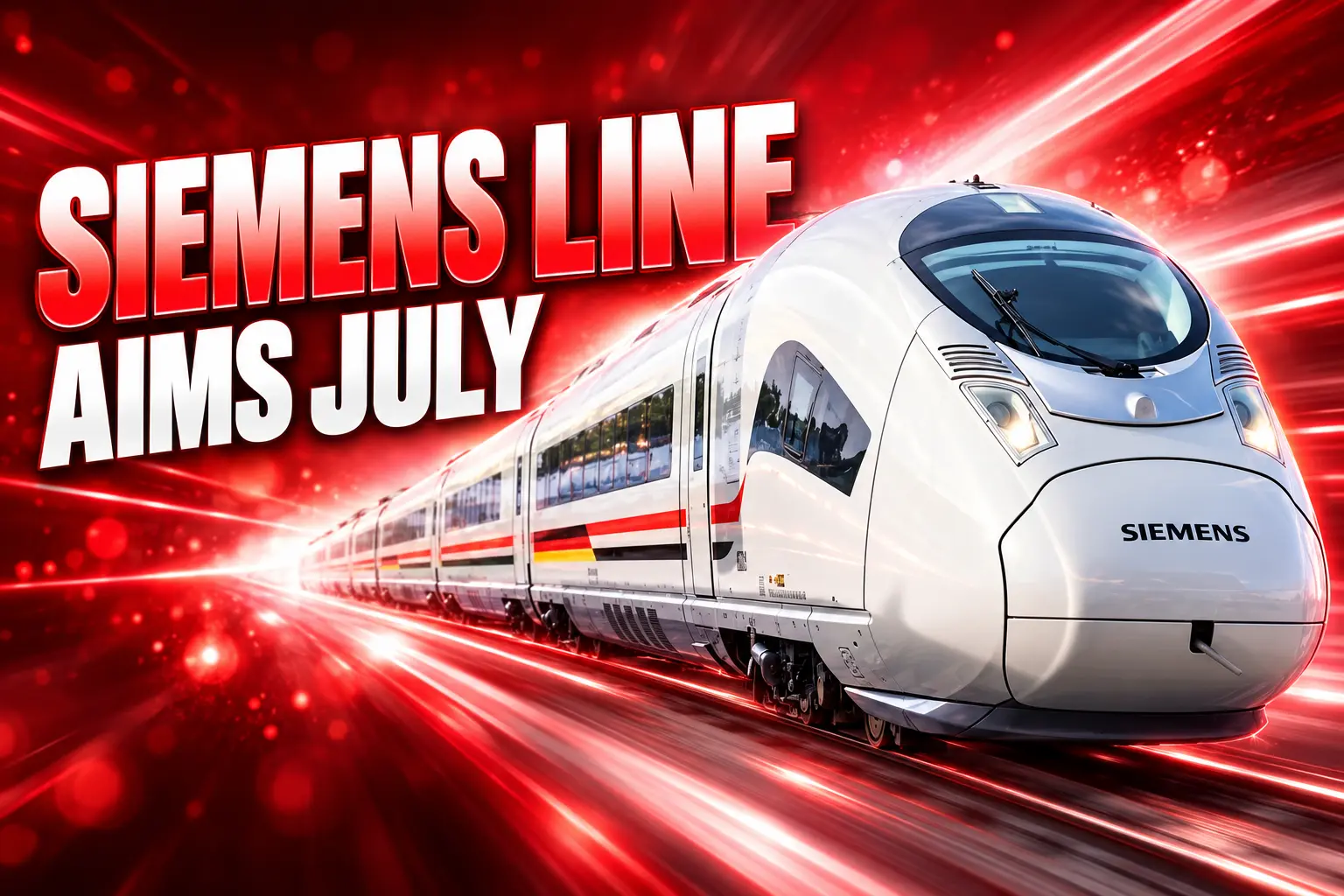
Egypt is aiming for July 2027 passenger service on its Siemens high-speed rail line, a delayed bet on a land link between two seas.

Egypt is aiming for July 2027 to start passenger service on its first high-speed electric line, Transport Minister Kamel El-Wazir said. The 660-kilometre route runs from Ain Sokhna on the Red Sea to Marsa Matrouh on the Mediterranean.
Unmanned trials on a first section are due in October 2026. That sequence is the latest test of a 2021 Siemens slogan, a Suez Canal on rails, after test dates had already moved.
Passenger Service Is Now Aimed at July 2027
El-Wazir set the ticket date in a 30 September 2026 interview. High-speed sets on the line are to run at up to 250 kilometres per hour. He put Cairo to Marsa Matrouh at two to two-and-a-half hours, and Ain Sokhna to Marsa Matrouh at three to three-and-a-half hours.
Regional trains that stop more often are to run at up to 160 kilometres per hour. Freight locomotives will share the same electrified corridor. Line 1 is planned with 15 high-speed trains, 34 regional trains and 14 freight locomotives.
Officials had earlier talked about starting empty tests in September 2026 and running them for about six months. Deputy Transport Minister Wagdy El Shahat had already moved a June 2026 trial slot into autumn. The July 2027 passenger target keeps the 2027 opening date officials have held since the Siemens contracts were signed, while pushing the first tickets past a winter of empty runs.
660 Kilometres, 21 Stations, Three Kinds of Train
Line 1 is the Ain Sokhna-Alamein-Matrouh Green Line. It has 21 stations, of which 13 are high-speed stops and eight are regional. A control centre sits on the same line. Construction of the first contract began in 2021.
The wider plan now on the books is four lines totalling 2,250 kilometres and 60 stations. The first three, about 2,000 kilometres, are under construction. Line 2 is meant to run from the 6 October area through Upper Egypt toward Abu Simbel. Line 3 is the 225-kilometre Qena-Hurghada-Safaga coastal link.
LINE 1 AGAINST THE FULL NETWORK
| Item | Line 1, Sokhna to Matrouh | Four-line network |
|---|---|---|
| Length | 660 km | 2,250 km |
| Stations | 21 | 60 |
| Velaro high-speed trains | 15 | 41 |
| Desiro regional trains | 34 | 94 |
| Vectron freight locomotives | 14 | 41 |
| Top passenger speed | 250 km/h | 250 km/h |
Siemens Mobility will install European Train Control System Level 2 signalling and the power supply on the three contracted lines. Civil works, bridges and tunnels are being built in Egypt and paid for in pounds from the National Authority for Tunnels budget.
WHERE LINE 1 MEETS OTHER TRANSIT
- Capital LRT: Interchange with the light rail at Central Capital Station.
- Metro Line 6: Planned link at Ahmed Orabi Station.
- Diesel main line: Transfer to the Cairo-Aswan railway at Giza Station, where high-speed tracks run above the existing lines.
- West Nile Monorail: Connection at October Station, with a planned shuttle to the Ring Road BRT at San Capital Station.
- Line 2: Same-level transfer at Hadayek October Station, which has five pedestrian bridges.
- Alexandria Metro: Links at Borg El Arab and Alexandria stations.
On 6 September 2026 El-Wazir walked the stretch from Hadayek October through Giza and Cairo stations to Ahmed Orabi. Giza is being built so passengers can move between high-speed and diesel trains without leaving the building. Hadayek October is the transfer hall for the north-coast line and the Upper Egypt line.
Siemens Booked Its Largest Order on This Network
NAT signed the first-line contract on 1 September 2021 with Siemens Mobility, Orascom Construction and The Arab Contractors. Siemens priced that package at about $4.5 billion, with its own share around $3 billion. On 28 May 2022 the same group signed the rest of a three-line system of about 2,000 kilometres. Siemens put its share of the combined deal at 8.1 billion euros, Siemens’s largest order, including 2.7 billion euros already booked for Line 1.
In addition, it is the biggest order in the history of Siemens!
Roland Busch, President and CEO, Siemens AG, 28 May 2022 contract statement
The 2022 package covers 41 eight-car Velaro high-speed trains, 94 four-car Desiro high-capacity regional sets and 41 Vectron freight locomotives, plus eight depots and yards and 15 years of Siemens maintenance. Siemens said the three-line job would create up to 40,000 local jobs. The 2021 first-line note had put direct jobs on that slice above 15,000.
On 10 November 2025, at TransMEA in Cairo, Siemens showed the Egyptian public a Velaro train built for desert heat. The eight-car set is rated at up to 250 kilometres per hour and 489 seats, with extra filtration and cooling for sand and heat. The same day a Desiro HC made its first run on new track near the 6th of October depot. Each Desiro is listed at up to 849 passenger spaces and 160 kilometres per hour.
El-Wazir called that Desiro run and the Velaro’s arrival a defining moment in the transport plan. Busch said the two events showed the future of mobility in Egypt taking shape. Siemens still describes the finished system as the sixth-largest high-speed network in the world, with access for about 90 percent of the population and travel times cut by up to 50 percent.
Egypt’s high-speed rail project is gaining momentum. Poised to become the world’s 6th largest high-speed rail network, it is redefining mobility and delivering impact far beyond the tracks. Watch the video to see history unfold in real time. #TransformMobilityForEveryone pic.twitter.com/qub6A8P0dM
— Siemens Mobility (@SiemensMobility) July 16, 2026
Michael Peter, CEO of Siemens Mobility, said in 2022 the 2,000-kilometre network would enable around 500 million journeys a year. That figure is for the full three-line map, not for Line 1 alone, which Siemens said would carry more than 30 million passengers a year.
Why Officials Keep Saying Suez Canal on Rails
The phrase is a land link between Red Sea and Mediterranean ports, not a substitute for the waterway. Siemens used “Suez Canal on tracks” when it signed Line 1, and El-Wazir still uses a “new Suez Canal on rails” when he inspects the Sokhna-Alexandria logistics corridor. Prime Minister Mostafa Madbouly used the same canal line on 13 September 2026, calling the route a development artery on a tour of Line 1.
The 2021 Siemens note said the 660-kilometre line would connect sea and dry ports and raise total inland freight moved by rail by 15 percent. That is the part of the bet that does not show up in a passenger timetable. Ain Sokhna is a Red Sea port and industrial zone. Alexandria and Dekheila sit on the other sea. Between them are 6 October, Borg El Arab and the new cities the state wants people and factories to use.
The same corridor is being sold to tourism planners. Stations on the north coast include New Alamein, Sidi Abdel Rahman, Dabaa, Ras El-Hekma and Marsa Matrouh. El-Wazir inspected that chain in July 2026 while finishing work was still under way. A fast electric service only pays off there if it runs in winter as well as in the summer car crush.
The slogan also has a limit. Ships returning to the Suez Canal are a different market from boxes moving between Egyptian ports and factories. The railway can feed those ports. It cannot take a ULCV from Asia to Europe. If freight customers still find trucks cheaper or easier to book, the 14 Line 1 locomotives become a quiet fleet on a loud passenger project.
Siemens’s 70 percent carbon cut is measured against cars and buses. Electric trains still take power from Egypt’s grid, which burns a lot of gas, so the climate gain is real versus the highway and smaller than a clean-power slogan sounds.
A Workshop Built for 50 Trains at Once
The Line 1 depot is at Hadayek October, next to the interchange station. NAT describes a 578-feddan depot at Hadayek October as one of the largest operation and maintenance centres in the region. It is meant to overhaul and store stock for all three contracted lines.
THE HADAYEK OCTOBER DEPOT
- Site area: The yard covers 578 feddans and is designed to hold 50 trains and locomotives at once.
- Building count: Forty-six service, technical and specialist buildings sit on the plot.
- Heavy shop: The main overhaul hall covers 67,000 square metres for periodic and full maintenance.
- Split of work: Orascom and Al Rowad hold civil, architectural and electromechanical design and build; Siemens, Orascom and Arab Contractors hold track, signalling, power and control.
Train storage is split across halls of 28,000 and 17,000 square metres, with paint, wash, track and sleeper shops beside them. On the 6 September 2026 tour El-Wazir also checked bridges that carry the line over water and pipelines. The Masar Bridge is complete. The 700-metre SUMED Bridge was nearing completion. The Nile complex, East Nile, main Nile and West Nile, has a combined length of 9 kilometres, with the west span still finishing. The 500-metre Giza Station Bridge is complete, and a 2.5-kilometre approach was still being built.
Those crossings are the unglamorous half of a 250-kilometre-per-hour railway. A Velaro is useless if a Nile span or a pipeline bridge is late. El-Wazir has said sections are being finished in parallel and that the last activity sets the completion date.
DB and Elsewedy Will Run It With Egyptian Staff
Building the railway and running it are separate jobs. On 13 November 2025 NAT signed a 15-year operating deal signed in Cairo with Deutsche Bahn International Operations and Elsewedy Electric, starting with Line 1. NAT Chairman Tarek Goweily signed with DB IO Chief Executive Niko Warbanoff and Elsewedy Chairman Ahmed El-Sewedy, with El-Wazir present.
Egyptian staff must make up at least 95 percent of the operating company’s workforce. The group is to train engineers and technicians so the network can later be run without a foreign operator in the cab. Egyptian drivers are to train each year on Germany’s high-speed lines. The commercial model is revenue sharing, with one operator across the three main lines to cut overlap.
Deutsche Bahn said work under the transport contract began in April 2026. That is the quieter clock running beside Siemens’s 15-year maintenance of trains and kit. Tracks can be handed over once. Timetables, freight slots, ticketing and depot discipline have to work every day, in sand, with crews who are still learning the system.
Hardware is the part of this project the public can already see. Capability is the part that does not show up at a station topping-out. A 2,000-kilometre electrified network at these speeds, mixed with freight, is an operating problem as much as a civil one.
Six Months of Empty Runs Before Any Tickets
The first unmanned section is the Sokhna-Administrative Capital-October City stretch of Line 1. Berlin meetings in September 2026 with Siemens, Orascom, DB and consultant Systra were held to lock that October start. Empty runs are then meant to move along the rest of the line on the project timetable, testing trains, stations, track, signalling, power, control and the join with other transit.
FROM CONTRACT TO EMPTY TRAINS
- 1 September 2021: NAT signs the first-line turnkey contract with Siemens Mobility, Orascom Construction and The Arab Contractors.
- 28 May 2022: The same group signs the expanded three-line system; Siemens’s share is 8.1 billion euros.
- 10 November 2025: Siemens unveils the Velaro at TransMEA and a Desiro HC makes its first run near the 6th of October depot.
- 13 November 2025: NAT signs the 15-year operating contract with DB International Operations and Elsewedy Electric.
- 6 September 2026: El-Wazir inspects station finishing and the Hadayek October depot ahead of empty trials.
- October 2026: Unmanned trials are due on the first Sokhna-Capital-October section.
- July 2027: Passenger service on Line 1 is the date El-Wazir has now set.
Ticket prices for regular service have not been published. Train frequency is still a planning choice, and that choice will decide whether the line is a mass service or a thin intercity product. Freight will turn on whether factories and ports book the locomotives instead of trucks.
The empty trains due in October 2026 are the first public proof of the 2021 slogan. If they stay on the six-month clock, July 2027 is the first day passengers can test it themselves.

The Court Revisits the Climate Nuisance Door It Left Open

ChatGPT Now Compiles Live Interfaces With GPT-6

A Tanker Attack Moves the War Into Qatar’s Waters

Personio Buys Circula to Own the DATEV Channel

Bluesky Files for .bsky and Enters the Registry Queue

Musk’s $914 Billion Lead Is a Public SpaceX Bet

Microsoft’s 96% Cyber Score Sits at 86.3% on the Board

Endgame Encore’s $86 Million Trial for Infinity Vision

Free Live Sports Streaming in 2026: What to Watch Without Cable

Andrew Garfield’s Spider-Man Films Are No Longer Free
-
 BUSINESS4 months ago
Musk’s $914 Billion Lead Is a Public SpaceX Bet
-
 NEWS2 months ago
Microsoft’s 96% Cyber Score Sits at 86.3% on the Board
-
 SPORTS3 months ago
Free Live Sports Streaming in 2026: What to Watch Without Cable
-
 ENTERTAINMENT3 months ago
Endgame Encore’s $86 Million Trial for Infinity Vision
-
 ENTERTAINMENT2 years ago
Andrew Garfield’s Spider-Man Films Are No Longer Free
-

 NEWS4 months ago
Singapore’s 3×3 and Surfing Debuts Miss the Medal Stand
-

 ENTERTAINMENT1 month ago
Sterling Point Holds No. 2 on Prime Video After 32 Days
-

 NEWS6 months ago
White Sands Footprints Put People in Ice Age New Mexico