
NEWS
Microsoft’s $17.5 Billion India Bet Now Runs in Hyderabad
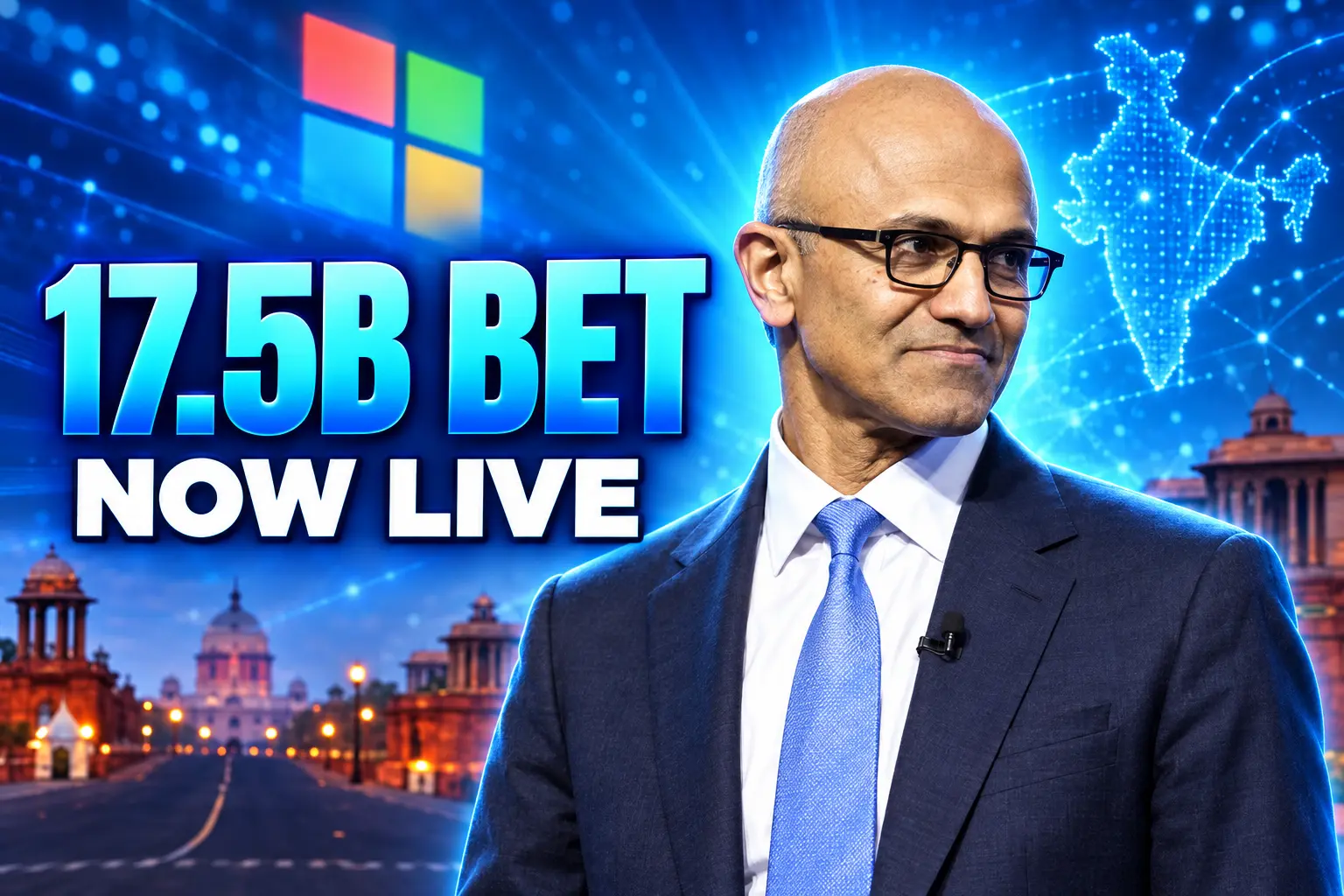
Microsoft’s $17.5 billion India bet is now a live Hyderabad region, built to keep Azure inside local data rules as Amazon and Google expand too.

Microsoft’s $17.5 billion India plan now has a live cloud region in Hyderabad, the first large build from the 2026 to 2029 Asia bet. CEO Satya Nadella announced the pledge on December 9, 2025, after meeting Prime Minister Narendra Modi in New Delhi. In September 2026 the company said India South Central is running.
The December package mixed hyperscale sites, training, and sovereign cloud products. The asset that opened is a three-zone datacenter, sold to banks, energy groups, and the state as local control over data, keys, and chips.
The $17.5 Billion Pledge Is Now a Working Region
Nadella’s post after the Modi meeting put the cheque in one line. “To support the country’s ambitions, Microsoft is committing US$17.5B, our largest investment ever in Asia, to help build the infrastructure, skills, and sovereign capabilities needed for India’s AI-first future.”
Microsoft’s own note dated that spend as US$17.5 billion over four years, calendar 2026 to 2029. It sits on top of a $3 billion package from January 2025 that the company said it was on track to finish by the end of 2026. Combined, Microsoft calls that a $20.5 billion India commitment.
Modi welcomed the Asia-high figure and said the world is optimistic about India on AI. He added that he was happy the largest Microsoft spend in the region would land here, and that Indian youth would use the opening.
The December plan put a new Hyderabad region at the centre, due in mid-2026, with three availability zones Microsoft compared in size to two Eden Gardens stadiums. On September 21, 2026, at an AI infrastructure summit in New Delhi, the company said that region was live and named it a strategic hub for Asia and the Global South. Telangana IT and industries minister D. Sridhar Babu inaugurated it on September 24, 2026.
Microsoft’s India account posted the go-live in those terms.
Microsoft's India South Central Cloud Region is now live in Hyderabad.
With security, sovereign-ready AI, and sustainable infrastructure, the region turns India's frontier AI ambition into capability at scale.
🔗 https://t.co/3RkagYWgCo#MicrosoftIndia #MicrosoftFrontier pic.twitter.com/H3t9hDucio— Microsoft India and South Asia (@MicrosoftIndia) September 23, 2026
FROM PLEDGE TO A LIVE REGION
- January 2025: Microsoft announces a $3 billion India investment, later described as on track to be spent by the end of 2026.
- July 22, 2025: Azure service for Nayara Energy, an Indian energy joint venture, is halted; Microsoft restores it on July 30, 2025.
- December 9, 2025: After a Modi meeting, Nadella announces $17.5 billion for 2026 to 2029 and sovereign cloud products for India.
- June 25, 2026: Amazon CEO Andy Jassy, after his own Modi meeting, adds $13 billion for AI and cloud, taking Amazon’s 2026 to 2030 India plan to $48 billion.
- September 21, 2026: Microsoft says India South Central in Hyderabad is live and a hub for Asia and the Global South.
- September 24, 2026: Sridhar Babu inaugurates the region; Telangana restates a 5 GW datacenter target by 2029.
Puneet Chandok, president of Microsoft India and South Asia, told the September summit that Microsoft’s datacenter regions across India are now AI-enabled, with AI-capable hardware and high-efficiency cooling. Early names on the new region include Adani Group, Bajaj Finserv, HDFC Bank, and PB Pay.
Microsoft Named Three Pillars for the India Spend
Microsoft framed the money as scale, skills, and sovereignty, matching language New Delhi uses for AI public infrastructure. Union electronics and IT minister Ashwini Vaishnaw, who met Nadella the day of the pledge, said the investment “signals India’s rise as a reliable technology partner for the world” and would help the country move from digital public infrastructure to AI public infrastructure.
The scale leg is physical. Microsoft said it would keep expanding three existing operational datacenter regions in Chennai, Hyderabad, and Pune, and add India South Central as its largest hyperscale region in the country. It also pointed to a workforce of more than 22,000 people in Bengaluru, Hyderabad, Pune, Gurugram, Noida, and other cities, spanning model work, engineering, datacenter operations, and sales.
The skills leg is a headcount target. In December 2025 Microsoft doubled a January goal and said it would equip 20 million people in India with AI skills by 2030. Through ADVANTA(I)GE India, run by Microsoft Elevate, it said it had already trained 5.6 million people since January 2025, ahead of the old 10 million goal, and that those programs had led to more than 125,000 jobs or entrepreneurial openings. By the September 2026 summit the company said it had equipped more than 10 million people, still aiming at 20 million by 2030.
The population-scale pitch runs through two labour platforms. Microsoft said it would put Azure OpenAI tools into e-Shram and the National Career Service for more than 310 million informal workers, with multilingual access, AI-assisted job matching, automated resume drafting, and pathways toward formal work. Chandok later said Centre and state governments are a large share of Azure’s India client base, and named e-Sanjeevani, with 400 million-plus healthcare consultations, beside e-Shram.
THE THREE PILLARS MICROSOFT FUNDED
- Hyperscale sites: India South Central in Hyderabad with three availability zones, plus expansion of Chennai, Hyderabad, and Pune regions.
- Training target: 20 million people with AI skills by 2030, with more than 10 million already counted by September 2026.
- Sovereign products: Sovereign Public Cloud, Sovereign Private Cloud on Azure Local, and in-country processing for Microsoft 365 Copilot.
Azure Local, the private-cloud stack, was described in December as scaling to hundreds of nodes, with external SAN storage and the latest NVIDIA GPUs, including a Microsoft 365 Local option. Copilot prompts and responses would, under normal operations, be processed inside India by the end of 2025, Microsoft said, making India one of the first four markets with that setup.
A July Cutoff Forced Azure’s India Rewrite
The sovereignty products did not arrive in a vacuum. On July 22, 2025, Nayara Energy lost Azure service. Microsoft restored it eight days later, on July 30, 2025, and pointed to European Union sanctions linked to Rosneft, which owns 49% of Nayara.
For Indian banks, energy firms, and state departments, that week made a remote cutoff a live operational risk. Five months later Microsoft introduced Sovereign Public Cloud, with landing zones and policy guardrails from Indian regions, and Sovereign Private Cloud on Azure Local for connected or disconnected sites in a customer’s or partner’s datacenter.
In September 2026 Chandok went further on who holds the controls.
On the data side, we are very clear that if customers want it in-country, it’s their control, their keys, their locations and their chips. We give in-country data residency, and are governed by local laws. We give sovereignty with sovereign controls, confidential compute, and customers own their data and where they want to keep it.
Puneet Chandok, President, Microsoft India and South Asia, in an interview
He said the sovereign client list in India now includes 22 states. Corporate affairs filings show Microsoft Corporation (India) Private Limited, the entity that bills Azure clients here, booked ₹29,302 crore in operating revenue and ₹1,245 crore in net profit in FY25, with revenue up 28% and profit up nearly 39%.
Sanchit Vir Gogia, founder of Greyhound Research, has said Microsoft’s government ties will help it sell sovereign cloud, but that signed intent can take time to become revenue. The legal wrapper Microsoft is selling is residency, local law, customer-held keys, and confidential compute. Whether that stack would survive a broad US sanctions fight with India is a diplomatic question, not a SKU question.
Amazon’s Cloud Slice Is Larger and Broader
Microsoft is not building this capacity into an empty field. Google announced a $15 billion, five-year plan in October 2025 for an AI hub in Visakhapatnam with AdaniConneX and Airtel. Amazon moved twice around the same political calendar.
On June 25, 2026, after Jassy met Modi in New Delhi, Amazon posted an additional $13 billion for AI and cloud through 2030. That came within six months of a $35 billion India package and takes Amazon’s 2026 to 2030 plan to $48 billion. Of that, Amazon said over $21 billion is for expanding and supporting AI and cloud, including more AWS capacity in Mumbai and Hyderabad, with access to custom AI chips and managed AI services. Jassy said Amazon is investing over $48 billion in the coming five years across its India businesses.
The two pledges sit in the same contest as Amazon and Microsoft’s India AI cloud expansion. Amazon’s headline is bigger because it mixes retail, logistics, and cloud. Lined up as AI and cloud spend, Amazon’s over $21 billion through 2030 sits beside Microsoft’s $20.5 billion through 2029.
HYPERSCALER INDIA PLEDGES BESIDE MICROSOFT
| Company | Headline pledge | Window | What it funds |
|---|---|---|---|
| Microsoft | $17.5 billion, plus $3 billion | 2026 to 2029 | Cloud and AI sites, skilling, operations, sovereign products |
| Amazon | $48 billion, of which over $21 billion for AI and cloud | 2026 to 2030 | AWS capacity in Mumbai and Hyderabad, plus wider India businesses |
| $15 billion, five-year plan | Announced October 2025 | Visakhapatnam AI hub with AdaniConneX and Airtel |
Jitin Prasada, minister of state for commerce, industry, electronics and IT, told Microsoft’s September event that the Hyderabad region strengthens the digital base for an AI-first nation and for the IndiaAI Mission. The buyers Microsoft named first are not startups. They are a conglomerate, a bank, a lender, and an insurer, the class of customer that now asks where the keys sit.
What the Hyderabad Region Does Not Guarantee
Microsoft says it has the largest hyperscaler cloud presence in India. India South Central is its fourth cloud region here. The September note also said organizations will be able to deploy eligible sensitive workloads in India “as supported services become available,” using controls meant for security, compliance, and sovereignty.
That clause is doing a lot of work. The region is live. The full menu of Azure and AI services, including Microsoft Foundry, was still rolling out in the months after launch. Residency for stored data is not the same promise as every model call staying inside the country.
Microsoft said its India regions are aligned with MeitY guidelines and designed to help customers meet the Digital Personal Data Protection framework and sector rules from the RBI and CERT-In. Tools cited for tighter control include Azure confidential computing, Customer Lockbox, and Azure Key Vault, as those services land.
So the product on offer is a ladder: public Azure in India, a sovereign public overlay, and a private Azure Local stack that can run disconnected. Indian customers get more places to put a workload. They do not, on Microsoft’s own wording, get every sensitive AI service on day one of the Hyderabad region.
Every New Rack Needs Firm Power and Cooling
The first public objection to a new Indian datacenter is water. Microsoft’s September note said high-efficiency mechanical cooling “delivers effectively zero water use for cooling.” Chandok has described air-cooled chillers on the Hyderabad site. That answers the water jab that followed Telangana’s inauguration posts. It does not answer the power bill.
A datacenter pulls load at 3 a.m. the same way it pulls load at 3 p.m. Solar does not cover that by itself. Firm power, from the grid mix the state actually runs, has to sit behind every advertised gigawatt.
Boston Consulting Group’s paper Powering India’s AI Ambition puts national datacenter capacity on a path to 6 to 8 GW by 2030, backed by $100 billion-plus in committed investment. It estimates the build could generate $140-200 billion in economic output through 2030, with about a 3.5x multiplier during construction as spend moves through civil works, electrical gear, cooling, and power. Microsoft cited that $140-200 billion range when it called Hyderabad a regional hub.
The same study is blunt about who captures the kit. A large share of datacenter spend in India still buys foreign electrical equipment, cooling, and racks. Local civil work and some electrical gear stay here. The second-order result of a $17.5 billion hyperscale cheque is a construction boom and a power problem, with a thinner domestic share of the high-value hardware.
Telangana Is Selling a 5 GW Future
Hyderabad is treating the Microsoft region as proof for a much larger pitch. Sridhar Babu, who has worked the Microsoft relationship for years, including the company’s long R&D presence in the city, used the inauguration to restate state targets.
With 300MW of data centre capacity already operational and 2GW under development, Telangana is now targeting 5 GW by 2029, alongside around $30B in potential investment across the wider AI and digital infrastructure ecosystem.
D. Sridhar Babu, Telangana IT and industries minister, on X
Those are Telangana’s figures, not Microsoft’s. 5 GW by 2029 against 300 MW already running and 2 GW in the pipeline is a political target sitting on land, transmission, and cooling that still have to be built. The state is also pairing the site with a Microsoft Data Center Academy, a 600-hour operations course with the Telangana IT department.
Microsoft still has three calendar years of the $17.5 billion window left to fill. The Hyderabad region is the first large asset that window has put on the ground, and the product it is really selling next to those racks is a promise that the next cutoff looks different from July 2025.

The Court Revisits the Climate Nuisance Door It Left Open

ChatGPT Now Compiles Live Interfaces With GPT-6

A Tanker Attack Moves the War Into Qatar’s Waters

Personio Buys Circula to Own the DATEV Channel

Bluesky Files for .bsky and Enters the Registry Queue

Musk’s $914 Billion Lead Is a Public SpaceX Bet

Microsoft’s 96% Cyber Score Sits at 86.3% on the Board

Endgame Encore’s $86 Million Trial for Infinity Vision

Free Live Sports Streaming in 2026: What to Watch Without Cable

Andrew Garfield’s Spider-Man Films Are No Longer Free
-
 BUSINESS4 months ago
Musk’s $914 Billion Lead Is a Public SpaceX Bet
-
 NEWS2 months ago
Microsoft’s 96% Cyber Score Sits at 86.3% on the Board
-
 SPORTS3 months ago
Free Live Sports Streaming in 2026: What to Watch Without Cable
-
 ENTERTAINMENT3 months ago
Endgame Encore’s $86 Million Trial for Infinity Vision
-
 ENTERTAINMENT2 years ago
Andrew Garfield’s Spider-Man Films Are No Longer Free
-

 NEWS4 months ago
Singapore’s 3×3 and Surfing Debuts Miss the Medal Stand
-

 ENTERTAINMENT1 month ago
Sterling Point Holds No. 2 on Prime Video After 32 Days
-

 NEWS6 months ago
White Sands Footprints Put People in Ice Age New Mexico