
NEWS
ChatGPT Now Compiles Live Interfaces With GPT-6
OpenAI is sending GPT-6 to ChatGPT with Intelligent UI, a compiler of live tools, while paid users get Sol and free users get Luna.

OpenAI began rolling GPT-6 and Intelligent UI through ChatGPT on October 7, 2026, aiming the new chat models at more than 1.2 billion people who use the app each week. Plus, Pro, Business, and Enterprise accounts received GPT-6 Sol that day. Free and Go accounts began receiving GPT-6 Luna on October 8, 2026.
The model names will show up in every recap. The quieter change is that ChatGPT can now compile a working interface while it talks, then hand you the buttons.
GPT-6 Starts Building Interfaces While It Talks
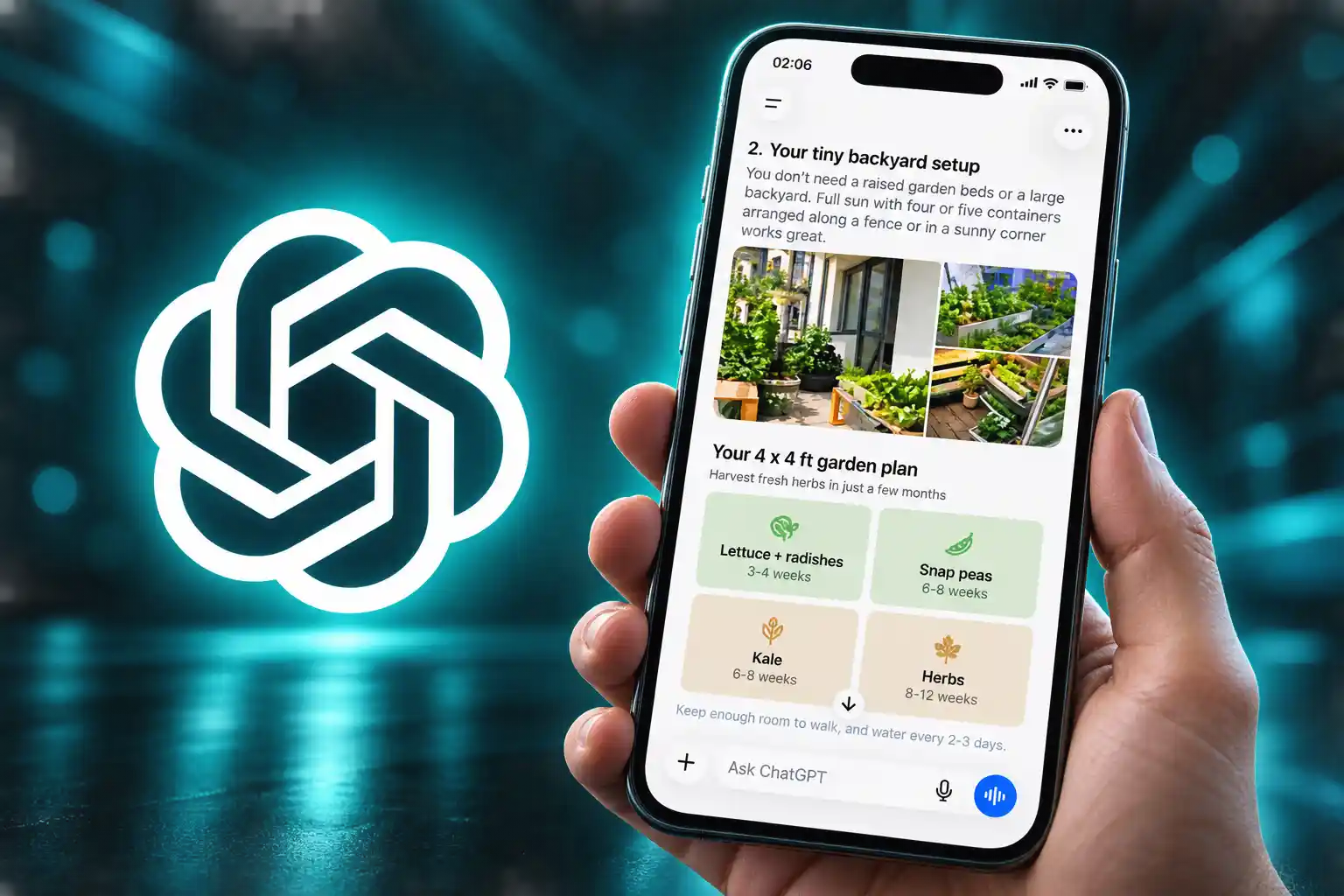
OpenAI trained GPT-6 to mix text, visuals, and controls, then pick a layout from the question. A comparison can land side by side. An explanation can become a diagram you tap. When plain text is still the better reply, the model is supposed to stay in prose.
The company did not bolt a template onto the old chat bubble. It shipped a library of native, streamable parts and a compiler that processes the interface as the model writes. The first widgets can appear before the last sentence exists, on web and on phones.
We built a library of native, streamable components, along with a compiler that processes the interface as the model generates it.
OpenAI, GPT-6 and Intelligent UI for everyone
Training covered content, layout, visuals, and when to skip the chrome. OpenAI says GPT-6 learned how to organize information, when interactivity helps, and when a short text answer is enough. Accounts do not flip a switch. The new model shows up in the Chat tab as the rollout reaches each login.
A Sunday Roast That Recalculates the Shopping List
The launch demo that shows the gap is a Sunday lamb roast. On GPT-5.6 Instant, the same prompt produced a long menu, a guest table, and a clock. On GPT-6 Instant, the reply opens as a small host kit. You change the headcount and the shopping list moves with it.
In OpenAI’s example, the guest stepper sits on five people. The quantities that follow are the ones the model put on screen for that count.
WHAT THE ROAST REPLY PUTS ON SCREEN
- Guest stepper: The demo defaults to five people and treats that number as the base for every quantity.
- Shopping math: It lists a 2.0 kg bone-in leg of lamb, 1500 g of potatoes, 8 carrots, 5 parsnips, 625 g of tenderstem broccoli, and 4 apples for crumble.
- Copy control: A button copies the shopping list, with a note to add garlic, herbs, lemons, honey, and ice cream.
- Cooking checklist: A stepped timeline sits under the menu, with a USDA reminder to cook whole cuts of lamb to 145°F and rest them at least three minutes.
The bicycle demo works the same way. Ask GPT-6 to break down a 7-speed bike and the reply is a labeled drawing with tabs for Frame, Wheels, Drivetrain, Brakes, and Cockpit. The caption still reads like a chat answer. The tabs are the new part: you stay inside the thread and poke at the machine.
Sol for Paid Plans, Luna for Free and Go
OpenAI is not putting one GPT-6 into every seat. Paid Chat runs Sol. Free and Go run Luna. Both, the company says, are tuned for everyday conversation. Enterprise access still depends on workplace admin settings.
THE CHATGPT ROLLOUT BY PLAN
| Plan | Chat model | Rollout date | Intelligent UI |
|---|---|---|---|
| Plus, Pro, Business, Enterprise | GPT-6 Sol | October 7, 2026 | Instant through Extra High |
| Free and Go | GPT-6 Luna | October 8, 2026 | Instant through Extra High |
| Pro reasoning option | GPT-6 Astra | Unchanged in this drop | Not supported |
Sol and Luna are not new names. They arrived in ChatGPT Work and Codex in September, after GPT-6 Astra on September 3, 2026. On Zapier’s AutomationBench test of business workflows, GPT-6 Sol scored 33.2% at $0.27 per task. This Chat drop is the consumer copy of those models, with a UI compiler bolted on.
HOW GPT-6 REACHED THE CHAT TAB
- September 3, 2026: OpenAI introduces GPT-6 Astra as the top model in the family.
- September 22, 2026: GPT-6 Sol and GPT-6 Luna arrive for everyday work in ChatGPT Work and Codex.
- September 29, 2026: GPT-6.1 Sol starts rolling through Work and Codex as a stronger Sol-class model.
- October 7, 2026: GPT-6 Sol and Intelligent UI open in the Chat tab for Plus, Pro, Business, and Enterprise.
- October 8, 2026: GPT-6 Luna and Intelligent UI begin reaching Free and Go.
The Chat tab is the only surface in this release. OpenAI says the models powering Work and Codex are not changing. Those products stay on the September builds. Builders who live in Codex get a visual ChatGPT and the same coding model they had last month.
Why Pro Reasoning Still Runs on Astra
OpenAI’s ChatGPT release notes draw a hard line inside paid Chat. Intelligent UI runs from Instant through Extra High. The Pro reasoning option keeps using GPT-6 Astra and does not support Intelligent UI.
That split will confuse people who treat “GPT-6” as one brain. The picker on Plus still leans on the short label. Selecting GPT-6 there means Sol, not Astra. The deepest reasoning path on Pro stays on Astra, and that path stays in the old text-first format.
So the flashy compiler is attached to the everyday settings. The setting sold as the most careful thinker does not get the new widgets. If you pay for Pro because you want the heaviest reasoning, you are looking at the one Chat mode this launch left alone.
A 44% Faster Start on Web Search
GPT-6 can start talking while it is still thinking. OpenAI says it trained the model to watch the user’s waiting time, then stack partial replies that add facts without padding, and to keep the finished answer as tight as one written in a single pass.
THE LATENCY CLAIMS OPENAI PUBLISHED
- Web search: GPT-6 Instant starts answering questions that need a search 44% sooner, on average, than GPT-5.6 Instant.
- What that measures: Time to begin answering, not time to finish the full reply.
- Extra High: In an internal test of everyday agentic tasks, GPT-6 Extra High starts in the same time as GPT-5.6 Medium.
- Quality claim: That Extra High setting also posted a better overall score than GPT-5.6 Extra High.
The company also says GPT-6 is choosier about when to search and better at finding support for the answer. In an internal set of hard problems, it hit the key part of the question more often than GPT-5.6. Those figures are OpenAI’s own tests. They are not a third-party bake-off.
OpenAI Still Calls Design Judgment Unfinished
The product post is blunt about taste. “There’s still work ahead to improve the model’s design judgment and expand what it can create,” OpenAI wrote. That sentence sits next to a promise that ChatGPT can invent new ways to explore information. The kit is live. The art director is still in training.
Safety work landed in the same package. The October GPT-6 Sol and Luna builds, OpenAI says, resist jailbreaks more strongly than GPT-5.6 Sol, including attacks that change shape across several turns. They are also trained to refuse fewer harmless requests. The published card treats both October models as High capability in cybersecurity and biology, and below High for AI self-improvement, and it keeps the same safeguard stack used for GPT-5.6 Sol and Luna.
The card is not a clean win on every row. Relative to their GPT-5.6 counterparts, GPT-6 Sol shows a statistically significant regression on standard self-harm (0.896 against 0.934). GPT-6 Luna shows regressions on standard self-harm (0.901 against 0.932), gore, and sexual content. OpenAI says a manual review found the failing replies generally low in severity, and that the models still refuse requests to help with self-harm while answering some informational questions and pointing people to help. Those scores are production-benchmark rates on hard cases, not a claim about everyday traffic.
Inside the Chat, a Calculator Appears on Demand
OpenAI’s own list of “create a tool” prompts is the tell. You can ask for a savings calculator, a bill splitter, or a game, and the reply is supposed to be the tool. A road-trip answer can drop stops on a map. A lesson can let you change an input and watch the diagram move. Dedicated apps still own anything that has to persist, sync, or bill. The one-off utilities that used to justify a wrapper site now compile inside a thread that more than 1.2 billion people already open.
GPT-6 and Intelligent UI, now rolling out in ChatGPT for everyone.
Intelligent UI in ChatGPT delivers fast, interactive answers that make everyday questions more visual, complex topics easier to grasp, and interactive tools for your task available on the spot. pic.twitter.com/XL2gDCPBwG
— OpenAI (@OpenAI) October 7, 2026
The compiler is also a closed kit. ChatGPT is choosing from native parts OpenAI already designed, then arranging them. That is faster than waiting for a full page of custom code, and it is not the same as inventing arbitrary software. A budget slider or a seat map can appear on the spot. A product that needs its own data model, identity, and history still has to live somewhere else.
TOOLS OPENAI SAYS YOU CAN ASK FOR IN THE THREAD
- Money math: A savings calculator or a bill splitter that runs in the reply, without opening another app.
- Plans: A roast timeline, a shopping list that scales, or road-trip stops on a map with detour notes.
- Lessons: Tappable diagrams, including the 7-speed bike breakdown with part buttons.
- Play: A game the model builds inside the conversation, then lets you operate.
People wrapping a thin form around a model answer just lost the easy pitch. If the chat can emit the form, the wrapper is a skin. The other squeeze is quieter: Work and Codex stay frozen while Chat learns to draw. The surface most consumers see is the one OpenAI chose to turn into a runtime.
Software That Adapts to the Person
OpenAI frames the next step without a ship date. Over time, it wants ChatGPT to create more of the interfaces people need for everyday tasks, so you describe the job and work inside an experience built around it. The Chat tab is the first place that idea is being tested at consumer scale, on Sol for paying seats and Luna for everyone else, with Astra still sitting out the new UI on Pro reasoning.
For decades, people have had to learn how to use software, navigating fixed interfaces designed around particular tasks. We believe the future will be different. Instead of people adapting to software, software will adapt to people.
OpenAI, GPT-6 and Intelligent UI for everyone
Until the design judgment catches up, a lot of those adapted interfaces will be a calculator, a map, or a guest stepper that compiled while the model was still finishing the sentence.

The Court Revisits the Climate Nuisance Door It Left Open

ChatGPT Now Compiles Live Interfaces With GPT-6

A Tanker Attack Moves the War Into Qatar’s Waters

Personio Buys Circula to Own the DATEV Channel

Bluesky Files for .bsky and Enters the Registry Queue

Musk’s $914 Billion Lead Is a Public SpaceX Bet

Microsoft’s 96% Cyber Score Sits at 86.3% on the Board

Andrew Garfield’s Spider-Man Films Are No Longer Free

Endgame Encore’s $86 Million Trial for Infinity Vision

Free Live Sports Streaming in 2026: What to Watch Without Cable
-
 BUSINESS4 months ago
Musk’s $914 Billion Lead Is a Public SpaceX Bet
-
 NEWS2 months ago
Microsoft’s 96% Cyber Score Sits at 86.3% on the Board
-
 ENTERTAINMENT2 years ago
Andrew Garfield’s Spider-Man Films Are No Longer Free
-
 SPORTS3 months ago
Free Live Sports Streaming in 2026: What to Watch Without Cable
-
 ENTERTAINMENT3 months ago
Endgame Encore’s $86 Million Trial for Infinity Vision
-

 NEWS4 months ago
Singapore’s 3×3 and Surfing Debuts Miss the Medal Stand
-

 ENTERTAINMENT1 month ago
Sterling Point Holds No. 2 on Prime Video After 32 Days
-

 ENTERTAINMENT3 months ago
The Odyssey’s IMAX Film Run Hit a 41-Theater Limit