
NEWS
Aoun Freezes Israel Talks After the Ali al-Taher Blasts
Joseph Aoun halted new Israel talks from Nabatieh after a 1,100-ton ridge blast, while Washington slipped the Rome round to October.

Lebanese President Joseph Aoun said Saturday there are no new talks with Israel, after Washington postponed a Rome round until October. He spoke in Nabatieh, under a ridge Israeli forces had just blown apart with more than 1,100 tons of explosives.
A U.S. official described the delay as a scheduling clash tied to the U.N. General Assembly, Jewish holidays, and a Paris meeting on the Lebanese army. Aoun, standing with Army Commander Gen. Rodolph Haykal, set three conditions the June deal has not met: withdrawal, prisoners, and reconstruction.
Aoun Tells Nabatieh There Are No New Talks
Aoun arrived unannounced in the southern city with Haykal and the heads of Lebanon’s security agencies, after Israeli attacks had wrecked government buildings and emptied much of the town. He answered a reporter’s question with a flat line: there were “no new negotiations with Israel at the moment.”
He then listed what he called national principles. “Withdrawal, the return of prisoners and displaced people, and reconstruction are national principles that we pledge to implement,” he said, according to the state-run National News Agency.
I came here to tell you that I am with you. I have not abandoned you at all. The purpose of my visit with the heads of the security services and the army commander is to tell you that we are by your side.
Joseph Aoun, President of Lebanon, in Nabatieh
He toured Nabatieh Governmental Hospital and praised staff who were still treating patients after most residents had fled. He inspected army units in the streets, then drove to Zawtar al-Gharbiyeh, one of the small towns Israel handed to the Lebanese army in July, and stopped at a church there.
Earlier in the week he had already asked, after strikes that killed civilians, whether Israel wanted peace or war. “If it wants war, let it say so clearly,” he said, while still calling talks the better path. Saturday’s wording was colder. The Rome round that Israeli radio had placed on the midweek calendar was already gone.
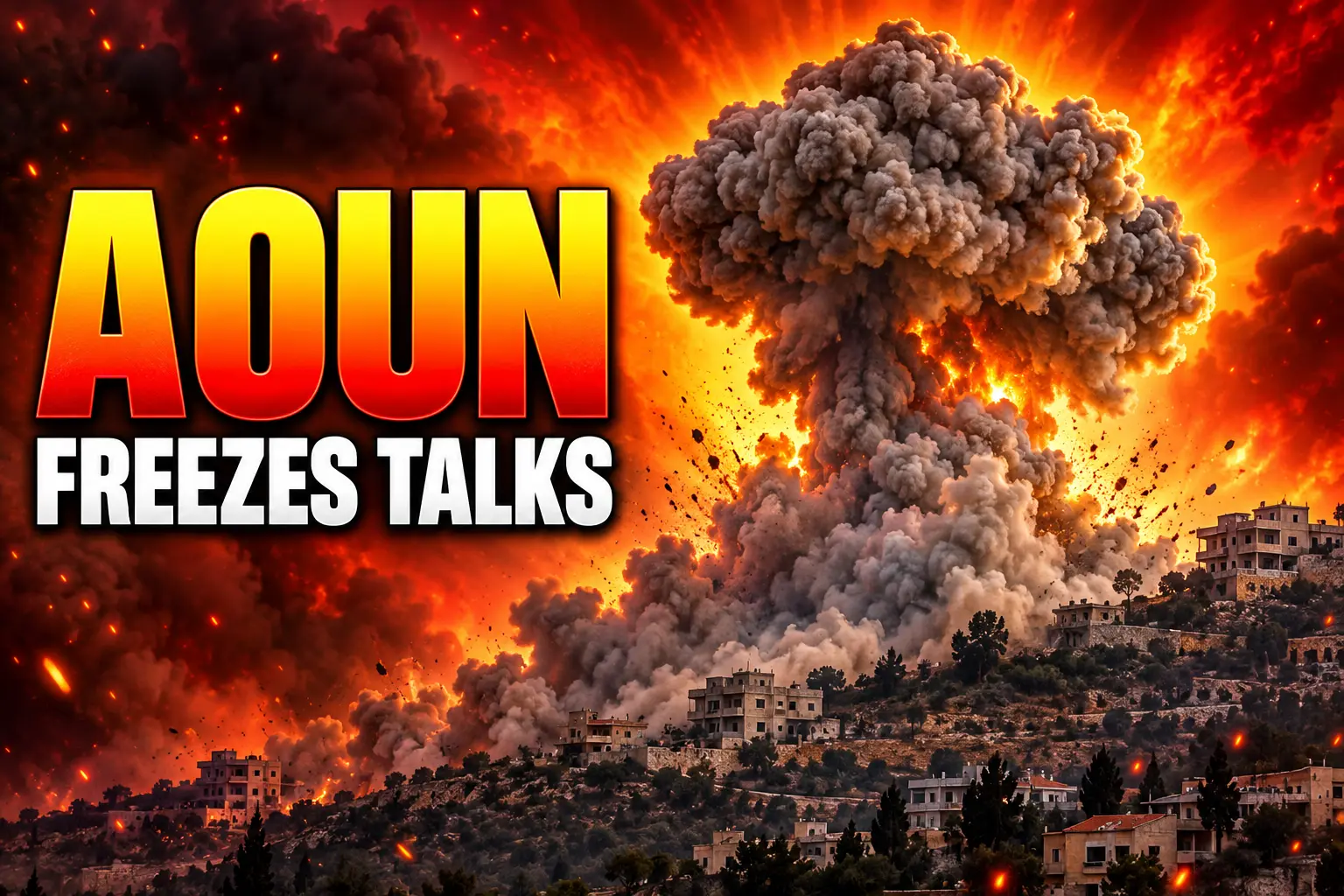
1,100 Tons Flattened the Ridge Above Nabatieh
On Thursday night the Israeli military said it packed more than 1,100 tons of explosives into tunnels under the Ali al-Taher ridge, a high point a few kilometers from Nabatieh that Israel treats as part of its buffer. The blast registered as a 4.1 magnitude tremor, according to the U.S. Geological Survey, at a depth of 10 kilometers. Lebanon’s National Center for Geophysics timed the shock at 9:08 p.m. local time.
The army said the wider Ali al-Taher and Beaufort network ran to eight tunnels stretching more than 5,400 meters, built over two decades with Iranian help, and that Thursday’s charges wrecked more than two kilometers of that system. It called the site the nerve center of Hezbollah’s Badr division, which operates north of the Litani River. Prime Minister Benjamin Netanyahu and Defense Minister Israel Katz said the demolition finished their organization of a security zone in the south, and that troops would stay to keep Hezbollah from coming back.
THE RIDGE BLAST IN FIGURES
- Explosives: More than 1,100 tons, according to the Israeli military.
- Tremor: Magnitude 4.1, recorded by the U.S. Geological Survey.
- Tunnel length: More than 5,400 meters across eight routes in the Ali al-Taher-Beaufort network.
- Unit: The 36th Division led the three-month fight for the ridge after taking Beaufort Castle in late May.
Chief of Staff Lt. Gen. Eyal Zamir walked the 36th Division’s zone on Friday, a day after the charges went off and troops pulled several kilometers south toward Beaufort. “The Yellow Line remains entirely under our control, unchanged,” he said. The ridge, the army added, would be held by fire and cameras rather than by soldiers on the crest.
Rocks closed the road between Kfar Tibnit and Khardali. Dust coated villages in the Marjayoun district, and residents asked the South Lebanon Water Establishment for water to wash orange grit off cars and houses. Katz said Friday that Israel was “prepared to continue the campaign and keep striking Hezbollah, including in other locations.”
Clips of the fireball moved faster than any statement from Rome. The argument around those clips split in a simple way: one side saw a two-decade tunnel fort finally cracked, the other saw a mountain and the towns under it taken apart. The postponed talks almost did not appear.
The June Text Tied Any Pullout to Disarmament
That is the bill from the June 26 trilateral framework signed in Washington by Israeli Ambassador Yechiel Leiter, Lebanese Ambassador Nada Hamadeh, and State Department Counselor Dan Holler, with Secretary of State Marco Rubio in the room. The text commits both governments to a sequenced process: the Lebanese Armed Forces restore control “pending the verified disarmament of non-state armed groups,” and only then does the Israeli military “progressively redeploy” out of Lebanon.
Israel states in the same document that it has no territorial ambitions, and that the threat from Hezbollah, named as Hizballah in the U.S. text, is the reason its forces are there. Lebanon pledges a state monopoly on arms and asks for U.S. and Arab help to take weapons from every non-state group. There is no calendar for a full pullout. Future pilot zones require mutual consent. A Military Coordination Group for Lebanon, with U.S. officers in the room, is supposed to run the checks around the clock.
Netanyahu said after the signing that remaining in the southern security zone was the core gain, and that Israel would hold it as long as Hezbollah was not disarmed. Hezbollah was not a party to the talks and rejected them. Direct contacts had started in April and produced five Washington rounds before the June signing. Fighting in this war opened on March 2. Lebanon’s Health Ministry has put the death toll since that date above 4,300.
JUNE PLEDGE VERSUS SEPTEMBER GROUND
| Track | June 26 text | By September 12 |
|---|---|---|
| Israeli forces | Phased, conditions-based redeployment after verified disarmament | Zamir says the Yellow Line is unchanged; Netanyahu and Katz say troops stay |
| Pilot zones | Two initial zones, then more only by consent | Lebanese troops in Zawtar al-Gharbiyeh, Froun, and Srifa |
| Hezbollah weapons | Complete, verified disarmament across Lebanon | The group rejected the talks; a Hezbollah MP calls them a dead end |
| Diplomacy | Direct talks toward a full peace and security agreement | Rome round moved to October; ambassadors meet in Washington |
The June text also tells both sides to work on detainees and remains. Aoun still puts prisoners in the same breath as withdrawal. Those files have not moved the Yellow Line.
Three Pilot Towns Did Not Move the Yellow Line
On July 20 the State Department said operations had begun in the first pilot towns in the south: Zawtar al-Gharbiyeh north of the Litani, a place Israel had occupied and then left, and Froun and Srifa south of the river, already outside the occupied belt. The Lebanese army moved in, started clearing unexploded munitions, and opened the way for some families to return.
By late July, Lebanon wanted the next zones drawn inside the Yellow Line. Israeli officers preferred towns outside that belt, including ground they were still hitting. Ali al-Taher sat inside the buffer Israel intends to keep. Blowing the ridge, then pulling troops to Beaufort and holding the crest by fire, fits that map. It does not look like the start of a wider handoff.
On September 9 the Lebanese army issued the army’s published count of seized arms from the three towns, listing checkpoints, patrols, and munitions taken out of circulation. Israeli research shops still call the pilot a failure because Hezbollah’s civilian networks, they say, walked back in. The deeper problem is scale. Three towns cannot certify a nationwide disarmament, and the June text makes that nationwide test the price of a real Israeli pullout.
Aoun’s Saturday stop in Zawtar al-Gharbiyeh underlined the split. He can visit a pilot town that now has Lebanese soldiers in it. He cannot tell Nabatieh, under a wrecked ridge, that the occupation is ending.
Kfar Rumman Lost a Family in a Night Strike
The human cost around Nabatieh is not a ridge statistic. Before dawn on September 7, Israeli aircraft hit a residential building in Kfar Rumman, a village next to the city, and a drone hit a vehicle in the same town. Lebanon’s Health Ministry said the building strike killed 11 people, including two children and four women, and that a medic died in the drone attack, bringing the toll in the town to 12 people.
The ministry said eight others were wounded, among them children and a paramedic. Deputy Mayor Noureddine Noureddine said the households were asleep and that there had been no military activity in the building. The Israeli military said it had struck people moving weapons after Hezbollah drones targeted its troops, and that it was hitting a militant in the area. It issued no evacuation warning for Kfar Rumman. It did warn another nearby town before a separate strike.
Aoun condemned “the attacks, the murders of innocent people, children and women.” Families of the dead later asked the state for an official position and a file at the United Nations. That demand sat beside a quieter local plea: residents and some lawmakers asked that Nabatieh be opened to the army and cleared of Hezbollah weapons, hoping Israeli jets would then stop treating the city as a target. Similar calls came from Arab Salim and Tyre. A like appeal three months earlier had gone nowhere.
Next Week’s Meeting Stays in Washington
The diplomatic downgrade is easy to miss if the story stops at Aoun’s sentence. An unnamed U.S. official said the September Rome round is off until October, and that the Lebanese and Israeli ambassadors will instead meet at the State Department in the week of September 14 to discuss “ongoing developments and the continued implementation” of the June deal. The official called that deal “the only viable mechanism to restore Lebanon’s sovereignty and Israel’s security.”
Implementation, in that usage, now covers a security zone Israel says it has finished building. It covers three small towns the Lebanese army already entered. It does not, on present evidence, cover a pullout from Nabatieh’s high ground.
FROM THE JUNE SIGNING TO SATURDAY
- June 26, 2026: Israel, Lebanon, and the United States sign the trilateral text in Washington, tying any Israeli redeployment to verified disarmament.
- July 20, 2026: Pilot operations begin in Zawtar al-Gharbiyeh, Froun, and Srifa under the Military Coordination Group for Lebanon.
- September 7, 2026: Strikes in Kfar Rumman kill 12 people, including two children, according to the Health Ministry.
- September 10, 2026: Israeli forces detonate more than 1,100 tons of explosives under Ali al-Taher; a 4.1 tremor is recorded.
- September 12, 2026: Aoun, in Nabatieh, says there are no new negotiations; the Rome round is put off until October.
On Saturday, while that calendar was being rewritten, Lebanon’s National News Agency reported fresh blasts in al-Mansouri, heard as far as Tyre. Israeli artillery hit the Douha area of Kfar Rumman, the outskirts of Arnoun, and Wadi al-Salouqi. A day earlier, Israeli forces had blown up most of al-Mansouri’s public school and flown drones low over Beirut and its southern suburbs. The agency said troops had started dropping barrels of explosive from drones onto roofs to bring houses down without sending in demolition crews.
STRIKES LOGGED AROUND THE VISIT
- Al-Mansouri: Heavy explosions on Saturday, after most of the public school was destroyed on Friday.
- Kfar Rumman: Artillery on the Douha neighborhood the same morning Aoun was in Nabatieh.
- Arnoun and Wadi al-Salouqi: Shelling on the outskirts, per the National News Agency.
- Beirut: Israeli drones flying low over the capital and the southern suburbs on Friday.
Each of those incidents lands inside a deal that still exists on paper. The ambassadors can discuss them as implementation. They cannot, on Aoun’s Saturday wording, open a new round.
Haykal Walks the City With Aoun Beside Him
Haykal’s presence was the other message. “The army is permanently deployed in the South,” he said after leaving the hospital. Extra soldiers had moved into Nabatieh earlier in the week. Officers described that move as a show of control, not the start of a disarmament drive in the city.
Hezbollah MP Hassan Ezzeddine, speaking the same day in Marwanieh, said direct talks with Israel had “reached a dead end” because they had not stopped the attacks or produced a withdrawal. He accused the authorities of feeding Israel’s position by signing the June text, and said Hezbollah’s presence was still needed to protect the country. Parliament, he added, would question the government about those commitments in a session in the middle of the week. He also argued that a future track involving Iran might force an Israeli pullout, a formula Washington spent the spring trying to keep out of the room.
So the army is in Nabatieh, the president is in Nabatieh, and the group that still holds most of the weapons in the wider south is calling the talks finished. The June text asked the army to take those weapons, in stages, under American watch. The ridge above the city is now a crater Israel says it will police from Beaufort. The ambassadors are due at the State Department in the week of September 14. The Rome round is listed for October. Zamir has already said the Yellow Line did not move.

Akerman Hires a Litigator to Build Firm AI

Aoun Freezes Israel Talks After the Ali al-Taher Blasts

Anthropic’s Own File Shows Claude Already Serving Spies

Shreveport Small Business AI Training Joins a $5 Million Network

Oppo Find X10 Pre-Orders Hide an 8,000mAh Battery Floor

Microsoft’s 95.95% Cyber AI Score Skips Its Own Leaderboard

Free Live Sports Streaming in 2026: What to Watch Without Cable

G20 Cheers AI Investment After Bailey’s Frontier Cyber Warning

Musk to Dell: How AI Split the World’s 10 Richest in 2026

Google Pixel 10 at Rs 64,649 on Amazon India: Buy Now or Wait?
-
 NEWS2 months ago
Microsoft’s 95.95% Cyber AI Score Skips Its Own Leaderboard
-
 NEWS3 weeks ago
G20 Cheers AI Investment After Bailey’s Frontier Cyber Warning
-
 SPORTS3 months ago
Free Live Sports Streaming in 2026: What to Watch Without Cable
-
 NEWS4 months ago
Musk to Dell: How AI Split the World’s 10 Richest in 2026
-

 NEWS3 weeks ago
The Yankees Bet Aaron Judge Can Skip the Minors
-
 NEWS3 months ago
Google Pixel 10 at Rs 64,649 on Amazon India: Buy Now or Wait?
-

 BUSINESS2 years ago
Retail Banking vs Commercial Banking: A Comprehensive Guide
-

 NEWS5 months ago
Samsung Galaxy Tab A11 Plus Lands as 2026’s Top Budget Pick