
NEWS
Clara Shih Opens dearCC After Her Agents Cut Jobs
On Oct. 1, New Work Foundation opened dearCC, a free Gen Z job platform funded by AI labs, after Clara Shih pulled her own junior postings.

New Work Foundation launched dearCC on Oct. 1, 2026, a free Gen Z career platform led by Clara Shih, the Meta adviser who pulled her own junior job postings.
Shih, former head of Business AI at Meta and former CEO of Salesforce AI, pulled those postings in fall 2025 after agents matched her strongest people. The Oakland nonprofit she co-founded with Nick Mehta, who ran Gainsight until August 2025, is backed by the Schultz Family Foundation and by grants from the labs that sell the agents.
She Took Down Her Own Entry-Level Postings
The break came on product work, not a slide deck. A Meta pipeline that used to run through user research, mockups, a requirements doc, then a front-end engineer, a back-end engineer, and an ML engineer collapsed into one or two people generating a prototype, testing it on real and simulated users, and handing a thinner build to production.
Shih said the same compression showed up in marketing, distribution, and privacy review. Work that had taken 10 steps and 10 days ran in minutes, with experts still checking the output. Under pressure to ship, she started taking down entry-level job postings because she no longer felt she needed them.
She has said she once believed customer-support tools would clear rote tasks and free people for harder problems. That happy case, she later said, has “primarily not been true.” She left the Business AI job in spring 2026 and remains a senior adviser at Meta. One in five corporate roles, she has predicted, is “especially going to be challenged.”
The bottom rung of the career ladder is disappearing.
Clara Shih, co-founder, New Work Foundation, Oct. 1, 2026 launch statement
In April she put the feeling in blunter words: “In that moment I knew that nothing would ever be the same. You feel radicalized in that moment when you see it working.” The nonprofit is her answer. It does not put those postings back on the board.
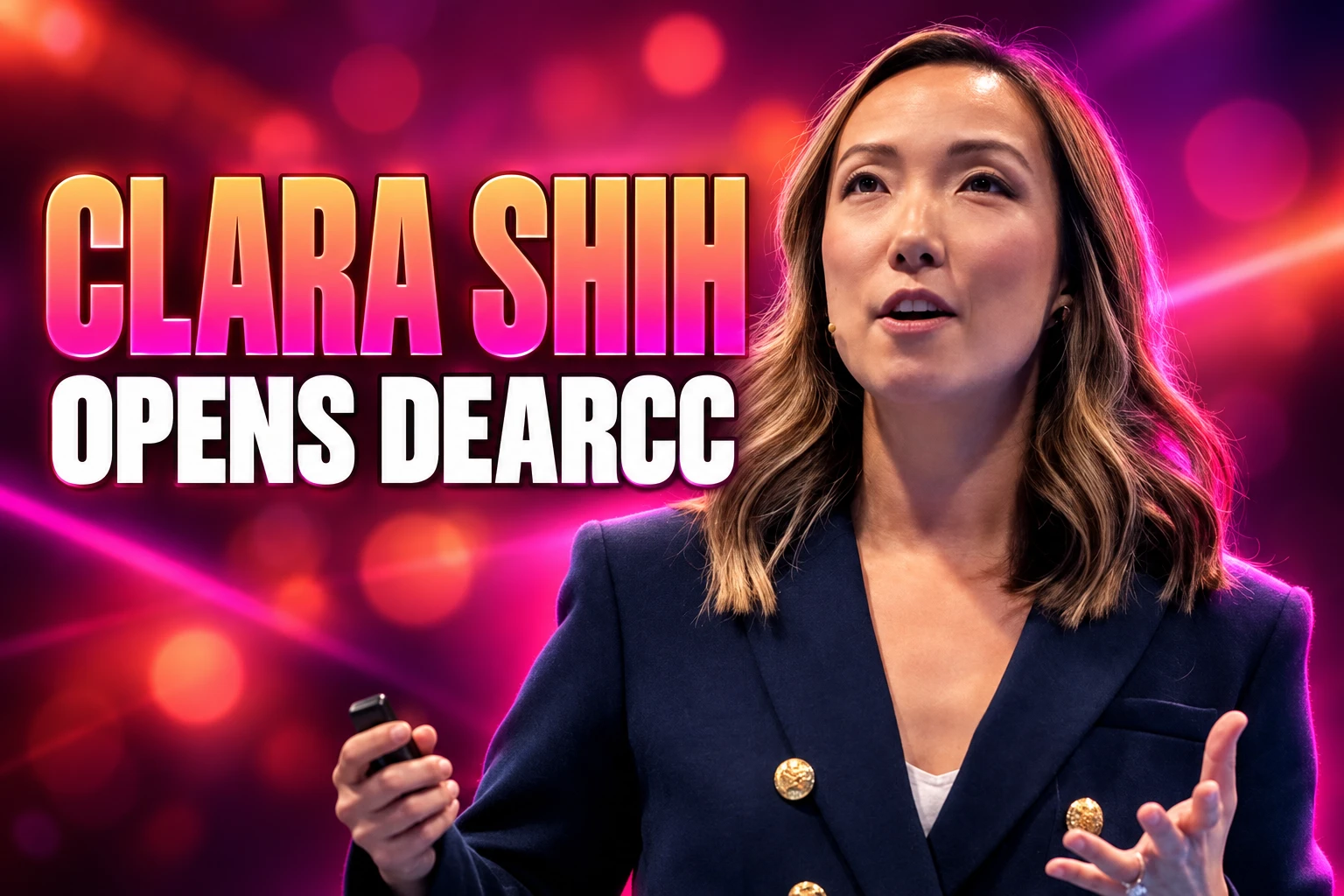
She Spent 20 Years Building the Agents
The foundation sits on a career spent making the systems now chewing the first rung. Shih founded Hearsay Systems and ran it into a 2024 sale to Yext, came back to Salesforce to run Service Cloud, then took the top AI job in 2023.
THE BUILD THAT LED HERE
- 2023: Named CEO of Salesforce AI and led the launch of the Salesforce agent platform Agentforce.
- November 2024: Moves to Meta to build Business AI, agents that answer customer messages for firms on WhatsApp, Messenger, and Instagram.
- Fall 2025: Agents match her strongest people on live tasks; she starts pulling junior postings.
- April 2026: Leaves the operating role, stays on as adviser, and launches New Work Foundation with Andrew Yang, the 2020 Democratic presidential candidate, as a founding adviser.
- Oct. 1, 2026: dearCC opens as a free consumer platform, with Mehta named co-founder and Howard Schultz’s family foundation as the anchor partner.
Mehta’s last operating job was Gainsight, the customer-success software firm he ran from 2013 until August 2025. Samantha Wen, UC Berkeley class of 2023, is listed as a Gen Z co-founder. Shih still describes herself as a conditional AI optimist. The tools she is giving graduates are agents, because she says older training cannot keep pace.
What dearCC Ships to Job Seekers
dearCC went live on Oct. 1, 2026 as a free site with four working pieces: Field Report, Game Plan, Community, and a Weekly Brief. JobClaw, the resume-free matching agent announced in April, remains an open-source skill and does not yet run live job-board searches. Oakland’s New Work Foundation says every product stays free.
Shih posted the launch the same morning, calling 500 unanswered applications a broken system rather than a rite of passage, and pointing people to the free platform live at dearCC.
Today, grads are navigating one of the toughest hiring environments in decades. Staring down 500 unanswered applications in isolation isn't a rite of passage. It's a broken system.
Today, alongside our incredible team at the @dearcc_official, I’m proud to announce the launch of… pic.twitter.com/7Iaa2jtBIo
— Clara Shih (@clarashih) October 1, 2026
THE FOUR TOOLS THAT WENT LIVE
| Tool | What it does | Input it needs |
|---|---|---|
| Field Report | Shows which roles are growing, flat, or changing, with AI exposure, wages, adjacent jobs, and geography | College degree |
| Game Plan | Scores the search, names skill gaps, and assigns AI practice plus outreach and interview prep | LinkedIn profile, resume, and current search plan |
| Community | Monthly mentor classes and a Crew of six jobseekers who meet weekly with a field mentor | Sign-up for a Crew or a class |
| Weekly Brief | A newsletter on how AI is changing the target job | Role, level, and experience |
Field Report’s law readout, as Shih has walked through it, listed 31,500 open U.S. roles with low competition and very high automation risk. That is the pattern she wants graduates to see before they chase a title that is already being eaten.
Named class leaders include Will Sentance, founder of Codesmith; April Underwood, former chief product officer at Slack; Katie Stanton, former chief marketing officer at Color Health; and Michael Matlock, chief accounting officer at Benchling. Jesus Garnica, a first-generation graduate of San Mateo Community College and San Francisco State, said the community, plus the AI skills, got him a job after 12 months of searching. Wen’s line is colder: “When you’re staring down 500 unanswered job applications, you don’t need theoretical advice and platitudes.”
Young Workers in Exposed Jobs Sit 19% Behind
Shih’s launch copy called this one of the toughest hiring environments in decades. Andrey Fradkin, an economist at Boston University’s Questrom School who is visiting the Stanford Digital Economy Lab, replied the same day that the first claim “is just not true” and that this is not one of the toughest hiring environments.
The payroll record that does line up with her product story is narrower. A revised Stanford Digital Economy Lab paper by Erik Brynjolfsson, Bharat Chandar, and Ruyu Chen, using ADP data through June 2026, finds no economy-wide wipeout. It does find a junior hole in the jobs most exposed to generative AI.
THE STANFORD PAYROLL GAP
- The 19% shortfall: Employment among workers ages 22 to 25 in highly AI-exposed occupations stands about 19% below less-exposed peers of the same age.
- The widening: That shortfall was 15% in the July 2025 data vintage and 19% as of June 2026.
- The level change: In the two most exposed quintiles, employment for ages 22 to 25 fell about 11% from November 2022 to June 2026, while the three least-exposed quintiles grew about 10%.
- The mechanism: The adjustment is showing up in reduced hiring of young workers, not a wave of separations, and in jobs where AI usage tends to automate tasks rather than complement them.
The authors warn the patterns are descriptive, not a clean causal verdict, and that some gaps shrink after education is accounted for. They also note the ADP sample runs larger than national survey benchmarks. Even with those cautions, the shape matches what Shih did inside Meta: companies are not firing the junior class so much as never opening the door.
Codified knowledge, the kind you can print in a textbook, is where young employment has slipped. Tacit knowledge, the kind you get by sitting next to someone for three years, still favors people who already have the years. If the first years never happen, the tacit layer has no one to inherit it.
OpenAI and Salesforce Are on the Donor List
The money around dearCC is not a side note. It is how the industry has chosen to answer the hole its own products opened. The Schultz Family Foundation put up a multi-year grant and is piping “Where You Work Matters” labor data, built with the Burning Glass Institute, into the product so jobseekers can see employer quality, not just openings.
Howard Schultz, co-founder of the Schultz Family Foundation, said young people “need more than another job board” and that AI should expand opportunity rather than make the first transition harder. Matt Sigelman, president of the Burning Glass Institute, said analysis of tens of millions of career histories shows how much the first few years matter, and that graduates now need to use AI “from day one.”
WHO IS PAYING FOR THE FREE TOOLS
- Anchor grant: Schultz Family Foundation, with Burning Glass Institute data inside Field Report.
- Lab and cloud grants: Salesforce (including Slack), Anthropic, Google, OpenAI, and Vercel.
- Named individual backers: Brian Halligan, Sheryl Sandberg and Tom Bernthal, Joe Lonsdale, April Underwood, Aaron Levie, Chirantan “CJ” Desai and Meera Desai, Nikki Pechet, and the Morfit Family Foundation.
- Volunteer operators: Eric Loeb, external affairs; Jody Kohner, learning; Pete Godbole, finance; Eric Stahl, marketing; Julien Capers, general counsel.
Salesforce is on that list after Shih spent years building its agents. Anthropic, Google, and OpenAI are on it while their models do the task work that used to train juniors. The grants keep dearCC free. They also keep the fix downstream of the products that made the first job scarcer, which is a tidy arrangement for the donors and a hard one for a 22-year-old who still needs a manager who has time to teach.
JobClaw Still Does Not Search Job Boards
April’s prototype was JobClaw, an agent that was supposed to match strengths to roles without a resume. On GitHub it is still framed as a free OpenClaw skill. You fill a five-question intake file, the skill writes a search brief, and it returns JSON for some other browser agent to run. The bundled chat app stores progress in local browser storage. It does not run live job-board searches yet.
The live consumer product is Game Plan, which still wants a LinkedIn page and a resume. The resume-free dream is the repo.
THE FIVE QUESTIONS JOBCLAW ASKS
- Five years out: It’s 5 years from now and you love your work. What are you actually doing on a typical day?
- Hidden skill: What are you genuinely good at that you never put on your resume or LinkedIn?
- Monday problem: What kind of problem makes you excited to come in on a Monday?
- Dread test: What would make you dread going to work, even if the pay was great?
- One-year mark: A year from now, what would make you feel like you actually moved forward?
Optional filters cover location, work mode, seniority, salary, and visa sponsorship. The questions are a cleaner account of a person than a keyword dump. They are also, for now, a brief sitting on a laptop, waiting for another agent to go look for a job that a hiring manager may have already decided a junior should not hold.
Shih’s working rule has not changed since April: “If you want to find a job and if you want to keep your job, you need to learn how to get really good at using AI agents.” Game Plan is built to drill that. The missing piece is the manager who used to let a new hire learn by doing the work the agent now finishes before lunch.
Grads Landed Faster by Taking Different Work
The placement numbers are less bleak than the launch rhetoric, and they still do not restore the old first job. ZipRecruiter’s 2026 graduate survey, fielded Jan. 30 to March 16 among 1,500 recent graduates and 1,500 rising ones, found 77.2% of recent grads had landed a role within three months, up from 63.3% a year earlier. They got there by sending more applications, taking different kinds of work, and accepting less say over where they landed.
Nicole Bachaud, ZipRecruiter’s labor economist, has described the path as less linear: internships, side work, stepping-stone roles, and new ventures instead of graduate, first desk, climb. A later ZipRecruiter employer survey found 38% of employers have already moved basic data processing off entry-level plates and onto AI, and 31% have raised experience requirements for entry-level jobs because of it. That is the same move Shih made on her own team, written across a wider sample.
Garnica’s 12-month search ending in a hire is the specimen dearCC wants. The Stanford gap says a large share of his peers in exposed white-collar tracks are not getting that ending, because the vacancy is never posted. dearCC can coach the people who still get a look. It cannot make a firm reopen a requisition it closed when the agent started clearing the queue.
The site is live, the classes have names on them, and the donor list is public. The junior postings Shih took down in fall 2025 are not on it.

The Court Revisits the Climate Nuisance Door It Left Open

ChatGPT Now Compiles Live Interfaces With GPT-6

A Tanker Attack Moves the War Into Qatar’s Waters

Personio Buys Circula to Own the DATEV Channel

Bluesky Files for .bsky and Enters the Registry Queue

Microsoft’s 96% Cyber Score Sits at 86.3% on the Board

Musk’s $914 Billion Lead Is a Public SpaceX Bet

Free Live Sports Streaming in 2026: What to Watch Without Cable

The Odyssey’s IMAX Film Run Hit a 41-Theater Limit

Endgame Encore’s $86 Million Trial for Infinity Vision
-
 NEWS3 months ago
Microsoft’s 96% Cyber Score Sits at 86.3% on the Board
-
 BUSINESS5 months ago
Musk’s $914 Billion Lead Is a Public SpaceX Bet
-
 ENTERTAINMENT3 months ago
The Odyssey’s IMAX Film Run Hit a 41-Theater Limit
-
 SPORTS4 months ago
Free Live Sports Streaming in 2026: What to Watch Without Cable
-
 ENTERTAINMENT4 months ago
Endgame Encore’s $86 Million Trial for Infinity Vision
-

 ENTERTAINMENT2 years ago
Andrew Garfield’s Spider-Man Films Are No Longer Free
-

 NEWS5 months ago
Singapore’s 3×3 and Surfing Debuts Miss the Medal Stand
-

 NEWS1 month ago
An AI Lung Drug Shifted Biological Age Clocks in Patients