
BUSINESS
Ivy Teammates Who Never Met Still Raise Hiring Odds
A former Ivy teammate raises Wall Street hiring odds by 193.70%, even when the two athletes never shared a locker room.

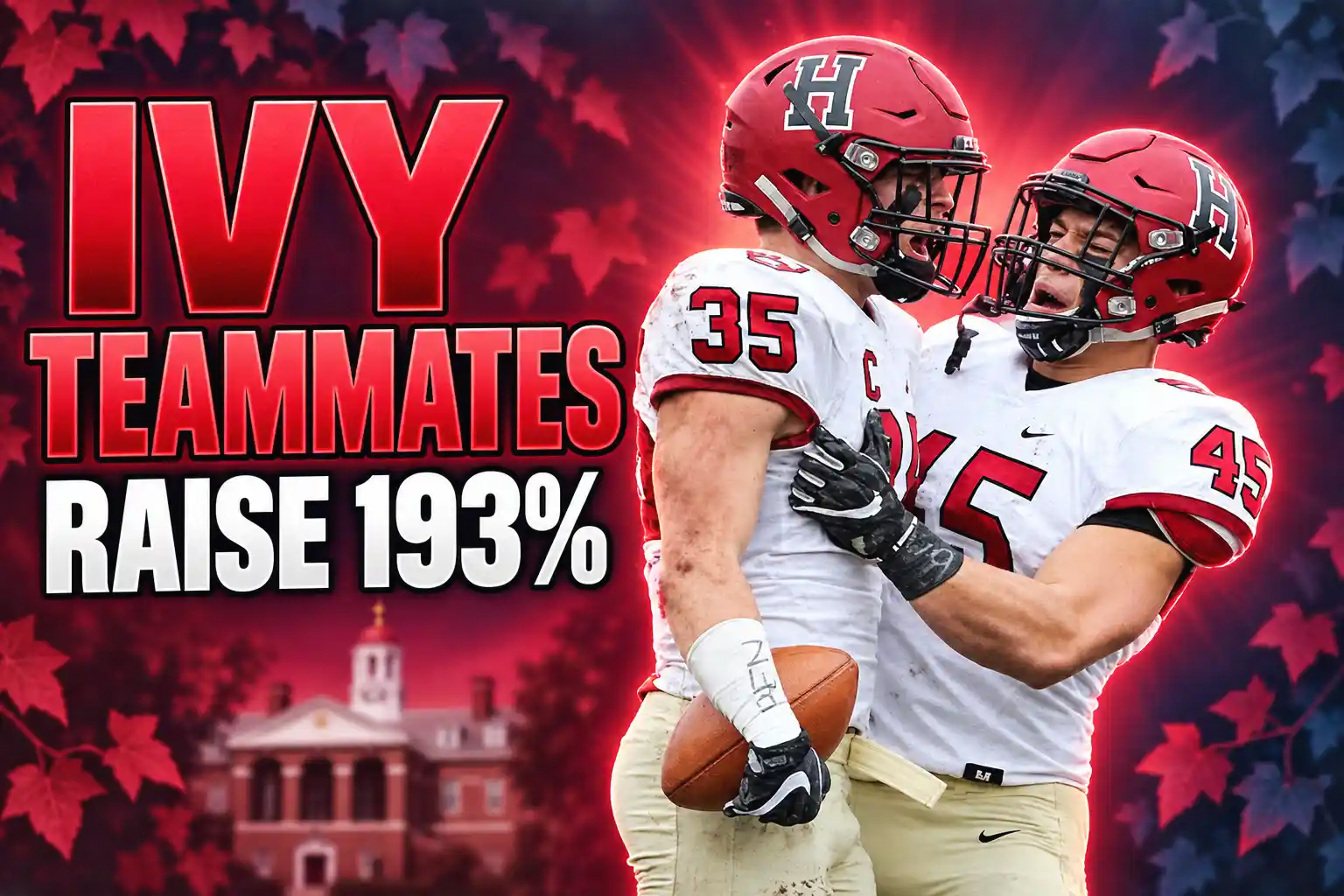
One extra former teammate at a firm raises an Ivy athlete’s odds of taking a first job there by 193.70% relative to baseline. The National Bureau of Economic Research tracked first jobs for 120,306 Ivy League graduates from 1950 through 2020, and a same-college diploma without a shared sport moved that match by only 1.81%.
Alumni who left the roster before a player arrived still raise that player’s match odds by 171.94%. The people doing the hiring are reacting to a team name, including in cases where no shared locker room ever existed.
One Extra Teammate Raises the Match by 193.70%
Paul Gompers of Harvard Business School and the NBER, George Hu of Harvard’s economics department, Will Levinson of Duke, and Sachin Srivastava of Wharton wrote the July 2026 working paper on athletic networks, titled From Field to Firm: College Sports and Early-Stage Career Choice. They compared each graduate’s actual first employer with other firms that could reasonably have hired that person, using Lightcast resume files plus hand-collected team rosters.
Examining how networks formed through college athletics influence the early-career trajectories of Ivy League graduates, from Paul Gompers, George Hu, Will Levinson, and @SachinS1703 https://t.co/h5ngVvHpi4 pic.twitter.com/xsoe8mHScS
— NBER (@nberpubs) July 31, 2026
School, sport, and team all move the first job, and they do not move it by similar amounts. An extra alum who played the same varsity sport at a different Ivy raises the chance the athlete joins that firm by 16.40%. An extra athlete from the same university who played a different sport raises it by 4.60%.
HOW ONE EXTRA COLLEAGUE CHANGES THE MATCH
| Tie already inside the firm | Change in match odds | What the count captures |
|---|---|---|
| Same-college graduate | +1.81% | Any alum of that Ivy, no sport required |
| Same university, different sport | +4.60% | Another athlete from the same school, not the same team |
| Same sport, different Ivy | +16.40% | The same varsity sport at any of the eight schools |
| Same team, any vintage | +193.70% | Same school, same sport, same roster |
| Overlapping teammate | +189.96% | College years overlapped, within a three-year window |
| Older team alumnus | +171.94% | Left the program before the candidate arrived |
Those percentages are for adding a single person. Because same-team alumni are scarce inside most firms, a one standard deviation rise in their count (0.06 people) still lifts the athlete’s match by 11.62%. A one standard deviation rise in same-sport, other-school colleagues lifts it by 2.46%.
People Who Never Shared a Locker Room Still Count
The authors split team ties into peers, whose college years overlapped, and older network affiliates, whose years did not. Adding one overlapping teammate raises the probability the athlete joins that firm by 189.96%. Adding one older teammate who was gone before the candidate enrolled still raises it by 171.94%.
On a typical payroll the overlapping channel is larger in practice, because those people show up more often. A one standard deviation rise in overlapping teammates (0.05) lifts the match by 9.50%. A one standard deviation rise in the older group (0.02) lifts it by 3.44%. The per-person figure for the older group remains huge, which is the part a hallway referral cannot explain.
Broad school ties do relatively little; the pull comes from intensive shared experiences like a varsity team.
Sachin Srivastava, Wharton School, co-author of the study
Gompers has said the similar sizes likely mix two jobs. Recent teammates pass along information. Older names, people the candidate never met, change how recruiters read a roster affiliation. The paper itself cannot fully split referral, screening, information, and shared taste, and it says so in the conclusion.
A jersey screen that large will miss people who never wore one, including most of an Ivy class. That is a hiring rule dressed up as a character test, and it will keep reproducing the same teams inside the same firms.
Football, Track, and a Male-Heavy Roster
Varsity athletes are a thin slice of the file and a thicker slice of some industries. The real-job sample has 5,658 athletes and 114,648 non-athletes. Men are 79% of the athletes and 54% of the non-athletes, in line with how varsity rosters looked across those decades.
THE CLASS THAT SHOWS UP IN THE FILE
- Headcount: 5,658 athletes sit inside 120,306 Ivy League first jobs.
- Class share: They are 4.70% of real observations and 4.96% of the expanded job set.
- Gender split: 79% of athletes are men, against 54% of non-athletes.
- School range: Princeton’s athlete share is 14.92% in this file; Cornell’s is 1.49%.
Princeton and Yale post the highest athlete shares, at 14.92% and 8.97%. Columbia is at 5.94%. Cornell sits at 1.49%, and the University of Pennsylvania also runs below the pack. Some of that is real program size. Some of it is uneven roster reporting, which the authors flag.
SPORTS WITH THE MOST ATHLETES IN THE SAMPLE
- Football: 18.35% of the athletes in the real data.
- Track and field: 11.84% of that group.
- Lacrosse: 7% of that group.
Fencing clusters at Columbia, Princeton, and Yale. The mix matters because a firm that keeps hiring from one roster is not sampling “Ivy athletes” in general. It is resampling football, track, and lacrosse from the schools that filled the data.
Morgan Stanley and Bank of America Lead Athlete Hires
Finance and insurance, NAICS 52, is where the athlete tilt is easiest to see. Athletes took 1,315 of those first jobs and non-athletes took 17,270, so athletes are 7.08% of finance first jobs against their 4.70% share of the class. Arts, entertainment, and recreation runs even higher at 7.21% (162 athlete jobs). Health care and social assistance sits at 2.28%.
The most common first employers overall are JPMorgan Chase, Goldman Sachs, Bank of America, and Morgan Stanley. Among athletes, Morgan Stanley and Bank of America lead, with JPMorgan Chase close behind. McKinsey & Company and Bain & Company rank high for both groups, as do IBM, Microsoft, and Google.
TOP FIRST EMPLOYERS IN THE REAL FILE
| Firm | Non-athlete first jobs | Athlete first jobs |
|---|---|---|
| Goldman Sachs | 1,704 | 88 |
| JPMorgan Chase | 1,475 | 93 |
| Morgan Stanley | 1,357 | 120 |
| Bank of America | 989 | 94 |
Goldman Sachs takes the most Ivy non-athletes in this file and trails on athletes. Morgan Stanley’s 120 athlete hires beat its rank on the non-athlete list. Bank of America shows the same pattern, with 94 athlete hires against 989 non-athletes. McKinsey takes 27 of the athlete first jobs; IBM takes 45. The authors also note athlete names at military branches and at the National Football League Alumni association.
Professional, scientific, and technical services still employs the largest absolute number of graduates. Finance is the sector the paper calls out for a strong athlete culture, which is another way of saying the pipeline is already staffed with people who know how to read a roster.
How the Study Built Jobs That Never Happened
The authors started with 120,306 real first jobs, then built 68.45 million jobs each graduate could have taken at firms that hired Ivy League people in the same industry. They counted teammates, sport-mates, and schoolmates already on each firm’s payroll, and asked which ties predicted the job the graduate actually took. Each person faces about 570 such alternatives.
A first job here is the earliest full-time role within two years after college, after the researchers drop internships and other short stints that do not look like entry-level work. Peers are people who graduated within three years of the candidate. Network affiliates are everyone from the same team, sport, or school outside that window.
Mean firm size is 308 employees in the real file and 750 in the expanded set, because large employers fill more of the counterfactual list. Athletes and non-athletes land at firms of similar size. Adding one former Ivy athlete to a firm raises a non-athlete’s match by 0.26% and an athlete’s match by 1.62%. A one standard deviation rise in Ivy athletes on the payroll (3.46 people) is a 0.90% lift for non-athletes and a 5.61% lift for athletes.
NBER working papers are circulated for comment and are not peer-reviewed as journal articles. The estimates are still the cleanest public measure of how team ties sit inside the first-job choice, because the design sees the jobs that were not taken.
Older Same-School Alumni Can Lower the Odds
Past the team, the older-alumni channel changes sign. Adding one athlete from the same university who graduated more than three years earlier, and who did not share the candidate’s team, lowers the probability of joining that firm by 9.23%. A one standard deviation rise in that count (0.23) lowers it by 2.12%.
Direct peers still help at the wider sport and university levels. Older names help when they wore the same jersey and hurt, in these estimates, when they only share the school. The authors read that split as evidence that team identity carries most of the effect, and that a loose alumni cloud is not the same asset.
Non-athletes pick up a small spillover when a firm already employs Ivy athletes, the 0.26% figure above. They do not pick up the 193.70% teammate jump. For the 114,648 people in this file who never made a varsity roster, the Ivy diploma is doing almost none of the work that the jersey does for the 5,658 who did.
Who plays, and at which of the eight schools, then becomes a gate on first jobs in finance, consulting, and the rest of the elite entry market. The paper ties that point to a wider literature on how elite schools ration top jobs, including work on old-boy networks inside firms.
The Paper Cannot Split a Referral From a Screen
One reading is skill. Varsity schedules eat nights and mornings, and employers say they want the habits that follow. Gompers, an All-American runner at Harvard College in 1986, has put the load at 20-plus hours a week year-round for most varsity athletes, and has argued that leadership and work with mixed groups are easier to learn there than in class.
If I were an HR person, and two people were pretty similar, and somebody spent 20 hours a week doing women’s basketball, I’d give them the nod.
Paul Gompers, Harvard Business School professor, HBS Working Knowledge
James Heckman and Colleen Loughlin, in a 2021 paper, find that college sports raise later wages after they control for cognitive scores, personality, and background. That is a human-capital channel, and it can be true at the same time as a network channel. The 2026 paper is about where the first job is, not about the wage that follows.
A 2023 companion study by Gompers, Hu, Levinson, Natee Amornsiripanitch, and Vladimir Mukharlyamov, covering 401,785 Ivy graduates from 1970 to 2021, finds that Ivy athletes out-earn non-athlete classmates by about 3.4% over a career and reach more senior seats, after school, year, major, and first job are held fixed. That later gap sits on top of the first-job sorting measured here.
The 171.94% figure from people who never met is the piece a skill story does not finish. A firm can like athletes and still be using the specific roster as a shortcut, repeating a pattern until it looks like taste. The authors say their data cannot fully separate referral, screening, information, and shared preference. Until a design does, the safest reading of the older-teammate result is that the jersey is doing work a handshake cannot explain.

Saquon Barkley’s Hamstring Leaves the Eagles Thin in London

The Online US Passport Still Needs a Witnessed Oath

Ken Urker Died on His Birthday With No Cause Named

FOX Ices Portnoy After Ohio State’s Access Fight

Micron’s Record Memory Profits Lock RAM Tight Through 2028

Musk’s $914 Billion Lead Is a Public SpaceX Bet

Microsoft’s 96% Cyber Score Sits at 86.3% on the Board

Free Live Sports Streaming in 2026: What to Watch Without Cable

Endgame Encore’s $86 Million Trial for Infinity Vision

The Odyssey’s IMAX Film Run Hit a 41-Theater Limit
-
 BUSINESS4 months ago
Musk’s $914 Billion Lead Is a Public SpaceX Bet
-
 NEWS2 months ago
Microsoft’s 96% Cyber Score Sits at 86.3% on the Board
-
 SPORTS3 months ago
Free Live Sports Streaming in 2026: What to Watch Without Cable
-

 ENTERTAINMENT4 weeks ago
Sterling Point Holds No. 2 on Prime Video After 32 Days
-
 ENTERTAINMENT3 months ago
The Odyssey’s IMAX Film Run Hit a 41-Theater Limit
-
 ENTERTAINMENT3 months ago
Endgame Encore’s $86 Million Trial for Infinity Vision
-

 ENTERTAINMENT2 years ago
Andrew Garfield’s Spider-Man Films Are No Longer Free
-

 NEWS4 weeks ago
G20 Cheers AI Investment After Bailey’s Frontier Cyber Warning