
BUSINESS
RBI SMS Alert Fee Ban Leaves Banks a Cost Problem
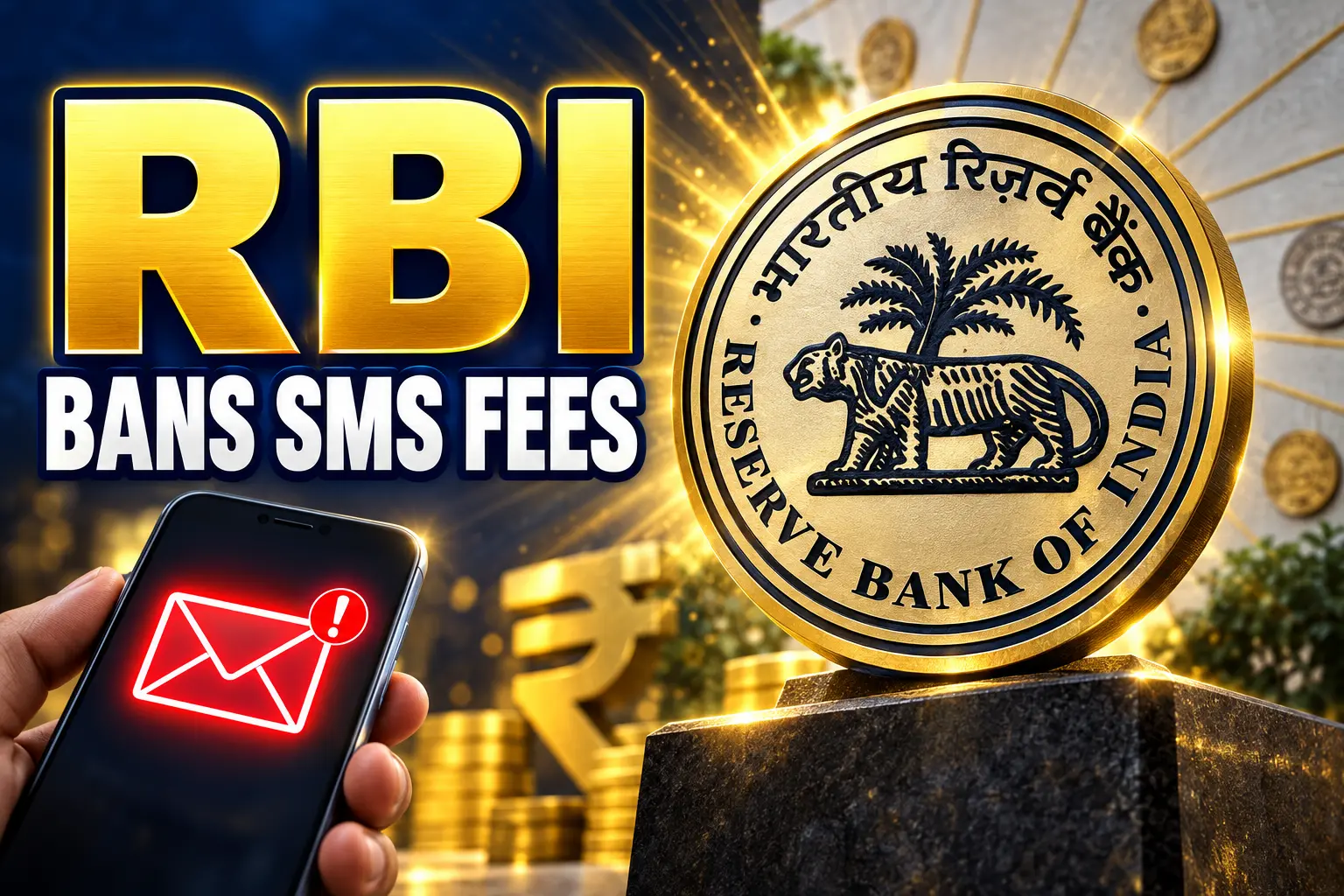
RBI’s SMS alert fee ban from January 2027 ends a ₹15 to ₹18 quarterly charge and lets banks drop texts on transfers of ₹500 or less.

The Reserve Bank of India barred banks from charging for compliance SMS alerts in a 24 June 2026 order that applies from 1 January 2027. Banking officials have put the lost fee line at up to ₹300 crore a year at large lenders, a take that had been coming in at ₹15 to ₹18 a quarter per customer.
The same directions also let banks stop sending SMS on electronic transfers of ₹500 or less, and they treat a failure to send a required alert as negligence by the bank. The quarterly saving is real only if no other fee rises in its place, and only if the small-value texts still arrive.
The Circular That Takes Effect on 1 January 2027
The legal name is the Reserve Bank of India (Commercial Banks – Responsible Business Conduct) Third Amendment Directions, 2026, issued as RBI/2026-27/167. It amends the 2025 commercial-bank conduct directions and rewrites the older customer-liability rules on unauthorised electronic banking transactions. The Third Amendment Directions dated 24 June 2026 apply to electronic banking transactions undertaken on or after 1 January 2027.
Until that date, banks are still working under the older usage-based SMS fee rules. The new text is a customer-protection package first, a tariff change second. It forces banks to collect a mobile number from anyone using electronic transfers other than ATM cash withdrawals, to verify that number and any email address on a set cycle, and to keep a record of when an alert was delivered and when the customer replied.
THE RULES IN DATE ORDER
- 26 November 2013: RBI/2013-14/381 tells banks to levy SMS alert fees on actual usage rather than a flat charge, after years of uniform annual fees.
- 24 June 2026: The Third Amendment Directions bar customer charges on compliance, promotional, marketing and awareness SMS, and set a ₹500 floor for required SMS alerts.
- 1 January 2027: Those rules apply to electronic banking transactions from this date. A one-year window for small-value fraud compensation runs from the same start.
The 2013 circular had assumed the texts would keep going out and that the argument was only about how to price them. The 2026 text changes both the price and, for the smallest transfers, the duty to send the SMS at all.
What Banks May No Longer Charge For
Paragraph 85 of the 2025 directions is replaced in full. The new wording is wider than the ₹500 threshold that has drawn most of the attention, because it also covers the required alerts on larger transfers.
A bank shall not levy any charges on its customers for SMS sent in compliance to extant regulations or those sent for promotional / marketing / customer awareness purposes. In case of SMS sent for other purposes, the bank may levy or waive charges as per its internal policy.
Reserve Bank of India, Third Amendment Directions, 24 June 2026
That ends the practice the 2013 circular had tried to civilise. After card-alert rules in 2009 and 2011 told banks to send online notices on card use irrespective of amount, lenders put SMS programmes in place and then billed a uniform fee. SBI’s early annual charge of ₹60 was copied across public-sector books. The 26 November 2013 notice then told banks to put SMS charges on an actual usage basis.
In practice many books never became a pure per-message tariff. HDFC Bank’s savings tariff has listed InstaAlert SMS at 20 paise a message plus GST since January 2022, with some senior and premium variants free. Kotak Mahindra Bank told customers that from December 2025 it would charge ₹0.15 per SMS after 30 free alerts a month, waived if combined savings, salary and term-deposit balances stayed at ₹10,000 or more. Those were still customer-side SMS lines. From 1 January 2027 a standalone charge on a required, promotional or awareness text is not allowed.
₹360 Crore on a 50 Million Customer Book
Banking officials have described two related figures, and they are not the same total. Across large lenders, they put the fee-income hit at up to ₹300 crore a year. Separately, they sketched a single large book of 50 million fee-paying customers: at ₹18 a quarter that book is about ₹360 crore a year, which is why that number is a high-end illustration, not a second industry sum.
THE OLD SMS FEE LINE
- Quarterly take: Most banks had been charging ₹15 to ₹18 a quarter to cover alert costs.
- Yearly take per customer: That is ₹60 to ₹72, before GST, if the customer paid all four quarters.
- One large book: 50 million customers at ₹18 a quarter is about ₹360 crore a year.
- Large-lender estimate: Officials put the blended hit across large lenders at up to ₹300 crore a year.
An unnamed banker said the hard part is not the software. It is absorbing the ongoing cost of customer messages, and then deciding whether texts on low-value transfers are still worth sending as a service. With a standalone SMS charge closed, some banks are expected to fold the expense into account maintenance charges, minimum-balance rules or other transaction fees.
Wholesale, banks typically pay 8 to 20 paise a message to telecom aggregators. That is the cost they were passing on. It does not disappear when the customer line is struck out; it only changes who is shown the bill.
Sub-₹500 Alerts Are Optional, and Free If Sent
Paragraph 76D splits the SMS duty by amount. Instant SMS is required for every electronic banking transaction of more than ₹500. For ₹500 or less, a bank may send the SMS under its own policy, and if it sends one it cannot charge the customer. Email is different: paragraph 76E requires an email alert for every electronic banking transaction where the customer has given an address, including the small ones.
In-app alerts, push notifications and instant messaging are allowed only as extras. They do not replace the required SMS above ₹500 or the required email where an address is on file. Banking officials have pointed to WhatsApp and RCS as the likely instant-messaging pipes for the optional band, but the circular itself names the category, not those brands.
ALERT RULES FROM 1 JANUARY 2027
| Channel | Transfers above ₹500 | Transfers of ₹500 or less |
|---|---|---|
| SMS | Required | Optional, and free to the customer if sent |
| Required if an address is on file | Required if an address is on file | |
| Push, in-app, instant messaging | Extra, per bank policy | Extra, per bank policy |
| Customer SMS fee | Not allowed for compliance texts | Not allowed |
India’s retail rails are built on small tickets, which is why the optional band is the cost lever. Dilip Asbe, chief executive of the National Payments Corporation of India, said 96 per cent of UPI transactions by volume sit below ₹2,000. NPCI’s September 2026 figures show 24.07 billion UPI payments in that month. A bank that switches off SMS below ₹500 still has to email every transfer when it holds an address, and it still has to SMS every transfer above ₹500.
People inside large private banks have said HDFC Bank, ICICI Bank, Axis Bank and Kotak Mahindra Bank are unlikely to switch the small-value texts off, because their customers already expect an instant SMS and the banks do not want that reputation dented. Smaller books with thinner fee income have a clearer incentive to treat sub-₹500 SMS as optional.
Every Remaining SMS Has to Carry More Words
The texts that stay get longer. Paragraph 76F says each transaction alert must carry the relevant details of the transfer: account or card number, amount, date, time, channel, and beneficiary or point of transaction. Paragraph 76G(2) adds a number inside the SMS itself, so the customer can object by return text without hunting for a web page.
WHAT EACH ALERT MUST CARRY
- Account or card number
- Amount, date and time
- Transaction channel
- Beneficiary or point of transaction
- A reply number in the SMS for an immediate objection
Aniketh Jain, cofounder of the enterprise messaging firm Fyno, said transaction alerts are the most-opened messages banks send. He has argued that moving sub-₹500 alerts onto push notifications turns a compliance cost into a channel the bank owns. The circular still leaves SMS in place above ₹500, so the owned channel is an add-on, not an exit.
Longer templates cost more at the aggregator because SMS is billed by segment, and Indian-language scripts use a tighter character budget than English. A bank that drops every sub-₹500 SMS and changes nothing else can still see its remaining SMS bill hold up, because each required text now has to carry the extra fields and the objection number. The recovery from the customer on those texts is zero under paragraph 85.
Why a Missing Alert Now Lands on the Bank
The fee ban sits inside a liability rewrite, and that is the part of the package the tariff debate has underplayed. The directions define negligence by a bank to include not sending mandatory alerts for electronic banking transactions. Where the fraud is the bank’s negligence, the customer has zero liability and the transfer is reversed, whether or not the customer reported it.
The burden of proving customer liability sits on the bank. Systems used to send alerts and receive replies must record the date and time of delivery and of any customer response. On a third-party breach, zero liability still depends on the customer reporting the fraud to the bank within five calendar days. After that window, the bank’s own policy decides the customer’s share, except that any further unauthorised transfer after the report is the bank’s loss.
Banks must give 24×7 reporting through phone banking, SMS, instant messaging, a dedicated email address, IVR, a toll-free helpline and the home branch, plus a home-page and app link. They must also point customers to the National Cyber Crime Reporting Portal and helpline 1930. Complaints have to be examined within 45 calendar days for domestic cases and 60 for cross-border ones. Credit-card frauds get a shadow reversal, a temporary credit the customer cannot spend, within five calendar days of the notice.
For a defined band of small-value frauds where the customer was negligent, the directions still create a compensation of 85 per cent of net loss or ₹25,000, whichever is less, on gross losses up to ₹50,000, once in a lifetime. The Reserve Bank bears 65 per cent of that payout. The SMS rule and the liability rule are welded: a bank that cheapens the alert trail is building the file that will be used against it.
The Cost Moves Into Other Account Charges
Once a standalone SMS line is illegal for required and awareness texts, the cost has three places to go. It can sit in the bank’s own expense ratio. It can be cut by sending fewer optional texts. Or it can be folded into a charge the directions still allow.
WHERE THE SMS BILL CAN REAPPEAR
- Account maintenance: A higher annual or quarterly maintenance fee recovers the aggregator bill without a line that says SMS.
- Minimum balance: Kotak’s 2025 tariff already waived SMS fees above a ₹10,000 combined balance, which is the same idea in miniature.
- Other transfer fees: NEFT, IMPS, cash or statement charges can be revised in the published tariff with prior notice.
- Volume cut: Dropping optional SMS on transfers of ₹500 or less reduces the wholesale bill directly.
A quarterly saving of ₹15 to ₹18 is a genuine line-item win on the old SMS fee. It is not a guarantee that the current-account or savings tariff as a whole gets cheaper, and it is not a guarantee that a ₹200 UPI debit still produces a text. Feature-phone customers without an email address are the ones who feel a dropped sub-₹500 SMS, because email cannot reach them and push alerts live on a smartphone app.
The directions apply to electronic banking transactions undertaken on or after 1 January 2027. Until then the older usage-based SMS fee rules remain the ones banks are billing under, and the new alert, recording and liability duties have not yet started.
Frequently Asked Questions
Can a Bank Replace SMS With WhatsApp for a Transfer Above ₹500?
No. Instant messaging is allowed only in addition to SMS and email. A debit of ₹501 still needs an instant SMS even if a WhatsApp template, an RCS bubble and an app push all went out, because paragraph 76F treats those channels as extras rather than substitutes.
Do the New Alert Rules Cover ATM Cash Withdrawals?
Paragraph 76C, which forces a bank to collect a mobile number from customers using electronic transfers, excludes ATM cash withdrawals from that collection duty. The ₹500 SMS floor in paragraph 76D is written for electronic banking transactions as defined in the directions, so the ATM carve-out sits at the collection step rather than as a second fee rule.
What If the Customer Has No Email Address on File?
Email alerts are required only where the customer has given an address. A customer with a mobile number and no email still has to receive SMS on transfers above ₹500. On transfers of ₹500 or less, that customer may receive nothing at all if the bank treats the small-value SMS as optional and has no other channel that can reach a basic handset.
Can Two Holders of a Joint Account Both Claim the Small-Value Fraud Payout?
No. Only one holder of a joint account may submit a compensation claim, and a person who takes the payout as a joint holder cannot later claim it as a sole holder, or the other way around. The 85 per cent / ₹25,000 relief is written as a once-in-a-lifetime payment for an individual, including a sole proprietor.
How Long Does the Small-Value Fraud Compensation Last?
Paragraph 76U limits the payout to losses on fraudulent electronic banking transactions occurring up to one year from 1 January 2027. Banks must keep the related records for two years after that compensation window closes, for audit and review. The SMS fee ban and the alert duties do not expire with that one-year payout.

Saquon Barkley’s Hamstring Leaves the Eagles Thin in London

The Online US Passport Still Needs a Witnessed Oath

Ken Urker Died on His Birthday With No Cause Named

FOX Ices Portnoy After Ohio State’s Access Fight

Micron’s Record Memory Profits Lock RAM Tight Through 2028

Musk’s $914 Billion Lead Is a Public SpaceX Bet

Microsoft’s 96% Cyber Score Sits at 86.3% on the Board

Free Live Sports Streaming in 2026: What to Watch Without Cable

Endgame Encore’s $86 Million Trial for Infinity Vision

The Odyssey’s IMAX Film Run Hit a 41-Theater Limit
-
 BUSINESS4 months ago
Musk’s $914 Billion Lead Is a Public SpaceX Bet
-
 NEWS2 months ago
Microsoft’s 96% Cyber Score Sits at 86.3% on the Board
-
 SPORTS3 months ago
Free Live Sports Streaming in 2026: What to Watch Without Cable
-

 ENTERTAINMENT4 weeks ago
Sterling Point Holds No. 2 on Prime Video After 32 Days
-
 ENTERTAINMENT3 months ago
The Odyssey’s IMAX Film Run Hit a 41-Theater Limit
-
 ENTERTAINMENT3 months ago
Endgame Encore’s $86 Million Trial for Infinity Vision
-

 ENTERTAINMENT2 years ago
Andrew Garfield’s Spider-Man Films Are No Longer Free
-

 NEWS4 weeks ago
G20 Cheers AI Investment After Bailey’s Frontier Cyber Warning