
NEWS
The Winter Games Reach Parity by Dropping Nordic Combined
The IOC built the first gender-equal Winter Olympics by cutting Nordic combined, the last men-only sport, and adding Synchro9 and freeride for 2030.

The IOC Executive Board dropped Nordic combined from the 2030 Winter Olympics on July 7, 2026, ending a run that began at Chamonix in 1924. The board set a 3,046-athlete Alpes 2030 quota, split 1,525 women and 1,521 men, across 126 events.
Those figures let the IOC call Alpes 2030 the first gender-equal Winter Games. The arithmetic ran through a cut, not an addition: the last men-only Olympic sport left the program, while Synchro9 and freeride skiing and snowboarding came in.
The First Winter Games Without Combined
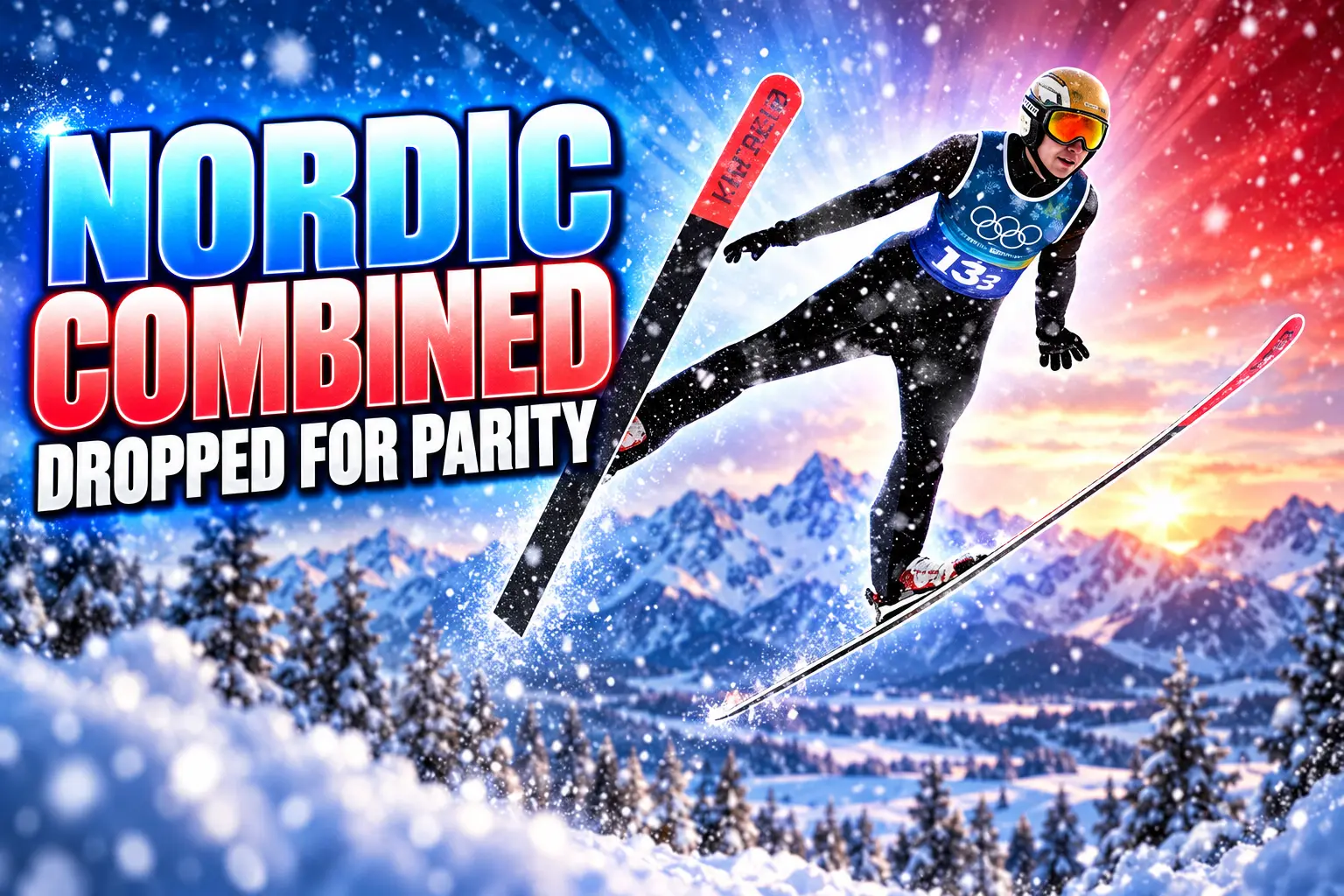
Nordic combined pairs a ski jump with a cross-country race. It had been on every Winter Games program for 102 years, from the first Chamonix meet through Milano Cortina 2026. Alpes 2030, set for Feb. 1-17, will be the first edition without it.
The Executive Board added three disciplines and 16 events after federations and the French organisers put up 26 proposals. Snowboard parallel giant slalom, which had sat on the same watch list, stayed. Ski mountaineering returns with five events after its 2026 debut, this time at Montgenèvre.
ALPES 2030 PROGRAM CHANGES
| Piece of the program | Decision | Scale |
|---|---|---|
| Total events | Expanded | 126 (56 women, 55 men, 15 mixed) |
| Athlete quota | Set at parity | 3,046 (1,525 women, 1,521 men) |
| New events approved | 16 of 26 proposed | Three new disciplines |
| Freeride ski and snowboard | Added | 4 events, 44 athletes |
| Synchro9 | Added | Nine teams of nine skaters |
| Nordic combined | Removed | First Winter Games without it |
IOC President Kirsty Coventry said she understood the news “may come as a disappointment,” and told combined officials that a return “could always remain open for 2034.” Pierre Ducrey, the IOC sports director, said the Milano Cortina data did not show “a progress that would justify keeping the discipline.”
Gender Parity Arrived by Subtraction
Female quota places will be 50 percent of 3,046. Women hold four more spots than men, and they have one more medal event (56 to 55), plus 15 mixed races. Milano Cortina had been sold as the most balanced Winter Games to date, with women at 47 percent of the field and 50 of 116 events.
The board also lifted women’s shares inside sports that stay on the program: luge from 44.3 percent to 50, skiing from 48.6 to 50, bobsleigh from 32.9 to 39.5, and ice hockey from 43.4 to 45.6. Synchro9, a team event the IOC called a key factor in hitting parity, does the rest of the headline work.
Ducrey told a news conference the debate was “not so much about the parity within the disciplines” as about “low popularity and their having a high concentration of a few countries at the top of the sport.” Officials had looked at expanding combined with women’s and team events. They cut it instead.
THE POPULARITY SCORECARD
- Lowest again: Combined ranked last among Winter disciplines at Sochi 2014, PyeongChang 2018, Beijing 2022 and Milano Cortina 2026.
- Milano Cortina: It finished last in 11 of 14 measures covering broadcast, digital, public interest, tickets and press, in 50-plus markets per measure.
- Medal map: Only five national Olympic committees won combined medals across the last four Winter Games.
- Field size: Thirty-six men started in 2026, down from 55 at Beijing 2022.
Christian Klaue, the IOC’s corporate communications director, posted the board’s findings the same afternoon.
📌 Nordic Combined will not be included on the Alpes 2030 Olympic Winter Games programme considering challenges observed in past editions of the Games from a participation and audience engagement perspective.
During every Games edition, the IOC conducts a global study covering… pic.twitter.com/RqyOK7cipi
— Christian Klaue (@ChKlaue) July 7, 2026
A founding Winter sport now has to clear a 14-point popularity scorecard built for television, tickets and social reach. That is a different test from the one that put a jump and a race on the Chamonix program, and it is the test parallel giant slalom survived after its scores improved from Beijing 2022.
Six World Cup Seasons, Zero Olympic Starts
Women have never started in Olympic Nordic combined. They have run a World Cup since the 2020-21 season and a world championship since 2021. The IOC still refused a women’s event for Beijing 2022 and again for Milano Cortina, then used the empty women’s column as part of the case against the whole sport.
Janne Hänninen, director of high-performance sports at the Finnish Olympic Committee, called the July vote a blow to a Finnish medal sport and said it was particularly unfortunate that women’s combined athletes will not compete in 2030.
THE ROAD TO THE CUT
- 1924: Combined debuts at the first Winter Games in Chamonix, men only.
- 2014: Women’s ski jumping reaches the Olympics; combined becomes the last Winter sport with no women’s event.
- 2020-21: The first women’s World Cup season is held; Tara Geraghty-Moats of the United States wins the overall title.
- 2021: The first women’s world championship draws 10 nations; Norway takes gold, silver and bronze.
- June 2022: The IOC keeps women out of Milano Cortina and warns the men’s event is at risk unless audiences and country depth grow.
- January 2026: Women at the Seefeld World Cup raise ski poles in an X for “no eXception”; Gyda Westvold Hansen of Norway races with a drawn-on beard.
- July 7, 2026: The Executive Board removes the discipline from Alpes 2030.
Nathalie Armbruster of Germany, the 2025 women’s World Cup overall winner, said she was “utterly devastated and so angry at the same time.” “Gone is a dream we have put so much effort in.”
Annika Malacinski, who campaigns for the U.S. team, had warned before Milano Cortina that if combined missed 2030, “most likely every single country will cut the funding.” Jill Brabec, president of Nordic Combined USA, said after the vote that the news made her job “100 times harder,” months after USA Nordic Sport had already stopped financially supporting the discipline in 2024.
Norway’s Jens Lurås Oftebro swept all three men’s events at Milano Cortina and will not get a chance to defend those titles on an Olympic hill. “Gender equality in sports is important, and it should never be a question of women or men. The goal must be to create space for both,” he wrote. Finland’s Ilkka Herola, who left Italy with a silver and a bronze, said the community would keep working toward a return.
What Synchro 9 and Freeride Replace
The holes in the French Alps program are filled with sports that already had mixed or women’s fields, a youth audience, and a format the IOC could sell. FIS still holds about half the Winter medals, and its athlete quota for 2030 is 1,264, four more than in Milano Cortina.
EVENTS ADDED FOR ALPES 2030
- Biathlon: Mixed singles relay.
- Figure skating: Synchro9 team event.
- Speed skating: Men’s and women’s team sprints.
- Freeride: Men’s ski, men’s snowboard, women’s ski, women’s snowboard.
- Freestyle skiing: Mixed team ski cross.
- Snowboard: Mixed team parallel.
- Ski jumping: Women’s super team.
- Ski mountaineering: Men’s and women’s individual, men’s and women’s sprint, mixed relay.
Nine Skaters Go Head to Head
The International Skating Union built a nine-skater knockout skating format for broadcast, with head-to-head rounds and themed programs rather than one long judged routine. Nine teams of nine skaters, plus one reserve each, will start. U.S. Figure Skating says nine countries will field a team at the Games, with a qualifying path due in the next 18 months.
ISU President Jae Youl Kim called the vote a historic step and thanked the IOC for its confidence. Synchro9 launches this season in Irvine, California, on Nov. 7-8, then Vantaa, Rouen and Budapest, before the 2028 Winter Youth Olympics in Dolomiti Valtellina. That Youth Games debut is women only, with a later decision on whether men skate in the French Alps. The event uses the existing figure skating venue, so it adds medals without a new rink.
Freeride Takes Ungroomed Slopes
Freeride puts skiers and snowboarders on unmarked natural terrain and scores difficulty, jumps and execution. The IOC gave it four events and 44 athletes, 22 women and 22 men, and praised a “natural field of play” that limits extra build. FIS says the circuit now has more than 10,000 licensed freeride riders and more than 300 competitions a year across four continents, 34 years after the Xtreme Verbier contest in 1996.
FIS President Alexander Ospelt said the first reaction on combined was “inevitably, one of disappointment,” then pointed at freeride’s junior-to-elite pathway. Secretary General ad interim Urs Lehmann said the 2030 absence “changes nothing” about World Cup and world championship support. “If anything, it’s a reason for us to back them up even more strongly.”
Bourgogne-Franche-Comté Tries to Reverse the Vote
The cut lands in the country that invented the Winter Games and is about to host them again. Fabrice Guy won France’s first Nordic Olympic gold at Albertville in 1992; Jason Lamy-Chappuis won again in Vancouver in 2010. The entire French combined team in Milano Cortina held licenses in Bourgogne-Franche-Comté.
Today the biggest defeat didn’t happen on the field. It happened in the IOC meeting room. Congratulations @iocofficial you broke thousand hearts and dreams.
Romane Baud, French Nordic combined athlete, on Instagram
Her brother Mattéo Baud said the dream had been taken away “not because I’ve stopped believing in it, not because I’ve stopped working hard, but because the Nordic combined will no longer be part of the Olympic Games.” Lubin Martin, another French starter, called the vote incomprehensible after 100 years on the program.
On Sept. 15, 2026, regional president Jérôme Durain sent a letter demanding the IOC reverse course to Sports Minister Marina Ferrari and to Amélie Oudéa-Castéra, president of the French National Olympic and Sports Committee. He asked them to press the Alpes 2030 organising committee to require a review, and wrote that Nordic sports “forge a collective pride” in his region. “Does one measure that Nordic combined might never recover from this eviction?”
Oudéa-Castéra said the combined “will not be included in the programme for the 2030 Alpine Games.” She set a Sept. 30 session with French Ski Federation president Fabien Saguez to work on a “resilience plan” for the sport and its athletes. A Change.org campaign launched in France before the vote, with names such as Jean-Claude Killy among the public backers, is still being passed around. It did not move the board in July, and the French Olympic chief has now closed the 2030 door.
The 2034 Pathway the IOC Left Open
Combined stays on the Dolomiti Valtellina 2028 Winter Youth Olympic Games. It is eligible for Utah 2034 through the candidate-discipline path in the Fit for the Future framework, which the IOC Session approved in June 2026 for use from Brisbane 2032 onward. Alpes 2030 was still judged under the older rules. Fraser Bullock, president of the Utah 2034 organising committee, said “everything is under consideration” and that the IOC will have the final say.
Ospelt said FIS will “do everything within our power” to have combined back in 2034. National federations still have a World Cup to fund without the Olympic spotlight that drives most of that money. Lake Placid is still staging jumping and combined this season, including U.S. nationals in October, which is the shape of the sport until Utah, or until the money dries up.
WHAT WE KNOW
- 2030 program: Combined is out; Synchro9, freeride and the extra mixed events are in.
- French position: Oudéa-Castéra has ruled out a 2030 reinstatement and pointed to a resilience plan instead.
- Youth Games: Combined remains on the 2028 Winter Youth Olympics.
WHAT IS UNCONFIRMED
- Utah 2034: Eligibility is not a place on the program; no host or IOC vote has restored it.
- Men in Synchro9: The 2028 Youth Games event is women only; the 2030 gender split is not settled.
- Funding: How many national programs keep paying dual-sport athletes through a non-Olympic cycle is still an open budget fight.
On Nov. 7, Synchro9 teams take the ice in Irvine. Combined’s next Olympic file is listed for Utah, eight years after Chamonix’s sport was taken off a French Games.
Frequently Asked Questions
How Does Nordic Combined Decide the Race Start Order?
Most races use the Gundersen method. Jump scores convert into time gaps, so the best jumper starts first in the cross-country race and the first athlete to the finish wins. That pursuit format is the sport’s usual television hook, and it is also why a long jump round can eat the window a broadcaster will give a niche event.
When Did Women First Contest a Nordic Combined World Championship?
The first women’s world championship was in 2021. Athletes from 10 nations started, and Norway took gold, silver and bronze. The first Women’s World Cup season was 2020-21, when Tara Geraghty-Moats of the United States won the overall title.
How Is Synchro9 Different From Traditional Synchronized Skating?
Traditional teams put as many as 16 skaters on the ice for a long judged routine. Synchro9 uses nine skaters, knockout rounds and themed programs, with 10 judges issuing technique and artistry scores and no technical panel. Swiss Timing is building the new scoring system for the 2026-27 season.
What Condition Did the IOC Attach to Keeping Snowboard Parallel Giant Slalom?
Parallel giant slalom stays on the Alpes 2030 program only if it does not need its own separate field of play. The board said the event’s popularity scores had improved since Beijing 2022 after it had sat on the same watch list as Nordic combined.

Saquon Barkley’s Hamstring Leaves the Eagles Thin in London

The Online US Passport Still Needs a Witnessed Oath

Ken Urker Died on His Birthday With No Cause Named

FOX Ices Portnoy After Ohio State’s Access Fight

Micron’s Record Memory Profits Lock RAM Tight Through 2028

Musk’s $914 Billion Lead Is a Public SpaceX Bet

Microsoft’s 96% Cyber Score Sits at 86.3% on the Board

Free Live Sports Streaming in 2026: What to Watch Without Cable

Endgame Encore’s $86 Million Trial for Infinity Vision

The Odyssey’s IMAX Film Run Hit a 41-Theater Limit
-
 BUSINESS4 months ago
Musk’s $914 Billion Lead Is a Public SpaceX Bet
-
 NEWS2 months ago
Microsoft’s 96% Cyber Score Sits at 86.3% on the Board
-
 SPORTS3 months ago
Free Live Sports Streaming in 2026: What to Watch Without Cable
-

 ENTERTAINMENT4 weeks ago
Sterling Point Holds No. 2 on Prime Video After 32 Days
-
 ENTERTAINMENT3 months ago
The Odyssey’s IMAX Film Run Hit a 41-Theater Limit
-
 ENTERTAINMENT3 months ago
Endgame Encore’s $86 Million Trial for Infinity Vision
-

 ENTERTAINMENT2 years ago
Andrew Garfield’s Spider-Man Films Are No Longer Free
-

 NEWS4 weeks ago
G20 Cheers AI Investment After Bailey’s Frontier Cyber Warning