Seattle closed its own streets to car traffic more than 500 times in 2025 under a program called Play Streets. Neighbors did nearly all of it themselves, with no city crew, no fee and no sign off from the house next door.
Cities from San Diego to Washington, D.C. already let residents close a block for a party. Seattle went further: any resident on a residential block can do it repeatedly, for free, through a permit process one city planner spent years stripping down to almost nothing. He grew up playing on a Seattle street the car boom eventually swallowed.
How Do You Close a Seattle Street?
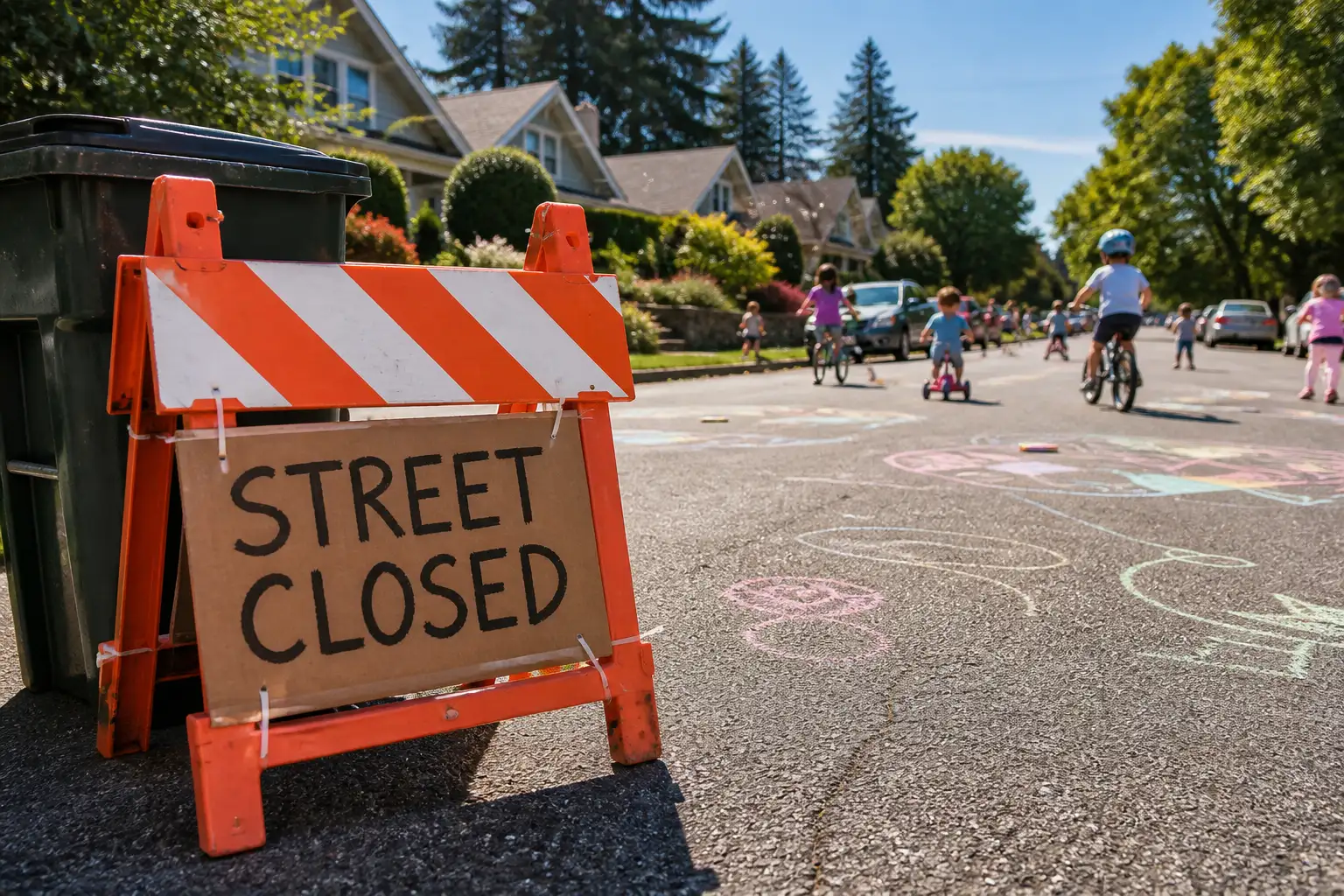
A Play Streets permit through SDOT’s online permit system costs nothing, takes about two weeks to process and does not require a neighborhood vote. Residents pick a non-arterial block, apply online, print the permit themselves and build barricades out of traffic cones, trash bins or a hand lettered sign.
Joel Miller, the Seattle Department of Transportation’s (SDOT) public space manager, spent years simplifying that process. “Public space is the front porch of the city; it’s how you see your neighbors, how you meet people,” he told The Christian Science Monitor. “It’s one of the few places left where you might run into someone who doesn’t look like you.”
The mechanics are deliberately narrow:
- Cost: Free, self printed permit through SDOT’s online system.
- Eligible streets: Non-arterial residential blocks only, not busier collector or arterial streets.
- Time limit: Up to three days a week, capped at twelve hours a week, daylight hours only.
- Lead time: Apply at least fourteen days before the first event.
- Access: Local traffic, deliveries and emergency vehicles can still pass through.
- Sign off: Neighbor notification is encouraged. Consent is not required.
Recurring events skip the reapplication process entirely, which is what let Barbara Alfeo, a Licton Springs mother of four, turn a single Wednesday closure four years ago into a standing weekly date.
A Childhood the Car Boom Erased
Miller was that kid once. He grew up dribbling a soccer ball and hopscotching between friends’ houses on a sidewalk in Northeast Seattle. By the time he reached college in 1997, the city around him had changed. Seattle’s tech fueled economy was booming, and the streets he grew up playing on filled with cars.
His block was not unique. By 1990, most American households owned two or more cars, according to the U.S. Department of Commerce. Childhood play never fully recovered.
“The biggest disaster that’s cast a long, dark shadow over childhood is the growth of the car,” says Tim Gill, author of the 2021 book “Urban Playground: How Child-Friendly Planning and Design Can Save Cities.” Gill’s own research site traces a decades long decline in children’s independent mobility, kids’ freedom to move around a neighborhood without an adult. Car dependent street design and more anxious, safety conscious parenting both drove it.
“That’s why Play Streets are so interesting,” he adds. “They’re tackling at source this catastrophic threat to the kind of freedoms that children deserve.”
Portland, New York and St. Louis Chase the Same Idea
Seattle keeps unusually little friction between a resident and a closed street, even as more cities copy the basic pitch of turning a residential block into a car free gathering space. Three other cities rolled out their own versions for the 2026 season, each with different rules for who gets to start one.
| City | Program | Who Can Apply | 2025-2026 Scale |
|---|---|---|---|
| Seattle | Play Streets, launched 2014 | Any resident on a non-arterial block, no neighbor sign off | 500+ closures in 2025 |
| Portland | Play Streets pilot | Partner groups such as the Sabin Community Development Corporation | Five scheduled dates for 2026 |
| New York City | Open Streets | Community partners coordinating with the city’s DOT | 150+ locations for the 2026 season |
| St. Louis | Open Streets Pilot Program | Property owners, adjacent businesses, improvement districts or registered nonprofits | Launching in 2026 |
The pattern holds across all three: the closer a program stays to Seattle’s model of putting the permit directly in an individual resident’s hands, the rarer it is. Portland’s transportation bureau runs its Play Streets pilot through community partner organizations rather than individual applicants. New York opened its 2026 Open Streets season with more than 150 locations, but most are run by community groups and business improvement districts, not a single family on a residential block. St. Louis’s Street Department, launching its own pilot this year, requires applicants to be property owners, adjacent businesses or a recognized nonprofit, a bar Seattle cleared away entirely.
The Grownups Keep Showing Up Too
Play Streets permits are written for children. The parents standing at the curb have built their own routine around them.
Barbara Alfeo watched it happen on her own block. Four years ago she started a Wednesday evening closure with four kids of her own. The permit now draws as many as 100 people, with neighbors organizing food trucks or pizza delivery so dinner is handled and play continues past dusk.
“Now my kids would tell you we always run into someone we know,” Alfeo told The Christian Science Monitor. “It was the dream for us. We are not raising individual kids. We are collaborating on a generation.”
Alberto Vildosola, a software engineer and father of two, wanted his kids to have the kind of neighborhood he grew up with in Cuba in the early 2000s, where neighbors leaned on each other for everything from a cup of sugar to watching the block. After the pandemic, he realized he did not know his own neighbors.
“We needed a reason to hang out,” he said. He built an app around his street’s weekly Play Streets, which has since expanded into park playdates, event planning and a neighborhood soccer league.
For Mehal Shah, a father who works remotely, the routine turned into a friendship group. He has brought his two children to his neighborhood’s Play Streets for more than two years, trading podcast recommendations and babysitter referrals with other dads on the sidelines.
Fatherhood can be isolating, especially for the first time, and especially for those of us who work remotely. It’s good having people that you can navigate it with.
Shah said that to The Christian Science Monitor. He now plays video games regularly with fathers he met at the barricades, a friendship that did not exist before the street closed to cars.
Play Streets is quietly doubling as an adult loneliness fix. About half of U.S. adults report loneliness, a rate the Surgeon General’s 2023 advisory on social connection compares to the health risks of smoking daily. Shah’s Wednesday nights, and the podcast recommendations and babysitter tips that came out of them, are one small, unplanned answer to that number.
The Barricades Work More Like a Suggestion
The system has real friction left in it. Seattle’s own permitting software is hard to navigate, some residents say. Neighbors who lose street parking or tolerate extra noise complain, and Miller hears about it.
Even a barricaded street rarely turns away every car. Signs and cones function closer to a yellow light than a red one. A driver determined to get through usually does.
“If you’ve designed a city for cars, and people have designed their lives and their culture around cars, getting people to change is a big ask,” Miller said.
That is also why Miller resisted letting a single objection stop a closure. Notification is expected. Consent is not. “We set the table; they bring the party,” he said. “If the city comes in and says we’re going to close your street so you can all hang out, that’s not a great look.”
Play Street After Dark
Shah has an idea for what comes next. “The holy grail,” he said, “would be if one day we can all hang out as a neighborhood after all the kids go to bed. As grown-ups. Play Street after dark.”
Miller is counting on some version of that. The barricades come down after twelve hours. The conversations that started behind them, he hopes, do not.
Frequently Asked Questions
Is a Seattle Play Streets permit really free, and how long does it last?
Yes. The permit costs nothing and residents print it themselves. A standard permit covers a single block for up to three days a week, but organizers who want a recurring weekly gathering, like Barbara Alfeo’s Wednesday event, can get a permit that stays valid for a year without reapplying.
Which streets in Seattle actually qualify for a Play Streets closure?
Only non-arterial residential blocks qualify. Busier collector and arterial streets, the ones carrying bus routes or higher traffic volumes, are excluded from the program entirely.
Do cars ever still use the street during a Play Streets closure?
Yes, by design. The permit restricts through traffic only. Local residents, visitors, delivery drivers and emergency vehicles can still drive in, which is different from a full road closure.
What is the difference between Play Streets and Open Streets programs?
Play Streets, the model in Seattle and Portland, are small, resident run closures of a single residential block built around children’s play. Open Streets, the term New York and St. Louis use, tend to be larger multi use programs spanning commercial corridors, with outdoor dining, vendors and biking alongside play.
How common is loneliness among U.S. parents right now?
Widespread enough that federal health officials have called it an epidemic. The Surgeon General’s 2023 advisory found that roughly half of U.S. adults report loneliness, and separately warned that isolation raises health risks for both children and the parents raising them.