
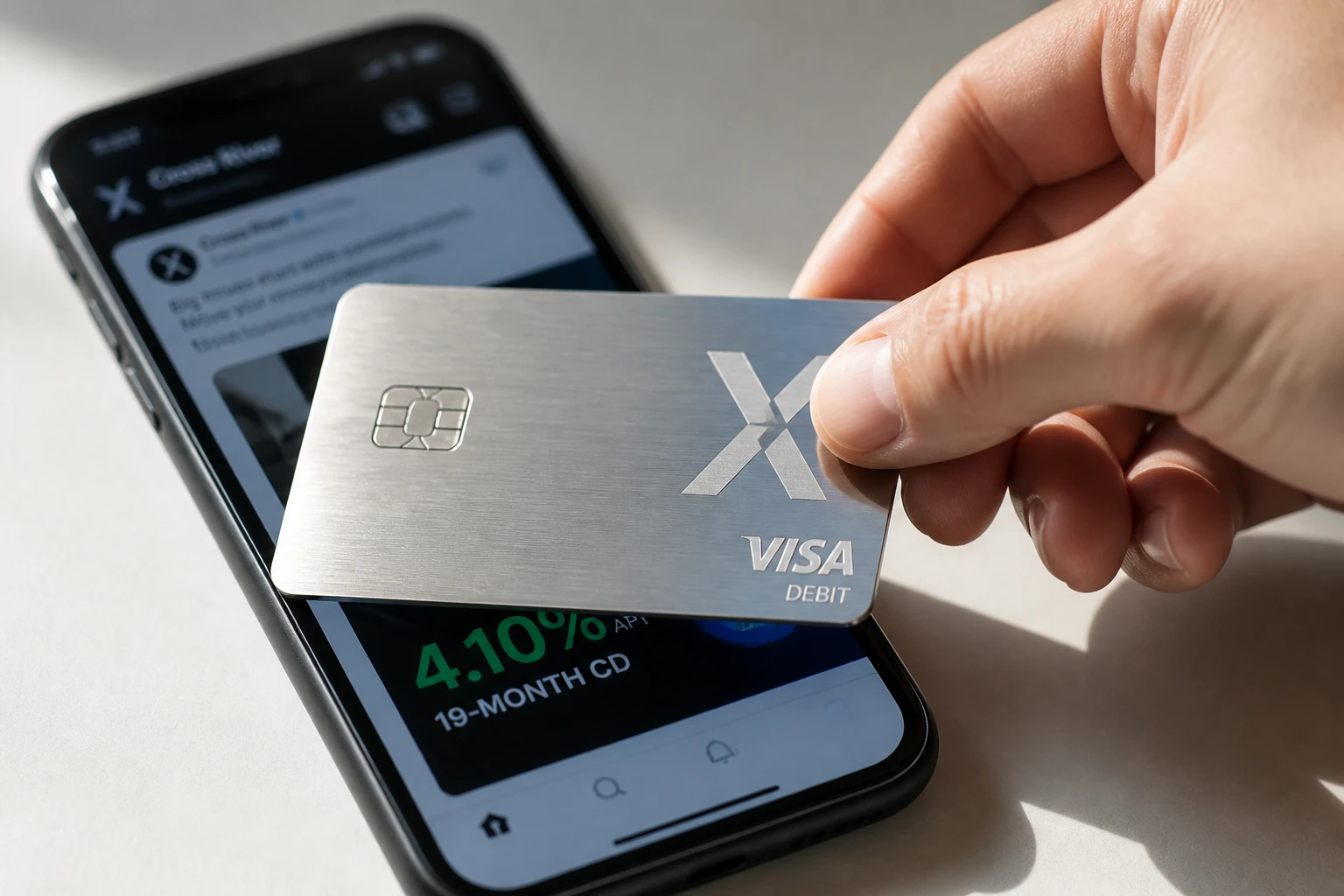
Cross River Bank has gone live as the sponsor powering X Money, embedding FDIC-insured interest-bearing accounts, a Visa debit card and peer-to-peer payments inside Elon Musk’s social app for select U.S. users. The July 27 launch marks the first time a major U.S. social platform has fully woven regulated banking rails into its core experience.
For Cross River, the New Jersey-based banking-as-a-service provider with more than 120 clients and an $8 billion balance sheet, the partnership is no ordinary fintech deal. It places the bank’s reputation and model squarely in the spotlight of Musk’s multi-year push to turn X into an everything app.
What Cross River Powers Inside X
Cross River supplies the regulated backbone: deposit accounts held at the bank (Member FDIC), access to payment rails, and card issuance under its Visa BIN. X users never leave the app to move money, earn yield or spend.
According to the bank’s own announcement, the collaboration makes X the first U.S. social media platform to embed these services at scale. Cross River stresses end-to-end ownership of its technology stack to avoid the handoff gaps common in multi-vendor setups.
That single-stack approach matters because every deposit, card swipe and P2P transfer runs through infrastructure the bank controls directly. Fewer handoffs mean fewer points where a compliance flag or settlement delay can stall a user mid-transaction.
X Money is invite-only and currently limited to Premium and Premium+ subscribers. Accounts sit at Cross River with automatic enrollment in a cash sweep program that can extend aggregate FDIC pass-through coverage up to $10 million across network banks.
The invite gate keeps early volume inside a controlled cohort while the bank and X test load. Premium and Premium+ status already signals users who pay for the platform, a natural filter before wider rollout.
Cross River’s High-Stakes Bet on Scale
Sponsor banks like Cross River earn fees and deposits by renting their charter and infrastructure to fintechs. Regional institutions can derive as much as 51 percent of revenue and deposits from these partnerships, per a 2024 Alloy report cited in coverage of the model.
Cross River already supports heavy hitters including Stripe, Affirm, Best Egg and Coinbase. Adding X’s roughly 570 million monthly users raises the volume dramatically. Aaron McPherson, principal at AFM Fintech, told American Banker the deal is ambitious.
This is an ambitious undertaking for Cross River, and if it succeeds, will do much to enhance their reputation among fintechs and banks. If there are problems, however, they will be more visible and have larger implications.
McPherson’s warning lands at a difficult moment. A surge in bank charter applications from fintechs and crypto firms, the largest since 2008, threatens the very sponsor model. Firms such as Affirm, PayPal and Stripe have pursued or obtained charters that let them keep deposit economics and drop the middleman.
Cross River itself carries history. In 2023 the FDIC issued a consent order over fair-lending compliance shortfalls tied to its marketplace lending and third-party programs. The bank neither admitted nor denied the findings and said it updated systems. The order remains a live compliance overlay that slows new program intake even as it hardens oversight.
- More than 120 fintech clients already on the platform
- $8 billion balance sheet managing deposits and payments
- Recent expansions into AI transaction monitoring and Solana stablecoin settlement with Visa
- Visible risk: any X Money outage or compliance slip now carries Musk-scale publicity
Success with X would cement Cross River as the go-to infrastructure for the largest consumer platforms. Failure would be equally public.
Six Percent Yield Meets the Metal Visa Card
X Money’s consumer pitch is aggressive. Official terms list up to 6.00% APY and 3% cashback on eligible purchases with the X Card. Premium+ users qualify for the full 6 percent rate; Premium users can reach it with qualifying direct deposits. The rate is variable and subject to change.
That 6 percent sits more than 10 times the national average savings rate of 0.38% published by the FDIC as of mid-July 2026. Additional perks include free global ATM fee reimbursement, no foreign transaction fees, free P2P transfers to any X handle with no limits, early direct deposit, wires and mailed checks, all inside the app.
| Feature | X Money | Typical Big Bank Savings |
|---|---|---|
| APY | Up to 6.00% (variable, sub-based) | 0.01%-0.50% |
| Cash back | 3% on eligible debit spend | Rare or tiered |
| FDIC coverage | Up to $10M via sweep | $250,000 standard |
| P2P | Instant free in-app by handle | App or Zelle fees/limits common |
| ATM / FX | Global fee reimbursement, 0% FX | Fees usual |
Deposits start with $250,000 coverage at Cross River itself before the IntraFi ICS sweep expands the umbrella. X Payments LLC is the fintech front; it is not a bank.
On X, early users and analysts immediately flagged the economics. One detailed thread noted Cross River’s ordinary margins cannot fund 6 percent plus 3 percent cash back, so X itself is subsidizing the rate as customer-acquisition bait. The platform’s existing user base keeps that CAC far lower than a pure neobank would face. The same voices warned that an account tied to an X login can vanish if the social account is suspended, turning the balance into a mailed check and creating soft pressure on creators.
The metal Visa card turns the account into a spending tool rather than a pure savings silo. Cash back on eligible debit purchases gives users a reason to route everyday spend through the same balance that earns the headline yield.
Social Platforms Have Tried Banking Before
X’s own history includes a discontinued BigCommerce “buy button” years ago when the company de-emphasized e-commerce. Meta’s Diem stablecoin project collapsed under political and regulatory heat. Facebook Pay never became a daily habit for most users.
Tony DeSanctis, senior director at Cornerstone Advisors, called a social-media money solution “a bit old school” and predicted it may age like Facebook Pay. He sees a narrower use case for influencers who want platform-native payments rather than a full bank replacement. The average X user, he noted, mostly comments rather than creates content that generates large payment flows.
KBW’s Sanjay Sakhrani offered a different cut: X Money looks more upmarket than the low-balance customers of Block or Chime. Traditional banks holding yield-seeking deposits may feel the pressure first if the product scales. He also flagged the 6 percent rate as likely unsustainable over time.
- Late 2010s, Twitter/X sunsets BigCommerce buy-button e-commerce push
- 2019-2022, Meta’s Libra/Diem stablecoin faces global regulatory shutdown
- 2023, Cross River receives FDIC fair-lending consent order
- July 27, 2026, Cross River announces full X Money powering with accounts, Visa debit and P2P
- Late July-August 2026, Invite rollout expands among Premium users; public rate and feature details firm up
The difference this time is Cross River’s claim of complete infrastructure control and X’s massive installed base of logged-in users who already spend hours in the app.
Prior social money efforts often relied on external processors or novel instruments that drew fresh regulatory fire. Cross River’s model stays inside established deposit and card rails, which lowers the novelty risk even as it raises the operational stakes for the sponsor bank.
How the Charter Wave Squeezes Sponsors
The same fintechs that once relied on sponsor banks are now racing for their own charters. Affirm, PayPal and Stripe sit among the names already pursuing or holding charters that let them keep deposit economics in-house and cut out the middleman.
That shift hits the core economics of banking-as-a-service. When regional institutions can derive as much as 51 percent of revenue and deposits from partnerships, every large client that leaves for a charter removes a meaningful slice of the model.
Cross River’s client roster still includes those heavy hitters alongside the new X relationship. The bank’s expansions into AI transaction monitoring and Solana stablecoin settlement with Visa show an effort to deepen the stack beyond plain deposit and card services.
Yet the consent order from 2023 keeps a compliance tax on new program intake. Heightened scrutiny slows the very growth that would offset clients who eventually self-charter. X Money therefore doubles as both a scale prize and a public stress test of whether the upgraded controls can carry a platform of this size.
- Charter surge: largest wave of fintech and crypto applications since 2008
- Client retention risk: former partners seeking to drop the sponsor layer
- Offset path: deeper stack services and flagship consumer platforms
- Constraint: live FDIC order that hardens oversight on third-party programs
Who Feels the Pressure First
Traditional banks with rate-sensitive depositors stand to lose sticky balances if 6 percent holds and users move cash. Yield-starved savers have long complained that large banks underpay while lending the same money at higher rates; products that flip that equation attract attention, as seen in other critiques of banks that fail to reward savers.
Neobanks and P2P apps such as Venmo or Cash App already own merchant acceptance and habit. X Money does not yet match that checkout ubiquity; its edge is native social graph and the everything-app vision. Creator payouts landing instantly inside X Money could lock in a powerful cohort.
For Cross River the win is prestige and deposit growth. The loss would be any compliance or operational failure broadcast across X’s user base and the broader BaaS industry. Other sponsor banks watching the charter surge already face the same structural squeeze.
Embedded finance itself continues to spread. Tools that add embedded bill-pay card options inside existing bank relationships show how payments keep migrating into the software people already open daily. X is simply taking that logic to the social layer.
| Player | Primary pressure point | X Money angle |
|---|---|---|
| Traditional banks | Yield-sensitive deposit flight | 6% headline rate draws balances |
| Neobanks / P2P apps | Habit and merchant acceptance | Social graph and in-app creators |
| Other sponsor banks | Charter wave and model squeeze | Public test of BaaS at scale |
| Cross River | Compliance load and visibility | Prestige win or high-profile miss |
Sustainability Questions and Near-Term Reality
The 6 percent APY is the clearest acquisition lever and the clearest target for future cuts once balances grow. X can afford temporary subsidies because every new funded account deepens engagement inside its app. Cross River earns its share on deposits and transactions without carrying the full promotional cost.
Invite-only status keeps early volume manageable while systems are tested. Wire and debit limits start high enough for most users ($75,000 daily wires, $25,000 daily card spend) with room to request more. Early direct deposit and free P2P remove friction that still plagues many bank apps.
Regulators will watch the partnership closely. Cross River’s existing consent order already subjects its third-party programs to heightened scrutiny. Scaling to X’s potential deposit base tests whether its upgraded controls hold under real load.
For now the product is live for a growing slice of Premium users. Cross River has placed its infrastructure and brand behind one of the highest-profile consumer finance launches of the year. How cleanly that infrastructure performs, and how long the headline yield lasts, will decide whether the bet enhances the bank’s standing or exposes the limits of the sponsor model itself.
The accounts are open. The metal cards are shipping. The next moves belong to users and the rate environment.