
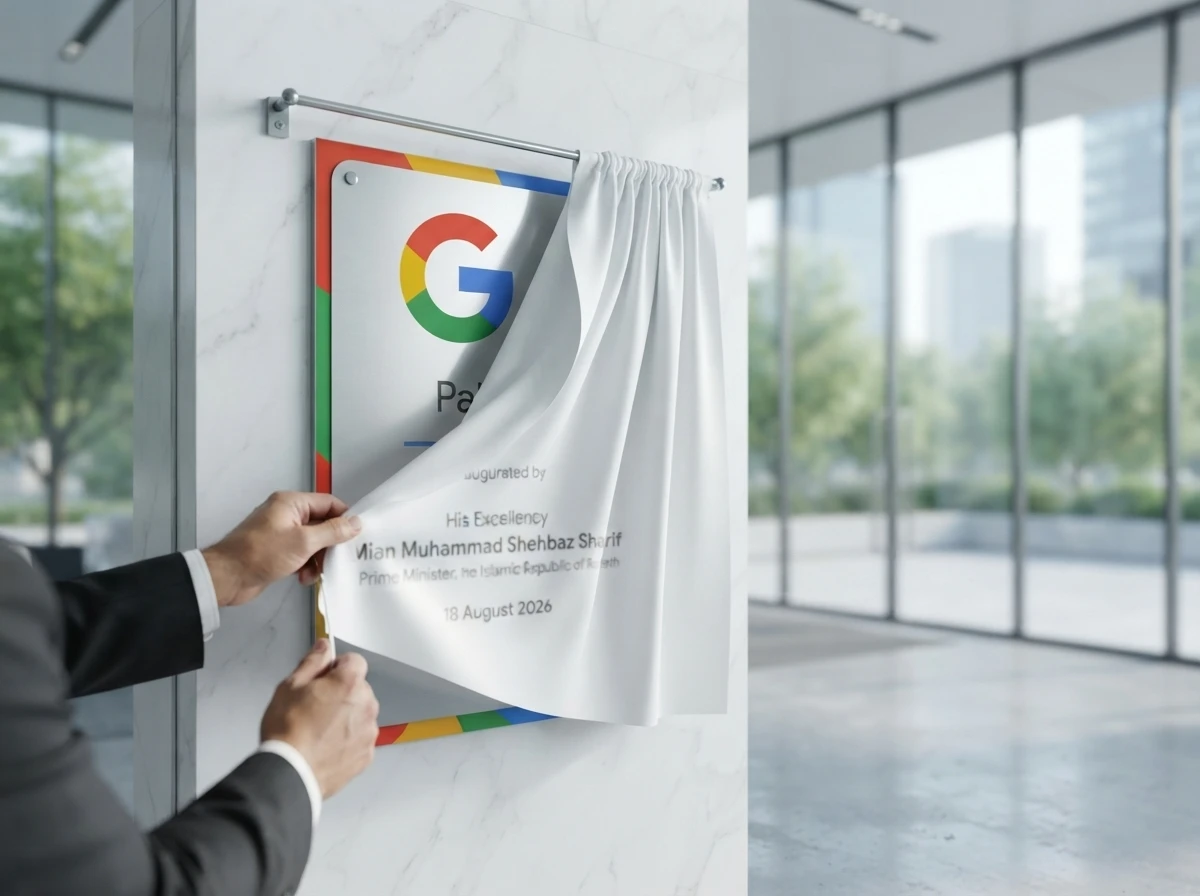
Prime Minister Shehbaz Sharif inaugurated Google’s first office in Pakistan on 18 August 2026 at the Prime Minister’s House in Islamabad, joined by Google Vice President for Government Affairs and Public Policy Wilson White and US Charge d’Affaires Natalie Baker. The nine-member Google delegation and government officials unveiled a commemorative plaque marking the permanent local presence.
The move builds directly on years of partnerships already delivering measurable scale. Google restated that its products and programmes have supported Rs3.9 trillion in economic benefits for Pakistani businesses and households and sustained 965,000 jobs.
The Plaque Went Up in Islamabad
Shehbaz described the opening as a major milestone in the Digital Nation Pakistan vision and said the government is already advancing digitisation of the economy, IT infrastructure upgrades and youth training in information technology and artificial intelligence. He welcomed deeper work with Google on those fronts.
Farhan Qureshi, Google’s Cluster Director for Pakistan, the Philippines and Thailand, said the office reflects confidence in the country’s digital future and talent. White briefed the prime minister on plans to deepen commitment, expand upskilling in IT, AI and gaming, and help local businesses reach international markets. He also flagged strong potential for Chromebooks assembled in Pakistan to ship across the region.
- Rs3.9 trillion in economic benefits claimed for businesses and households
- 965,000 jobs sustained through Google products and programmes
- More than 1 million teachers, students, developers and creators equipped with digital skills
- Free one-year Gemini subscriptions announced for all Pakistani students
White told the gathering that the prime minister’s ambition to build a $30 billion IT export hub aligns with Google’s goals and that human-resource investment remains essential for digital transformation to succeed.
The ceremony itself was short. The substance lay in the programmes already running and in the hardware and AI commitments attached to the new desk. Officials treated the plaque as a coordination signal rather than a starting gun.
A Decade of Numbers Behind the Ribbon
The office does not start from zero. Since 2022 Google has awarded 350,000 Career Certificate scholarships in Pakistan. More than 80 percent of graduates reported a new job or business growth within six months. Google Developer Groups have reached 300,000 developers. The AI Seekho programme has trained 50,000 developers in generative AI and Google Cloud technologies.
Think Apps and App Design Masterclasses have backed 120 local gaming and app studios whose products have posted significant international downloads. Digital Safar has trained more than 300,000 students and 5,000 educators in digital citizenship and online safety, integrating Be Internet Awesome with Gemini Academy.
| Programme | Reach | Focus |
|---|---|---|
| Career Certificates | 350,000 scholarships since 2022 | Job-ready digital skills |
| Google Developer Groups | 300,000 developers | Community and tools |
| AI Seekho | 50,000 developers | Generative AI and Cloud |
| Digital Safar | 300,000+ students, 5,000 educators | Online safety |
| Think Apps / Masterclasses | 120 studios | Gaming and apps |
An Access Partnership study underpinning Google’s figures found that in 2023 alone Search, Ads, AdSense, Play, Cloud and YouTube helped deliver PKR 2.6 trillion of economic activity for Pakistani businesses, plus PKR 1.3 trillion in household benefits, with hundreds of thousands of jobs supported. Those 2023 totals feed the decade-scale Rs3.9 trillion claim now cited at the inauguration.
Read together, the programme counts and the 2023 study describe two layers of the same story. One layer is direct skilling and community reach. The other is platform-level activity that already moves money through ads, cloud, Play and YouTube. The inauguration folded both layers into a single economic headline.
| 2023 component | Amount | Who benefits |
|---|---|---|
| Search, Ads, AdSense, Play, Cloud, YouTube | PKR 2.6 trillion | Pakistani businesses |
| Household benefits | PKR 1.3 trillion | Households |
| Jobs supported | Hundreds of thousands | Workers linked to those products |
The career-certificate placement rate gives the skilling side a near-term test. When more than four in five graduates report a job or business growth inside six months, the pipeline looks less like a brochure and more like a labour-market channel. The permanent office now has a local base from which to watch whether that rate holds as volumes grow.
Chromebooks From Haripur to the Region
Hardware forms the second concrete pillar. Google, Tech Valley, Allied and the National Radio and Telecommunication Corporation launched a local Chromebook assembly line at NRTC’s facility in Haripur with a target to assemble 500,000 Chromebooks by 2026. The line aims to lower device costs for education, create local jobs and open an export channel.
White expressed satisfaction with the assembly progress and said devices made in Pakistan carry real potential for regional markets. Qureshi linked the hardware push to higher-value, AI-powered growth and Pakistan’s ambition to become a regional technology and export hub. The same partners have framed the plant as a step toward “Made-in-Pakistan” devices that pair with the skilling programmes already running.
- Partners: Google, Tech Valley, Allied, NRTC
- Location: Haripur assembly facility
- Volume target: 500,000 units by 2026
- Goals: education access, employment, regional exports
Earlier announcements in late 2025 positioned the line as both an education tool and an industrial foothold. The permanent office now sits beside that hardware bet rather than above it.
Assembly volume matters because device cost still shapes who can train on modern tools. A lower-priced Chromebook aimed at classrooms pairs with Digital Safar’s student and educator reach and with the free Gemini tier for students. Export potential, if realised, would turn the same line into a foreign-exchange contributor rather than only a domestic education play.
Free Gemini for Every Student
White announced that Google will provide free one-year subscriptions to Google Gemini for all students in Pakistan. The offer sits inside a broader AI push that already includes AI Seekho and localised tools developed with the Ministry of IT and Telecommunication.
We are opening Google’s office in Pakistan because we believe deeply in the country’s digital future and its talent.
Farhan Qureshi said the local presence will strengthen commitment to accelerating digital transformation and build on existing partnerships for long-term opportunities.
Google’s public Pakistan pages group the work under Future Forward Pakistan initiatives that cover economic contribution (Agay Barho), online safety (Safe Raho) and AI advancement. Separate AI opportunity modelling cited by Google projects multi-trillion-rupee upside from AI in productivity, exports and agriculture if barriers fall. The free Gemini tier gives students immediate access to the same class of models that face Gemini models under tighter rules in other markets.
The student offer also narrows the gap between classroom access and the AI Seekho track already taken by 50,000 developers. One path is broad and time-limited. The other is deeper and aimed at people already building on Cloud and generative tools. Together they give Google a way to seed familiarity at school age and specialisation among working developers without waiting for new curriculum cycles.
Local Partners and the Export Ladder
Pakistan’s IT and IT-enabled services exports have recently run in the low-to-mid single-digit billions of dollars, with the government repeatedly setting a $30 billion horizon. Shehbaz has directed ministries to build roadmaps with annual targets toward that mark. Google’s presence adds a fixed coordination point for skills, cloud, apps and hardware that previously operated through visiting teams and local partners.
The winners sit closest to the pipeline. Students and recent graduates gain certificate pathways, free AI tools and a higher chance that Google-linked roles stay inside the country. The Haripur assembly partners and supply chain gain volume and potential export orders. App and game studios already in the Think Apps orbit gain closer product and cloud support. The government gains a high-visibility private partner for its Digital Nation messaging and export targets.
- Students and graduates: certificates, Gemini access, local role retention
- Haripur partners and suppliers: assembly volume and export orders
- Think Apps studios: nearer product and cloud support
- Government: a visible partner for Digital Nation and export messaging
On X, reactions split between celebration of youth opportunity and cooler notes that an office plaque alone does not rewrite capital or regulatory constraints. One recurring observation is that converting certificates into retained talent has always been the harder step; a permanent Google desk may make that conversion slightly less leaky.
The export ladder still depends on firms that can sell abroad, not only on headcount trained. Cloud, Play and ads already show up in the 2023 activity totals. A local office can shorten the path from a studio or services firm to those same channels, but it cannot invent demand. Annual ministry roadmaps will remain the public scoreboard against which both sides are judged.
The Timeline That Led to the Plaque
The Islamabad opening closes a sequence that mixed skilling, research, hardware and diplomacy. None of the major pieces arrived in the same year. The office is the first fixed address that can hold them in one place.
- Since 2022 – Career Certificate scholarships begin at scale, later reaching 350,000 awards.
- 2023 – Access Partnership measures PKR 2.6 trillion in business activity and PKR 1.3 trillion in household benefits from core Google products.
- Late 2025 – Partners position the Haripur Chromebook line as an education tool and industrial foothold.
- 18 August 2026 – Shehbaz Sharif, Wilson White and Natalie Baker unveil the Islamabad office plaque; free one-year Gemini subscriptions for students are announced.
- By 2026 – Chromebook assembly target of 500,000 units stands as the hardware deadline tied to the same partners.
That order helps explain the tone at the Prime Minister’s House. Speakers could point to graduates, developers, studios and a factory line rather than to a greenfield promise. The residual risk is execution speed: scholarships and safety courses scale faster than export receipts or regional device shipments.
Skills, Devices and AI Pull in One Direction
White’s brief to the prime minister bundled upskilling in IT, AI and gaming with help for local firms seeking foreign buyers and with Chromebooks built for regional shipment. Qureshi tied the same hardware push to higher-value, AI-powered growth. The government side already lists digitisation, infrastructure upgrades and youth training in IT and AI among active priorities.
Those threads share a simple mechanism. Certificates and Developer Groups enlarge the pool of people who can ship software. AI Seekho and free Gemini lower the cost of experimenting with generative tools. Haripur aims to put cheaper devices under more of those hands and, later, into nearby markets. The office keeps product, policy and partnership staff close enough to adjust the mix when one strand lags.
Alignment with the $30 billion IT export ambition is explicit in White’s remarks and in Shehbaz’s Digital Nation framing. Current IT and IT-enabled exports still sit in the low-to-mid single-digit billions of dollars. Bridging that gap requires retained talent, sellable products and reliable infrastructure, not only ceremony. Google’s stated focus on expanding existing programmes with government and ecosystem partners is the operational answer it offered on inauguration day.
Gaming sits in the same bundle for a reason. Think Apps and the masterclasses have already backed 120 studios with international downloads. White’s plan to expand upskilling in gaming treats that studio base as a seed rather than a side project. Cloud support and a local desk give those teams a shorter route to the same platforms that contributed to the 2023 activity totals.
What a Permanent Desk Changes
Before this week Google ran large programmes without a formal local office. Scholarships, developer groups, safety training and the Chromebook line all proceeded through partnerships and remote coordination. The Islamabad base shortens that loop. White said the office will deepen work with local businesses seeking international markets and expand upskilling in emerging areas including gaming.
Qureshi framed the decision as belief in Pakistani talent and digital trajectory. The company said its focus now shifts to expanding the existing programmes in cooperation with government and ecosystem partners. That expansion sits beside other Google physical bets, including Google’s first overseas flagship store in Tokyo, which signalled similar long-term market commitment in a different region.
The second-order effect is compounding. Skills programmes feed a larger pool of developers and creators. Affordable local Chromebooks put devices under more of those hands. Free Gemini access lowers the barrier to AI experimentation. A permanent office keeps product, policy and partnership staff close enough to iterate. None of those pieces is new; the office is the piece that keeps them from drifting apart.
Shehbaz said the government will keep investing in the young population and modern technology. Google’s representatives restated interest in the rapidly developing digital ecosystem. The plaque is up. The test is whether the next cohort of Career Certificate graduates, AI Seekho developers and Haripur-built devices show up in the export numbers the government has already written down.