Samsung’s Galaxy S26 FE just spilled its full marketing deck. More than two dozen images published by Android Headlines name the launch colors Blueberry, Pistachio and Graphite, lock in a 6.7-inch Full HD+ 120 Hz panel, a 4,900 mAh battery with 45W Super Fast Charging 2.0, and Samsung’s 3 nm Exynos 2500. The phone measures 161.6 × 76.9 × 7.4 mm and keeps IP68 protection plus a promise of seven Android OS upgrades.
The package looks familiar for a reason. Design and chip move forward a step; battery capacity, base storage and camera megapixels largely do not. Early price talk already points higher than last year’s model.
What the marketing slides actually list
Android Authority and Android Headlines walked through the same set of digital materials. The rear cameras sit on a single island copied from the main Galaxy S26 line: 50 MP main, 12 MP ultrawide and 8 MP telephoto. The front camera is 12 MP. An aluminum alloy frame pairs with Gorilla Glass Victus+ on the display. Software call-outs include Horizontal Lock and My FanCam. The phone is expected to ship with Android 17-based One UI 9.
GSMArena, citing WinFuture material, adds the finer points. The Exynos 2500 uses a 10-core layout (1+2+5+2) and an Xclipse 950 GPU. Memory stays at 8 GB of RAM with 128 GB or 256 GB storage options. No microSD slot appears. Dual SIM and eSIM support are listed along with Wi-Fi 6, Bluetooth 5.4 and NFC.
| Spec | Galaxy S26 FE (leak) | Galaxy S25 FE |
|---|---|---|
| Display | 6.7″ FHD+ Dynamic AMOLED 2X, 120 Hz, ~1,200/1,900 nits | 6.7″ FHD+ Dynamic AMOLED 2X, 120 Hz |
| Chipset | Exynos 2500 (3 nm) | Exynos 2400 |
| RAM / Storage | 8 GB / 128 or 256 GB | 8 GB / 128, 256 or 512 GB |
| Battery / Charging | 4,900 mAh, 45W wired | 4,900 mAh, 45W wired |
| Rear cameras | 50 MP + 12 MP UW + 8 MP 3× | 50 MP + 12 MP UW + 8 MP 3× |
| Thickness / Weight | 7.4 mm / 193 g | 7.4 mm / ~190 g |
| OS updates | 7 Android generations | 7 Android generations |
The table makes the pattern plain. Most numbers stay put. The chip and the camera island are the clearest upgrades.
Connectivity stays modern enough for the tier without stretching into flagship-only radios. Dual SIM plus eSIM covers travel and dual-number use. Wi-Fi 6, Bluetooth 5.4 and NFC round out the everyday checklist. The missing microSD slot keeps the storage story closed once the buyer picks 128 GB or 256 GB at purchase.
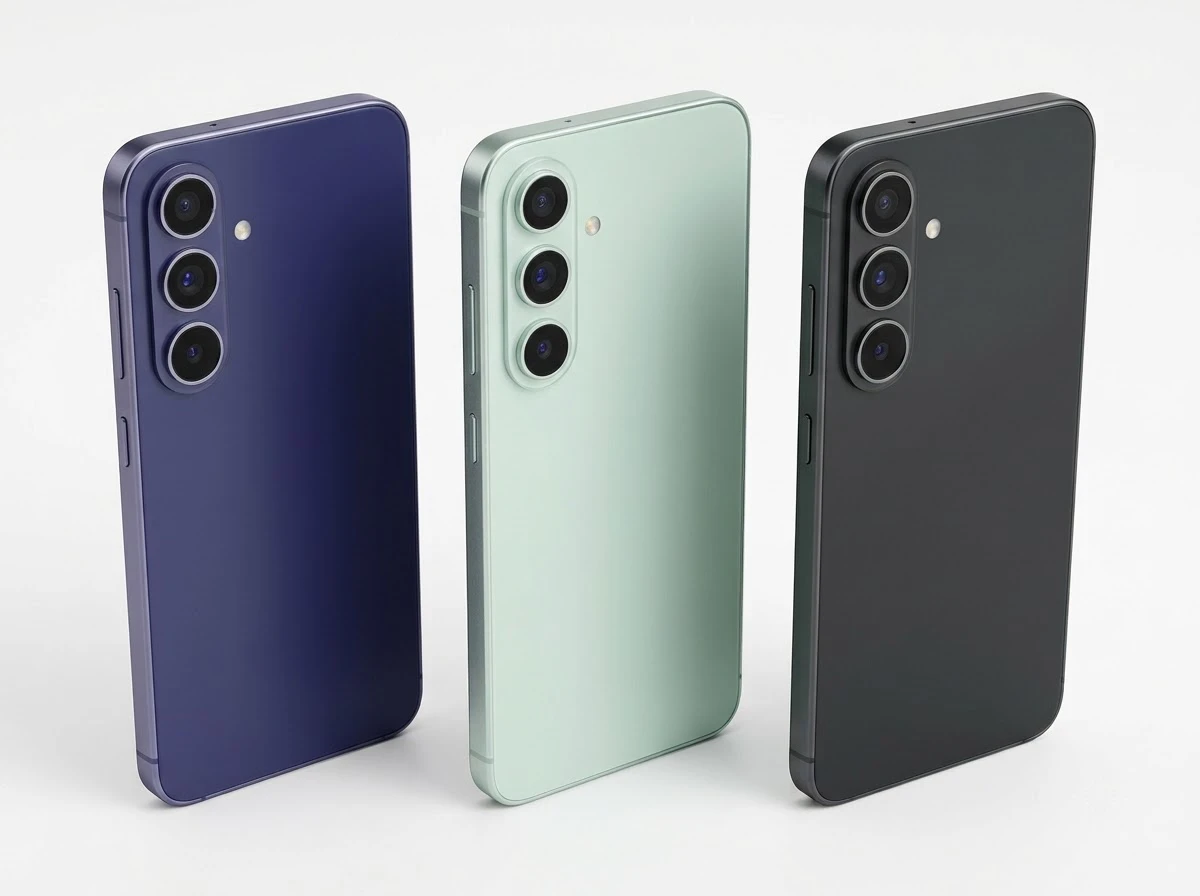
Blueberry green and the flagship camera island
Official-looking images show three launch colors with those fruit-and-mineral names: Blueberry, Pistachio and Graphite. Earlier low-res renders had simply called them purple, green and black. The back is flat. The frame is flat. Three cameras sit vertically inside one raised island with the LED flash beside it, exactly the layout Samsung gave the main S26 series.
Bezels run thin all around, though the bottom edge looks a hair thicker. The front camera sits in a centered punch-hole. Overall dimensions match the S25 FE almost exactly, so cases and habits carry over with almost no change.
- Blueberry: the purple-leaning option
- Pistachio: the green finish
- Graphite: the dark neutral
That visual step-up is real. Buyers who want the new S26 look without the full flagship bill get it here first.
Flat surfaces and a shared island mean the FE no longer reads as a softened cousin on a shelf. From across a room it tracks the main line. The 161.6 × 76.9 × 7.4 mm shell and the 193 g weight keep the familiar hand feel, so the redesign is mostly visual rather than ergonomic.
Exynos 2500 scores and the midrange ceiling
Samsung is skipping a third outing for the Exynos 2400 and dropping the 3 nm Exynos 2500 into the FE instead. Geekbench listings for SM-S741 units running the chip have posted single-core scores between roughly 2,100 and 2,400 and multi-core results between about 7,100 and 8,000, depending on the regional sample. The Xclipse 950 GPU has shown Vulkan scores around 22,100 in one listing.
Those numbers sit well below the main Galaxy S26’s Exynos 2600 results, which land closer to 3,200 single-core and 11,000-plus multi-core. The FE stays a generation behind the flagship silicon, the same pattern the line has followed for years. Efficiency and thermals on the newer process should improve over the 2400, yet the ceiling remains midrange.
Early Geekbench range (Exynos 2500 samples):
- Single-core: ~2,100-2,426
- Multi-core: ~7,148-8,004
- GPU Vulkan: ~22,100 in one run
Eight gigabytes of RAM and a 128 GB base storage option complete the picture. Samsung has not raised memory capacities this generation.
The 10-core (1+2+5+2) layout and the move to 3 nm are the practical gains. Daily apps, multitasking inside 8 GB, and sustained loads should feel cleaner than on the Exynos 2400. Peak throughput still trails the Exynos 2600 by a wide margin on both CPU and GPU charts, so the FE remains the efficient midrange pick rather than a quiet flagship substitute.
Cameras and battery hold the same numbers
The 50 MP main sensor, 8 MP 3× telephoto and 12 MP front camera carry over. The ultrawide is described as a new 12 MP unit, a modest sensor swap rather than a resolution jump. Video options include 8K at 30 fps and 4K at 60 fps on the main camera. No one is calling this a photography flagship.
Battery capacity stays locked at 4,900 mAh with the same 45W Super Fast Charging 2.0 wired support and 15W wireless. GSMArena notes an official endurance claim of 50 hours versus 42 hours 37 minutes for the S25 FE, likely helped by the newer chip. At the same time the EPREL cycle rating drops from 2,000 to 1,200, a change some link to possible silicon-carbon cell chemistry already seen elsewhere in Samsung’s 2026 lineup. Weight edges up 3 g to 193 g.
Same size pack, same peak charging rate, slightly longer claimed life, lower official cycle count. The battery story is mixed on paper.
| Battery detail | Galaxy S26 FE (leak) | Galaxy S25 FE |
|---|---|---|
| Capacity | 4,900 mAh | 4,900 mAh |
| Wired charging | 45W Super Fast Charging 2.0 | 45W wired |
| Wireless charging | 15W | 15W (same class) |
| Official endurance | 50 hours | 42 hours 37 minutes |
| EPREL cycle rating | 1,200 | 2,000 |
| Weight | 193 g | ~190 g |
Video still tops out at the same headline modes. The 8K30 and 4K60 tags keep pace with last year rather than leap ahead. Still photography leans on the familiar 50 MP main and 8 MP 3× pair, with the ultrawide change as the only named sensor refresh. Buyers chasing bigger leaps in zoom reach or low-light hardware will not find them in this deck.
Seven years of updates and the small software extras
Samsung again promises seven Android OS upgrades and the matching security patches. That matches the commitment it made for the seven generations of OS upgrades on the S25 FE and the broader S26 series. In a market where long support has become a selling point, the FE stays competitive with the phones that lead on long software support.
Two software tools get called out in the slides. Horizontal Lock keeps video horizons level even when the phone rotates, using the gyroscope and accelerometer. My FanCam, previously seen on the Z Fold 8, appears as another camera-mode extra. One UI 9 on Android 17 should bring the rest of the current Galaxy AI feature set that Samsung has been spreading across its lineup.
Those extras and the long update window are the quiet strengths. Hardware is incremental; software longevity is not.
Horizontal Lock and My FanCam are small on a spec sheet and large in daily use. Level horizons matter for quick clips. FanCam gives a mode already proven on foldables. Wrapped in seven OS generations and the wider Galaxy AI set on One UI 9, the software side does more heavy lifting than the camera megapixel list.
What moves forward and what stays put
Read across the leak and the split is sharp. A short list captures the upgrades. A longer list captures the freezes. That balance is the product story in miniature.
- Moves forward: Exynos 2500 on 3 nm, S26-style camera island, named launch colors, claimed endurance up to 50 hours, One UI 9 on Android 17
- Stays put: 6.7-inch FHD+ 120 Hz panel class, 8 GB RAM, 4,900 mAh cell, 45W wired and 15W wireless charging, 50 MP + 8 MP 3× rear pair, 12 MP front camera, seven OS upgrades, IP68, dual SIM and eSIM
- Steps back on paper: storage tops out at 256 GB with no 512 GB tier and no microSD, EPREL cycles fall to 1,200, weight rises 3 g, early price talk runs above the S25 FE
Design and process node do the visible work. Capacity figures and the camera resolution stack do not. The FE still borrows the flagship look and a newer chip while holding the midrange envelope on memory, battery size and sensor counts.
That is a coherent cost-control choice. It is also the tension early commenters keep naming when they pair the Exynos 2500 with a 128 GB floor and a higher expected sticker.
Price talk already starts above last year
No official price has leaked with the slides. WinFuture material cited by GSMArena puts the 128 GB model at €800, €50 above the S25 FE’s European launch. US talk clusters between $650 and $700, which would match or slightly exceed the S25 FE’s $649.99 start. Samsung’s recent Z Fold 8 pricing and broader industry moves make a flat or lower sticker unlikely.
| Market signal | S26 FE early talk | S25 FE reference |
|---|---|---|
| Europe (128 GB) | €800 | €50 lower at launch |
| United States | $650-$700 cluster | $649.99 start |
That is the ironic core. The Fan Edition was built to deliver most of the flagship experience for less money. Design now tracks the current S series more closely and the chip is newer, yet the storage base, camera set and battery capacity refuse to grow while the expected asking price does. Early reactions on X and in comment threads already flag the combination of Exynos 2500, 128 GB floor and higher euro price as a stretch of the original FE bargain.
Earlier Galaxy S26 FE listing signals and hands-on videos had already pointed to a September window, likely around IFA. The marketing materials remove almost every remaining unknown except the final shelf price and the precise day.
How the September window shapes the wait
A September target, tied to the IFA timeframe in earlier signals, fits the FE habit of landing after the spring flagship wave. By then the main Galaxy S26 line will already have defined the year’s design language. The FE can arrive as the lower-cost echo with the same island and the same color naming style.
The marketing deck now does most of the pre-launch work. Colors, dimensions, chip, cameras, battery and update term are public. Reviewers and buyers can prep comparisons before units ship. The remaining suspense is narrow: the exact open date and the final tags in each region.
- Spring flagship cycle: main S26 line sets design and silicon hierarchy
- Leak wave: listing signals, hands-on videos, then the full marketing slides
- September / IFA window: expected retail arrival for the FE
- Shelf moment: confirmed price and day decide if the bargain still reads as one
That sequence leaves little hardware mystery. It puts the pressure on pricing and on whether 8 GB, a 128 GB base and a carryover camera stack still feel fair once the new island and Exynos 2500 are in hand.
When the phone lands, buyers will weigh a fresher look and a more efficient chip against numbers that mostly stood still and a bill that may not. The leak leaves little mystery about the hardware. The only open variable is whether the Fan Edition still feels like a fan deal once the price tags go up.