
NEWS
Brisbane’s Olympic Fast-Track Follows an Old Host Pattern
Brisbane won 2032 on reused venues, then copied the old Olympic special-law playbook, lifting 15 state Acts around the Victoria Park stadium.

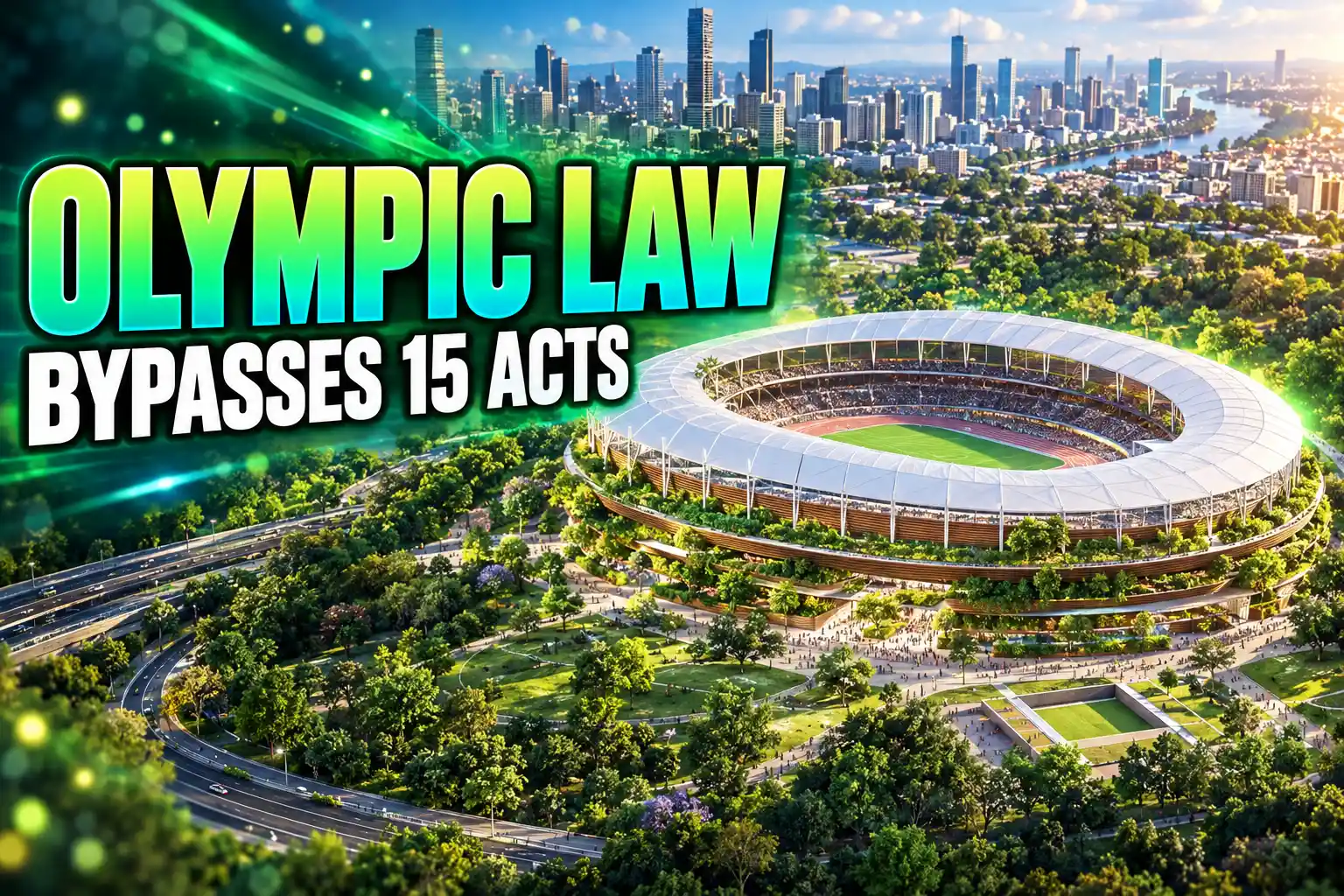
Queensland’s Olympic law now makes a 63,000-seat stadium at Victoria Park lawful even if it breaks 15 state planning and heritage Acts. Fences went up on 1 June 2026. Earthworks followed.
Host cities have written special Games statutes before. Sydney still tied its delivery body to green rules. Brisbane’s version cuts those strings, then starts digging.
Queensland Wrote the Stadium Out of Planning Law
The vehicle is Chapter 3A of the Brisbane Olympic and Paralympic Games Arrangements Act, inserted in 2025 and widened again when the Major Sports Facilities and Other Legislation Amendment Act 2026 was assented to on 19 February 2026. Partner Paul Wilson, in an Ashurst note dated 14 May 2026, wrote that venue, village and Games transport work is lawful despite key environment, planning and water laws.
That is a bigger step than the 2024 “accepted development” path it replaced. Public notice drops away. So do third-party appeals. Civil suits that would stop or limit the work are barred. A decision on a venue or village is final, with one narrow exception: the Supreme Court can still act if it finds jurisdictional error.
The Building Act 1975 still applies to venue construction. Federal environment law still applies too. Everything else in the state list is the point of the clause.
ACTS THE GAMES LAW SETS ASIDE
| Act | What it usually controls |
|---|---|
| Planning Act 2016 | Development approval and public notice |
| Environmental Protection Act 1994 | Pollution, noise and environmental harm |
| Queensland Heritage Act 1992 | State heritage places |
| Nature Conservation Act 1992 | Protected plants and animals |
| Economic Development Act 2012 | Priority development areas |
| Environmental Offsets Act 2014 | Offsets when habitat is lost |
RedeMont’s March 2026 briefing lists 15 Acts in all. The rest include the City of Brisbane Act 2010, the Coastal Protection and Management Act 1995, the Regional Planning Interests Act 2014, the Local Government Act 2009, the Fisheries Act 1994, the Vegetation Management Act 1999, the Integrated Resort Development Act 1987, and the state’s water-retail and water-supply statutes. Those are the ordinary checks on a big inner-city build. Chapter 3A says the stadium does not have to meet them.
Sydney’s Olympic Act Still Required Green Rules
Special Olympic law is not new in Australia. New South Wales passed the Olympic Co-ordination Authority Act in 1995 so a single body could buy land, run projects and speed approvals for Sydney 2000. The same package still forced the bid’s Environmental Guidelines onto every Olympic job through State Environmental Planning Policy 38. Tenderers had to show how they would meet those rules.
London copied the delivery-authority model in the London Olympic Games and Paralympic Games Act 2006. Rio later changed zoning on a nature reserve so a golf course could go in, against local opposition. The IOC’s later Agenda 2020+5 line is that permanent Olympic building should not sit in statutory nature and cultural protected areas.
Brisbane’s statute sits in that family and then goes further. Sydney’s authority still had to perform the green rules. Chapter 3A makes listed development lawful even when the listed Acts would have said no. Speed is the stated aim: be ready to host, meet Games agreements, and lock in later uses of the same venues.
Marcus Foth, a QUT design professor, wrote in May 2026 that Brisbane is now planning seven new venues. Paris 2024 built one major new venue, an aquatics centre. Los Angeles 2028 plans to use the Memorial Coliseum, opened in 1923. Winter hosts in that period lean on plant they already have. Brisbane is the summer outlier in that set.
Barrambin Is Now a Federal Heritage File
To Turrbal and Yagara people the park is Barrambin, a place of springs and living heritage in inner Brisbane. A Sacred Fire went in on 5 April 2026, lit by Uncle Derek Oram and Derek “Deejayy” Oram Sandy Jr. Police cleared a protest camp in late May. The Games Independent Infrastructure and Coordination Authority, or GIICA, took possession on 1 June 2026.
State heritage law is in the 15-Act list, so the live legal fight moved to Canberra. Federal Environment Minister Murray Watt refused those emergency heritage declarations on 31 May 2026. Ten applications under the Aboriginal and Torres Strait Islander Heritage Protection Act 1984 had been received by then. One had already been decided in January. Two had been withdrawn. Two April filings sought a section 9 emergency stop on fencing and ground works due to start the next day. Watt said he could not be satisfied the statutory tests were met, and he noted the area’s importance to Turrbal and Yagara people.
Section 10 applications, which seek longer protection, were still before the minister in August 2026. Yagara Magandjin Aboriginal Corporation said about 200 trees had come down by 11 August. Gaja Kerry Charlton, a Yagara Elder and a section 10 applicant, put the group’s position in a 25 March 2026 statement.
We are pro Olympics, but we are anti-stadium in Barrambin. This project shows a lack of care for Aboriginal cultural heritage.
Gaja Kerry Charlton, Yagara Magandjin Aboriginal Corporation
A May 2026 federal note also found the stadium and a National Aquatic Centre “not a controlled action” under national environment law, so they can proceed without a further federal assessment of that kind. The emergency heritage door closed. The longer file is the one that can still change the ground.
What Brisbane Told the IOC in 2021
The IOC’s own feasibility assessment, dated 10 June 2021, sold Brisbane as a New Norm host with 80% to 90% existing or temporary venues. An IOC poll in January 2021 put local and national support at 66%. The same paper said the concept was “fully aligned with Olympic Agenda 2020”.
The bid text went further than seat counts. Brisbane said it had a duty to maximise social, environmental and economic gains for host communities, and to watch Games-related human rights impacts on construction jobs, services and access. The pre-election commitments in the host contract are the guarantees and statements made in that process. Hosts are told to honour them.
Mikaela Cojuangco-Jaworski, chair of the IOC Coordination Commission, visited Brisbane in May 2025 and described the state law changes as “fast tracking, and not circumventing”. Griffith University researchers Millicent Kennelly, Adele Pavlidis, Laura Ripoll Gonzalez, Natalie Osborne and Sarah Joseph, writing the same month, argued the opposite: the changes sit badly beside those bid lines.
THE 2021 PITCH, IN FIGURES
- Venue mix: The IOC wrote 80% to 90% existing or temporary venues into its feasibility paper.
- Public backing: An IOC poll in January 2021 put support at 66% locally and nationally.
- Later research: Griffith’s 2023-2024 work, 41 Queenslanders, found apathy and cost worry, not a second wave of that poll result.
- Money now: The state is working to a $7.1 billion Games infrastructure program, with $3.4 billion of federal money inside a total of that size.
The 2021 paper also flagged a live risk: write proper later-use plans for any new venues, and look again at using more existing sites, even in Sydney, instead of adding plant.
Dirt, a Preferred Builder and the $7.1 Billion Cap
GIICA was carved out in 2024 to deliver venues and villages. Queensland-founded BMD has the early-works job through mid-2027: bulk earth, haul roads, drains, walls. Design sits with Cox, Hassell and Azusa Sekkei. On 30 September 2026 the authority moved that joint venture into final talks, picking BESIX Watpac and John Holland over Built and Sacyr after an early-contractor process that began on 31 October 2025. The main contract is meant to be settled in early 2027, with major construction that year.
The stadium is costed in the $3.6 billion to $3.8 billion range, inside the $7.1 billion envelope. After the Games it is planned as home for the Brisbane Lions, the Brisbane Heat and the Queensland Bulls, with concert crowds up to 70,000. GIICA chairman Stephen Conry said the precinct would connect the park to the rest of the city “and allow far more people to enjoy it, rather than just a few.” An August 2026 draft precinct plan says two-thirds of Victoria Park would stay public green space, with footbridges over the Inner City Bypass and a larger York’s Hollow.
Premier David Crisafulli had already owned a broken election promise on the venue mix in March 2025. “I have to own that, and I will, and I am sorry,” he said. His government’s comparison with the last Labor plans puts a full Gabba demolition and rebuild at $2.7 billion and temporary stands at the Queensland Sport and Athletics Centre at $2.25 billion. Sport and Olympic minister Tim Mander, on 1 October 2026, defended 63,000 seats against calls for 80,000. The argument in that interview was size, not whether the park should be a stadium.
FROM BID TO DIRT
- 10 June 2021: IOC papers describe a New Norm host using 80% to 90% existing or temporary venues.
- 2025: Chapter 3A makes listed Games work lawful despite 15 state Acts and shuts most court paths.
- 19 February 2026: Further Games Act changes are assented to and take effect, adding venues and villages to the schedules.
- 31 May 2026: Watt refuses section 9 emergency declarations over Barrambin.
- 1 June 2026: GIICA takes Victoria Park and early works begin.
- 30 September 2026: BESIX Watpac and John Holland become the sole builder finalist.
Once the state appeal path closed, the public row moved to seat counts, concert nights and who pours the concrete. That shift is the statute doing its job.
Neighbours, Elders and a Closed Courthouse
Save Victoria Park spokeswoman Rosemary O’Hagan called the 2025 bill “kill-all, draconian” and a “slap in the face”. In the March 2026 statement she said 1 June would not be a real stadium start, and she asked where the geotechnical results, project-validation reports and the community consultation tied to Commonwealth funding had gone. The park sits beside a hospital and university precinct. Those neighbours no longer have the usual planning appeal.
Griffith’s 41 interviews, from 2023 and 2024, were already cool on the Games. One person said the wellbeing of Brisbane’s communities “is not going to be better because of the Olympics.” Another asked why money was going into an event “that could possibly fail” instead of into services people need to get by. Kennelly and her colleagues warned that stripping the usual checks would feed that cynicism.
The Crisafulli government says the opposite: get on with tenure and digging so GIICA can hit 2032, and leave a permanent oval the city will use. Chapter 3A also shortens time to negotiate cultural heritage management plans, the documents that set how work should avoid harm to Aboriginal and Torres Strait Islander heritage. That is a state process running beside the federal section 10 file.
WHO STILL HAS A HAND ON THE SITE
- GIICA and BMD: They hold the park and the early-works contract through mid-2027.
- Watt’s department: Section 10 applications were still under assessment in August 2026.
- Traditional Owners: Yagara Magandjin and other applicants are using the federal Act because the state Heritage Act no longer binds this job.
- The Supreme Court: Jurisdictional error is the remaining state-court opening, not a merits appeal on noise, trees or park use.
A slice of comment now treats the park decision as settled and argues about unions and blowouts instead. That is what a closed courthouse produces. The cost fight becomes the only fight left for people with no standing in Chapter 3A.
After the Games, the Gabba Pitch Moves In
On 21 September 2026 the premier said Gabba turf would be grown on a new tray, then shifted to Victoria Park as a drop-in wicket after 2032, with other Gabba pitches likely cut out and set as permanent wickets. The Gabba is to be demolished once the Games end. The new oval is not a one-month overlay. It is the city’s next cricket and AFL ground, which is why the government chose a park with room and why the statute is built for a permanent bowl, not a temporary stand.
Sydney’s “Green Games” still used a special Act, then spent years cleaning Homebush and writing park rules that outlived the fortnight. Brisbane is running the special-Act half of that pattern without the same statutory green tether. The $7.1 billion cap, the 63,000 seats and the builder shortlist are the delivery story. The 15 Acts, the barred suits and the federal heritage file are the other half, and they will still be on the books after the flame goes out.
The main construction contract is due in early 2027. Section 10 is the process that can still stop the dirt. Until it does, the park is a worksite under a law written for speed.

Saquon Barkley’s Hamstring Leaves the Eagles Thin in London

The Online US Passport Still Needs a Witnessed Oath

Ken Urker Died on His Birthday With No Cause Named

FOX Ices Portnoy After Ohio State’s Access Fight

Micron’s Record Memory Profits Lock RAM Tight Through 2028

Musk’s $914 Billion Lead Is a Public SpaceX Bet

Microsoft’s 96% Cyber Score Sits at 86.3% on the Board

Free Live Sports Streaming in 2026: What to Watch Without Cable

Endgame Encore’s $86 Million Trial for Infinity Vision

The Odyssey’s IMAX Film Run Hit a 41-Theater Limit
-
 BUSINESS4 months ago
Musk’s $914 Billion Lead Is a Public SpaceX Bet
-
 NEWS2 months ago
Microsoft’s 96% Cyber Score Sits at 86.3% on the Board
-
 SPORTS3 months ago
Free Live Sports Streaming in 2026: What to Watch Without Cable
-

 ENTERTAINMENT4 weeks ago
Sterling Point Holds No. 2 on Prime Video After 32 Days
-
 ENTERTAINMENT3 months ago
The Odyssey’s IMAX Film Run Hit a 41-Theater Limit
-
 ENTERTAINMENT3 months ago
Endgame Encore’s $86 Million Trial for Infinity Vision
-

 ENTERTAINMENT2 years ago
Andrew Garfield’s Spider-Man Films Are No Longer Free
-

 NEWS4 weeks ago
G20 Cheers AI Investment After Bailey’s Frontier Cyber Warning