
NEWS
Lismore’s Gold Workshop Restores Moluag’s Lost Monastery
Community digs on Lismore found gold and silver working at Saint Moluag’s monastery, the church of a rival kindred Iona’s books left out.

Community trenches on Lismore have produced more than 1,000 pieces of early medieval metalworking debris, some with gold and silver, at Saint Mo Luóc’s monastery. An Antiquity paper published on 1 October 2026 places the workshop in Dál Riata, the Gaelic sea-kingdom later Scottish kings claimed as kin.
The island sits at the mouth of Loch Linnhe in Argyll. For centuries its early church lived in chronicles and place-names. The people who paid to open the ground were not a university field school. They were a historical society on an island of 190.
A Retired Plant Scientist Paid for the Dig
In 2016 the Lismore Historical Society went looking for Saint Mo Luóc’s house, long presumed to lie under the later cathedral at Clachan. The first question was smaller. Could they pin down the nave of that cathedral, a building whose mortar dates to the late thirteenth century?
Dr Clare Ellis of Argyll Archaeology led the trenches. Robert Hay, a retired plant scientist listed on the paper as an independent researcher in Edinburgh, organised the money and the volunteer rota. Grants, donations, legacies and a crowdfunding appeal raised a low five-figure sum. Hay, who moved to the island in 2001, later called the logistics easier than his old job.
Gordon Noble, professor of archaeology at the University of Aberdeen and corresponding author, said the plan came from the island. Professional teams often invite locals in, he said, but here the heritage society wrote the brief and then hired the specialists. Ellis put the gap in one line: Lismore, founded by Saint Mo Luóc in the sixth century, was known from records, place-names and tradition, “but there was very little archaeological evidence to confirm its character, extent, or significance.”
Mid-2000s trenches on the same ground had yielded only later medieval and post-medieval finds. That work is now framed as community-led archaeology on Lismore, a bottom-up project the historical society took to professionals and, through Hay, to donors on both sides of the Atlantic.
More Than 1,000 Fragments Beside an Oval House
The haul that changed the argument came in 2019 from trench T11, in a wet patch of glebe east of the parish church. Excavators opened an oval stone building about 8 m across, with a thick drystone wall, a narrow west-facing door and a limestone-slab floor. A charcoal layer between two episodes of paving may mark an earlier structure that burned.
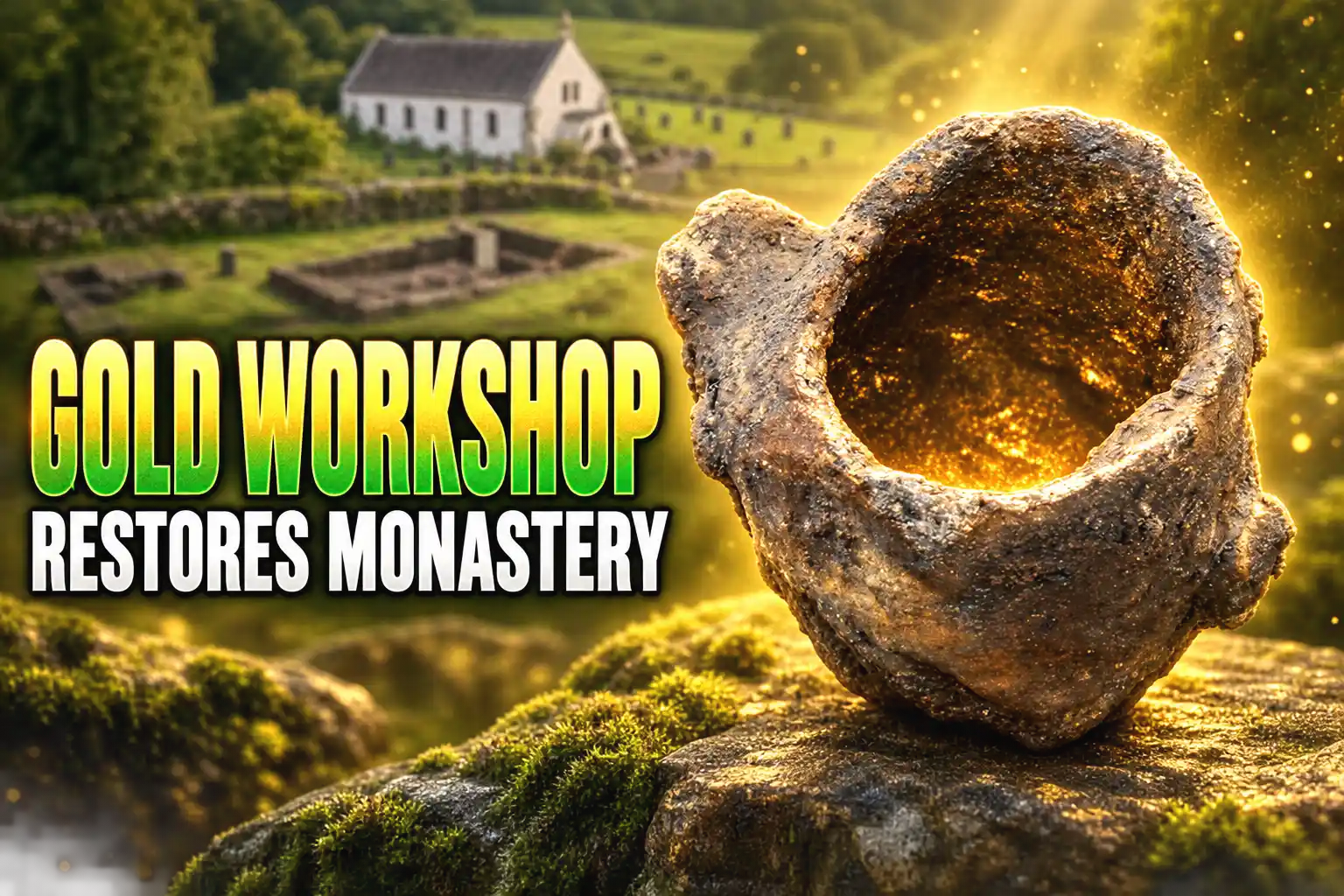
Inside they found little: handmade pottery, struck flint, cut antler, a possible metal punch and a crucible sherd. Immediately east, charcoal-rich dumps produced the industry. The team recovered more than 1,000 fragments of non-ferrous metalworking debris from that trench alone, among them handled crucibles, crucible lids and clay moulds. Carbon dates put those craft layers in the seventh to ninth centuries. Deposits tied to the oval house itself run later, in the eighth to tenth centuries. The doorway had been narrowed, perhaps so the building could hold stock.
X-ray fluorescence showed copper alloys as the main metals. A small number of crucibles carried high levels of silver and gold, rare evidence that precious metal was being cast. That reading also gives a new setting to an early medieval touchstone for testing gold, found on Lismore in the nineteenth century and now held by National Museums Scotland. Gemma Cruickshanks, a metallurgy specialist at the museum, told islanders the crucibles rank among the best of the period found in Scotland.
Gordon Noble told interviewers the collection is “one of the largest metalworking assemblages we have from any site, secular or sacred, in this time period.” The paper is more local and more precise. After Dunadd, the royal fort of Dál Riata, it is the largest assemblage of non-ferrous moulds and crucibles yet found in Scotland. They set the results out in an open-access Antiquity excavation report that moves Lios Mòr from tradition into the small set of dug early churches in Scotland.
HOW LISMORE SITS AMONG THE KNOWN WORKSHOPS
| Site | Role | Metalworking on the record |
|---|---|---|
| Lios Mòr, Lismore | Island monastery | More than 1,000 non-ferrous fragments in T11; gold and silver in a small number of crucibles |
| Dunadd, Argyll | Dál Riata power centre | The only larger mould and crucible assemblage in Scotland |
| Iona | Columba’s monastery | Small numbers of moulds for glass studs, rings and rods |
| Portmahomack, Easter Ross | Monastery | Eighth-century work in metal and glass, including church fittings |
Moulds from T11 show at least two types of penannular brooch, plus rectangular objects that may have been buckles. The point is not that monks ran a mint. It is that a church on a small island was commissioning, or hosting, the same class of jewellery work found at royal centres.
WHAT THE TRENCH 11 HAUL INCLUDES
- Brooch moulds: Clay pieces used to cast at least two forms of penannular brooch, the status fastener of the Irish Sea world.
- Motif pieces: Two fragments of long bone with chip-carved interlace so fine that the authors know no match of that quality in Scotland, and only a few in Ireland.
- Yew work: Hoops from stave-built vessels, the corner of a possible yew box, and offcuts, a craft early Irish law texts treat as high-status.
- A large whetstone: Big enough, the team says, for swords or sickles, found with pumice that could finish hide, wood or bone.
Eight worked bone and antler objects came from the same dumps. Waterlogging saved wood, horn and antler that usually rot. The workshop sat, as far as the trenches can tell, inside the monastic enclosure, though the authors note that brooches can also mean a secular hand in the mix.
The Graves Stop Short of the Founder’s Century
Burial is what makes a monastery feel like a monastery, and the graves are early, but they are not sixth-century. Human bone turned up in the 1980s when a church house went up south-east of the parish church. In 2018, trench T5 confirmed a forgotten lower cemetery that appears on an eighteenth-century plan of the glebe. A clay-bonded limestone wall enclosed it. At least six intact burials lay on an east-west line, mostly adults, with much intercutting. Carbon dates run from cal AD 650 to 780 at the early end to cal AD 900 to 1040 at the late end. A cross-slab fragment came out of the same trench.
In 2021, trench T10 opened around the Sanctuary Stone, a broken granite cross south of the church house. Upper layers were full of mixed bone and later medieval objects. Lower down, the team found infants, adolescents and adults. First inspection found every adult skeleton in that patch to be male, with worn joints. A few of the younger dead showed infection or metabolic disease. Two pairs of infants appear to have been placed in single grave cuts; the lower legs of one child lay over the head of the other. One femur from a mixed deposit carried a sharp cut that may have come from a sword or axe. Trench T12, north of the church house and also walled in limestone, produced a third decorated cross-slab.
None of those dates reach the lifetime of Mo Luóc. The authors still think the parish church stands on his site. They have not found the early church. The driest ground, they write, is to the west under the working graveyard, which has not been dug.
FROM LEGEND TO OPEN TRENCHES
- Around 563: Columba founds Iona, the house that would write the conversion story for the west.
- 592, mapped to 593 or 594: Irish annals record the death of Lugaid of Les Mór, the man later called Mo Luóc.
- Late thirteenth century: A cathedral goes up at Clachan; its chancel still forms part of the parish church.
- 2016: The Lismore Historical Society starts the search.
- 2018: Trench T5 confirms the lower cemetery.
- 2019: Trench T11 hits the oval house and the metalworking dumps.
- 2021: Trench T10 opens around the Sanctuary Stone.
- 9 May 2026: A packed island hall hears that gold particles sit on a crucible surface.
- 1 October 2026: Antiquity publishes the paper.
Three newly found cross-slab fragments carry ornament not previously recorded in early medieval Scotland, alongside key patterns that specialists link to Applecross, Nigg and Rosemarkie. The stone assemblage is still modest next to Iona. The cemetery, though, is no family plot.
Why Columba’s Island Wrote the Story
Mo Luóc was Lugaid, an Irish missionary whose pet name means “my little Lu(g).” Genealogies in manuscripts after 1100 place him among the Dál nAraide of north-east Ulster. A twelfth-century source credits him with founding no fewer than 100 monasteries, a figure that reads as later praise rather than a headcount. Irish chronicles also name later abbots, Neman around 614 and Eochaid around 635 to 637, though a Lismore Abbey in County Waterford muddies which house some of those men belonged to.
Irish chronicles preserve a blunt line, the Death of Lugaid of Les Mór, under the Annals of Ulster entry U592.1. The excavation team notes that that annal corresponds to 593 or 594. Columba’s Iona, founded around 563, sits only a short sail to the south-west. One saint got a Life. The other did not.
Hay has been blunt about that gap. Adomnán’s Life of Columba, written on Iona around the end of the seventh century, carried one founder through every later textbook. Moluag left no surviving biography of that weight, and a Life that may have existed in the twelfth century is lost.
I think Moluag had a very big impact on the evangelising of Scotland, but unfortunately, he didn’t get his PR right.
Robert Hay, independent researcher and volunteer organiser
Local tradition still tells a boat race for Lismore, in which Moluag cut off a finger, threw it ashore, and claimed the island by flesh and blood while Columba had to settle for smaller Iona. Folklorists have long heard in that tale the later Red Hand of Ulster. It is a story about who deserved the green island, not a field report. The dirt now supplies a colder kind of claim: in the seventh to ninth centuries, Moluag’s house was melting metal and cutting interlace while Iona’s fame was already hardening into literature.
Dedications still mark Moluag’s trail from Lismore into Pictland, at Mortlach in Banffshire, a precursor to Aberdeen as a bishop’s see, and at Rosemarkie on the Black Isle, where the Aberdeen Breviary says he was buried. His name sits on churches from Lewis to Tiree. By the early eleventh century it had been copied into martyrologies used by Gaels at Metz and Regensburg.
Lismore Sat at the Mouth of the Great Glen
Lios Mòr means the big enclosure. The name is odd in Scotland, where lios more often marks a secular court than a church, and A. D. S. MacDonald argued in 1974 that the hollow at Clachan may already have been a gathering place before the monks arrived. The monastery later gave its name to the whole island.
Location did the rest. Loch Linnhe opens the Great Glen, the long cut that runs across the Highlands. To the south of the island stands Dunollie, a nucleated fort named five times in the Annals of Ulster between 685 and 734, more often than almost any other western stronghold of the period. The paper maps agricultural potential across Dál Riata and finds the strip around Lismore and Dunollie among the richest in Argyll. In 1845 the Reverend Gregor McGregor, writing in the New Statistical Account, called Lismore “like a garden in a desert” and said no district in Argyll reared cattle better, because the grass was that good.
Iona is a smaller, poorer island with a better library. Lismore had soil, fish, a choke point on the sea road, and a fort across the water that chroniclers could not stop mentioning. A church in that seat did not need to win a poetry contest to matter.
The Kindred Iona’s Biographer Left Out
By the early eighth century Lismore sat in the territory of Cenél Loairn, one of the kindreds fighting for the over-kingship of Dál Riata. That group often held the top job between 690 and 740. Iona, the authors note, leaned toward the rival kindred Cenél nGabráin. Adomnán’s Life of Columba is conspicuously quiet about Cenél Loairn.
That silence has been treated as geography. It looks more like editing. If the surviving books emphasise Iona, other churches in the same sea-kingdom drop out of the story even when they sat on better land beside a chronicle-famous fort. The paper does not claim Lismore dethroned Iona. It argues that early Christian Argyll was a contest with more than one house, and that archaeology can recover the house the books skipped.
Noble’s press line stays inside that caution. For centuries, he said, Lismore’s early monastery was known mainly from written records and local tradition. “We can now see that it was a thriving centre of worship, craftsmanship and learning, whose importance may have rivalled some of the best-known monasteries in early medieval Britain.” The verb is may. The metal is not.
Later history followed the dirt more closely than the Life did. Lismore became the seat of the medieval bishops of Argyll. The cathedral of the late 1200s did not land on a random green field. It landed on a hollow that had already been burying people and casting brooches for hundreds of years.
Gold Particles on a Crucible and No Vallum Yet
On 9 May 2026 every seat was taken in the island hall for a ten-year briefing. Ellis reviewed the trenches. Dr Carly McNamara of the University of Glasgow walked through the new cross-slabs. Cruickshanks put up an image of gold particles on a Lismore crucible, a detail the room had not seen. Noble and Dr Adrian Maldonado, then curator of the Galloway Hoard at National Museums Scotland, set the finds beside Iona and other houses. Finds from the glebe were already on show at the Lismore Gaelic Heritage Centre: carved stone, crucibles, moulds, slag, and those bone motif pieces.
The classic curved Irish vallum, a bank and ditch that marks the holy precinct, has been hard to trace. MacDonald guessed it in today’s field boundaries. Resistivity and gradiometry picked up possible lines, but trenches on those boundaries found a turf bank, a pebble path and limestone cobbles with no secure date. On Lismore the bedrock is shallow. A wall or a turf bank without a ditch may have done the job, or the line may simply run elsewhere. An Aberdeen team flew drones and ran fresh geophysics in the days before the May meeting. The October paper still treats the enclosure as unfinished business. Size of vallum, at other sites, tends to track the rank of the church. Until that line is drawn, “major” remains a well-supported inference rather than a measured plan.
WHAT WE KNOW
- The workshop: More than 1,000 non-ferrous fragments from T11 include moulds for brooches and crucibles with gold and silver traces, dated to the seventh to ninth centuries.
- The cemetery: Walled burial grounds around the later church hold early medieval graves from cal AD 650 to 1040, with new cross-slab fragments in three trenches.
- The politics: Lismore sat at the heart of Cenél Loairn territory beside Dunollie, while Iona’s surviving texts lean toward a rival kindred.
WHAT IS UNCONFIRMED
- The sixth-century church: Direct evidence from Mo Luóc’s own lifetime has not been found; the authors still think it lies under the parish graveyard.
- The vallum: Field boundaries and geophysics suggest an enclosure, but trenches have not dated it.
- The upper cemetery: Ground around the parish church itself has yet to be opened and is likely to hold more early burials.
Writing of the paper was backed by a Leverhulme Trust Research Leadership Award. Dig money came from the Lismore Gaelic Heritage Centre (a bequest of Hugh MacPherson), the Society of Antiquaries of Scotland, the historical society, the MacDougall McCallum Foundation in the United States, the Hunter Trust, the MacDougall Clan Society of America, and individual donors. Full study of the waterlogged wood is still in train, as is a specialist account of the carved stone.
The sixth-century church is still the blank. Ellis’s team thinks it most likely lies on the drier ground to the west, under the parish graveyard that has not yet been opened.

Ken Urker Died on His Birthday With No Cause Named

FOX Ices Portnoy After Ohio State’s Access Fight

Micron’s Record Memory Profits Lock RAM Tight Through 2028

Sia Sells Half Her Catalog and Keeps the Face

The 7.28% Mortgage Rate Traps Owners and Feeds ARMs

Musk’s $914 Billion Lead Is a Public SpaceX Bet

Microsoft’s 96% Cyber Score Sits at 86.3% on the Board

Free Live Sports Streaming in 2026: What to Watch Without Cable

Sterling Point Holds No. 2 on Prime Video After 32 Days

Endgame Encore’s $86 Million Trial for Infinity Vision
-
 BUSINESS4 months ago
Musk’s $914 Billion Lead Is a Public SpaceX Bet
-
 NEWS2 months ago
Microsoft’s 96% Cyber Score Sits at 86.3% on the Board
-
 SPORTS3 months ago
Free Live Sports Streaming in 2026: What to Watch Without Cable
-
 ENTERTAINMENT4 weeks ago
Sterling Point Holds No. 2 on Prime Video After 32 Days
-

 ENTERTAINMENT3 months ago
The Odyssey’s IMAX Film Run Hit a 41-Theater Limit
-

 NEWS3 months ago
Pixel 10’s Amazon Cut Now Sits Beside Pixel 11
-
 ENTERTAINMENT3 months ago
Endgame Encore’s $86 Million Trial for Infinity Vision
-

 ENTERTAINMENT2 years ago
Andrew Garfield’s Spider-Man Films Are No Longer Free