
BUSINESS
Sri Lanka Closed Its Inclusion Plan With Literacy Still Short
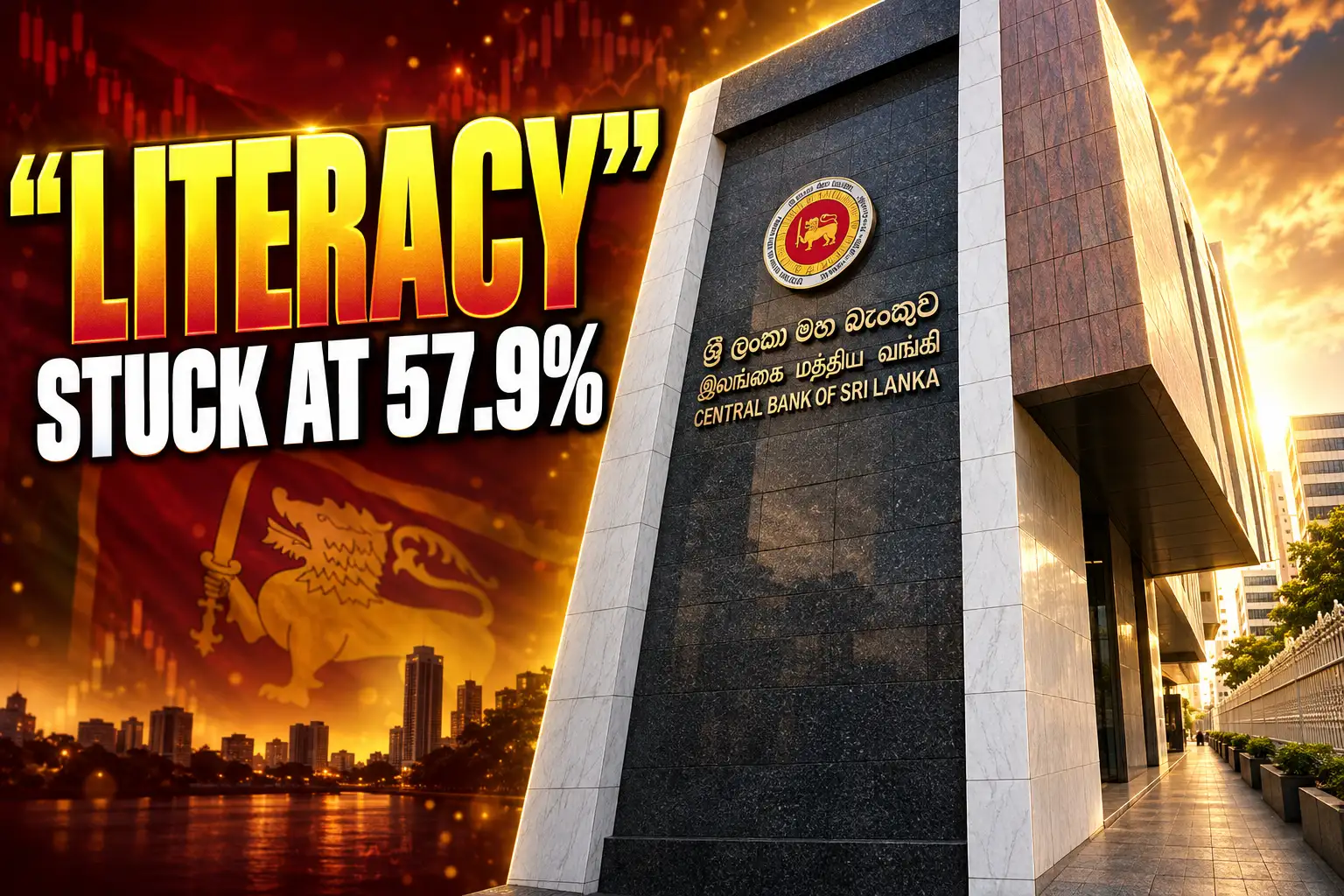
Sri Lanka’s inclusion strategy closed at over 80% complete, yet the 2025 literacy curriculum still teaches to a 57.9% score last measured in 2021.

Sri Lanka’s first national financial inclusion plan closed with over 80% of its action list done, and with the only nationwide literacy score still stuck at 57.9%. Account ownership was already 89% of adults in the 2021 Global Findex, a figure the Central Bank of Sri Lanka cited in its own literacy study. The leftover problem was never the passbook. It was whether people could use, trust, and keep those accounts without being fleeced.
On 3 July 2025 the Bank launched the country’s first national Financial Literacy Curriculum, seven chapters in all three official languages, under a 2024 to 2028 Roadmap. Phase II of the National Financial Inclusion Strategy is still being written in 2026 from a fresh household survey whose results are not yet public.
Phase I Closed With an 80% Action Plan and a 2021 Survey
The National Financial Inclusion Strategy of 2021 to 2024 was Sri Lanka’s first coordinated attempt to treat inclusion as more than branch density. The Central Bank of Sri Lanka Act, No. 16 of 2023, which took effect on 15 September 2023, then made financial inclusion a statutory duty of the Bank. In its 2024 Financial Statements and Operations report, the Bank said Phase I finished with over 80% of the action plan complete, tracked every quarter with more than 20 implementing bodies.
That score measures tasks ticked, not whether households budget, save, or refuse a pyramid scheme. The strategy’s own literacy KPI was a 2021 baseline that was never replaced during the four-year term. Phase II was billed for 2026. A five-year Financial Literacy Roadmap went out on 21 May 2024 with more than 40 national stakeholders, which is how the Bank tried to keep the literacy pillar alive after the first strategy’s calendar ran out.
THE DOCUMENT CHAIN
- March 2021: National Financial Inclusion Strategy of 2021 to 2024 launches with pillars on digital finance, MSME finance, consumer protection, and literacy.
- July to December 2021: Nielsen IQ fields the first countrywide literacy survey for the Bank and the International Finance Corporation, 4,800 adults in 480 Grama Niladhari divisions.
- 21 May 2024: Financial Literacy Roadmap of 2024 to 2028 launches as the literacy pillar’s next map.
- 8 August 2024: Financial Consumer Protection Regulations No. 01 of 2023 enter full force, with market-conduct exams attached.
- 3 July 2025: First national Financial Literacy Curriculum, a Certified Trainer programme, and two video series launch together.
- March 2026: Nationwide Financial Inclusion Survey begins, again across 480 Grama Niladhari divisions, to feed Phase II.
In 2024 the Bank’s six regional offices, in Matara, Anuradhapura, Matale, Kilinochchi, Trincomalee, and Nuwara Eliya, ran 404 literacy programmes and 116 awareness programmes. Regional forums in Jaffna and Batticaloa put the Governor in the room with banks, local officials, and MSMEs. The machine was busy. The yardstick was old.
What the 2021 Literacy Numbers Still Show
The first countrywide Financial Literacy Survey is still the only national score on the books. A person counted as literate if they got at least three of four concepts right: numeracy, compound interest, inflation, and risk diversification. On that cut, 57.9% of adults passed, up 23 percentage points from the 35% Standard & Poor’s Global Financial Literacy Survey recorded in 2014.
Men cleared 61.1% and women 55.2%, a 5.9 point gap the survey flagged even though school attainment is close to even. Compound interest was widely understood, at 90.5%. Risk diversification was not. Only 33.3% of adults answered that item correctly, 30.8% of women and 36.3% of men. Just over half of adults handled inflation as a change in the real value of money.
The broader OECD-style score, knowledge plus attitude plus behavior, is harsher. Knowledge averaged 5.03 out of 7, just over the target of 5. Attitude averaged 2.65 out of 5 against a target of 3. Behavior averaged 4.44 out of 9 against a target of 6. The composite was 12.12 out of 21 against a target of 14. Knowledge was adequate. The shortfall sat in how people actually handle money.
OVERALL LITERACY SCORES BY GROUP
| Group | Overall score (out of 21) | Gap versus 12.12 national average |
|---|---|---|
| Digital-tool users | 13.04 | +0.92 |
| Non-users of digital tools | 10.98 | -1.14 |
| Ages 18 to 29 | 12.81 | +0.69 |
| Ages 60 and above | 11.04 | -1.08 |
| Graduate and postgraduate | 14.99 | +2.87 |
| No schooling | 9.54 | -2.58 |
| Men | 12.30 | +0.18 |
| Women | 11.97 | -0.15 |
| Urban | 12.18 | +0.06 |
| Rural | 12.10 | -0.02 |
Rural adults, 81.89% of the sample, sat almost on the national mean. The split that matters is digital use, age, and schooling, not the village line. People who already used cards, internet or mobile banking, QR, or mobile money scored 13.04. People who did not scored 10.98. Literacy and digital use travel together, which is why a curriculum that never reaches non-users will miss the group that needs it most.
The First National Curriculum Puts Digital Risk in the Syllabus
Governor Nandalal Weerasinghe used the 3 July 2025 launch to say the quiet part of the 2021 scores out loud. Knowledge was not the binding constraint. Over-indebtedness, weak budgeting, thin savings, and fraud were.
Knowledge alone is insufficient. We must also cultivate the skills and attitudes that empower Sri Lankans to make prudent, informed, and rational financial decisions.
Nandalal Weerasinghe, Governor, Central Bank of Sri Lanka, 3 July 2025 launch
The syllabus is built as seven essential domains of the curriculum, written with the University of Kelaniya and paid for in part by UNDP, with JICA backing the videos. It is posted in Sinhala, Tamil, and English for schools, vocational centres, public agencies, and bank trainers.
WHAT THE SEVEN CHAPTERS COVER
- Economic Environment: Inflation, interest rates, and economic cycles in plain language.
- Financial Environment: Banks, other financial firms, and markets as they sit in daily life.
- Personal Financial Management: Budgeting, saving, debt, insurance, retirement, and emergency cash.
- Financial Management for MSMEs: Bookkeeping, cash flow, planning, and how small firms get credit.
- Digital Financial Literacy: Mobile banking, wallets, online payments, and staying safe on those rails.
- Financial Consumer Protection: Rights, scams, complaints, and where to take a dispute.
- Tax Literacy: Personal and business tax, including income tax and VAT.
Two video series, funded by UNDP and JICA, target the same wounds: over-indebtedness, impulse spending, saving, illegal deposit-taking, and pyramid scams. The Certified Trainer in Financial Literacy programme, built with the Institute of Bankers of Sri Lanka, aims to certify 100 trainers a year, with weight on public servants and bank staff outside Colombo.
𝐂𝐞𝐧𝐭𝐫𝐚𝐥 𝐁𝐚𝐧𝐤 𝐨𝐟 𝐒𝐫𝐢 𝐋𝐚𝐧𝐤𝐚 𝐚𝐭 𝐭𝐡𝐞 𝐡𝐞𝐥𝐦 𝐨𝐟 𝐃𝐫𝐢𝐯𝐢𝐧𝐠 𝐅𝐢𝐧𝐚𝐧𝐜𝐢𝐚𝐥 𝐋𝐢𝐭𝐞𝐫𝐚𝐜𝐲 𝐟𝐨𝐫 𝐚 𝐑𝐞𝐬𝐢𝐥𝐢𝐞𝐧𝐭 𝐒𝐫𝐢 𝐋𝐚𝐧𝐤𝐚
On 3rd July 2025, the Central Bank of Sri Lanka launched several key initiatives under the… pic.twitter.com/3osjgxnIjf
— CBSL (@CBSL) July 4, 2025
Consumer protection is no longer only a chapter in a booklet. The 2023 regulations gave the Bank market-conduct powers, and full enforcement started on 8 August 2024. Supervisors have since run full-scope exams of licensed banks and finance companies and thematic reviews of digital products, credit cards, loan pricing, and early settlement. A trilingual contact centre takes complaints, which in 2024 clustered around requests for loan concessions and high interest charges.
Digital Rails Grew Faster Than the Habit of Using Them
Sri Lanka was already well banked when the first strategy began. The 2021 Findex put account ownership at 89%, and branch density was 16.4 per 100,000 adults, nearly double the South Asian average of 9.4. The 2018 national inclusion survey found 48% of borrowers still going to semi-formal or informal lenders. Access was not the scarce resource. Use was.
WHERE OWNERSHIP AND USE PART COMPANY
- Accounts in 2021: 89% of adults, per Global Findex Database country-level data cited in the Bank’s literacy report.
- Women’s accounts in 2024: 80.2% of women aged 15 and over held an account at a financial institution or mobile-money provider.
- Digital payments in 2024: 42% of women and 54% of men had made digital payments.
- Formal saving among women in 2024: 21.4% saved at a bank, similar institution, or mobile-money account; 10% did so monthly; 35.3% saved no money at all.
Mobile access still leans male: 70% of women and 80% of men in 2024, with smartphone use almost even at 43% and 45%. In the 2021 literacy field work, 34.47% agreed and 22.11% completely agreed that digital payments are safe and efficient, 56.58% in all. Comfort and daily use are different things. South Asia is the region where account owners are least likely to send or receive a digital payment, and Sri Lanka’s own gender gap on that measure sits near 13 points among people who already have accounts.
That is the same usage problem that leaves digital banking still misses true inclusion in districts where the app exists and the habit does not. A second drag has shown up in the cost of staying on those rails. Digital channels cut a bank’s branch load, yet annual app fees, transfer charges, and debit-card costs can wipe out the 2% to 3% interest on a small savings balance, especially once a 10% withholding tax comes off the interest. For a household living paycheque to paycheque, the “included” account becomes a bill. That fights the cash-lite goal the Roadmap is trying to teach.
A Hundred Trainers a Year and a Northern Test
One hundred new CTFL trainers a year is a thin sheet over an island of about 22 million people. The Bank is therefore stacking other pipes: regional offices, school uptake of the curriculum, bank staff, and donor-funded campaigns. On 16 June 2026 UNDP Resident Representative Azusa Kubota signed a second-phase memorandum with the Central Bank after two years on the Roadmap. The new work covers a national advocacy campaign, digital payments in selected communities, and a Financial Inclusion Research and Education Network with the University of Kelaniya.
@UNDPSriLanka signed an MOU with @CentralBankSL, after two years of collaboration in advancing Sri Lanka’s National Financial Literacy Roadmap.
Under the broader National Financial Inclusion Strategy, we will work together on a nationwide advocacy and communications campaign, to… pic.twitter.com/rTYE0TJZTn
— Azusa Kubota Tachiiri (@AzusaKubota) June 16, 2026
Kubota said a Northern Province pilot, run when literacy was folded into local economic programmes, moved people from classroom to counter. Of the supported beneficiaries, 21% approached a bank for the first time, and 55% of that group obtained a loan for the first time. That is a small, named result, and it is the sort of figure Phase I never published at national scale.
Australia’s High Commission in Colombo said on 9 April 2026 that the Skills for Inclusive Economy programme is turning MSME learning modules into mobile-first, trilingual material with the Bank. In September 2026 UNDP added a Visa-backed effort aimed at women and youth on estate estates, starting at Hope Estate in Nuwara Eliya. On 13 August 2026 a joint agricultural-credit and literacy session ran in Monaragala with the Bank. The map of activity is wide. The map of measured behavior change is still the 2021 tables, plus one Northern pilot.
Phase II Is Being Drafted From a 2026 Household Survey
On 19 and 20 November 2025 the Bank ran an internal workshop to shape NFIS 2.0, with staff, financial institutions, and Indian advisers from FinValue Advisors. Chatura Ariyadasa, Director of Regional Development, said the next plan should speed inclusion with stronger consumer protection and hold the line for women, MSMEs, and youth. Inclusive green finance is on the agenda because of climate risk. That is not a published strategy.
The Department of Financial Inclusion posted a public notice on 12 March 2026. Kantar Lanka will field a nationwide Financial Inclusion Survey across 480 Grama Niladhari divisions in every district, the same primary-unit count as the 2021 literacy sample. The brief is awareness, usage, and barriers, so that Phase II has demand-side numbers the first strategy never refreshed.
WHAT WE KNOW
- Phase I score: Over 80% of the 2021 to 2024 action plan was completed, on the Bank’s own count.
- Literacy baseline: 57.9% of adults met the three-of-four-concepts test in 2021; the composite score was 12.12 against a target of 14.
- Curriculum: Seven chapters, three languages, live from 3 July 2025, with 100 CTFL trainers planned each year.
WHAT IS UNCONFIRMED
- Phase II text: No final strategy document has been issued.
- 2026 survey results: Field work was launched in March 2026; findings are not public.
- National behavior change since 2021: No second literacy survey has been released, even though the Roadmap listed one as an impact check.
The 2026 teams are walking a sample frame that matches the 2021 literacy survey’s 480 divisions. Until those results are out, the new curriculum is teaching to a test the country has not sat again, and Phase II is being sketched in the dark that the first strategy promised to light.

Saquon Barkley’s Hamstring Leaves the Eagles Thin in London

The Online US Passport Still Needs a Witnessed Oath

Ken Urker Died on His Birthday With No Cause Named

FOX Ices Portnoy After Ohio State’s Access Fight

Micron’s Record Memory Profits Lock RAM Tight Through 2028

Musk’s $914 Billion Lead Is a Public SpaceX Bet

Microsoft’s 96% Cyber Score Sits at 86.3% on the Board

Free Live Sports Streaming in 2026: What to Watch Without Cable

Endgame Encore’s $86 Million Trial for Infinity Vision

The Odyssey’s IMAX Film Run Hit a 41-Theater Limit
-
 BUSINESS4 months ago
Musk’s $914 Billion Lead Is a Public SpaceX Bet
-
 NEWS2 months ago
Microsoft’s 96% Cyber Score Sits at 86.3% on the Board
-
 SPORTS3 months ago
Free Live Sports Streaming in 2026: What to Watch Without Cable
-

 ENTERTAINMENT4 weeks ago
Sterling Point Holds No. 2 on Prime Video After 32 Days
-
 ENTERTAINMENT3 months ago
The Odyssey’s IMAX Film Run Hit a 41-Theater Limit
-
 ENTERTAINMENT3 months ago
Endgame Encore’s $86 Million Trial for Infinity Vision
-

 ENTERTAINMENT2 years ago
Andrew Garfield’s Spider-Man Films Are No Longer Free
-

 NEWS4 weeks ago
G20 Cheers AI Investment After Bailey’s Frontier Cyber Warning