
NEWS
Kosovo’s Third Winter Games Ended Without a Finish
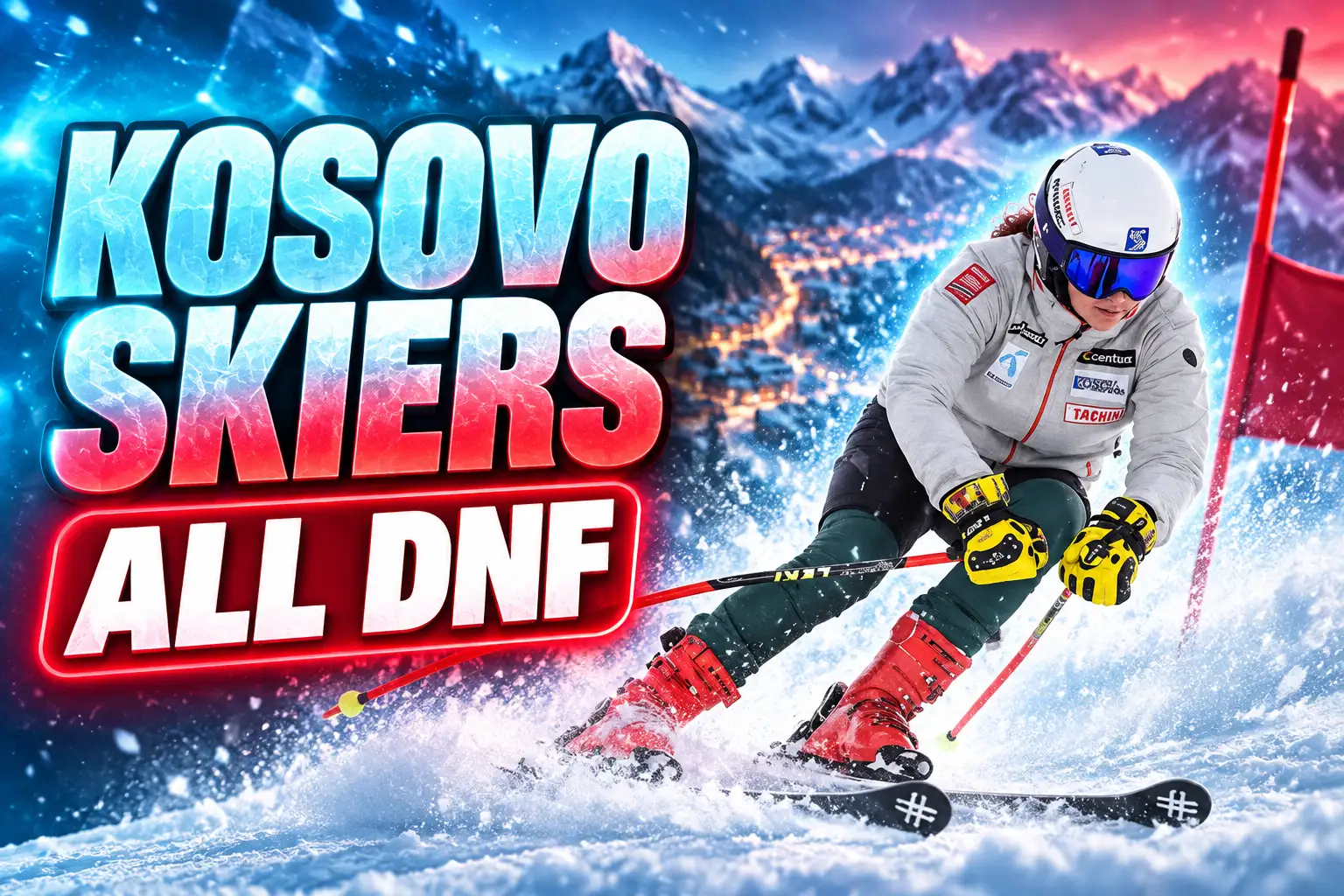
Kiana Kryeziu and Drin Kokaj started four alpine races at Milano Cortina 2026 and finished none, after Kosovo cut two other qualifiers and went silent.

Kiana Kryeziu and Drin Kokaj started four alpine races at the Milano Cortina 2026 Winter Olympics and finished none of them. Kosovo’s third Winter Games closed on 22 February 2026 with zero finishes, after a January send-off that had called this the best-prepared ski group the country had ever put on snow.
Kryeziu, 21, went off course in the women’s super-G, giant slalom and slalom. Kokaj, 22, did not finish his Olympic debut in the men’s slalom. The Kosovo Ski Federation posted about her first start, then went quiet.
Four Starts, Four DNFs
The International Ski Federation recorded the same outcome on each of Kosovo’s four race days in Cortina d’Ampezzo. Kryeziu did not finish any Cortina run, skiing out of the super-G on 12 February and out of run one in both the giant slalom on 15 February and the slalom on 18 February. Kokaj’s only start, the men’s slalom on 16 February, ended the same way.
KOSOVO AT CORTINA, RACE BY RACE
| Athlete | Event | Date | Result |
|---|---|---|---|
| Kiana Kryeziu | Women’s super-G | 12 February 2026 | DNF |
| Kiana Kryeziu | Women’s giant slalom | 15 February 2026 | DNF, run 1 |
| Drin Kokaj | Men’s slalom | 16 February 2026 | DNF |
| Kiana Kryeziu | Women’s slalom | 18 February 2026 | DNF, run 1 |
A DNF is not rare in Olympic slalom, where one missed gate ends the day, and Kryeziu had already failed to finish World Championship slaloms in 2023 and 2025. The new part was the clean sweep. She had completed an Olympic giant slalom in Beijing, and the man who built Kosovo’s winter file had completed every start he took.
Her last race before Italy did not offer much cover. On 18 January 2026 in Jahorina, Bosnia and Herzegovina, FIS logged a disqualification and a DNF in two slaloms, a week before the Olympic Committee named the team.
Kelmendi Called Them the Best Prepared Team Yet
On 19 January 2026 the Olympic Committee of Kosovo named Kryeziu and Kokaj. Nine days later it presented the two-skier Olympic team in Pristina, with selector Agim Pupovci, Kryeziu’s coach Visar Kryeziu, and chef de mission Jeton Rudari. Ismet Krasniqi, the committee president, said Kosovo would be on course for four days and pointed to Olympic scholarships and training camps “which we know are not easy at all.”
Milaim Kelmendi, who heads the Ski Federation and sits as a committee vice president, went further than a polite send-off.
Never in the history of Kosovo skiing have athletes been as prepared as they are now going to the Cortina Olympics. So I wish great success to the competitors first of all, and I expect better results than in previous editions.
Milaim Kelmendi, president, Kosovo Ski Federation
Kryeziu, who races for Club Prishtina, treated Cortina as a step up from one Beijing start. “I was 17 in Beijing, where I competed in only one discipline, the Giant Slalom,” she said. “Now, after four years, a lot of work and dedication, I have enabled myself to compete in three disciplines. I expect good results from myself, a much better performance than last time.” Kokaj, from PriSki, said the FIS bar was tighter than in earlier cycles and that he had cleared it.
President Vjosa Osmani handed them the flag on 28 January. Both carried it into the opening ceremony on 6 February at Piazza Dibona in Cortina d’Ampezzo. Kokaj carried it again at the close. Osmani wrote that they competed “with the pride and support of an entire country.”
Proud to see our fantastic skiers carry Kosovo’s flag at the Opening Ceremony of the @milanocortina26 Winter Olympics 2026!
Wishing Kiana Kryeziu and Drin Kokaj strength and success in the days ahead. They compete with the pride and support of an entire country. 🇽🇰
📸 Getty… pic.twitter.com/W0ocLKjkrT
— Vjosa Osmani (@VjosaOsmaniPRKS) February 7, 2026
That was the peak of public talk. After the gates started falling, the conversation shrank to a handful of start-house notes, then almost nothing.
The Two Skiers Who Stayed Home
Kosovo did not have a two-skier talent pool. It had four athletes over the Olympic line and a rule that kept two of them in street clothes. Kelmendi said in mid-January that Drin Kokaj, Klos Vokshi, Kiana Kryeziu and Lirika Deva had all met the criteria, and that the International Ski Federation would lock the points list on 18 January.
The committee applied the basic alpine quota, one competitor per gender. Kryeziu was picked because she had the standard in slalom, giant slalom and super-G. Kokaj was picked because his slalom points were lower than Vokshi’s, which in FIS terms is the better score.
THE FOUR WHO CLEARED THE LINE
- Kiana Kryeziu: Standard in slalom, giant slalom and super-G; selected for three Olympic starts.
- Drin Kokaj: Standard in slalom; selected after beating Vokshi on slalom points.
- Lirika Deva: Standard in slalom and giant slalom; left home after the one-woman cap.
- Klos Vokshi: Standard in giant slalom; left home after Kokaj’s slalom points.
Deva already had Youth Olympic finishes on her file, 27th in slalom and 31st in giant slalom at the 2024 Winter Youth Games, while Vokshi did not finish that giant slalom. Kokaj’s own Youth Olympic trip, Lausanne 2020, ended in disqualifications in both slalom and giant slalom. The January choice was a points decision, not a mystery, and it still left two qualified skiers watching a Games that then produced no times at all.
Kelmendi had set a modest bar in that same interview, saying a place around 40th would count as a success “based on our infrastructure.” Cortina never got far enough for a placing to appear.
Tahiri Used to Finish
The winter file Kosovo took to Italy was supposed to look like growth. In 2018, Kosovo’s first Winter Olympian, Albin Tahiri, started five men’s alpine events in PyeongChang and completed all five, with a best of 37th in the combined. In Beijing he finished four more, including a 15th in the combined that remains the country’s best Winter result, plus 30th in giant slalom, 35th in downhill and 37th in slalom. Kryeziu, then 17, became the first Kosovan woman at a Winter Games and placed 49th in the Beijing giant slalom in 2:42.19.
THREE GAMES, ONE SPORT
| Games | Athletes | Starts | Finishes | Best result |
|---|---|---|---|---|
| 2018 PyeongChang | 1 (Tahiri) | 5 | 5 | 37th, combined |
| 2022 Beijing | 2 (Tahiri, Kryeziu) | 5 | 5 | 15th, combined |
| 2026 Milano Cortina | 2 (Kokaj, Kryeziu) | 4 | 0 | None |
Tahiri was not on the 2026 team. The next generation arrived with more events on Kryeziu’s start list and a debutant in slalom, and left without a time. Kokaj’s senior championship record had already pointed to a hard ceiling: 80th in giant slalom at the 2023 World Championships, 66th in 2025 in Saalbach, with slalom DNFs at both.
Small Winter Olympic teams are common under the alpine basic quota, and Kosovo’s two-skier party stood in the same Games as Haiti’s Winter Olympians at Milano Cortina. The comparison that hurts is internal. From 2018 to 2022 every Kosovan Olympic alpine start produced a result. In 2026 none did.
The Money Came From Lausanne, the Snow Did Not
Both Cortina skiers are listed as Olympic Scholarship athletes. In 2023 and 2024 the Olympic Committee of Kosovo said five alpine skiers would receive $600 a month (553 euros) from the International Olympic Committee’s Olympic Solidarity fund: Arbi Pupovci, Kiana Kryeziu, Lirika Deva, Drin Kokaj and Klos Vokshi. The stipend was the pipeline. The snow was not.
WHAT FUNDED THE TRIP
- The stipend: $600 a month each, paid through Olympic Solidarity, for five named skiers.
- The quota: One man and one woman under the alpine basic quota, even after four skiers met the standard.
- The home slope: Kelmendi said conditions in Kosovo “do not exist at all” for preparation.
- The ask: Krasniqi and Kelmendi told the government to invest in the ski centre at Brezovica so athletes could train in the country.
Kokaj’s FIS calendar shows where the points actually came from: Entry League and FIS slaloms in places such as Bansko, Kolašin and, in April 2025, indoor races at Ski Dubai. Kryeziu’s winter before Cortina ran through Italian junior and FIS events, then Jahorina. The flag was Kosovan. The racing life was a circuit of other people’s hills.
Kelmendi said that out-of-country camps had produced the best preparation the sport had seen, “despite the fact that conditions in Kosovo do not exist at all for preparation.” He still asked Pristina to put money into Brezovica. Cortina did not change that ledger. It only made the gap visible on the biggest start list the two skiers will see until 2030.
Kosovo’s Judo Coach Asked Who Owns the Result
On 27 February 2026, five days after the Closing Ceremony, Driton Kuka went after the silence. Kuka is the judo coach behind Kosovo’s five Summer Olympic medals, all of them in that sport, a haul the Olympic Committee still lists as three golds, one silver and one bronze. The Ski Federation, he noted, had announced Kryeziu’s first Cortina start on 12 February and then published nothing more about the main event of its year.
The Olympic Committee posted about two of Kryeziu’s races and Kokaj’s slalom, then skipped her third DNF, so the last image on file was not the last race. Kuka wrote that hiding results had become a habit.
We should never hide the results of athletes, especially in serious competitions, under the carpet. Something like this has become a practice in our sport. Someone should be responsible for the results of our athletes in the Winter Olympic Games, and not be marginalized as if there was no competition at all. As a nation, we have a very big ego and pride, but in sports we must be more honest with ourselves and create a sports culture. Just as we talk about victories, we should also talk about losses, because in the end, sport is a game.
Driton Kuka, judo coach
The country’s winter talk had already followed that script. It swelled for the flag handover and the parade, then dropped away when the times failed to appear, which is how a two-person alpine team can vanish between an opening ceremony and a closing one.
IOC recognition of Kosovo dates to 2014. The winter program has now been to three Games, all in alpine skiing, and it still has no home training slope that its own federation will stand behind. The French Alps in 2030 will not wait for Brezovica. The next Kosovan skier will still need FIS points, and someone in Pristina will still have to say what those points were worth when the clock does not start on run two.
Frequently Asked Questions
Has Kosovo Won a Winter Olympic Medal?
No. Kosovo has zero Winter Olympic medals across PyeongChang, Beijing and Milano Cortina. Its five Olympic medals all come from summer judo: Majlinda Kelmendi’s gold in Rio in 2016, golds for Distria Krasniqi and Nora Gjakova in Tokyo, then Krasniqi’s silver and Laura Fazliu’s bronze in Paris.
Who Was Kosovo’s First Winter Olympian?
Albin Tahiri, a dentist born in Slovenia to a Kosovan father, made the country’s Winter debut in 2018 and started all five men’s alpine events. He trained at the Mölltaler Gletscher in Austria before those Games and later posted Kosovo’s best Winter result, 15th in the Beijing combined.
How Did Kosovo Qualify Two Alpine Skiers for 2026?
Through the alpine basic quota of one man and one woman, after four skiers had already met the International Ski Federation’s standard. Kryeziu held the line in three events, Kokaj held it in slalom with better (lower) points than Klos Vokshi, and Lirika Deva’s slalom and giant slalom qualifying marks were not enough to beat the one-woman cap.
What Does DNF Mean in Olympic Alpine Skiing?
Did not finish, which in slalom and giant slalom is usually logged as DNF1 when the skier fails to complete the first run and never starts the second. A missed gate, a straddle, or a crash is enough; the super-G is a single run, so a DNF there ends the event with no second chance.

Saquon Barkley’s Hamstring Leaves the Eagles Thin in London

The Online US Passport Still Needs a Witnessed Oath

Ken Urker Died on His Birthday With No Cause Named

FOX Ices Portnoy After Ohio State’s Access Fight

Micron’s Record Memory Profits Lock RAM Tight Through 2028

Musk’s $914 Billion Lead Is a Public SpaceX Bet

Microsoft’s 96% Cyber Score Sits at 86.3% on the Board

Free Live Sports Streaming in 2026: What to Watch Without Cable

Endgame Encore’s $86 Million Trial for Infinity Vision

The Odyssey’s IMAX Film Run Hit a 41-Theater Limit
-
 BUSINESS4 months ago
Musk’s $914 Billion Lead Is a Public SpaceX Bet
-
 NEWS2 months ago
Microsoft’s 96% Cyber Score Sits at 86.3% on the Board
-
 SPORTS3 months ago
Free Live Sports Streaming in 2026: What to Watch Without Cable
-

 ENTERTAINMENT4 weeks ago
Sterling Point Holds No. 2 on Prime Video After 32 Days
-
 ENTERTAINMENT3 months ago
The Odyssey’s IMAX Film Run Hit a 41-Theater Limit
-
 ENTERTAINMENT3 months ago
Endgame Encore’s $86 Million Trial for Infinity Vision
-

 ENTERTAINMENT2 years ago
Andrew Garfield’s Spider-Man Films Are No Longer Free
-

 NEWS4 weeks ago
G20 Cheers AI Investment After Bailey’s Frontier Cyber Warning