
She once used coral walls for flip turns and plastic bottles to mark swim lanes in a backyard lagoon. Today, she sits at the table where the 2028 Olympic Games are being planned. Noelani Day’s journey from Tonga’s open ocean to the LA28 boardroom is not just a personal triumph. It is fast becoming a rallying call for every small nation athlete the world has been ignoring.
Training Without a Pool: The Tonga Story
At the age of five, Day moved from the United States to her mother’s home village of Holonga, Tonga. What followed was a childhood shaped entirely by the sea. By necessity, Day did not grow up as a pool swimmer. Tonga is a collection of nearly 200 islands in the South Pacific, with a population of around 100,000 people. It lacks an Olympic-size swimming pool. Roughly 90 percent of her training took place in the ocean back home. “My competitors have pools, coaches, access to everything and that intimidated me a lot when I was young,” Day has said. “I grew up doing dives on a rock, and I was lucky to do dives because it had to be high tide. I learned how to do flip turns on coral walls. Things like that you have to train double for and on your own.” The unconventional training paid off. At age 8, she joined the island’s first swim club, established by Canadian expat Ella Mawdsley. The club would rent time at hotel pools, and finding more traditional facilities required travel abroad. Day earned scholarships to train at camps in Japan, China and Fiji. Her feats outside the pool were equally remarkable. Day is the youngest person ever to swim across the 8-mile Apolima Strait in Samoa. When she swam across during the annual Apolima Strait Swim, the water churned with dark, heavy waves. Race organizers declared it the worst conditions the event had ever seen. She was just a teenager. She prepared for the Tokyo Games with an intensive stay at Thanyapura Sports and Health Resort in Thailand. Even then, the pandemic forced another creative solution. During COVID-19 lockdowns, she trained in her family’s backyard lagoon, rigging swim lanes with plastic bottles.
Two Olympics, One Historic Achievement
All that sacrifice paid off in Tokyo. Noelani was the first ever homegrown swimmer to represent Tonga at the Olympic Games. She finished seventh in the 50m freestyle, heat 4, with a time of 29.06 at the Tokyo Olympics. She did not stop there. At one point, Noelani had to choose between her career and trying to make her second Olympics happen, so she delayed her application to attend physical therapy school by a year. “Summer last year, I was trying to decide to apply to physical therapy school and to be able to work internships. So be able to apply, or do I go to train and try to make my second Olympic? Ultimately, I chose to try and make my second Olympic. Trying to decide between delaying my career by a year or shooting for Olympics was a sacrifice I had to make.” That sacrifice was worth it. Competing in Heat 4 at the Paris 2024 Olympics, Day clocked a time of 28.60, securing third place in her heat. With 79 swimmers in the event, her time ranked 51st overall. It marked her second Olympic appearance, improving on her Tokyo time of 29.06. In Paris, she also set a personal best, proving that ocean-trained athletes from small Pacific Island nations can grow and compete at the highest level of world sport.
From the Pool to the Boardroom at LA28
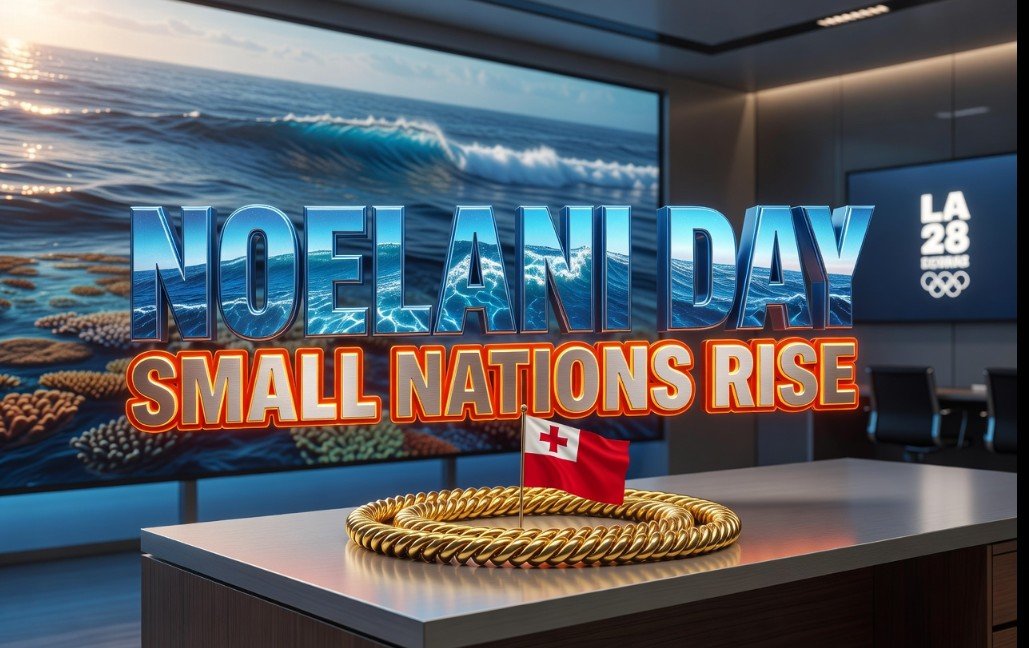
After Paris 2024, Day made a powerful transition. Day, a USC alumna and Olympic swimmer who represented Tonga at Tokyo 2020 and Paris 2024, is now an LA28 Fellow, advising the organizing committee on how to support competing athletes. The LA28 Athlete Fellowship Program marks the first time an Olympic and Paralympic Organizing Committee has created a structured, paid pathway where athletes contribute to the very event they once trained to reach. The Fellowship provides retired athletes with two six-month rotations within LA28’s operational teams, giving them the opportunity to gain experience and expand their networks following their professional athletic careers. Through the program’s first five cohorts, athletes have not only gained invaluable business experience, but 10 have made the jump to full-time positions within LA28 departments. For Day, the role is not just a career move. It is a mission. She has described the contrast between athletes raised within established sports systems and those from nations where facilities and coaching may be limited. “For a lot of athletes from smaller nations, the starting line is very different,” she said. “If you grow up somewhere like the United States, you have access to pools and facilities. I grew up in a country without a swimming pool.”
What It Really Means to Be an Olympian
Day’s presence on the LA28 stage has sparked a wider conversation about who the Olympics are really built for. During a panel discussion at USC in March 2026, she drew a sharp line between two very different Olympic realities. “To be an Olympian doesn’t always mean you’re a double NCAA champion,” she said. Day argued that understanding those varied journeys is important when considering what it means to compete at an Olympic level. “Sometimes it means you’re the first athlete from your country to compete in that sport.” Now, her goal is to become the first physical therapist in Tonga. She also raised a lesser-known barrier that athletes from small nations face: the simple ability to watch Olympic sport at all. For competitors from countries with limited Olympic broadcasting rights, social channels can also expand access to the Games themselves. Day noted that growing up in Tonga she rarely saw Olympic coverage because of media restrictions. “Social media is how people back home are watching the events,” she said. “From the perspective of a lot of athletes from smaller countries, dedication doesn’t always look like time, the amount of hours you put into your sport,” she said. “It can also look like sacrifice, sacrificing certain moments with family, with your country, your home.” The barriers Day is describing are not new, but having someone at the LA28 planning table who has lived them firsthand changes the conversation in a way that statistics alone never could. These challenges are widely documented across the Pacific region. Research into Pacific Island athletic development highlights that:
- Geographic isolation limits access to sporting events and inter-national competition
- Access to training facilities, equipment, coaching and sport science expertise necessary to optimise athletic development is constrained
- There is limited connection with global broadcast visibility and commercial attention, potentially constraining professionalisation or systematic performance enhancement
- Financial barriers often limit training opportunities in small island nations
A Legacy That Reaches Far Beyond the Water
Day’s impact is already flowing back to Tonga, especially to its young women. She is active in the Talitha Project, a non-government organization aimed at empowering young girls and women in Tonga. Sport has given her a platform and an instrument to help others find the fulfillment she has. “One of the most joyful things for me is to have younger girls come up to me and be like, ‘oh I really like this and I want to compete, too,'” Day said. “That was very fulfilling, and it was a full circle moment because for so long, there were a lot of things that I had to go through that made me uncomfortable as a Pacifica woman in sport. But having younger girls come up to me and be like, ‘if you’re doing it, it can’t be that bad,’ then I know I’ve done my job because I don’t want girls to ever feel uncomfortable or like they don’t want to take part in sports because of cultural things.” “My background was completely different from your average collegiate swimmer, which for a while made me a bit insecure, but now it is something I am proud of. I grew up in a country where we did not have proper facilities or a swimming pool, so we trained in the ocean.
I am slowly overcoming it and understanding that the pathway to the Olympics looks different for so many athletes. Mine might not be the most conventional, but I wouldn’t have it any other way.” As Day noted during a panel discussion at USC, the Olympics remain “the biggest peacetime gathering in the world.” That gathering, she believes, should reflect the full diversity of human struggle and spirit. Not just the athletes who had elite pools and professional coaching at their fingertips from birth. Noelani Day swam from a lagoon in Tonga to two Olympic Games, then walked into the room where Los Angeles 2028 is being built. She carries with her every Pacific Island athlete who has ever trained without a pool, competed without a crowd, and made it to the start line anyway. That story is not a footnote to the Olympic ideal. It is the very heart of it. What do you think about how the Olympics can do more to support athletes from small nations? Share your thoughts in the comments below.