By mid-May 2026, roughly $31.4 billion in tokenized real-world assets (RWA, physical or financial assets represented as blockchain tokens) sat on public blockchains, and almost none of it arrived because a bank fell in love with crypto. Institutions are adopting crypto infrastructure as plumbing, not as a belief system. BlackRock runs a tokenized fund worth close to $2.5 billion. JPMorgan settles more than $5 billion a day on a chain it built itself. Stripe paid $1.1 billion for a stablecoin company.
Read one way, that looks like Wall Street finally validating crypto. Read another, it is Wall Street quietly harvesting a decade of public trial and error, wrapping the survivors in custody, compliance, and audit trails, and plugging in without ever having to say the word crypto on an earnings call.
Banks Stopped Building and Started Plugging In
The pattern repeats across every serious institutional move this year. No CFO is rotating idle treasury into governance tokens. No pension committee suddenly speaks fluent decentralized finance (DeFi, financial services run by code instead of intermediaries). The money is going into settlement, collateral, and payment rails that already work.
The numbers back the shift. On-chain real-world assets have climbed sharply through the year, and you can watch the totals move in near real time on live data for tokenized real-world assets.
- $13.4 billion in tokenized US Treasuries by early April 2026
- $240 billion-plus in total tokenized value once stablecoins are counted
- 263% year-over-year growth in on-chain real-world assets
- $16 trillion the size that Boston Consulting Group and Standard Chartered project the market could reach by 2030
None of those figures describes a speculative bet. They describe a build-out, and the through-line is that institutions are buying access to systems crypto already debugged in public.
The Code Was Never the Moat
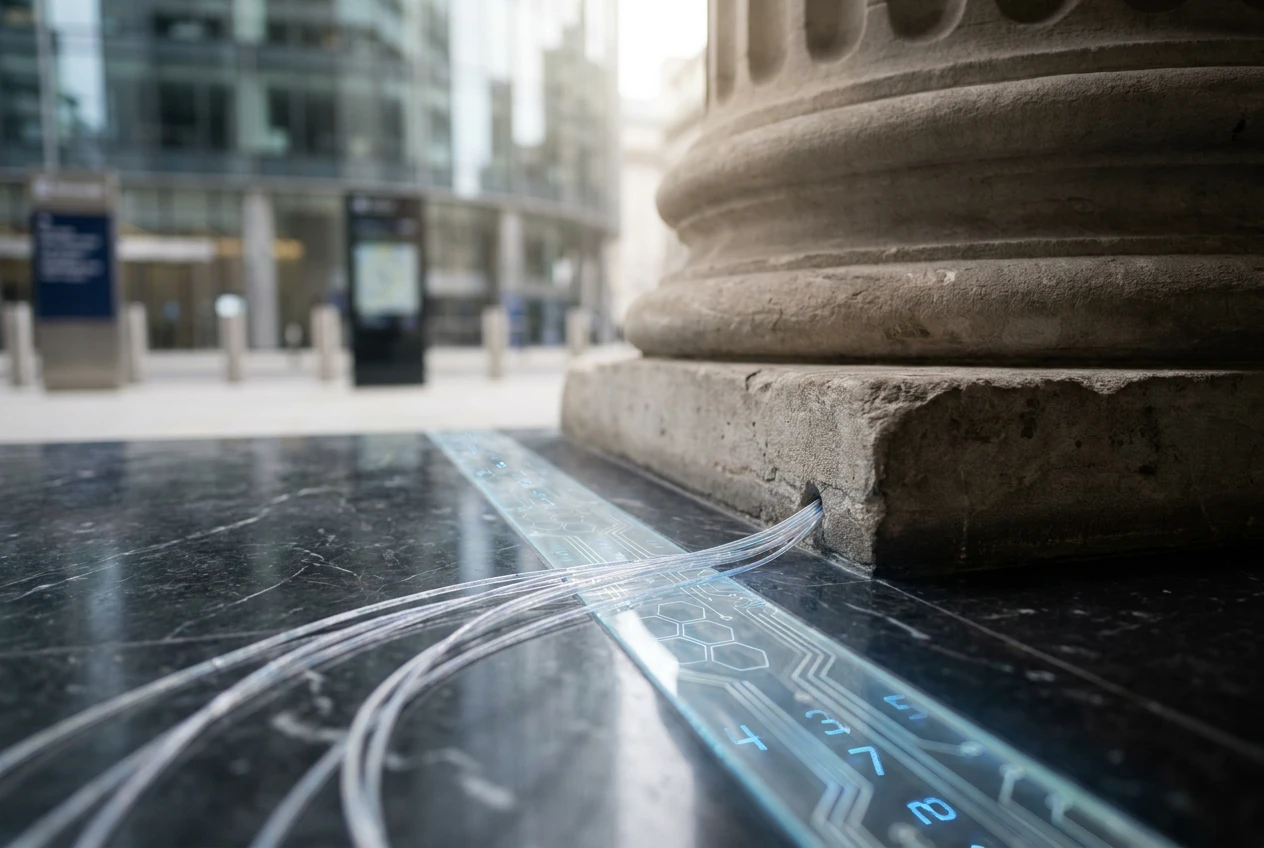
Start with what banks can do, because it is a lot. They have capital, engineers, consultants, vendors, and enough internal innovation labs to staff a small city. A bank can spin up a blockchain. It can fork an execution environment, add permissioning, wrap the whole thing in compliance language, and present it six months later under soft blue lighting at a financial infrastructure conference.
So the interesting question is why so many of them are not bothering. Stripe is the cleanest tell. A payments company valued in the hundreds of billions did not assign a team to clone stablecoin rails; it spent $1.1 billion buying a company that already ran them, a deal it confirmed on completing the Bridge acquisition. Buying beat building.
The advantage of web3 was never that banks were technically incapable of writing the contracts. The moat is iteration velocity under pressure. Products launch, break, fork, attract liquidity, lose it, get arbitraged, get exploited, and get rebuilt by someone with a better version before the original team has finished the post-mortem. That looks chaotic from the outside because it is. It is also one of the most efficient financial testing environments ever built.
What $292 Million in Stranded Ether Taught the Market
In April 2026, an attacker drained $292 million from Kelp DAO, a liquid-staking protocol, by exploiting its cross-chain bridge. The thief made off with 116,500 rsETH, roughly 18 percent of the token’s circulating supply, leaving it stranded across more than 20 chains.
The mechanics were brutal and instructive. The bridge relied on a single verifier to check inbound messages before releasing funds. Attackers knocked the legitimate data nodes offline with a denial-of-service flood, forced a failover to nodes they controlled, fed the lone verifier a fake cross-chain message, and walked the funds out. Cybersecurity firms attributed the operation to the North Korea-linked Lazarus Group. Lending markets including Aave froze their rsETH positions to stop bad debt from spreading.
Every one of those failures becomes shared memory. The single-verifier design is now widely treated as unacceptable. Bridge assumptions get rewritten. Liquidation cascades teach the next protocol where its collateral math snaps. Painful, expensive, occasionally absurd, but useful in a way a clean internal sandbox can never be.
This is the part traditional finance both fears and needs. A bank is built to preserve trust, protect depositors, obey regulators, and avoid blowing itself up in search of product-market fit. It cannot ethically run the Kelp experiment with customer money. Crypto already ran it, in public, with real capital and real adversaries, and the survivors carry the scar tissue.
Why a Bank Reaches Version One Last
A bank building this internally has to solve every problem in sequence, and each gate is staffed by people whose job is to slow things down on purpose. That caution is rational. It is also why speed compounds against them in precisely the domain where speed matters most.
- Architecture and a security sign-off before a line of production code ships
- Custody and key management that satisfies an internal risk owner
- Compliance, legal treatment, and accounting for an asset class regulators are still defining
- Vendor review and operational-risk assessment
- Steering-committee approval, followed by a pilot that gets de-risked until it barely tests the thing it was meant to test
By the time the bank reaches a working version one, crypto has shipped its own version one, watched it fail, launched version two, discovered the bridge assumption was wrong, and rewritten the liquidity model. The gap is not intelligence. One side is engineered for market-speed experimentation, the other for institutional control, and the second design simply cannot move at the first one’s clock speed.
Four Institutions Already Wiring In
The proof is no longer theoretical. Four of the most-watched names in finance have each chosen a different entry point, and none of them is trying to rebuild the entire stack alone.
| Institution | What it built or bought | Scale or status |
|---|---|---|
| BlackRock (BUIDL) | Tokenized Treasury fund, built with Securitize | Near $2.5B in assets, live across multiple chains |
| JPMorgan (Kinexys) | Bank-built blockchain payments rail | More than $5B a day, $3T-plus processed since inception |
| Stripe (Bridge) | Stablecoin payments API | $1.1B acquisition, accounts live in 101 countries |
| DTCC (Collateral AppChain) | Tokenized real-time collateral network | Q4 2026 launch, Besu base with Chainlink data layer |
BlackRock’s USD Institutional Digital Liquidity Fund, the product behind the BUIDL ticker, grew from a tokenized fund crossing $1 billion in assets under management to one of the largest on-chain money funds in the world. It was launched because settlement, access, and collateral movement could be redesigned on-chain, not because tokenization sounds futuristic.
JPMorgan took the build route and still ended up running on shared crypto plumbing. Its Kinexys blockchain payments unit, formerly Onyx, now clears billions every day for institutional clients across five continents. The competitive heat is visible elsewhere too, in the race among banks to win crypto custody mandates and in platforms merging fiat and crypto cash management into a single 24-hour system.
What the Smart Money Is Buying
Strip away the branding and the institutional shopping list is short. Faster settlement. Programmable collateral that can move across systems at any hour. Transparent backing. Tokenized yield that can be audited rather than trusted. A CFO does not want an exotic balance sheet; a risk committee does not want hype. They want capital that moves faster, settles cleaner, and stays explainable when auditors and board members start asking questions.
That is the genuine offer, and it is why the adoption is real. But the picture is not all upside. Much of the ecosystem is still noisy, fragile, over-financialized, or one verifier away from the next nine-figure loss. Banks are adopting selectively, taking the parts that survived live fire and bolting on the layers they cannot skip: custody, reporting, auditability, and permissioning. The regulatory frame is still wet paint, visible in the fight over crypto bank charters in Washington.
Ben Nadareski, co-founder and chief executive of stablecoin firm Solstice, framed the limit of what money can buy in a recent guest essay.
Wall Street can and will replicate the architecture. What it cannot replicate is the years of live market pressure and community anticipation that made the architecture worth using in the first place.
The next test arrives on a calendar. DTCC’s tokenized collateral platform is slated to go live in the fourth quarter of 2026. If the strongest crypto rails keep getting legible and compliant enough, banks plug in and rebrand the output as settlement efficiency. If the next bridge exploit dwarfs Kelp’s, the plugging-in slows while the lawyers recheck every assumption all over again.
Frequently Asked Questions
What Does It Mean for Banks to Use Crypto as Infrastructure?
It means banks treat blockchain rails as plumbing for moving money rather than as assets to speculate on. Instead of buying tokens, they use stablecoins for payments, tokenized funds for collateral, and on-chain settlement to clear transactions faster, while keeping their own compliance and custody controls on top.
What Is Tokenization of Real-World Assets?
Tokenization turns a claim on a real asset, such as a US Treasury bill, a money-market fund share, or collateral, into a digital token recorded on a blockchain. The token can settle and move 24 hours a day, which removes much of the delay and fragmentation in traditional clearing systems.
Why Don’t Banks Just Build Their Own Blockchains?
Many can and a few have, including JPMorgan with Kinexys. The barrier is not the code. Building a usable system means rediscovering bridge risk, liquidity fragmentation, oracle failures, and smart-contract exploits that public crypto networks already lived through, which takes years a bank rarely wants to spend.
How Big Is the Tokenized Asset Market in 2026?
By mid-May 2026, roughly $31.4 billion in tokenized real-world assets sat on public blockchains, with about $13.4 billion of that in tokenized US Treasuries. Counting stablecoins, total tokenized value exceeds $240 billion, and longer-term projections from major firms run into the trillions by 2030.
Is Institutional Crypto Adoption Safe After Hacks Like Kelp DAO?
No on-chain system is risk-free. The $292 million Kelp DAO exploit in April 2026 showed how a single weak verifier can drain a protocol. Institutions reduce that exposure by adopting only battle-tested components and adding custody, audit, and permissioning layers, but reader-level caution remains warranted.
Will Banks Still Call Any of This Crypto?
Often not. Institutions tend to describe the same capabilities as settlement efficiency, treasury optimization, embedded yield, or real-time liquidity. The underlying rails are crypto-native, but the marketing language is built for boards, regulators, and auditors rather than for token communities.
Disclaimer: This article is for informational purposes only and is not financial, investment, or legal advice. Digital assets, stablecoins, and tokenized products carry significant risk, including total loss of capital and exposure to exploits. Consult a qualified financial professional before acting. Figures are accurate as of publication.