
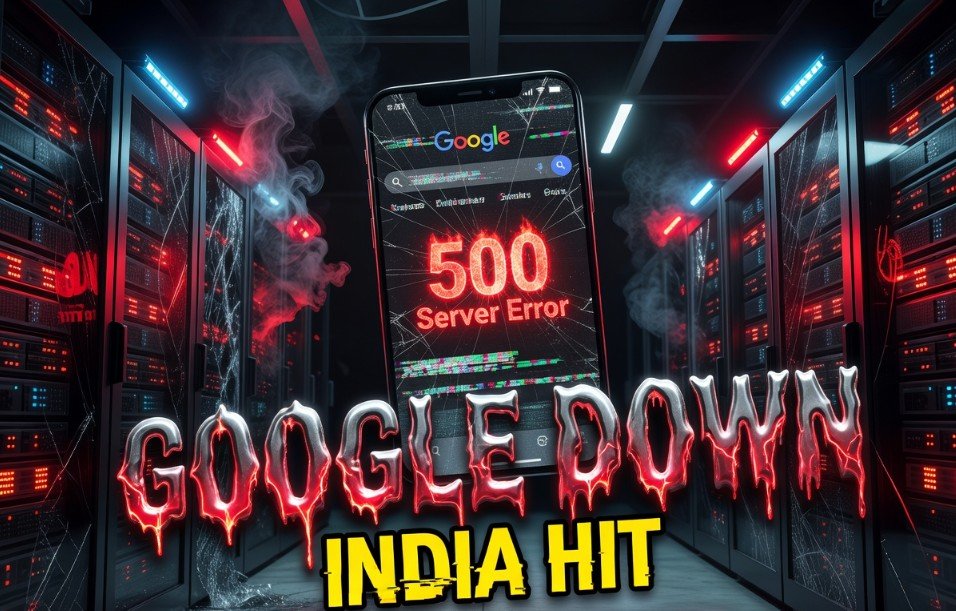
Google Search went dark for thousands of users across India on Tuesday morning, sparking panic, memes, and a flood of complaints on outage trackers. The disruption kicked off around 10:20 am IST, leaving offices, students, and casual browsers staring at a blunt “500 Internal Server Error” message. Within minutes, “Is Google down?” started trending on X as people scrambled for answers.
What Happened During the Sudden Google Outage
The issue began quietly but spread fast. Users opening Google Search on Tuesday morning saw blank pages, incomplete results, or a stark server error notice instead of the familiar list of blue links.
The disruption was not tied to one device or one network. Reports came in from Android phones, iPhones, Windows laptops, and Mac users alike. That pointed clearly to a backend problem on Google’s side rather than a local internet hiccup.
Downdetector Data Reveals the Real Scale
Outage tracking platform Downdetector lit up almost instantly. Complaints crossed the 3,300 mark within minutes of the first reports, with a sharp spike noted around 10:29 am IST. By the time the dust settled, the platform had captured a clear picture of what broke.
Here is how the complaints were split during the peak window:
| Type of Problem | Share of Complaints |
|---|---|
| Google Search not working | 57% |
| Content not loading | 28% |
| Website inaccessible | 11% |
| Other issues | 4% |
The numbers made one thing obvious. This was not a small glitch in one feature. It was a wider failure cutting across the core Search product and the website itself.
Where the Outage Hit and How Users Reacted
The blackout was not limited to India. Reports surfaced from Australia, the Philippines, Malaysia, New Zealand, parts of Europe, and pockets of the United States. Outage trackers logged sudden spikes from multiple time zones, suggesting a global server side fault.
Social media did what it does best during a tech crisis. People rushed to X, Instagram, and Reddit to confirm if the problem was real or just their Wi-Fi acting up.
Another viral post in Hindi joked, “Google down hai, Sundar Pichai aisa kya search kar liya bhai.” Memes flooded timelines within the hour. Behind the humour, though, the panic was very real for people in the middle of work calls, exam revision, or last minute travel plans.
Key impact points reported by users:
- Students preparing for board and entrance exams lost access to study material.
- Small business owners could not run product searches or check competitor prices.
- Journalists and content creators reported broken research workflows.
- Travellers using Google Maps queries indirectly faced delays.
Recovery, Silence from Google, and What It Means
The good news arrived faster than many expected. By around 11:05 am IST, complaints on Downdetector had crashed from over 3,300 to just 464. By 11:30 am, only about 155 reports remained active, showing that engineers had patched the issue.
Still, Google has not released an official statement explaining the root cause. The Google Workspace Status Dashboard, the company’s own monitoring page, continued to display “No Incidents” hours after services returned to normal.
- Start time: Around 10:20 am IST, May 12, 2026
- Peak complaints: Over 3,300 on Downdetector
- Main error: 500 Internal Server Error
- Recovery time: Roughly 45 to 60 minutes
- Official cause: Not disclosed by Google yet
This outage is a sharp reminder of how deeply the world leans on a single search engine. Google handles more than 90% of global search traffic, and even a 45 minute hiccup can stall classrooms, newsrooms, and businesses across continents.
Why This Matters for the Future of Search
Outages at Google are rare, which is exactly why they feel so jarring. The last major Search disruption of this scale hit users in mid 2024, and Tuesday’s incident landed at a time when AI driven search tools are slowly chipping away at Google’s dominance.
Tech analysts point out a clear takeaway. Users are starting to keep backup options ready, with platforms like Bing, DuckDuckGo, and AI chat tools picking up small but visible bumps in traffic during every Google blip.
For Google, the bigger worry is trust. Each unexplained server error chips away at the image of an always on giant. Transparency about the cause, whether it was a routing bug, a software push, or a hardware fault, will decide how quickly users move past Tuesday’s scare.
The Tuesday morning blackout may have lasted less than an hour, but it left a mark. It exposed how fragile our daily digital habits really are, how quickly the internet leans on one company to find answers, and how loudly the world reacts the moment that lifeline blinks. Were you one of the users hit by the Google Search outage today? Drop your experience in the comments and share this story using #GoogleDown on X so others know they were not alone in the chaos.